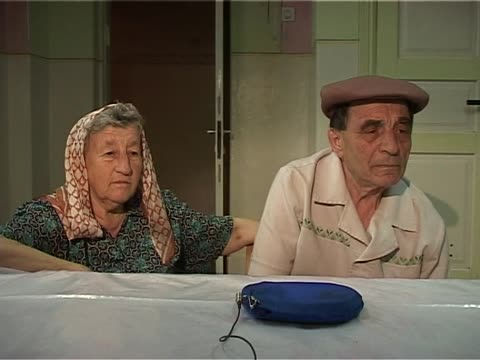
The interviewee talks about her daughter, who married a Jew and lives in America with two children, whom she calls of Jewish blood. They say they wait for a visit and cannot travel, being old and unwell. Kerler wishes them good health and then asks permission to put some questions.
The daughter's marriage ending and the grandchildren's Jewish identity are mentioned.
The interviewee speaks of a daughter who married a Jew and now lives in America with her children, and of the couple's age and poor health today. Kerler wishes them good health before turning to questions.
The Vaismans answer questionnaire items from Kerler. These include a Russian word for 'forbidden' or 'gloomy', words for ear, attic and the Passover afikoman, and a Hanukkah song. Toward the end Kerler asks what latkes were made from; buckwheat is suggested and not confirmed.
Passover seder customs and a Hanukkah song come up in the elicitation.
Isaak and Bella address food customs, particularly latkes. They then continue to answer dialectological questions from the AHEYM Yiddish linguistic questionnaire.
They talk about latkes made from potatoes, with Kerler asking about prewar practice. The questionnaire then continues with words for blue, grey and colours of hair and eyes, window panes, groats, deaf, a mouse, and a small bird. Several questions are met with 'I don't know', and a Russian passage is heard briefly.
Potato latkes and colour and body terms are covered, not only latkes.
Bella talks about her family. Her father was a refugee from Poland during World War I. Bella recalls the dangers to receive a Jewish education during her childhood. They then continue to answer dialectological questions from the AHEYM Yiddish linguistic questionnaire.
The interviewee says her father was an honest man who was a refugee in the First World War, apparently from Poland, and was from a German-origin family. She mentions that Jewish learning was no longer given at home in her day and speaks of a rebbe. Elicitation follows on words for quick, Kremenets, blue, sun and sons, 'whose child is this', a thing in school, and a word for face.
Kerler's questions on thanksgiving blessings (gomel) and on how Lithuanian Jews speak are included.
The questionnaire continues with words for a man or male, the expression for 'we sit near', the past form of 'to be', crying and a verb 'to cry', and 'pathology'. The informants disagree over words such as 'on the bridge' and 'someone told us', and a participant remarks on the Lithuanian speaker among them. A wedding song is not clearly identifiable in the transcript.
The wedding song is not evident in the transcript; the passage is mostly elicitation.
Katz and Kerler ask the difference between a rav and a rebbe and what is meant by a good Jew. The Vaismans say they know little about Hasidism before the war. They add that going to a rebbe with a question and to a rav for a wedding canopy is known.
Katz's comments on rav and rebbe are not covered by the label.
They discuss prewar Jewish religious life in Berdychiv, with a view that there was one religion and no sharp split between Hasidic and other Jews. A companion tells that people used to walk at night to a grave in town and an anecdote of Rabbi Bik on the Sabbath goy. The informants also recall that the lamp was kept burning on the Sabbath. Kerler then asks plural forms of rav and rebbe.