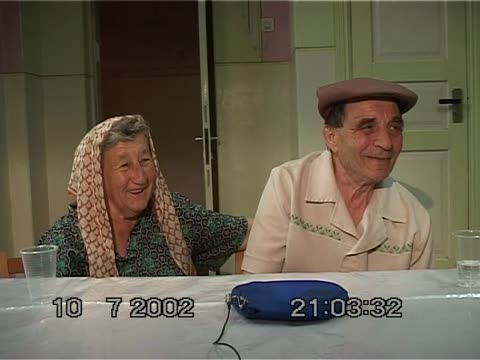
Talk about Jewish doctors in prewar Berdychiv, especially a much-loved doctor (named Barabán or similar) who treated people at any hour, took no money from Jews, and was reported to have been killed by the Germans. Many such doctors were murdered. Kerler then begins asking about word meanings.
The catalogue speaks of locals and their fate; the transcript centres on Jewish doctors and one doctor in particular.
Answers questions about Yiddish words and expressions, such as terms for a pest or bore, a good-for-nothing, a woman who goes about disheveled, Lithuanian Jews and their pronunciation, a monastery, gentile holidays, Easter and a cemetery. The Vaismans say Galicians were not known in their area. The informants contrast their own speech with Litvak Yiddish, and the discussion also touches on dialect sounds.
The transcript shows the contrast with Litvak speech and a Galician question, not only terminology.
Discussion of prayer terms such as kiddush and kaddish and how they were said, with talk about who in Berdychiv still remembers the kaddish and about who attends the synagogue today. The passage is garbled, and the catalogue's recitation of the kaddish is not clearly confirmed in the transcript.
The transcript shows questions about words and about present-day synagogue life rather than a recitation.
Answers questions from the dialect questionnaire and on cultural terminology: a bridal gift or dowry, the words for milk, yellow, flower and flowers, painting oneself, how Christians cross themselves and pray, and photographer and photographing. The informants also explain the expression 'gentile luck' and what Jewish luck means.
Bella and Isaak address prewar cultural life. Bella remembers a theater performance by Solomon Mikhoels in Kharkiv. They then speak about concerts by Appelbaum in Berdychiv.
Recalls seeing Mikhoels perform in Kharkiv, in the role of Tevye the milkman and in both Yiddish and Russian, and comments on the actor Ulyanov. The conversation then turns to the singer Appelbaum in Berdychiv, to the meeting of young and old on a bridge, and to sayings about youth and old age. Asked to sing a Yiddish song, the informants say they do not remember one, and mention a relative who knows a little.
The transcript shows no discussion of Cracow; it concerns Kharkiv and Berdychiv, with a failed request for a song.
Bella and Isaak answer dialectological questions from the AHEYM Yiddish linguistic questionnaire. Bella also addresses prewar Passover celebrations at home (27:50).
Answers questions about the words for a peasant and a peasant woman, a non-Jewish woman, and what Jews meant by saying someone 'speaks gentile'. Then recalls the Passover seder at home, including the closing song Khad gadyo, the four cups, the plagues, stealing the afikomen, and the burrs thrown at people. The questions come from Kerler and Katz.
The catalogue speaks of questionnaire items and a Passover passage; the transcript also covers terms for non-Jews and what 'speaking gentile' meant.
Speaks about Jewish life in Berdychiv today: a wasteland that has been rebuilt, the synagogue's revival with help from Americans, pensions, and the husband's service at the front at eighteen with medals. The speaker links this to Jewish revival. Katz then begins a question about the 1920s.
The transcript mentions the rebuilding of the synagogue site and pensions, and the husband's service at eighteen.
Bella and Isaak talk about their lives in the prewar Soviet period. They particularly address the generational gap between the older observant and the younger generations. Isaak addresses the difficulties to teach about Jewish history and religious under Soviet rule.
Talks about Jewish religious life under Soviet rule before the war. The parents were learned and observant but the children were afraid to study openly, the cheder was forbidden, and Jews were taught in a Yiddish school for four years and then sent to Russian schools. Katz asks how the Soviet Yiddish school differed from the earlier education, and the informants describe the generation gap and intermarriage.
The transcript adds the Yiddish-school question and the conversation about marriage.
Talks about weddings before and after the war, with half marrying Jews, and about the daughter and grandchildren in America and a grandchild who knows Hebrew and English. The conversation then turns to whether Jews drink, and the informants argue that Jews seldom get drunk.
The transcript shows talk about intermarriage, grandchildren abroad and Jews and drinking.
Talks about Jewish coachmen in prewar Berdychiv, who sometimes drank, and says they spoke Yiddish. The speaker also says that non-Jews spoke Yiddish before the war because there were so many Jews, while the grandchildren today do not know it.