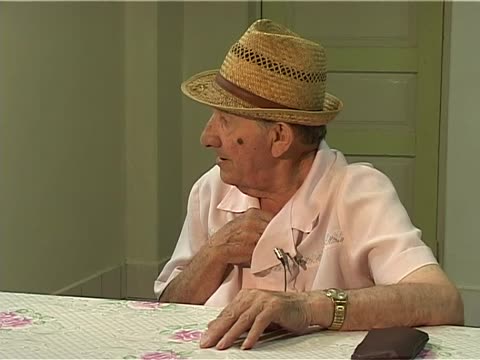
Skobilitskii mentions a book by Y. L. Peretz that ought to be in the synagogue, then answers Kerler's questionnaire questions with the second voice joining in. The items include the word for a deaf person, the name for the one who recites the closing blessing, a Torah reader, and the blessing said after recovering from illness or danger, with a story about a man who escaped a machine; the word for galoshes is also asked.
The catalogue mentions only literature and questions; the transcript also shows talk of the synagogue and the thanksgiving blessing.
Skobilitskii discusses his childhood memories and remembers how his maternal grandfather practiced kosher slaughter. He then answers questions about cultural terminology and linguistic questions.
Skobilitskii recalls his maternal grandfather's slaughtering knife, apparently used for slaughtering. He then answers questions about the Hanukkah top and what it was called, the word for a fool, colour words such as grey and sallow, and adverbs such as "quickly" and "then", with the second voice commenting. Toward the end he returns to a Yiddish book and to the writers Peretz and Sholem Aleichem.
The transcript also shows the closing talk about Peretz and Sholem Aleichem.
Skobilitskii talks about a Yiddish literary work, apparently Sholem Aleichem's story "Motl Peysi the Cantor's Son", which he describes as an allegory narrated by a child. Kerler then continues the questionnaire: wagon and wagons, a ship's cargo, "each thing", the word for "near", cotton wool and padded garments, and "probably".
The transcript shows the literature discussion as a story summary and a long run of word-by-word items.
Skobilitskii addresses prewar cultural life, including theater performances, in Berdychiv. He then speaks about cultural life after the war. Skobilitskii explains how the community collected money to hire an opera singer from Kyiv to perform after synagogue services.
Asked about Yiddish actors and plays in Berdychiv, Skobilitskii recalls good artists, and says that Yiddish troupes came after the war but he does not remember before the war; he names Zuskin and talks of Mikhoels. He says plays were staged by the community in the synagogue before the war. He tells how after the war the Jews collected money to bring an opera singer from Kyiv to sing Yiddish songs after services, and Kerler asks about singers such as Epelbaum and Zinovii Shulman.
The transcript also shows Zuskin and Mikhoels and a possible synagogue-based amateur play before the war.
Skobilitskii answers more questionnaire items from Kerler, with the second voice contributing: ceiling, floor and a clay floor, how his mother's and father's speech differed, and how the town name Berdychiv was pronounced by old Jews. Further items are "put away", "back", "suddenly" and an expression for someone not thinking clearly. At the end the talk turns to the books the team bought and some thanks.
The team then visits the town market in Berdychiv with Rabbi Shlomo Breuer in order to film Isaak Iosipovich Vaisman selling seltzer water. They also discuss the contemporary community.
The team goes to the town market to film a man selling seltzer water. The transcript is largely garbled; the speakers, including Kerler, converse with those at the stall and an elderly community member, with a few words about the water and its syrup.
The transcript is too garbled to confirm the rabbi or what is said of the community.
In the soup kitchen of the community center, the team talks with members and staff. The talk touches on the blessing said after meals and a Russian-language text for the blessing before eating, on the community's office, and on a doctor who visits on Sundays for the old people.
A short informal interview with Chukh. She says her husband used to pray, and mentions his age and her father's age at death. She gives her name as Rachel (?) Rozenblat, from Berdychiv, born in 1919, and says her parents were also from Berdychiv.
The next informal interview with Furman begins. He provides some details about his biography. He studied at a religious school (cheder) and then Yiddish school. Furman fought at the Stalingrad front and received several military awards. He returned to Berdychiv in 1945. Furman also mentions his family's fate during World War II. Furman's wife passed away in 1992 and he does not have any children.
Furman tells his biography. He did not go to cheder but began work as a carpenter at thirteen, was sent to the front in 1941, and fought at Stalingrad in a guards army. He returned to Berdychiv in 1945 without a leg and found none of his family, which had numbered seven. His wife died in 1992 and he has no children; he is 82. Asked by Kerler, he says he studied at a Yiddish school.
The transcript shows the return in 1945 to find no family, and the school-name question at the end.