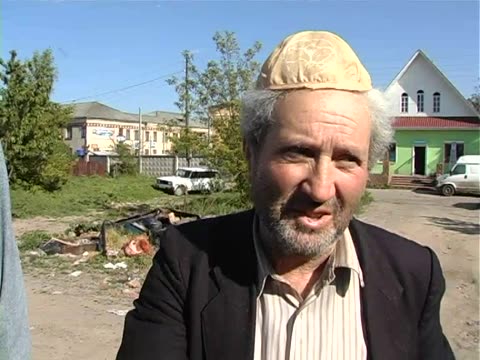
Closing exchange with Gvinter and others at the end of his interview. They talk about cards, where the visitors live, and thanks and good wishes, with some Russian and a recogniser loop. The passage ends with talk about fish.
Mostly farewells and card-giving, not formal interview content.
Outside the house, Gvinter explains how he makes gefilte fish: fried onions, matzo meal or bread, eggs and pepper, cutlets, long cooking and horseradish for Passover. Lemster and another man ask about cooking times and compare their own recipe from Bershad'.
Others join in with their own recipe and cooking times.
Kerler asks about Sholem Aleichem and other Yiddish writers, and a street named for Sholem Aleichem (Kyiv?) and a memorial are mentioned. Kerler then thanks Gvinter, the team leaves, and Russian directions are given to the driver in town.
Contains the Sholem Aleichem question and the departure; the camera footage is not evident from the transcript.
The team arrives at Feldman's apartment and greets her. She says she was asleep, they sit, and there is talk of relatives abroad, a daughter in Odessa, and the apartment address.
They discuss local geography. Then the formal interview begins. Feldman provides personal information and talks about her family. Feldman's father died during World War II. She also addresses her mother's work after the war. Feldman's father worked with ropes.
They talk about the main street of Bershad' (named for Lenin). Feldman gives her name, her birth in Bershad' and her age. Her father went to the war in 1943 when she was three and was lost; her mother, a shoemaker, went blind, had cataract operations, and later carried water to earn bread. She names her mother and father (Khave and Moshe, with surname forms unclear) and mentions a phone call.
Gives the family's names and her father's loss at the front.
Feldman talks about her contemporary relations to her neighbors. She then talks about her life after the war and today. Feldman worked as kitchen help and then at a furniture factory for thirty-five years. Feldman also talks about her family, as well as communal support. She raised two daughters by herself.
Feldman speaks of her non-Jewish neighbors, who help her when she is ill. She describes her work in a kitchen and then 35 years in a furniture factory, her pension, and her husband, who left. She raised two daughters; the younger works in Odessa and the elder has two children. She explains how the Jewish community (Hesed) helped with a stove and money.
Covers neighbors, her work history and communal support.
Feldman briefly remembers her life in the Bershad ghetto during the war, when she was three years old. In particular, Feldman recalls hiding. She also talks about her family and communal support. Her half-sister lives in Israel.
Kerler asks what she remembers of the ghetto. She recalls being about three, being beaten, and hiding with others in a cellar with water and bread, with Romanians and Germans present. She also tells about her half-sister, who lives in Israel, and about money and her factory.
Includes the cellar hiding and her half-sister in Israel.
Feldman talks about her life and family today. She then tells a story about her grandfather, Feldman recalls from her mother. Feldman then describes traditional burial customs before the war.
Feldman speaks of her health and her daughter's treatment, then tells a story from her mother about her grandfather, who asked for a small window in his grave. She describes prewar burial customs: carrying the dead by hand, washing hands, and the dressing of the dead. She says she speaks Ukrainian and Yiddish and is proud to be Jewish.
Adds the grandfather story and her statements on language and identity.
Feldman recalls Yiddish songs, before she addresses postwar religious life. Feldman shares an episode about fasting on Yom Kippur. She also describes religious customs, including yizkor services.
Feldman recalls her mother's songs and stories. She answers Lemster's questions about Jewish life after the war and describes fasting on Yom Kippur as a child. She also describes going to the synagogue and hearing yizkor, which made her cry. She speaks of the officials who run the synagogue.
Lemster asks why the Soviets did not close the Bershad' synagogue; Feldman does not know. Kerler asks about rich Jews, and she describes prewar occupations: water-selling, shops, shoemakers, and rich and poor. She says no Jews were in prison, and compares the old cinema and entertainment with television today.
Adds the question about the open synagogue and the cinema.
Feldman speaks about her life after the war, particularly her leisure activities. She then talks about her family and recalls poverty. Feldman states that she received to help to bury her mother.
Feldman talks about leisure after the war, such as cinema, television and the lack of Jewish merriment in Bershad' today. She says she did not have a Jewish wedding or register her marriage. She recalls her poverty and her mother's illness and death. She tells how a Jewish man collected money for her mother's gravestone, and how his daughter later gave her money. She says the monument is now crumbling.
The passage also covers her marriage without a Jewish wedding and her mother's illness, which the catalogue sentence does not mention.
Answering Lemster, Feldman recalls a Jewish klezmer musician whose daughter was her friend. She names the instruments and says the musicians played at weddings. She mentions the custom of bringing a cake to the grandparents and parents, and the dances they played. In response to Lemster's question she lists wedding food such as stuffed fish, cutlets, calf's foot jelly, cheese and flaky pastry. She is unsure whether it was kosher.
The catalogue sentence does not mention the cake custom or the dances.
Feldman talks about holiday celebration, particularly Passover. She then returns to traditional weddings, before addressing prewar Jewish life. Feldman recalls the local kosher butcher. She also speaks about her family.
Feldman speaks about Passover matzah and baking, and about hiding the pots on the attic. She answers Kerler and Lemster on toasts and who led the ceremony at weddings, and on whether a huppah was set up. She recalls a local kosher slaughterer, whom she helped by plucking fowl. She answers questions about the Jewish school, which her sister attended, and says her sister now lives in Israel and no longer writes to her.
The passage also covers the Jewish school and her sister in Israel.
Feldman cannot remember postwar synagogue holidays and answers a greeting exchange that Kerler tests her on. She describes celebrating Passover at home, with chicken soup cooked for her children and grandchildren, with no formal seder. She talks about Hanukkah, including Hanukkah money and latkes made from potatoes. She also mentions a Christian neighbour's grandchild who does not speak Yiddish, and an interruption by a Russian phone call.
The passage also covers a conversation about a Christian family's child and the Russian phone call.
Feldman recalls the hunger of her childhood after the war. She describes how she and her mother cooked and ate flour, potato and berry dishes, black bread and cornmeal. She and Lemster discuss the Yiddish word for maize and the Yiddish, Ukrainian and Russian words for it. She then describes a semolina porridge and mamaliga with milk.
The passage also contains a short terminology exchange with Lemster on words for maize.
Feldman speaks about folk and healing customs before. She recalls the customs of rolling an egg and to avert the evil eye. Feldman then describes the custom of burning old shoes after someone passes away.
Answering Kerler and Lemster, Feldman describes folk healing in Bershad': a woman who cured a child who had fallen asleep by rolling an egg, and the evil eye with spells against it. She tells how a Christian neighbour was advised to wash a child's face. She then answers questions about mourning, including sitting shiva, and the custom of burning the shoes of the deceased and of a dead person's clothes.
The passage also covers sitting shiva and the Christian neighbour's child.
Feldman shares a contemporary story about a Christian woman entering a synagogue to find help for her sick child. She then addresses the circumcision custom.
Feldman tells a story about a Christian woman whose grandchild could not stay awake and who went to the synagogue with money and food seeking help. She then speaks about circumcision, how it was done in the past and how it is now, and mentions a grandson who is studying at a Jewish school in Zhytomyr. She also recalls antisemitic abuse of Jewish men in the past.
The passage also covers antisemitic abuse of Jewish men and the grandson's school.
Answering Kerler and Lemster, Feldman describes how water was drawn in Bershad' from a well with a bucket on a chain. She recalls a Jewish water-carrier who brought barrels of water to houses and was paid for it. She says that now water is piped into houses.
The passage also includes how water was drawn from wells.