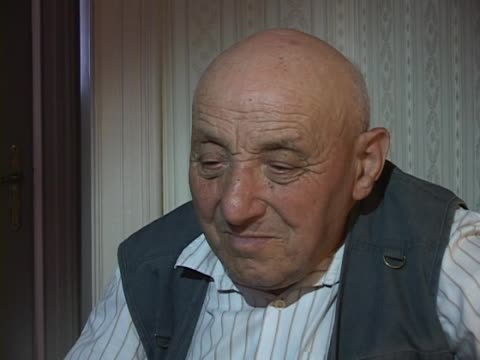
Answers questions from the dialectological questionnaire about words for a convert and a non-Jew, a monastery, a peasant or field worker, a convert to Judaism, and the terms for 'local' and 'from there'. Kerler and the informant also compare Polish and Russian equivalents.
Brandler speaks about prewar Yiddish theater performances and proverbs, before he continues to answer dialectological questions from the AHEYM Yiddish linguistic questionnaire.
Begins with a recollection of a prewar amateur performance in the shtetl, with a large club with a stage somewhat outside the center, near Przemyśl. Kerler then continues the questionnaire with words for bed, flowers, vodka, numbers and money, kinship terms and household words such as cellar, attic and beams. He also asks about sentences with prepositions and plurals (the way, the wagon), words such as enemy, trouble, face and 'fooled', and a few Polish loan words.
A prewar theater recollection opens the passage before the questionnaire resumes.
The team concludes the interview with Brandler, before conducting an informal interview with Dorfman. They speak about contemporary religious life and the community.
The interview with Brandler ends and an informal talk with a second man (probably Dorfman) begins. He talks about the contemporary religious community in L'viv, its rabbi and shoykhet, the people who attend, the American connections and the two small synagogues. Kerler asks how the shoykhet learned the trade.
The team and Dorfman come to Leibel's apartment and are greeted. They explain the project of recording Yiddish speakers (from an American university) and mention that they recorded Brandler the day before. They discuss how hard it is to find Jews to interview, and fit the microphone.
The formal interview with Leibel begins. He gives his surname and first name, and says he was called Volf at home and by an older name (unclear in the transcript).
Leibel provides personal information. He also talks about prewar Jewish life in his hometown Rivne. Leibel also addresses his childhood memories and family. Leibel's father was a scrap dealer. Leibel attended a Polish school until 1939, before attending the university for two years.
Leibel gives his birth year (not clear in the transcript) and recalls prewar Rivne as a Jewish town with many small synagogues, and the street where he lived. His grandfather Moshe was a tinsmith and his father kept a cellar shop dealing in old things. He describes the state gymnasium, where he sat at the last bench next to a prince's son, a religion lesson and a discussion on Zionism. He finished in 1939, expected to go to Warsaw, and after the Soviet entry studied for two years before being drafted.
Adds the gymnasium, the religion lesson and the Zionism discussion; the university detail in the catalogue is not clear.
Leibel speaks about his life during World War II. He was drafted into the Red Army and came through Berezhtsi, near Kremenets, Pochaiv, Kharkiv province in 1942. Leibel describes the situation Berezhtsi under German occupation. Leibel was sent to the front from Kharkiv province. He was the commander of a division within the cavalry. In February 1945, Leibel explains, he was sent to a military training school for lieutenants.
Leibel recalls being sent to the front with the Red Army and seeing German vehicles near Berezhtsi (near Kremenets), where he saw a Jew praying in a window, and reaching Pochaiv. He was taken to the Kharkiv region and, in 1941–42, to Sweden-bound (?) Polish Jews were sent east; he became a sergeant and fought at the Third Ukrainian Front, where he was wounded and commanded a unit. In 1945 he was sent to a lieutenants' school, which was then disbanded, and he was demobilized.
Gives detail on a fellow soldier from Łódź and on the cadet school's disbandment.
Leibel speaks about his life after the war. He returned to Lviv and graduated from military school. Leibel then speaks about his family. He met his wife in 1948 and raised a son.
Leibel speaks about his return to the institute in L'viv and finishing his studies, after which he was assigned to work. He met his wife in 1948 in a Jewish family; she taught Yiddish. They had a son, and both the son and wife have since died. Kerler clarifies that a woman relative is a cousin of the wife. Leibel then begins to say he attended synagogue on holidays and fasted on Yom Kippur in Soviet times.
Leibel addresses his observance in Soviet times, when he fasted on Yom Kippur and took off as much time from work as possible. He worked at one institution for 43 years and was kept on after reaching seventy; after retirement he went to synagogue daily. A Ukrainian friend warned him he was being watched, but Leibel regards the synagogue as a piece of the Land of Israel.
Gives the duration of employment (43 years) and the warning about surveillance.