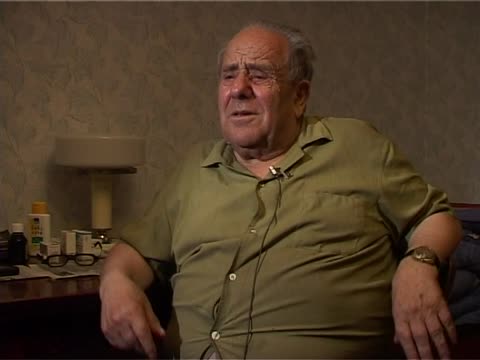
Furer talks about prewar Jewish life, particularly wealthy people. Out of a population of 10,000 lived 8,000 Jews, according to Furer. He then addresses his religious childhood education. He studied with a religious teacher (melamed) for a year and a half. Furer recalls the morning prayer "Modeh ani."
Kerler introduces the tape as the second cassette of the interview on the Yiddish of Kryzhopil'. Furer describes the town as a Jewish shtetl of about ten thousand people, with rich Jews who had large shops and banks, and mentions other nearby towns. He recalls studying with a melamed for about a year and a half, running away from it, and the morning prayer he was taught.
Kerler's introduction of the tape and naming of other nearby towns.
Furer speaks about his life before World War II. He attended a Yiddish school for four years, before switching to a Russian school. Furer then remembers a local Yiddish leisure club. According to Furer, his childhood friends were only Jewish. He then lists his Jewish friends who served in the Red Army.
Furer says he studied at a Jewish school for four years, after which Jewish children were put into Russian schools. He describes a Jewish youth club with dancing and games, held mostly in Yiddish. He says his childhood friends were all Jewish, names several of them, and tells how many of the friends who went into the army did not survive the war.
Furer describes his present life: he has difficulty walking, eats at a communal canteen, and meets people. Kerler asks about his sons, one of whom lives nearby and visits weekly. Another child, he says, studied at a polytechnic institute and went to Israel to work in computers, and a grandchild lives in America. He talks about his grandchildren and their working lives.
Details about his sons and grandchildren in Israel and America.
Furer describes prewar holiday celebrations, particularly Sabbath and Passover. He then recalls the shofar blowing on Rosh Hashana and and Yom Kippur, before he talks about Sukkot celebrations.
Kerler asks about Sabbath and holidays at home. Furer remembers the Passover seder at his grandfather's, with the grandfather's six sons and the children asking the questions, and children running home after the shofar on Yom Kippur to eat. About Sukkot he recalls his grandfather's small attic that opened up as a sukkah. Kerler then asks about Hanukkah food.
Answering Kerler's questions about Hanukkah food, Furer recalls latkes made of potatoes and corrects himself about Purim pastries. Kerler asks about the difference between latkes and blintzes. Furer says he still makes potato latkes and baked potato cakes himself, and describes cakes made of rye flour that his grandmother baked. He describes the family as poor but cheerful.
Furer addresses contemporary religious life, before he turns to poverty and hunger before the war. Furer states that his father passed away when he was fourteen years old.
Asked about songs from that time, Furer says he does not remember songs, only the singing in the synagogue on the Sabbath, where he still goes. He recalls the hard years of his youth, when he hunted for bread and waited at the kolkhoz kitchen for scrapings of porridge. His father died when he was fourteen. Kerler then turns to Russian words for the questionnaire.
Songs question and the hunger of his youth in the kolkhoz.
Furer answers dialectological questions from the AHEYM Yiddish linguistic questionnaire. Furer also addresses Yiddish dialects, he remembers from his childhood.
Kerler asks Furer how Russian words are said in Yiddish, including words for a cross, to cross oneself, groats, colors, 'there is none', luck and the mouse; Furer also gives the word for house. Furer recalls Lithuanian Jews and their speech, and does not know one particular Lithuanian term Kerler asks about.
Furer speaks about his family's religiosity. He recalls how his grandfather prayed at home, before continuing to answer dialectological questions from the AHEYM Yiddish linguistic questionnaire. Furer also addresses contemporary religious services.
Furer says his grandfather prayed in the synagogue and later at home, and describes the present prayer house, which is poorly kept, with few people attending and donations from visitors from Israel. Kerler asks the cantor's place at prayer and then Russian words for 'head aches' and 'back'. A reference to a local figure, Novosyolovsky (?), is unclear.
Prayer-house conditions today and the questionnaire items about head and back.
Furer addresses holiday food customs before the war. He remembers how his grandfather would keep geese in the attic. Furer also addresses contemporary religious life.
Kerler asks what was baked for Passover. Furer recalls his grandfather's geese kept in the attic and taken to the shoykhet before Passover, and matzah brought from Kyiv. Kerler then asks questionnaire items such as bald, young man, pot, book and near. Furer remarks that few of the fifteen people who go to synagogue today know Yiddish.
Questionnaire items on near, bald, pot and book follow.
Kerler puts a further run of questionnaire items on late and later, the dreidel, a Purim noisemaker, to ask or beg, bed, attic, all together, floor, boards, and the whole life. Furer answers and comments on the words, some familiar and some not.
Furer addresses his life on the eve of World War II, when he visited Chişinău. He remembers shooting in the city and recalls a number of Jewish soldiers.
Asked about meeting Jews in Chişinău, Furer recalls the Soviet occupation of Bessarabia, probably in 1939 or 1940. He tells of army barracks and shooting from the roofs, a Jewish owner of a shop near the barracks, and of how education has changed compared with his youth.
Furer speaks about the difference between prewar and contemporary education, before he shares an episode from October 1940 during his military service.
Furer describes his army service: old cavalry barracks, a plank bed made with straw, and a military drill in October. He mentions Moldova and Russia. The transcript is garbled here and the details are unclear.
Furer talks about life today and addresses the political situation in Israel. He then addresses possibilities of emigration and reasons why he decided not to.
Furer talks about life today and about the political situation in Israel and the war there. He explains that after 1948 a sister of an acquaintance sent him invitations to emigrate from Romania, but he did not want to go, since he had been a communist and life had not been bad. He talks about a grandson who studied at a polytechnic and is not yet married.
A grandson's career and the invitations from Romania.
Kerler closes the interview and thanks Furer, who says in reply that he cannot walk and has heart trouble and bronchitis. He adds that he suffered from the frost, mentioning Stalingrad.