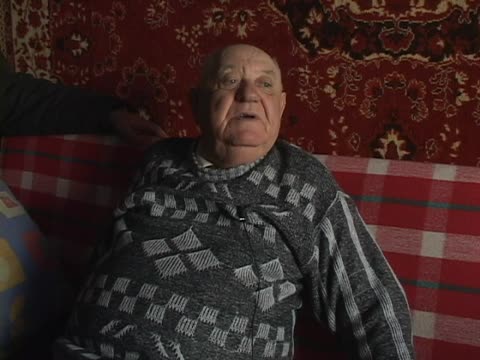
Kalussky provides personal information and talks prewar Jewish life in Briceni. He then addresses his family. His father was a tailor and also born in Briceni. His mother was born Briceni. He grew up with four siblings. He lost two sisters in the ghetto and his two brothers moved to Israel after the war.
From the machine transcript
Kalussky gives his birth year and says Briceni had many Jews who spoke Yiddish. Kerler asks about the difference between a klooz and a shul. He names his father as a tailor and says his mother's family was well-to-do. He names his siblings, two brothers who lived in Israel and two sisters who died in the camp. He also names his paternal grandfather and his maternal grandfather, a butcher family.
names the siblings and both grandfathers, and the klooz/shul distinction
Kalussky talks about his family's life during the war. He describes how his grandparents were killed in the woods.
From the machine transcript
Kalussky describes his grandparents being taken to a forest during the war, where Christians were paid to take a person. He mentions a relative's death there, and Lemster says his own mother was also in that region. Kalussky says two cassettes have already been recorded with him earlier.
Kalussky discusses his childhood memories. Particularly, he addresses his religious school (cheder) education. He finished his cheder education at thirteen (bar mitzvah).
From the machine transcript
Kalussky talks about his childhood and his cheder education until bar mitzvah at thirteen. He names two teachers, Yone and Khayim, and says there were many cheders. He mentions the Romanian school and the Soviet takeover, then the start of the war.
Kalussky talks about his life during the war. He recalls how Lipcani Jews evacuated to Briceni and local Jews initially greeted the Romanian soldiers. Shortly after the Romanians' arrival, he explains, local Christians looted Jewish homes. He then describes how Jews were assembled two months later and forced to march toward the Dniester. Kalussky remembers how his documents were taken away at a school.
From the machine transcript
Kalussky recalls the start of the war. Lipcani Jews fled to Briceni, local Jews welcomed the Romanian soldiers with bread and salt, and local Christians looted Jewish homes. Two months later Jews were ordered to assemble and were driven to the Dniester, where documents were taken in a school. Lemster then questions him about the year and his age, which he gives as 13 in 1941.
includes extended discussion establishing his age and the year
Kalussky speaks about childhood games. He then talks about his family. His grandmother moved to the Land of Israel in 1946.
From the machine transcript
Kalussky names the games children played, including a game with a stick (tsikele), and Kerler stresses that these are of interest. He then talks about his grandmother Dine, who returned from the camp and moved to Israel in 1946 or later.
Kalussky talks about his life before the war and holiday celebration, including food customs, before the war. He particularly addresses Sabbath celebrations.
From the machine transcript
Kalussky describes Sabbath in his childhood: his mother lit candles and blessed, the father and children went to the klooz, and they ate a Sabbath meal with chicken soup and meat. Lemster and Kerler ask about foods and beards. Kerler steers him back to children's games.
Kalussky speaks about childhood games. He then speaks about Hanukkah, Simkhat Torah, and Purim celebrations. He then sings a Purim shpiel.
From the machine transcript
Kalussky describes children's play, including sledding, and holiday customs: Hanukkah money, Simchat Torah flags with apples, and Purim. Children dressed up for a Purim play and went to the homes of the wealthy. He then sings part of the Purim shpiel.
Kalussky sings the well-known Yiddish song "Vos vet zayn az meshiekh vet kumen?" (What will happen when the Messiah comes?), he recalls from his cheder education.
From the machine transcript
Kalussky sings the cheder song about what will be at the feast when the messiah comes, as he learned it from his teacher. He says he no longer knows more.
Kalussky speaks about prewar Soviet times and the difficulties to conduct services. He then talks about prewar cultural life and theater. He recalls performances by Sidi Tal and how non-Jews attended her concerts.
From the machine transcript
Kalussky talks about Soviet times when prayer houses were hard to attend, and about prewar Jewish theater and songs. He says Christians also attended Yiddish performances, and some knew some Yiddish. He sings a Simchat Torah song.
includes the singing of a Simchat Torah song and Kalussky's refusal of drink
Kalussky sings a Yiddish song about Simkhat Torah. He then speaks about prewar religious life. Kalussky explains the difference between a melamed (teacher at a cheder) and the "doyne moyre" (instructor who teaches Yiddish writing and singing).
From the machine transcript
Kalussky sings a Yiddish song that mentions Simchat Torah, explaining the word rendlekh (gold, brilliants). He answers questions about a Yiddish writer, saying there were none locally. He distinguishes the rebbe who taught Torah from the teacher who taught writing and Yiddish song (the "doyne moyre").
adds the explanation of rendlekh and the question about a Yiddish writer
Kalussky recalls how his family went to see the Rîbniţa rebbe and describes the rebbe's place. He then addresses prewar Jewish life. According to Kalussky, 14,000 Jews lived in Briceni. He also mentions a visiting cantor from Kamyanets-Podilskyy. Kalussky then tells a story from a visiting rebbe from Khotyn, who wanted to eat fish and received advice-seeking people.
From the machine transcript
Kalussky answers whether people went to rebbes, recalling a rebbe at Ribnita near the Dniester. He says Briceni had 14,000 Jews, and tells a long story about a clever visiting rebbe from Khotyn who wanted fish on Friday and received people seeking advice. Details of the story, including horses and a man named Moshe, are hard to follow.
includes the account of the rebbe's story at length; the catalogue says cantor from Kamyanets-Podilskyy, which the transcript does not clearly support
Kalussky talks about his family, specifically his uncle, who told him stories and sang at family gatherings.
From the machine transcript
Kalussky talks about an uncle, a clever man who served as a Romanian officer and then mayor of Briceni, and whom Christians liked. His wife and son died in the camp. Kalussky does not recall stories but says the uncle sang Yiddish songs for children on Friday night.
adds the uncle's Romanian military and mayoral office
Kalussky sings a Yiddish song about Sabbath, he learned from his uncle. He then talks about traditional weddings before the war.
From the machine transcript
Kalussky sings a short Friday-night song and answers Lemster's questions about weddings: a shames announced the wedding, and guests received fruit compote and meat. Old men drank brandy and the young drank wine. He cannot recall wedding songs.
Kalussky speaks about Purim celebrations and recalls how non-Jews played Jewish music on the streets. He then addresses non-Jews who spoke Yiddish.
From the machine transcript
Kalussky says that on Purim Christians with a fiddle played Jewish tunes on the street for pay. He cannot recall a tune to sing. He also says some non-Jews spoke Yiddish because they worked for Jews, and later some of them killed Jews.
Kalussky speaks about life during the war and mentions how Yiddish-speaking non-Jews told on Jews during the war.
From the machine transcript
Kalussky says young Christians who knew Yiddish pointed Jews and communists out to the Romanians during the war. Kerler asks about Jews who converted and about non-Jews wanting to become Jewish. Kalussky says many Christians want to be Jews today.
Kalussky speaks about his family, specifically his grandfather. He then addresses food customs.
From the machine transcript
Kalussky talks about his grandfather, who gave him treats as a child. He answers questions about kishke (stuffed intestine), kugel and potato dishes.
Kalussky speaks about the local fire department. He then speaks about his life after the war. He was a merchant. He then addresses prewar Ukrainian Jewish history. In particular, Kalussky talks about the assassination of Symon Petliura by Sholom Schwartzbard.
From the machine transcript
Kalussky says there was a local fire brigade in which Jews served, and names a family of butchers. He says briefly that after the war he worked in trade. Kerler asks about a Jewish library. Kalussky then tells at length how Sholem Schwartzbard assassinated Petliura in revenge for the murder of his family in pogroms.
adds the Briceni fire brigade and the library question
Kalussky talks about Yiddish literature. He then speaks about prewar Jewish life and tells an anecdote about a tailor's family that wanted to celebrate Passover.
From the machine transcript
Kalussky discusses Yiddish books and learning, and mentions a clever man called Tuvye (?). He then speaks about Jews in his town after the civil-war period of the 1920s–30s. He tells an anecdote about a poor tailor who writes a letter to God asking for money for Passover. The letter is opened by the police and the postal clerks, and the tailor is beaten in the end.
Also mentions books and libraries and the civil-war period.
Kalussky answers questions about cultural terminology. He mentions the local kosher butcher for chicken.
From the machine transcript
Answers questions from Kerler and Lemster about the meaning of terms: a 'good Jew' (a rabbi who judged disputes and gave blessings), hasidim, a holy Jew, giving a pidyon, a dibbuk, a Litvak and a golem. He mentions the yeshiva in Chișinău and the shoykhet who slaughtered only chickens. He also describes how a rabbi ruled on questions about doubtful chickens, depending on whether the asker was poor or rich.
Also yeshiva and rabbinic rulings on kosher questions.
Kalussky talks about his life during the war. He was imprisoned in the Vinnytsya ghetto. He then sings a Yiddish song, he remembers from the ghetto. Kalussky then describes how he went into the villages to beg for food.
From the machine transcript
Kalussky is asked about the war years and the ghetto. He says he was in a ghetto near a place called Vinets (?). He sings a sad war song and recites a ghetto lament. He then recalls being left with two small brothers and going out to beg bread from Christians, and says Ukrainians helped. Interviewers ask for his phone number and he says he may recall more later.
Gives a second song and says non-Jews helped him; a phone number is also asked for.
Kalussky lists proverbs. He then talks about prewar Jewish social life. He then addresses folk customs.
From the machine transcript
Lemster asks Kalussky for curses and sayings and he gives a few. He then talks about a poor Jewish street in the town, near the tanneries, and the rough and merry behavior of the poor Jews there. He talks about folk remedies against the evil eye, such as a red ribbon and cut potatoes.
Gives the curses and sayings and the evil-eye remedies.
Kalussky talks about his traditional wedding after the war.
From the machine transcript
Kalussky says he had a traditional wedding with a chuppah, and that the marriage was registered with the state only a year later. Kerler asks about the Yiddish word for the register entry.
Kalussky sings again the war song.
From the machine transcript
At Kerler's request Kalussky sings the war song again, 'oy vey mame', about the war.
The team travels to the Edineţ cemetery and then walks around the cemetery, before making a stop in Edineţ.
From the machine transcript
Mostly travel and chat in a car; the team drives to the cemetery, with Russian remarks and talk about the way. They walk among gravestones and talk about names and families on them. They mention Jews of Edineț (Yedenitser), a woman from Ariv, and that they travel from Kyiv to Chișinău. Much of the Yiddish is garbled.
Adds the walk through the cemetery and talk of Jews from Edineț and Ariv.