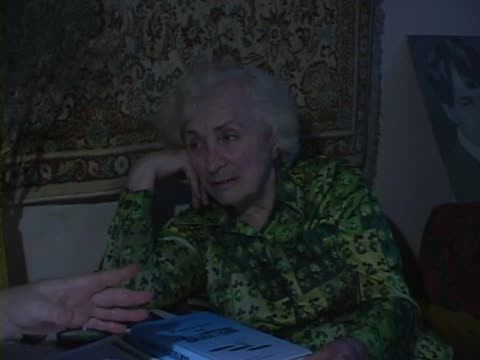
Diner provides personal information and talks about her family. Her father was an accountant and was shot in 1941. Diner grew up with one sister and one brother. Her mother was born in Edineț.
From the machine transcript
Kerler opens the interview with the date and the interviewee's name. Diner gives her Yiddish name, birthplace Fălești and birth year (1925). She names her parents: her father Berl (Boris) was a bookkeeper, her mother Fesye came from Edineț. She names her sister Sarah and her brother Yosef, mentions that the siblings studied at a conservatory in Bucharest, and begins to say what happened to the family under the Soviets.
names her sister and brother and the conservatory in Bucharest
Diner talks about her life during World War II. During Soviet occupation, she was sent to Sibiria in 1941. Diner talks about her father's political activities, founding a Jewish party in the Romanian parliament.
From the machine transcript
Diner recounts that the family was sent away in June 1941 and her father was taken two days later. They were told afterwards that he had been shot, in the first days of the new year. She explains that he was a Zionist who had worked to set up a Jewish party in the Romanian parliament because of the rise of fascism.
Diner speaks about her life and education in Fălești before the war. She attended a Romanian primary school four years and secondary school for four years. She also speaks about her family. Diner explains his father's work as mediator.
From the machine transcript
Diner talks about her childhood in Fălești. Her maternal grandfather Yosef Moldover took in her mother from Edineț as a child, and she names her grandmothers and says whom she was named after. She describes her father as a respected man whom people consulted to settle disputes instead of going to court. She says she attended a Romanian primary school and then a Romanian gymnasium, four years each.
Diner talks about prewar Jewish life in Fălești. She then discusses her childhood memories, including games. Diner also talks about her Romanian secondary school education. She then recites a Romanian poem, before addressing prewar cultural life.
From the machine transcript
In answer to questions Diner describes Fălești as a town with many Jews, two synagogues, a beis-medresh and a kloyz, and many Jewish children in her class. She describes a childhood game of playing mother and father, and says that the gymnasium had much reading. She recites part of a Romanian poem by Coșbuc and says there were libraries, but no Yiddish books in them, though her parents read the Yiddish newspaper Undzer Tsayt.
Diner speaks about her life before the war and leisure activities. She then talks about her family, as well as literature.
From the machine transcript
Diner says young people met in houses and sang songs. She says her father read Sholem Aleichem but had little time, and that she herself read Romanian books, including Eminescu and translations of world literature such as Tolstoy. She is asked whether she was taught prayers and which Jewish holidays she remembers.
Diner speaks about prewar holiday celebration, including Simchat Torah. She then sings a Yiddish song about happiness, she recalls from her mother. Another Yiddish song, Diner remembers from her mother, concerns making the wrong decision.
From the machine transcript
Diner recalls Simchat Torah with an apple and a candle, and the interviewers ask about other holiday customs. She sings two Yiddish songs she learned from her mother, one telling the listener to stay cheerful and hide pain, the other about not having listened to one's wife. She says her mother also sang Russian romances and that her mother's family name was Gutman, from Edineț.
Diner speaks about her life before the war and recalls her mother's cooking. Diner moved to Chișinău in 1965. She then talks about her siblings' visits during the summer, when they studied at the conservatory.
From the machine transcript
Diner talks about her mother's cooking, including gefilte fish on Sabbath, kugel, tarts and bagels, and says she moved to Chișinău in 1965. She recalls her sister and brother coming home in the summers from the conservatory in Bucharest with their friends to play and sing operetta and opera. Her father wanted her to become a doctor, which is why she later could not study in Siberia.
Diner speaks about her life in Siberian gulag during the war. Diner and her mother worked at a sewing factory, before she escaped to Novosibirsk after three years. In Novosibirsk, Diner explains how she met fellow Jews, who helped her out by providing papers. The father of the family worked as director of the Minsk Yiddish theater.
From the machine transcript
Diner describes working very hard with her mother in a factory in Siberia and escaping after three years to Novosibirsk without a passport. There she met a Jewish couple by chance. The man was a director of the Minsk Yiddish theater, evacuated to Novosibirsk, and he helped her get papers by making copies of a birth certificate until she obtained a passport. She says he could have been given ten years for it.
Minsk director's help with a forged passport
Diner addresses prewar Yiddish cultural life in Fălești. She also mentions her encounter with Sidi Tal in Chernivtsi after the war.
From the machine transcript
Asked about Yiddish theater in Fălești, Diner says visiting artists came, including Sidi Tal. She says that in Novosibirsk someone told her to look up Sidi Tal in Chernivtsi, and that she did meet her there after escaping. She also mentions concerts and operettas, some in Romanian and some in Yiddish, which came to the town.
Sidi Tal's meeting in Chernivtsi and visiting concerts and operettas
Diner sings a Yiddish theater songs, she recalls from Sidi Tal's performances. She then addresses prewar traditional weddings.
From the machine transcript
Diner sings a few lines of Yiddish theater songs she remembers from Sidi Tal's performances. She then answers questions about prewar Jewish weddings, saying a wedding was held with a chuppah outdoors and the couple circled seven times. Jewish musicians played the violin at weddings.
wedding customs and klezmer questions
Diner addresses prewar holiday celebration, including Purim and Passover. She also talks about her family and recalls her grandfather's observance. Diner then discusses her childhood memories and shares an episode from a non-Jewish holiday celebration, for which her mother sewed costumes. Diner then shares more stories about her interaction with her grandfather.
From the machine transcript
Diner answers questions about Purim masks and about Passover, saying her father led the seder and was an honest man, which is why he was shot. She describes her grandfather, who prayed daily in a tallit and was her confidant. She tells how a teacher dressed another girl in her national costume for a school holiday, how her grandfather taught her to value learning and to give charity from her Hanukkah money, and which languages were used at home and school.
grandfather's advice and charity, and languages of home and school
Diner speaks about her book collection. She then speaks about her life and encounters in a Siberian gulag. Diner describes how she read Russian poetry to fellow inmates.
From the machine transcript
Diner says which languages her books are in and names Tolstoy works she loves. She describes how in the Soviet camp she refused to smoke or to speak coarsely, how she found a book by Eminescu in the library and swore not to take part. She says she read Russian poetry to a fellow prisoner, Natalia Sats, for eleven months, and describes the few Jews among the inmates and what each had done.
Natalia Sats and the Jews in the camp
Diner discusses Yiddish songs. She then sings "A brivele der mamen" (a little letter to mama), "Lomir zikh iberbetn" (Let's make up) and "Ikh hob dikh tsufil lib" (I love you too much) "Ikh bin farlibt in mayn eygenen man" (I'm in love with my own husband).
From the machine transcript
Diner is asked about Yiddish songs, films and her own Yiddish. She sings fragments of Yiddish songs she remembers: "A brivele der mamen", "Lomir zikh iberbetn", "Ikh hob dikh tsufil lib" and "Ikh bin farlibt in mayn eygenem man". She says she speaks no Yiddish with anyone now. The interviewers then ask about amateur theater in the town.
the interviewers' questions about theater and Yiddish films
Diner speaks about prewar Jewish life in Fălești. She then addresses folk customs and describes how her mother went to a local healer at the beginning of the Soviet occupation.
From the machine transcript
Diner is asked about Fălești and says Jews travelled to Chișinău, Bucharest and Iași. Kerler and Lemster ask about customs of going to a healer, quenching coals against the evil eye and similar practices. She says that when the Soviets came her mother went to a Jewish woman healer who told her she would not see her son and daughter again.
questions about quenching coals and the healer
Diner speaks about her life after the war. She was imprisoned in the Mykolayiv prison.
From the machine transcript
Diner describes being arrested and held in a prison in Mykolaiv after the war, in cell 39. She says she met a German woman, Marta, who told the story of the operetta Silva, which Diner copied down in the camp. She recounts Marta's story of a Russian officer who fell in love with her in Germany and how she was arrested.
Diner talks about her life during and after the war. She was imprisoned in a Soviet gulag for three years during the war and spent two years in the Mykolayiv prison. Diner was caught in Mykolayiv, escaping the gulag in 1954 and sentenced to seven years. She explains that she was released from prison in 1956. Diner also speaks about her family. Diner then speaks about life in prison and fellow prisoners, as well as shows her handicraft, she made during the imprisonment. Diner then shows her booklet, in which she collected poems and songs during this period.
From the machine transcript
Diner talks about her arrest and imprisonment: three years in a camp, then exile or banishment, with a long sentence given to her and to her mother after her father, described as a Zionist, was shot. She says she escaped, was caught in Mykolayiv (?), and was held in a camp in the Perm region, and that she was released after Stalin's death. She describes camp life, including the shirts and sacks they sewed from, and shows her handwritten booklet of poems and songs from the camp, including an operetta text. She recalls a fellow prisoner, a talented thief from Kyiv, and a Kyiv political prisoner who wrote.
Also tells of a female thief and a political prisoner from Kyiv, and shows her handicraft or sewing; the dates are garbled.
Diner briefly sings "Itsik hot shoyn khasene gehat" (Itzik already got married). She then speaks about prewar Jewish life in Fălești, including occupational structure, drinking customs and religious institutions. Diner also recalls a Russian doctor who treated patients for free.
From the machine transcript
Diner sings a few lines of a song about Itsik's wedding. Asked what she wants remembered about her shtetl, she describes the people of Fălești as fine, with many doctors and engineers, and tells of a young man who fell in love with a Jewish girl whose uncle liked a drink. She answers questions about drinking at Purim and Passover, wine, and non-Jews who understood Yiddish. She names a Russian doctor, Putsyata (?), who treated poor patients without payment.
Also covers a family named Braverman, drinking customs, and matzo baking.
Diner answers dialectological questions from the AHEYM Yiddish linguistic questionnaire, as well as questions about cultural terminology.
From the machine transcript
Kerler and Lemster put questionnaire items to Diner. They ask about a rare word of Polish Yiddish origin, Lithuanian Jews and the word for a Lithuanian Jew, and the meanings of 'dybbuk' and of a simpleton or fool. They also ask about the term 'a good Jew', Hanukkah food such as latkes and doughnuts, and the golem. She often does not know the word or answers in Russian.
Diner speaks about her childhood friends, before she addresses her mother's cooking during the winter season. She then answers dialectological questions from the AHEYM Yiddish linguistic questionnaire.
From the machine transcript
Diner recalls a Jewish schoolmate from the third year of gymnasium who volunteered for the Soviet army in 1941 and died near Smolensk, and says many boys perished. Asked for another song, she says she has forgotten the Yiddish ones. She answers questions about her mother's preparations in winter, such as meat salting and preserves, and says Yiddish is hardly spoken today. Kerler asks about expressions and the discussion moves to local customs and eccentrics.
Also covers a schoolmate killed at Smolensk in 1941 and the decline of Yiddish speaking today.
Diner speaks about Jewish life before the war and recalls the local village idiot. She then talks about local figures and mentions religious customs.
From the machine transcript
Diner speaks about the shtetl's madman, a character called Khantse (?), who shouted in the streets. She names well-off local Jews, among them Sara Fuks's family with a mill, and a dealer in karakul and furs, and says Fălești had three Jewish pharmacies and many doctors. She says Jewish boys went to the cheder and had bar mitzvahs, and discusses circumcision at home. The interviewers ask about girls' observances and other customs.
Also names pharmacies and shop-owners, and covers bar mitzvah and circumcision customs.
Diner speaks about food customs, including dishes, at home before the war. She then speaks about her family, particularly her sister's biography.
From the machine transcript
Diner describes her mother's cooking at home, including baking and mamaliga with various toppings such as sour cream and cheese. Kerler and Lemster discuss the Yiddish word for cheese curd. She then talks about her older sister, who lived in Bucharest, met a man there and married him; the sister was later in a ghetto in Transnistria with her husband and his parents. She also says her father, a Zionist, worked all day and had little time for the children.
Also covers the sister's marriage and Transnistria, and her father's lack of time and his Zionism.
Diner speaks about her life after the war, following her release from prison. She married a non-Jewish man and worked at 32:38 as engineer 32:53. Diner does not have children.
From the machine transcript
Diner speaks about her life after her release from prison. She met a non-Jewish man from the Urals (?) and lived with him for three years until he died; she had no children, saying she did not want any and that doctors had told her she could not. She worked in construction as an engineer on labour and wages and received an apartment through work. The interviewers then praise a very old acquaintance with an excellent memory, and Lemster asks if she can read Yiddish poetry; she says she knows Russian poems.
Also covers a non-Jewish husband, her work as engineer and the apartment, and a mention of Sherman.
Diner recites a poem in Russian, before she speaks about her life today. Diner then addresses contemporary politics.
From the machine transcript
Diner recites a Russian poem on Jewish fate, which she says she assembled from three quatrains by Gubermann. She then talks about her life today: she helps neighbours with injections and is afraid to go to the polyclinic. Kerler asks her about God, and she says there is one God and hopes for peace. She comments on contemporary politics, including Russia's relations with Iran compared with its earlier friendship with Hitler.
Also covers her helping neighbours medically and a view on God and politics.
The team concludes the formal part of the interview with Diner. She then speaks about her family. Diner states that she was taught how to read in Romanian by her sister at the age of four.
From the machine transcript
The formal part of the interview ends and the interviewers ask whether Diner remembers any songs her mother sang, but she has forgotten the Yiddish ones; Kerler recalls lines of a song about in-laws (makhetunim). She says her sister taught her to read in Romanian from the age of four so that she would not have to learn from religious texts. Lemster tells of a very old acquaintance who remembers everything. Kerler thanks her warmly.
The camera records pictures from Diner's book.
From the machine transcript
Camera footage of pictures from Diner's book, with Kerler and Diner speaking briefly about a television and some foreign currency.