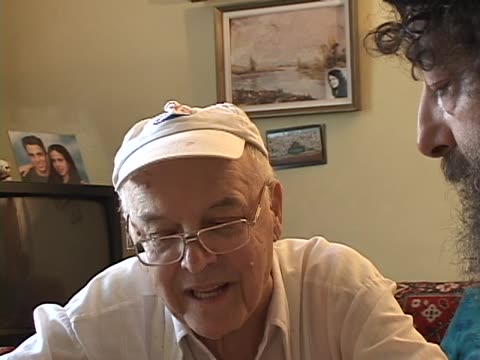
Hershkovich speaks about life today and shows documents, as well as statistics.
From the machine transcript
Hershkovich and Kerler look at a book and documents about the Jews of the Bogata area, sent from Yad Vashem and from America. They go through the Hungarian-language text, names of rabbis and local figures, and Jewish population statistics for the villages around Bogata in the 1920s–40s, noting that nobody Jewish remains there today. There is also some talk of Bogata dialect words.
The passage also shows Kerler examining a book and Hershkovich's account of Jewish population counts in the Bogata villages, with some dialect words.
Hershkovich talks about prewar religious life in Bogata de Sus. He then speaks about his education. He attended a religious school (cheder) in Bogata and then a yeshiva in Dej.
From the machine transcript
Hershkovich describes the small prayer house in Bogata, with families walking in from nearby villages for Sabbath prayer under an eruv. He studied in Bogata until age eight or nine, then went to the yeshiva in Dej. He also learned from his father, who was a learned man. Part of the passage is interrupted by a Romanian remark from a woman in the room.
Adds the Sabbath arrangements of Jews from nearby villages and a Romanian-speaking interruption.
Hershkovich talks about his family. His sister and brother were killed in Auschwitz. He also shows family photographs. His father was a tailor and then a religious teacher (melamed).
From the machine transcript
Hershkovich names family members and shows photographs: his sister Sheyndl and brother Yisroel were deported and did not return, and his mother's name was Blime. His father Aaron, son of David (?), came from Budapest, worked as a clerk and then as a melamed in various communities, and his grandparents are buried in Jerusalem. He also speaks of his teacher at the Dej yeshiva and of being the middle child of five.
Gives details of the father's career as clerk and melamed and names of the head of the yeshiva.
Hershkovich speaks about his yeshiva education in Dej.
From the machine transcript
Hershkovich talks about his time in the yeshiva in Dej: the tractates he studied, his attendance at the rabbi's lectures, and how he ate at the yeshiva's refectory and at other people's homes because his father could not pay. Kerler asks to see the photograph of the rabbi.
Hershkovich talks about his family and discusses his childhood memories of Bogata. He also addresses prewar Jewish life in Dej.
From the machine transcript
Hershkovich answers Kerler's questions about his childhood in Bogata: Yiddish at home, Romanian with outsiders, and Hungarian learned in Dej and later in the army. He describes Jews in Dej, mostly religious businessmen, and Sabbath observance. He then speaks of the Hasidic family of the yeshiva head, who were all rabbis, and says he has lost much of his memory.
Adds the languages he spoke and the Dej Jews' Sabbath observance and the rabbinic family.
Hershkovich talks more about his yeshiva education, in addition to addressing his childhood memories of Bogata.
From the machine transcript
Hershkovich describes the strict daily schedule of the yeshiva and of a young child's learning, with no free time, and then recalls children's games in Bogata, such as a homemade ball of rags. Kerler asks about the word for it and about the word for money, then begins a question on how holidays were celebrated.
Adds the schedule of study and meals and children's games with dialect terminology.
Hershkovich talks about prewar Passover celebrations at home. He then answers linguistic questions.
From the machine transcript
Hershkovich talks about how Passover was prepared at home before the war: bringing down the dishes, scalding, and selling the chametz. Kerler then asks for words for stream or brook in Hungarian, Romanian and Yiddish, and Hershkovich gives a few terms.
Hershkovich addresses the custom "shlugn kapores" on Yom Kippur. He then addresses food customs on Erev Yom Kippur, Sabbath and Purim.
From the machine transcript
Hershkovich answers questions on the kapores custom before Yom Kippur, on food at the meal before the fast, and on Sabbath food, including false fish made of meat, which was eaten on Friday night. He describes a sweet dish made of flour, nuts and honey. Kerler also asks about Purim songs, which Hershkovich recalls only a little.
Hershkovich recalls a couple of Purim shpiels. He remembers the local wedding rhymer in Dej.
From the machine transcript
Hershkovich recites a Purim rhyme for children going from house to house. He recalls the long Purim plays in Dej, including the Joseph story, and a well-known wedding rhymer, Zuldi (?), who performed at weddings throughout the area and died in Canada.
The Purim rhyme and the Joseph play are in the transcript; so is the wedding rhymer's name.
Hershkovich talks about his education. He studied at a yeshiva for approximately five years and then joined the military in 1942. He then talks about his life during the war, when he worked in forced labor as soldier.
From the machine transcript
Hershkovich says he studied about five years at the yeshiva and was then taken into the army in 1942 (?), where he was in a labor unit with only Jews, carrying heavy loads of ammunition and building defenses against tanks. He also mentions sleeping in Galicia in severe cold.
Hershkovich speaks about prewar Jewish life in Dej, including synagogues. He also addresses praying customs and Purim plays.
From the machine transcript
Answering Kerler, Hershkovich describes Jewish streets and quarters in Dej, the languages spoken there, and the number of synagogues, and mentions the burial place of his rabbi's father. He also talks about whether Purim plays were performed at other times, who performed them, and Jews who learned a trade and spoke Yiddish.
Hershkovich talks about Hanukkah celebrations in prewar Bogota. He then addresses food customs on Shavuot and Passover.
From the machine transcript
Kerler asks about Hanukkah in Bogata, and Hershkovich says few presents were given. Hershkovich describes the Shavuot rule of waiting after milk and meat, and the strict Passover custom of not eating gebrokts. Hershkovich asks Kerler where he is from, and Kerler says he was born in Russia.
Includes the exchange in which Hershkovich asks where Kerler is from.
Hershkovich talks about Jewish life after World War II, as well as contemporary Jewish life. Hershkovich then talks about his life today and after the war. Hershkovich moved to Cluj-Napoca in 1969. He worked as revenue officer. According to Hershkovich, there were three active synagogues in town and traditional weddings taking place in the immediate postwar period.
From the machine transcript
Hershkovich describes Jewish life after the war: a few years of communal life, then Jews leaving as the communists took over business, and almost no Jews left in Cluj. He tells of his own difficulties in recent years and of requests for help to the community. He moved to Cluj in 1969 (?) and worked in the tax service, and he describes synagogues, weddings, a wedding rhymer, and Jewish and non-Jewish musicians.
Adds the community's refusal of aid, the lack of a yeshiva and the musicians at prewar weddings.
Hershkovich answers questions about cultural terminology. He then addresses Yiddish dialects.
From the machine transcript
Kerler asks Hershkovich what 'a good Jew' and 'a good place' (cemetery) mean, and about the difference between a rov and a rebbe. Hershkovich also talks about differences between Yiddish dialects in Romania and Transylvania, and Kerler begins questions on how things are said in Yiddish.
Hershkovich answers dialectological questions from the AHEYM Yiddish linguistic questionnaire.
From the machine transcript
Hershkovich answers questionnaire items from Kerler: how to say to pour, 'I need something', and 'pour me a little water', and how such expressions were said in Bogata and in Romanian-influenced Yiddish.
Hershkovich addresses anecdotes and folk customs. Her then answers questions about cultural terminology.
From the machine transcript
Kerler asks Hershkovich about folk stories (stories of a character whose name is unclear in the transcript), schnapps, the evil eye cure with coals and bread, a dybbuk, and the golem and its plural. Hershkovich also gives words for church and for a non-Jewish cemetery. Part of the passage is about speaking Yiddish and Hungarian.
Hershkovich answers questions about cultural terminology.
From the machine transcript
Hershkovich answers questions about cultural terminology. He and Kerler discuss derogatory words for a non-Jewish child and for a non-Jew, and a Jew who behaves like a non-Jew. Kerler asks about the night before a circumcision and how a baby girl was named, which Hershkovich says happened in the synagogue with the father. Kerler then asks what Hershkovich would like remembered about the region.
includes the customs of the night before a circumcision and naming a baby girl, and a closing question on what should be remembered
Hershkovich compares prewar and contemporary Jewish life and then addresses Jewish and non-Jewish relations.
From the machine transcript
Asked what should be remembered about Jewish life in the region, Hershkovich mentions the Jewish rabbi there. He says people used to learn respect for one another and had closer ties. Today, he says, there is more enmity among Jews. Kerler asks about life with non-Jews, and Hershkovich says it was harder in antisemitic periods but otherwise not much of a problem.
adds the comparison with today's Jewish community and the question about relations with non-Jews
Hershkovich recalls Sabbath songs and then addresses his best moments in life.
From the machine transcript
Hershkovich recalls what happened when the family came home from synagogue on Friday night, and Kerler asks for songs. They discuss a song or rhyme about the days of the week and a song about how hard it is to be a yeshiva student. Asked about the best time in his life, Hershkovich says life was hard, but the holidays were a joy, when children got new clothes.
adds the Friday-night return from synagogue, the yeshiva-student song, and the question on his best memories
Hershkovich speaks about childhood games and the team concludes the interview.
From the machine transcript
Hershkovich names a childhood ball game, which Kerler notes is a Hungarian word for a ball, and describes how it was played. Kerler thanks him for his account and wishes him good health. The interview ends with Kerler's closing remarks, including a reference to a rabbi.
adds Kerler's closing thanks and blessings