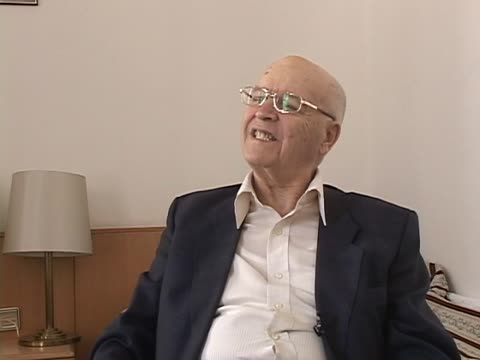
Hershkovich provides personal information and briefly addresses food customs. Although Hershkovich was born in Bogata de Sus, he moved to Dej at the age of ten.
From the machine transcript
Opens with a question about the Yiddish word for turkey meat, which Hershkovich says was called 'kurke fleysh' at home. Hershkovich then gives personal information: his name Solomon, his Yiddish name, and his birth on 27 June 1922 in Bogata de Sus. He says he grew up in Dej and discusses the village's name and its two parts (upper and lower).
Includes an elicitation of food and place-name terms and the village's division into two parts.
Hershkovich discusses his childhood memories and education. He attended a religious school (cheder) and a Romanian school for four years in the village. According to Hershkovich, twelve Jewish families lived in Bogota de Sus.
From the machine transcript
Hershkovich recalls his childhood in the village until age nine or ten, after which he went to Dej to study. He attended both cheder and a four-year Romanian school in the village, and discusses which state ruled the area before and after his birth. He puts the number of Jewish families at about twelve, many of them Kohanim, and begins to speak about his father.
Adds the discussion of Romanian versus Hungarian rule.
Hershkovich talks about his family and prewar Jewish life. His father was born in Volovets, Ukraine. Hershkovich explains that his father's parents left for Israel when he was eleven years old and moved to his brother, who was a professor in Pest. His father studied at a yeshiva and worked as a religious teacher (melamed).
From the machine transcript
Hershkovich talks about his father Aharon, who came from Volovets and whose parents went to Israel when he was eleven; he stayed with a brother in Pest, studied, and was then sent to the village. The father came from a Hasidic family, was a follower of the Belz Hasidim and a modern man, and later worked as a melamed in Dej. Kerler asks where Volovets lies and whether the village had a congregation; Hershkovich says about twelve families.
Adds the father's Hasidic affiliation and a terminological aside about 'shtraymldik'.
Hershkovich talks prewar religious life. He recalls how people from the surrounding communities came together for services in Bogota de Sus. He also describes professional life.
From the machine transcript
Hershkovich describes religious life in the village: Sabbath and holiday services drew people from neighbouring places into a room that served as a prayer room with one Torah scroll, since there was no synagogue building. He then says what the other families did: his grandfather had an inn, a shop and fields, and another family of Kohanim also owned fields.
Hershkovich speaks about his cheder and yeshiva education in Gheorghe Gheorghiu-Dej.
From the machine transcript
Hershkovich speaks about learning Chumash at cheder in the village and then studying at the yeshiva of the rebbe Panet in Dej. He explains how study worked, with the review student (khazer bokher) helping the rebbe's lessons and the Thursday examination. Kerler asks about havrutas and about a song on the hard life of a yeshiva student, which Hershkovich has forgotten.
Hershkovich talks about prewar Jewish life in Bogota. He explains how religious teachers frequently came from Gheorghe Gheorghiu-Dej.
From the machine transcript
Returning to the village, Kerler asks about the melamed; Hershkovich says young men came from elsewhere for a term and the cheder was a small room in a courtyard. He confirms that only Yiddish was spoken at home, though his parents also knew Romanian and Hungarian, which were used with non-Jewish neighbours.
Adds the languages spoken at home and with neighbours.
Hershkovich addresses Purim and Passover celebrations. He describes how he helped to bake matzos. He then speaks about life today and continues to share information about Purim celebrations. According to Hershkovich, children dressed up in non-Jewish clothing on Purim. He then recalls a Purim shpiels.
From the machine transcript
Hershkovich describes Purim and Passover customs: sending gifts at Purim, preparing for Passover from after Sukkot, and baking shmura matzo, in which he helped as a child. He reflects that Jewish observance can hardly be kept today. He recalls going out as a child to perform a Purim play in disguise, in non-Jewish clothing, to nearby villages, and with Kerler's prompting recites bits of Purim play rhymes and begging verses.
Adds the comments on how observance is impossible today and the recited Purim play verses.
Hershkovich speaks about his family. He grew up with two brothers and two sisters. He also addresses food customs on Sabbath. His grandfather was deported in 1944. His daughter lives in Israel.
From the machine transcript
Hershkovich names his mother Blime and his siblings: sisters Rachel and Sheindl and brothers David and Yisroel, with himself named after his grandfather; he explains his home name and his Torah-call name. He talks about Friday baking of challah and a cheese pastry called dalke (?), and about kolach. He describes his paternal grandfather Chaim Hershkovich, a shopkeeper and landowner in Bogata, who was deported in 1944.
Adds the names of siblings and the grandfather's deportation and details of Friday food terms.
Hershkovich speaks about his studies in prewar Dej for seven or eight years. He also addresses Jewish life in Gheorghe Gheorghiu-Dej in the 1930s and contemporary Jewish life.
From the machine transcript
Hershkovich says he went to the yeshiva in Dej alone after four classes in the village, staying about seven or eight years, while the family remained at home. He says Dej had a large Jewish community of perhaps two thousand and gives his impressions of Jewish life there in the 1930s. He laments that Jewish life has gone, and also speaks about the situation in Cluj today, saying a few hundred Jews remain and they gather mainly for aid packages.
Adds the reflections on the decline of Jewish life today in Cluj and a break for camera matters.
Hershkovich speaks about Jewish life in the immediate postwar period. He turns to prewar political organizations, including Mizrahi, Hashomer Hatzair. He then speaks about his life in Israel, where he lived between 1985 and 1989 and worked at a hospital. Hershkovich has relatives in America.
From the machine transcript
Hershkovich speaks about postwar Jewish life, noting that many did not return and that Jews left after the communists came. He mentions prewar Zionist organisations such as Mizrachi and Hashomer Hatzair. He says he lived in Israel in the late 1980s, where his daughter works as a doctor, and why he came back, citing the heat; he also mentions relatives in America, and Kerler then asks about weddings in Dej.
Adds his daughter in Israel and the reasons for his return.
Hershkovich talks about traditional weddings in prewar Gheorghe Gheorghiu-Dej. In particular, he recalls a wedding jester. He also addresses postwar weddings.
From the machine transcript
Hershkovich recalls the wedding jester (badkhn) Zoldi of Dej, who was famous in the region, performed in rhymes, sang and danced at weddings, and mocked Hasidim. Kerler asks about related terms and about Hershele Ostropolier. Hershkovich says the jester went to Canada after the war and died there, and that Jewish weddings continued for a few years after the war.
Adds the terms for the jester and the question about Hershele Ostropolier.
Hershkovich speaks about prewar Jewish life, specifically different religious groups, in Dej and Cluj.
From the machine transcript
Hershkovich speaks about the religious make-up of Dej and Cluj: Dej was largely Hasidic with a few families, and Cluj had a Neolog community and synagogue. He recalls two shops that opened on Sabbath afternoons, causing a stir. He discusses the language of the Neolog Jews and how children learned Hebrew in cheder from age four or five, and why many cannot read with understanding today.
Adds the Neolog synagogue and language use of Neolog Jews.
Hershkovich speaks about life today and local families.
From the machine transcript
Hershkovich tells of a family from America who came about three years earlier to find their roots in his native village, and how he helped them with a translator in finding graves. He recounts the story of the Rozman family and their sons who emigrated. They speak about the term for relatives and Yad Vashem, and Kerler asks whether there were other wedding jesters in the region.
Adds the visit by American relatives and the Yad Vashem matter.
Hershkovich speaks about his education at a yeshiva, which he attended until 1938 in Dej. He then mentions other local yeshivot and remembers how his family visited him in Dej.
From the machine transcript
Hershkovich says he studied at the yeshiva until 1938, and explains how he was fed, with daily meals at different homes, and where he lodged, using the word 'kvartir'. Kerler asks about other yeshivas nearby; Hershkovich mentions one with a trade school teaching carpentry between Dej and Cluj, and talks about visiting his sister in Cluj and praying there on the High Holidays.
Adds the terms for lodging and meals and the other local yeshivas.
Hershkovich explains different religious practices. He then answers questions about cultural terminology.
From the machine transcript
Hershkovich explains the different prayer rites in Cluj, Ashkenazi, Sephardi and Neolog, and why he attended particular synagogues; he mentions that he wears Sephardi tefillin today. He then answers Kerler's questions about expressions such as 'a good Jew' and about words for a cemetery.
Adds the questions on idioms and cemetery terms.
Hershkovich answers questions about cultural terminology. He also mentions the Satmar rebbe, Rebbe Yoel Teitelbaum. His sister went to see him and brought back a blessed coin, he explains.
From the machine transcript
Hershkovich answers questions about cultural terminology: words for the cemetery, the euphemism for the evil eye, the difference between rav and rebbe, and the plural forms of these words. He says his father travelled to the Satmar rebbe (Teitelbaum family). His sister brought him a blessed coin from the rebbe, which he still keeps. They also discuss the verb for holding the Passover seder.
adds the terms for rav and rebbe, the plural forms, and the verb for holding the seder
Hershkovich talks about prewar life, in particular non-Jews who spoke Yiddish and holiday songs.
From the machine transcript
Hershkovich talks about prewar life, including non-Jews who knew Yiddish. They discuss using Hebrew words so that outsiders would not understand, and the term mame-loshn. He sings or recalls a Passover song and a song about the Messiah, and says he spoke little Hungarian until the labor service, where he spoke more of it. Kerler then asks Dr. Lemster to put some sentences to him.
adds the Hebrew words used as a secret language and the question of language in the Hungarian army
Hershkovich addresses prewar cultural life and reading in the Yiddish language. He also mentions different Yiddish dialects.
From the machine transcript
Hershkovich speaks about prewar culture and reading. As a yeshiva student he did not go to the theater. He read religious texts and stories of tsadikim in Hebrew, though he spoke and wrote letters in Yiddish. He says there are different Yiddish dialects, and that his own is closest to Polish Yiddish. He is asked about Litvaks, whom he describes as learned people.
adds the dialects, Litvaks, and the question of theater and Yiddish letters
Hershkovich addresses food customs.
From the machine transcript
Hershkovich answers questions about food terms and customs. These include the loaf called dalek, meat dishes, cholent with kishke, and the Sabbath fish, with imitation fish (made of meat) as an alternative. He names the word for brandy and the kinds of fruit brandy.
Hershkovich speaks about folk and healing customs. He then answers questions about cultural terminology. He recalls Hebrew proverbs about the term "golem."
From the machine transcript
Hershkovich speaks about the evil eye, the practice of removing it with water and coals, and the words connected with it. He knows the word dibbuk but does not use it. He then discusses the word golem and recites a Hebrew saying about seven things of the wise and the golem, tracing it to Pirkei Avot. Kerler closes by asking about the war years.
adds the dibbuk and golem terms and the Hebrew saying from Pirkei Avot
Hershkovich speaks about his life during World War II. He served in the army and worked in construction between 1942 and 1944. He then talks about his family's fate during the war and shows family photographs. He also shares photographs of the Dej synagogue and the head of the yeshiva.
From the machine transcript
Hershkovich recalls being taken in 1942 into the army labor service, where he worked in construction without arms until October 1944 (?). His unit was all Jews, working long hours on poor food. His mother and sisters were deported to Auschwitz, where they perished. He shows photographs of his family, of the Dej synagogue and of the head of the yeshiva (Panet), and mentions relatives in America.
adds the Auschwitz deportation of his mother and sisters and the named photographs
Hershkovich talks about his family and shows family photographs. He then talks about local cantors before the war.
From the machine transcript
Hershkovich shows photographs of his family, including a grandson's bar mitzvah in Israel, a brother-in-law buried in Israel and his sister's grave in Cluj. Kerler asks about Jewish weddings and famous cantors visiting Dej. Hershkovich names some cantors, including Rosenblatt. The conversation turns to Kerler's own background, his documentation of Yiddish, and Litvaks and the Vilna Gaon.
adds Kerler's explanation of his own background and the Vilna Gaon
Hershkovich answers questions about cultural terminology. He then speaks about the head of his former yeshiva.
From the machine transcript
Hershkovich answers a question about the term ilui (a child prodigy), then speaks about the head of his former yeshiva. He recalls that the rabbi's brother, a learned rav, left the Dej ghetto for Romania with ten children, while the rabbi himself refused to leave. Kerler then begins greetings questions from the questionnaire.
adds the rabbi who refused to leave the ghetto
Hershkovich answers dialectological questions from the AHEYM Yiddish linguistic questionnaire.
From the machine transcript
Hershkovich answers dialectological questions from the AHEYM Yiddish questionnaire. The items include greetings, requests, words for the cat and mouse, war and battle, teeth, minyan and the well, and prepositions meaning 'at the father's'. They also cover plurals, the Hanukkah dreidel and regional names (the Regat). Further items are Jewish and non-Jewish terms, the word for face, house, room, and several sentences to translate.
Hershkovich answers dialectological questions from the AHEYM Yiddish linguistic questionnaire.
From the machine transcript
Kerler puts dialectological questionnaire items to Hershkovich. They cover particles and adverbs (perhaps, maybe, but, or, also, 'in three days'), phrases for liking a person, a sentence to translate, and words for farmer, illness and war. Hershkovich answers and mentions Maramureș Jews who all spoke Yiddish. Kerler then invites a song or joke.
Hershkovich also mentions Maramureș Jews speaking Yiddish and Kerler asks for a song or joke at the end.
The team concludes the interview with Hershkovich and the camera records his family photographs.
From the machine transcript
Kerler ends the interview with Hershkovich and asks for a few closing words on the continuity of Jewishness. Hershkovich comments on genealogical research by relatives from America. The camera then records family photographs. He identifies a sister, Shindl, and a brother, Yisroel (?), both in Auschwitz in 1944 (?), and shows a photograph of a synagogue.
Names the sister and brother in the photographs, who were at Auschwitz in 1944 (?).
Grunfeld speaks about prewar Jewish life and surrounding towns. He also mentions how he dressed up as peasant on Purim and recalls Purim shpiels.
From the machine transcript
The new interviewee talks about languages in his youth. Jewish friends knew Yiddish, while Romanian and Hungarian were spoken with non-Jews and in town. He describes a village of about twenty Jewish families (twenty 'taleisim') with a melamed, mikveh and synagogue, between Cluj and Târgu Mureș. He recalls dressing as a peasant for Purim and visiting Jewish families, and Purim plays such as the Sale of Joseph and Esther.
Grunfeld speaks about his religious education and recalls Sabbath zemirot (songs). He attended a religious school (cheder) until the age of nine. Grunfeld then talks about an episode from his childhood when he did not say the morning prayer "moyde ani" and was chastised by a Christian woman. He also mentions the Yiddish Bible for women "tsene-rene."
From the machine transcript
He talks about his religious education, learning with a poor teacher, and Friday-night Sabbath songs at his grandfather's and father's house. He tells of a childhood episode in which a Hungarian Christian maid or nanny caught him eating before saying the morning prayer and reported it. He mentions the women's Yiddish Bible (tsene-rene) and that he studied Talmud and gymnasium.
Grunfeld speaks about traditional weddings and food customs. He then turns to different religious groups before the war.
From the machine transcript
He speaks about wedding customs and the matchmaker, and compares Maramureș Jews with those of Transylvania. He describes Passover food made with potato and goose fat. He also touches on Ashkenazic and Sephardic prayer rites in Cluj and Moldavia, and says his parents were in prison.
Grunfeld speaks about his family and his life during the war as forced laborer. His sister moved to Israel and lived a Hasidic life. Grunfeld also has Hasidic relatives in England. Grunfeld then addresses contemporary Jewish life in surrounding towns and the Satmar Hasidic dynasty.
From the machine transcript
He tells how his parents survived thanks to the prison and how aunts were taken to Auschwitz. He served in forced labour in the army and was held in a fortress. He has grandchildren in Israel and a Hasidic nephew in London. He then discusses Oradea, Satu Mare and its rebbe, and Hasidim near Czernowitz. He speaks of Sighet and Vișeu (Vișeul?) with many Jews, and shows a family-lineage document.
Grunfeld shows his family tree in Hebrew. He then speaks about life today, before the camera collects town footage.
From the machine transcript
The man shows a Hebrew family-tree or yikhes letter, naming Menakhem Yehuda as himself and his parents David and Miriam Guta (?). The talk drifts to the interview and recording, with Romanian and Russian asides and a mention of the languages he uses. He mentions a village about thirty kilometres from where he grew up with a stream, and Friday-night fish at home.
Grunfeld speaks about food customs, in particular gefilte fish. He then speaks about contemporary Jewish life in Cluj-Napoca and answers a dialectological question.
From the machine transcript
He answers questions about gefilte fish and its taste, then calls Cluj a beautiful town where he lives and speaks of a street in town. Kerler asks which words he used for war (milkhome, krig, shlakht), and he explains them.
The team greets Eugen Kraus and sets up an interview with him. Kraus and Hershkovich speak about the former synagogue, which is presently used as Jewish Studies department of the university.
From the machine transcript
A short exchange as the team greets someone and discusses the former synagogue, now a Jewish institute of the university. There is no actual interview with Kraus in this stretch.
The transcript shows only a brief remark about the former synagogue being a Jewish institute.
Grunfeld tells a joke.
From the machine transcript
Grunfeld tells a joke that his grandfather used to quote, about the best joke, followed by a short exchange with the interviewers over a word for something a man makes for himself.
The formal interview with Kraus begins. He provides personal information.
From the machine transcript
The formal interview begins. Kerler and Lemster settle the date of the recording and the microphone, and Kraus gives his name. The interviewers ask the name of the street.
mostly settling the date and name rather than detailed personal information
Kraus provides personal information and talks about his family. He studied at the Cîmpia Turzii yeshiva in 1939/40. His father was also born in Zorein and worked in agriculture. He owned land and horses. Kraus' mother was born in the nearby village Feldioara and worked as a seamstress. He grew up with four sisters and two brothers.
From the machine transcript
Kraus gives his birth in October 1923 in Zorein, a village some sixty kilometres from Bistrița (?), and says he studied in Cîmpia Turzii in 1939/40. His father Zelik was also born in Zorein and was deported; he worked the land and kept horses. His mother Golda, a seamstress, was born in nearby Feldioara. He names his grandfathers and siblings: three brothers and four sisters, with one brother killed in a labor battalion. He says that Yiddish was spoken at home and that the village had a minyan.
adds the grandfathers, the siblings' names and the home language
Kraus speaks about prewar Jewish life in Zorein and Cîmpia Turzii. He then addresses his childhood memories. He attended a religious school (cheder). Kraus completed an apprenticeship between the age of 14 and 18 in Cîmpia Turzii.
From the machine transcript
Kraus compares prewar Jewish life in Zorein and Cîmpia Turzii, the latter with a yeshiva, a rabbi and many Jewish families. He says his maternal grandfather is buried in Zorein, where the grave is now only marked off. He describes cheder in Zorein with a melamed and a shoykhet, and the education of girls. From age 14 to 18 he learned a trade as an apprentice in Cîmpia Turzii.
Kraus talks about prewar Sabbath celebrations, including food customs. He recalls how women read the Yiddish Bible for women (tsene-rene).
From the machine transcript
Kraus describes prewar Sabbath customs: his mother's candle-lighting, the cholent carried to the baker's oven, challah, and the father's havdalah. He says that women read the tsene-rene and psalms, which he did not read himself. He compares this with the decline of such practice today.
Kraus speaks about contemporary religious services. He then describes how his mother koshered meat and speaks about food customs.
From the machine transcript
Kraus mentions that he reads from the Torah at services today. In answer to Lemster he describes how his mother koshered meat after the village shoykhet slaughtered it, salting it on a board. He briefly mentions cholent.
adds how his mother koshered meat
Kraus discusses holiday celebrations, including Purim. Kraus shares that he blows the shofar during contemporary services.
From the machine transcript
Asked about holidays, Kraus says he blows the shofar at services today. He recalls Purim in the village as eating and drinking, masking, and a man who made an amusing rabbi's sermon, and a Purim song with a request for money. He then says he spent the war in Ukraine and Transnistria.
Kraus speaks about his work. He worked in the plastic processing industry for thirty years. He then talks about his yeshiva education.
From the machine transcript
Kraus says that he worked for thirty years in plastics processing, and retired as a technician. Questions about his yeshiva schooling follow: he was not a yeshiva student but learned a trade near the yeshiva in Cîmpia Turzii, and had been to cheder in Zorein until about age fourteen. The segment ends with a short exchange about the name Blackman.
Kraus talks about Passover celebrations, including food customs and matzo baking, before the war. He then explains the recipe for "ibergetsoygene matsos" (coated matzo). He also recalls his family's "shabbos goy."
From the machine transcript
Kraus describes prewar Passover: matzo baked at home from flour milled on stones, soup, meat, kneidlach (?), potato dishes and "ibergetsoygene matsos" coated with eggs and goose fat. He recalls his mother force-feeding geese for the fat, and a Christian who lit the fire for the family on Sabbath, whom he says was called a shabes goy (?) by the Jews in the village. Kerler also asks about turkey and a food term.
Kraus speaks about food customs for Purim, before he recites the morning prayer "moyde ani." Kraus discusses prewar Jewish life in the surrounding towns.
From the machine transcript
Kraus names meat eaten at Purim, then recites the morning prayer modeh ani learned as a boy. Kerler asks about yeshivas in the surrounding area, and Kraus names Satu Mare and Sighet and Maramureș with many Jews, and says he heard of a Vizhnitser rebbe but never met him. His family did not travel to rebbes.
Kraus speaks about his life during the war. He was sent to do forced labor in various places, including Tighina, Chernivtsi, Orhei, Bălți, Balta and Tiraspol. Kraus returned to Cluj-Napoca in 1945. He then speaks about his family's fate during the war. His siblings and parents were deported to Auschwitz.
From the machine transcript
Kraus recounts the war years: forced labor in Transnistria and Ukraine in places including Tiraspol, Chernivtsi, Bălți, Bukovina and Tighina, and the end of the war in Bălți (?). He returned alone to Cluj in 1945 after his parents, brothers and sisters had been deported. Kerler then asks whether elderly Yiddish-speaking Jewish women live in the city, and Kraus says an elderly woman from Satu Mare lives there but does not speak Yiddish, since in Transylvania people spoke Hungarian and German.
adds the question about Yiddish-speaking elderly women in Cluj
Kraus answers questions about cultural terminology. He then addresses the custom "shlogn kapures" on Yom Kippur.
From the machine transcript
Answering Lemster's and Kerler's questions about terminology, Kraus says he knows the word golem, and describes the Yom Kippur custom of shlogn kapores, with a rooster for men and a hen for women. He speaks about Yiddish texts and letters, the term "a gut ort" for a cemetery, and the word for the cemetery used by the community. He says that Romanian and Hungarian are spoken in the community today.
Kraus addresses prewar Yiddish culture in Bukarest. He then talks about prewar Jewish life in Cluj-Napoca, including synagogues. He also addresses prewar Hasidism.
From the machine transcript
Kraus says that Yiddish theater in Bucharest is rare today, and mentions a rabbi from France who visited. He says that before the war there were about seventeen thousand Jews in Cluj, with a number of synagogues and associations, and that Christians there spoke Yiddish. He says he first saw Hasidim at the yeshiva in Cîmpia Turzii. Kerler and Kraus then discuss the word shofer/sofer (the scribe).
Kraus talks about contemporary religious services. He then talks about his work as a the head of the community for twenty years.
From the machine transcript
Kraus speaks about the Jewish community in Cluj today, where non-Jews come to the services, and about the shrinking minyan. He served on the community board for twenty years and organized the storehouse, Sabbath meals and prayers. He explains that many Jewish men married Christian women after the war.
Kraus talks about postwar Jewish life, as well as his life after the war. Kraus then speaks about his wedding in 1955. He raised two daughters.
From the machine transcript
Kraus describes the postwar years: most young people left for kibbutz or Israel, he spent a year in a kibbutz, and he stayed in Romania. His sister lives in Israel. He married in 1955 and has two daughters, an engineer and a doctor. He says his wife speaks Yiddish only weakly. He then discusses what is Yiddish and what is German, calling Yiddish a jargon, and Hebrew.
adds the discussion of what counts as Yiddish
Kraus addresses Yiddish dialects. He then talks about food customs, including onions with egg. He then answers dialectological questions from the AHEYM Yiddish linguistic questionnaire.
From the machine transcript
Kraus answers questions about Yiddish dialects: he says Yiddish in Maramureș, Bukovina and Iași is much like his own. Questionnaire items follow on food terms (gefilte fish, onion with egg, oysters (?), vinegar meat), the words for the hand, apple, water, milk and money, and for the dreidel; Grunfeld disputes whether the word "tenderl" is from Maramureș.
adds food terms and the dialect discussion
Kraus answers dialectological questions from the AHEYM Yiddish linguistic questionnaire. He also explains how to play nuts.
From the machine transcript
Answers questions from the dialectological questionnaire on the word for the spinning top (tenderl, drenderl, dreidel, dreiderl) and on the nut game played at Sukkot. Kerler then asks about a comic named Zaldi/Zeldik (?) and the word for 'green'. This leads to a discussion of colour words, red and fair hair, and the surname Grunfeld.
Includes a discussion of a comic named Zaldi/Zeldik (?), colour words and the name Grunfeld.
Kraus discusses Yiddish songs, he recalls from performances by Tarbut school students. He then talks about contemporary weddings.
From the machine transcript
Kraus is asked about Yiddish songs such as 'Papirene kinder'. He says he heard such songs in Cluj in the 1940s after returning from deportation, at the Tarbut school, and forgot them within a year or two. He says he does not like singing or dancing and recalls no Hungarian or Romanian songs. Lemster then asks about weddings: there was no chuppah at his own wedding, which was modern, though a chuppah is arranged today through the community.
Kraus says he recalls no songs, and gives his own modern wedding without a chuppah; the catalogue's 'contemporary weddings' is only partly supported.
Kraus answers dialectological questions from the AHEYM Yiddish linguistic questionnaire.
From the machine transcript
Long dialectological questionnaire session in which Lemster, often prompting with Romanian words, and Kerler ask for Yiddish equivalents. Items include greetings and thanks, small and belly, house and room words, window glass, floor, attic and beam, building and wall, ear and deaf, earlier and later, quick, sick and weak, to run away, pious, reliable, cross and convert, bridge, potatoes, shop and clothes. They also ask for prepositions ('in' or 'on' the street) and for translation sentences such as 'he said to him/her', and compare usage in Maramureș (?) and Moldova.
Grunfeld sings a Hasidic song by the Kaliver rebbe, Yitzchak Isaac Taub, he recalls from his grandfather.
From the machine transcript
The second man sings a Hungarian-language song, then a Hasidic song attributed to the Kaliver rebbe. He says his grandfather used to sing it. He tells how the rebbe is said to have heard the melody from a shepherd child and bought it from him. Kerler praises the singing and begins to thank the interviewees.
The speaker is the second man, not Kraus; a Hungarian song precedes it, and he tells the story of how the rebbe acquired the melody.
The team concludes the formal part of the interview with Kraus and they discuss proverbs.
From the machine transcript
Kerler and Lemster thank the two men for sharing their Yiddish, and the men say how much they value hearing it. Lemster then asks for sayings; they give drinking toasts and wishes for the sick, including one about a cloudburst. They mention Bessarabian Jews whom the second man knew from the army or work, and he compares words such as pocket (kesene and tash). A woman in the town who also knows Yiddish is mentioned, and the second man begins to recall a Havdalah song learned from Bessarabians.
The catalogue's 'proverbs' include toasts and wishes, with talk of Bessarabian Jews and a woman who speaks Yiddish.
Grunfeld and Kraus sing Yiddish songs for Havdalah, they learned from Bessarabian Jews. They also address contemporary Jewish life. Grunfeld has relatives in Israel.
From the machine transcript
The second man performs or describes Havdalah songs learned from Bessarabian/Moldovan Jews, with Kraus adding lines. They say they have spoken little Yiddish in recent years, since synagogue announcements and community talk are in Romanian or Hungarian and few know Yiddish. The second man mentions visiting Israel every few years, where he has relatives. Lemster closes by asking about Jewish weddings.
Includes the decline of spoken Yiddish in the community, with Romanian and Hungarian used in the synagogue.
Grunfeld speaks about contemporary traditional weddings. They then speak about life today.
From the machine transcript
Talk of a traditional Jewish wedding held in the town a few years earlier, involving a woman with ties to America and a required chuppah. This is followed by an exchange about the word for pouring (anshitn) a little wine and an offer of food. Kerler and the men then discuss a woman from Satu Mare (Satmar), about eighty, who speaks good Yiddish but not English, and the second man gives his business address and telephone. The details of the wedding story are unclear.
Adds a woman from Satmar, about eighty, who speaks Yiddish, and an exchange of contact details.