People › Faina Braverman › conversation

Faina Braverman; Semyon Braverman

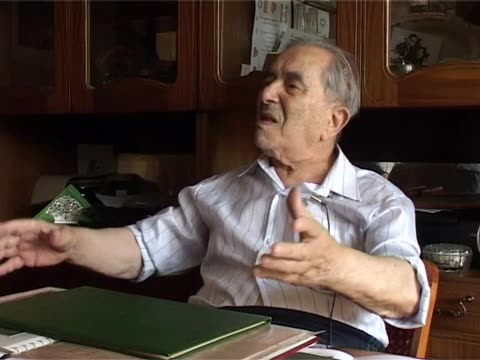
Kyiv 7 July 2002 Interviewed by Dov-Ber Kerler, Jeffrey Veidlinger, Dovid Katz 2.7 h · 4 parts on 4 tapes
Loading the player…
  1. MDV 496 0:00–38:10 · 38 min · not online — MCO
  2. MDV 497 0:00–41:24 · 41 min · not online — MCO
  3. MDV 498 0:00–41:42 · 42 min · not online — MCO
  4. MDV 499 0:00–40:01 · 40 min · not online — MCO
Passages
MDV 496 0:00–38:10

0:00

Life today.

life today Life today MDV 496 · MCO
From the machine transcript

At the start the team is received in the house. The hosts discuss some books they want to give away and Katz says Kerler can take them, and Shapiro's helper is from Vinnytsya and now lives in Kyiv. Shapiro mentions his work at an institute, a congratulatory address and a gift of money from a former institute director, and the talk ends with the start of an account of his family and his orphaned father.

The passage is mostly about books to hand over, the helper's origins and funding, and begins his family story, rather than life today.

14:21

Synagogues in Vinnytsya.

From the machine transcript

Shapiro describes the synagogues of Vinnytsya, among them a workers' synagogue and one connected with a hasidic rebbe, and Katz asks which kind of hasidim the rabbis were. He remembers carrying a tallis as a child, the women's section, a choir and music at one prayer house. He also says his father knew little Hebrew, and that he himself later became an officer.

20:33

About AHEYM project.

Informal MDV 496 · MCO
From the machine transcript

Katz and Kerler explain who they are and what the AHEYM expedition is. Kerler mentions his father, the Yiddish poet Yosef Kerler. They discuss a Vinnytsya man (Glovman, name uncertain) and plans to meet him, and Kerler outlines the route of the trip (Vinnytsya, Zhytomyr and other towns). They then ask to see the books.

The segment also covers the Vinnytsya contact and the planned itinerary.

24:28

Books and photographs.

From the machine transcript

The team looks at five books that had been shown earlier and returned. The talk touches on a gravestone for a mother, a Torah scroll and a synagogue, and on photographing the couple and the books, but the transcript is very garbled.

It adds the discussion of photographing the host and wife.

31:52

Formal introduction.

From the machine transcript

Katz thanks the couple for the book and takes down Braverman's address in Kyiv, to send them his own books of stories.

It adds the address exchange; no formal introduction is evident.

34:07

Discussing Braverman's articles.

From the machine transcript

Braverman talks about her Yiddish articles. She wrote a column and a piece about Shapiro's booklet, and mentions an article for a Kyiv newspaper on the state of Yiddish after the Soviet period and its anniversaries. She also speaks about a Yiddish periodical and a Yiddish lecture course, and about a writer from Odessa (Tishchenko?) who emigrated.

MDV 497 0:00–41:24

0:00

Recent Yiddish writers.

From the machine transcript

Talk about a Yiddish writer, evidently a younger man still active and of a hoped-for great age; the transcript is fragmentary. Kerler then notes that it is 7 July in Kyiv and says he is glad to talk with both of them.

Kerler's closing remark about the date and place.

0:35

Formal introduction and family.

From the machine transcript

Kerler explains the video-archive project and the team's plan to travel to Shatmar(?) the next day. Braverman and Semyon introduce themselves. She comes from Solkhov, about 25 km from Berdychiv, was named Faigele, and was born in 1923 (Kerler makes a special exception to the post-1920 birth rule). Semyon is from Zhmerynka, his father from Hryntsiv (?) and his mother from Derazhnia; he finished Ukrainian school as the war began, was taken into the army, and did not hear Yiddish for fifty years.

Discussion of Braverman's childhood name and of the Solkhov name; Semyon's family names are also given.

6:13

Childhood memories from Solkhov and family.

before the war ChildhoodFamily history MDV 497 · MCO
From the machine transcript

Braverman recalls Solkhov childhood and mentions an essay she published about it. She describes her siblings, including a younger brother who was killed in the war, an older brother and sister, and a sister who died at age three, and how her parents hoped for a boy. She recalls a house without electricity and her grandmother coming with a basket of feathers and a Yiddish Pentateuch, whose pictures she looked at while hearing the Joseph story. An aunt in Tinkrad (?) gave her another book, and she recalls her grandfather praying in tallit and tefillin.

Details of siblings and a lost sister, and her own anecdote of wandering alone as a toddler.

14:23

Holiday celebrations and family.

From the machine transcript

Braverman describes holiday food: buckwheat latkes with goose cracklings and fat for Hanukkah, and potato latkes for Passover. She then recounts how her father's younger brother, a Zionist who founded a Jewish gymnasium in Solkhov, fled during the civil-war period, went through Poland and settled in France, and how the relatives there lived. She talks about her cousins in France, a cousin's birthday, and her own parents' fates: her mother was killed in Kalinovka. A discussion of where Kalinovka is follows.

Latke types, the uncle's Zionism and Jewish gymnasium, and the cousins in France.

21:26

Family and prewar life in Solkhov.

From the machine transcript

Braverman names her cousins in France and their ages, saying they were four children in her family, too. She recalls relatives she was not allowed to know about because of fear, matzo parcels, and the family's expectation that grandchildren would care for the old. She describes her grandfather, his quiet manner, his shop that was kept secret until 1937, when a regional newspaper wrote that she had not mentioned it on joining the Komsomol, and his cabinet of books and Talmuds. A neighbor's apple cellar and an apple drink are mentioned, and the grandfather's death in the early 1930s (?) is recalled.

Details of other relatives and children in France; grandfather's cabinet of books.

30:57

Education and books.

From the machine transcript

Braverman describes her Yiddish school, which she attended for four years, starting before she was six, and her early reading of Yiddish, Russian and Ukrainian books. She recalls books left by her uncle's gymnasium (physics, archaeology, geography) and the novel Stempenyu that she read at about ten. She says she learned Hebrew only later. She names her teacher Litinetsky (Israel Borisovich), who she says taught Perets Markish, and recalls a difficult arithmetic problem and what her mother taught her.

Details on languages of books, her reading, and her mother's advice.

MDV 498 0:00–41:42

0:00

Visiting artists and theater plays.

From the machine transcript

Braverman answers a prompt to tell something and recalls the theatre in Solkhov. Visiting artists lodged with the family and her mother cooked for them. She remembers a play and a song from it, and begins to tell about the town's doctor.

adds the mother's cooking for the artists and a remembered song from a play

2:51

People in prewar Solkhov.

before the war Local Jewish history MDV 498 · MCO
From the machine transcript

Braverman describes the town's only doctor, a Russian field-surgeon, his non-Jewish mistress, and the scandal with his wife; Kerler asks about a dialect word. She recalls the fear of school and a rhyme spoken by an old woman when she was falling asleep.

adds the doctor's mistress and the old woman's sleep-time rhyme

8:52

Hunger and family.

From the machine transcript

Braverman places the hunger in 1932–33 and speaks of her father's job as an inspector of factories and scrap metal around Vinnytsia and Haisyn, and the food he brought home. She recalls the start of the famine, swollen peasants passing the house, and her mother's help to a non-Jewish woman. Kerler then asks about the look of the town.

adds the father's job as inspector and the mother's help to non-Jewish neighbours

14:51

Prewar Solkhov.

before the war Local Jewish history MDV 498 · MCO
From the machine transcript

Braverman describes the layout of prewar Solkhov, the main road, and the absence of electricity until after the war; Semyon Braverman adds remarks on Ukrainian villages. She and Kerler discuss local food and dairy terms. She speaks of the Jewish population, the kloyz and the synagogue, the low riverside site, the mikvah her mother took her to, and the seder at her grandparents'.

adds food and dairy terms, and the seder and the mikvah visit

24:59

1930s.

before the war MDV 498 · MCO
From the machine transcript

Braverman recalls the closing of the Yiddish school in the mid-1930s, with a Ukrainian school taking over after four classes. She speaks of her talks in Moscow and of Yiddish used with a professor. Kerler then asks about Jewish–non-Jewish relations.

26:41

Relationship between Jews and non-Jews.

From the machine transcript

Braverman recalls relations with Ukrainian neighbours and a bandit, a maid, her friends and playing in the village, a local shopkeeper, and the river. Kerler asks the Yiddish and Ukrainian names for the river and the figures for Solkhov: about a thousand Jews among four thousand or more inhabitants. She also mentions the secondary school.

adds the river names and a bandit named Simen Rudy (?)

34:42

Return after the war and childhood memories.

From the machine transcript

Braverman recounts the first postwar visit, in 1946, when her sister found the house plundered, and she describes the family home. She talks of the many Polish families, teachers and watchmen near Solkhov and how they spoke Polish. Kerler asks about the name Solkhov in Yiddish, Ukrainian and Russian, and she recalls the Hasidic kloyz, Jewish holidays and a childhood memory of the synagogue gallery at Sukkot (?).

adds the Polish neighbours and the Sukkot memory

MDV 499 0:00–40:01

0:00

Childhood memories and Hasidim.

From the machine transcript

Braverman recalls her Hasidic grandfather's household: bringing the lulav and etrog, the prayers she learned as a child, and Passover customs. She discusses Sabbath breads (kuletsh versus challah) and a favorite baked treat (name uncertain). She remembers her mother's heavy baking work, her grandmother preparing the fish head on Fridays, and her father bringing a carp from the villages. The segment ends with Kerler's question about how the fish was made.

Adds the Passover prayers, the kuletsh/challah distinction and her father's weekly carp.

4:56

Food customs and non-Jewish acquaintances.

From the machine transcript

Braverman describes making gefilte fish, including the stuffed head and the sugar her mother added, and her own borscht with a little sugar. She mentions her first husband, a non-Jew, whose father was of gentry background and who had a Jewish-sounding name. She then answers Kerler's questions about non-Jews who spoke some Yiddish, including a villager called Kuzma, and about terms for gentiles. A story follows about an unbaptized Russian girl. Semyon adds that non-Jews in Zhmerynka spoke Yiddish at the market.

Adds her non-Jewish first husband and his family background and terms for gentiles, beyond food and Yiddish-speaking neighbors.

17:15

Family and Jewish life in Zhmerynka.

From the machine transcript

Semyon Braverman describes the Zhmerynka synagogues and what they became after the war (a club, a bakery, a library, a militia building). His pious father led the congregation and made Yiddish calendars that were mailed across the country. The father's biography, from a Jewish gymnasium graduate, appears in a published book, and Semyon mentions a police fine for an unregistered prayer gathering. Semyon then begins the story of Zhmerynka friends who wrote a letter in 1948 asking to go to Israel.

Adds the fate of the synagogues and the father's Yiddish calendars, beyond family and prewar Jewish life.

25:21

Theater.

From the machine transcript

Answering Kerler's questions, Braverman remembers the Jewish theater and club in Zhmerynka, which the Jews put together themselves after the war, with singing and dancing. He does not recall a particular play. He mentions that he studied in a Ukrainian school while Jewish children studied in Yiddish, and he mentions a Yiddish school certificate. The speakers then discuss how to film the document.

27:35

Tsene-rene.

From the machine transcript

Faina Braverman shows her tsene-rene, which belonged to an aunt (name uncertain) with inscriptions in Russian. She tells how she first learned Torah as a small child, starting with Leviticus, and Kerler examines a Bible translation she also owns. Semyon's father's calendar leaf and copies of the newspaper Eynikeyt are brought out. Katz and Kerler work out a date from Hebrew letters.

34:29

Semyon’s diploma.

From the machine transcript

The group looks at a Yiddish school certificate belonging to a friend named Roza, who finished a Jewish school in Zhmerynka. Kerler and Katz read the school and director names (the director's name is uncertain), and the discussion touches on Jewish schools in Belarus. They go through a leaf from Semyon's father's postwar Yiddish calendar, with its holidays, and look at the newspaper Eynikeyt. The interviewers ask whether they may take the originals.