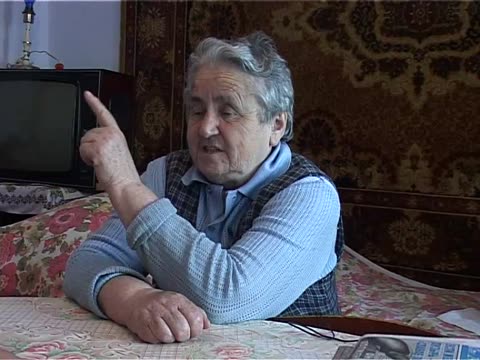
Interview with Donia Shoilevna Presler
From the machine transcript
Presler gives her parents' and grandparents' families: both parents were born in Tul'chyn, and her mother had six sisters and two brothers. Her maternal grandfather was a glazier, and her father's family were musicians who played in a klezmer band for weddings, Purim and holidays. She describes growing up in the Kapsynivka quarter by the little river with crowded houses, and the family gatherings there with food, dancing and Yiddish songs. She recalls the 1933 famine, in which a relative died, and the dollars her sisters sent from America. She describes prewar hunger and poverty, and discusses her sisters' wartime and postwar lives, one of them marrying a non-Jewish officer. She answers Kerler's questions about plural forms, Yiddish words and dance names, and recalls Purim and weddings. She also talks about her grandson's singing and her prewar religious life, a synagogue building taken over, and her father's prayer. The passage ends with photographs of Pechera camp survivors, including one from 1990, the year her husband died.
The transcript shows far more than the label: the family and its musicians, the 1933 famine, prewar food, wartime and postwar family fates, and photographs of Pechera survivors.
Presler shows the team family photographs, before she reads a Yiddish excerpt. She also discusses the Yiddish language.
From the machine transcript
Presler shows photographs of relatives, including a daughter-in-law, and Kerler asks her to read and speak more Yiddish. They discuss reading Yiddish and Soviet Yiddish books, and Kerler asks about her earliest childhood years and schooling, which she places between ages seven and thirteen in a Soviet Yiddish school.
includes Kerler's discussion of reading Yiddish books and her mother's memories
Presler speaks about her life before the war, specifically her education at a Yiddish school for four years. Presler then speaks about her life after the war, particularly how her family rebuilt their lives in Tulchyn. Presler states that unemployed people were taken to labor camps between 1946 and 1948. Presler's husband was taken to a labor camp in the Donbas region and returned after three years.
From the machine transcript
Presler says she finished four classes at the Yiddish school before being driven off to a labor camp. She describes the hunger and homelessness afterwards, and how people without regular work were sent to the Donbas between 1946 and 1948. Her sisters worked at a distant factory, and her husband, an orphan whose father died in a camp and mother died, was seized for the Donbas and returned after about three years.
includes the account of her husband's background as an orphan
Presler speaks about her education and work after the war. She attended a night school to finish ten grades and then worked at a shoe factory for thirty-seven years. Presler also discusses her family and the working conditions in factories during the postwar Soviet period.
From the machine transcript
Presler recalls helping her mother and going to night school, then working 37 years in a shoe factory. She tells of her husband's death at the factory just before his pension, and of her own injuries and years in hospital. Her son and daughter-in-law also worked there, and she describes a sister jailed for taking bread from a bakery. Kerler asks about the Yiddish word for the Soviet system.
includes the sister's bread theft and prison sentence and the Yiddish word for the regime
Presler talks about antisemitism in Tulchyn before and after the war.
From the machine transcript
Presler speaks of what she and others expected on coming back from the camp, hoping for mercy and help, and of the hostility they met afterwards. She compares the postwar mistreatment of Jews with what happened before. The details are hard to follow.
Presler briefly speaks about her life in the Pechera concentration camp during the war. She then talks about her family and prewar holiday celebration at home. Presler states that she started fasting at the age of ten.
From the machine transcript
Presler mentions hunger and thirst, when people ate grass. Kerler then asks the birth years of her parents and sisters, and she gives some years. He asks about holidays at her parents' home, and she says she has fasted since age ten. She mentions Passover and holiday soups with milk.
adds the birth years of her parents and sisters
Presler speaks about the living conditions in the Tulchyn ghetto during the war and describes how her mother took care of cooking. Presler then describes their kitchen dishes and how her mother cooked before the war.
From the machine transcript
Presler describes how her mother cooked in wartime without gas, using bundles of straw bought at the old market, and before the war in pots set in the oven. Kerler asks about Yiddish names for items such as bundles of straw (kalat(?)), and for pots and bowls. Presler describes the stove, wood and coals, and offers to show her oven.
adds the Yiddish terms for straw bundles, pots and bowls
Presler talks about her mother's cooking and baking for holidays. She describes how her mother used the oven for Sabbath.
From the machine transcript
Presler describes how her mother fired the oven before holidays and baked poppy-seed cakes for Sabbath. Kerler asks about cholent, and she explains that the oven was closed with a metal lid and kept hot over the whole Sabbath, with the cholent pot left inside. She mentions a neighbor who brought tea and that hardly any meat was available.
includes the oven's use for cholent and the poppy-seed cakes
Presler speaks about holiday food customs, particularly for Shavuot, Hanukkah and Passover.
From the machine transcript
Kerler asks what was eaten on Shavuot, Hanukkah and Passover, and Presler answers with dairy dishes: rice-filled pancakes, milk soup, sour-milk latkes and buckwheat porridge. For Hanukkah she mentions doughnuts and sweet latkes, noting that Jews did not eat draniki. She also describes Passover potato latkes and noodles made from matzo meal.
adds the Passover dishes and Kerler's questions about the terms used
Presler shares her recipe for potato kugel.
From the machine transcript
Presler explains how to make Passover potato kugel from grated, squeezed potatoes and describes making matzo-meal pancakes, noodles and kugel, including how to use potato starch. Kerler asks about the words tatsh(?) and babke(?), and she explains that babka is the non-Jewish word for kugel. Kerler closes by asking for recipes for malai, mamaliga and gefilte fish.
Presler shares her recipes for malai (corn meal cake) and Mămăligă (maize flour porridge). Presler also lists cuts of meat in Yiddish.
From the machine transcript
Presler gives recipes for malai, a baked cornmeal-based dish, and for mamaliga, cooked in a pot with water and stirred until thick. Kerler asks about a word for a meat dish (petshe(?)), and Presler denies knowing it and says it is a non-Jewish word for oven. Presler then names cuts of meat and where they lie on the animal.
adds the Yiddish names for cuts of meat and the exchange about petshe(?)
Presler shares her gefilte fish recipe. She also explains cooking terms.
From the machine transcript
Presler gives her gefilte fish recipe: cleaning the carp, chopping the flesh with onions and oil, binding it with matzo meal and eggs, and boiling it for two hours in broth with onions and carrots. She also explains how the skin is stuffed and the fish served whole. Kerler asks about cooking terms such as for beating eggs and for pushing out.
adds the discussion of cooking terms
Presler dialectological questions from the AHEYM Yiddish linguistic questionnaire. Presler then shows the team her oven and explains how to use it.
From the machine transcript
Kerler asks a few questionnaire items, including the word for street, and Presler answers. She then shows the team her oven, naming its parts, explains cholent and cooking inside it, and says children warmed themselves on top. Kerler asks about Yiddish and Russian words for stove, kitchen and porch.
adds the oven vocabulary and the use of the oven for cholent
Presler then gives a tour of her house and garden, before the team concludes the interview with her. She also talks about her neighbors.
From the machine transcript
Presler and Kerler walk through her house, yard and shower, and Kerler asks Yiddish words for house and porch. They talk about neighbors and the poverty of living conditions, and she mentions her father playing at weddings. They say goodbye and Kerler thanks her.
adds her father's playing at weddings