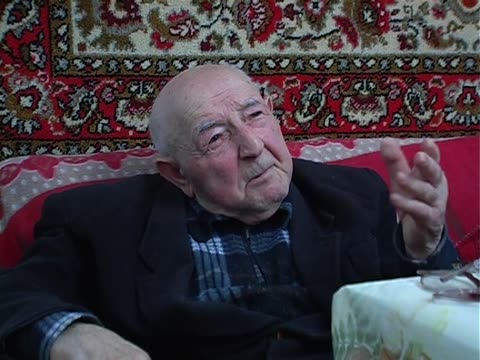
The camera cuts to the next formal interview with Kogan. The team greets Kogan, before setting up the interview. Then the formal interview begins and Kogan recites one of his Yiddish poems about the Bershad ghetto experience and survival.
From the machine transcript
Cut to the interview with Kogan. After greetings he prepares to read a text he has written. He recites a poem about the camp and ghetto during the German occupation, calling for survivors to remember and for peace, and ends with greetings in Hebrew.
Kogan's wife talks about her life during the war, when she was imprisoned in the Zhabokrych ghetto. Kogan briefly addresses postwar Jewish life in the region.
From the machine transcript
Kogan's wife says she was in Zhabokrych. Kogan and Kerler talk about his being from Bershad', the surviving Jewish institutions there, and what he saw there during the occupation.
Kogan talks about his life during World War II, when he was imprisoned in the Bershad ghetto. He shares an episode about daily food acquisition, while he encountered Ukrainian police. Kogan then addresses mass killings in the region, before he talks about his brother's fate during the war.
From the machine transcript
Kogan recalls the Bershad' ghetto, an episode with police guarding a bridge near a monastery while he was getting food, and Bukovinian, Bessarabian and Hungarian Jews there. He speaks of the mass killing of Jews, including the shoykhet Gedalye, at the Komuna Voroshilov kolkhoz pit, and of the fate of that man's family. The visitors then take their leave.
Adds the killing pit near Komuna Voroshilov and Gedalye the shoykhet.
Kogan speaks about life today and relations to non-Jews. He then briefly talks about his wife's fate in the Zhabokrych ghetto. Kogan then addresses his and his family's life in the Bershad ghetto. He also remembers Jewish refugees from other areas.
From the machine transcript
Kogan talks about relations with non-Jews, mass killings by the Romanians in Bershad', and a woman's fate in the ghetto (the transcript does not make clear whether it is his wife's). He mentions Jews from Bukovina and his love of Yiddish, and says he wrote in Yiddish and finished seven grades in a Jewish school.
Kogan talks about his school education before the war, including teachers. He studied at the Yiddish school for seven years.
From the machine transcript
Kogan talks about his Yiddish school in Bershad' before the war: subjects such as Yiddish, Ukrainian, Russian and German, arithmetic and grammar taught in Yiddish. He names teachers and the school director and says the schools were later closed.
Adds the teachers' names and subjects, and the later closing of the schools.
Kogan talks about his life in the Bershad ghetto under Romanian occupation. In particular, he remembers the market and (Jewish) policemen gatheringJews for forced labor. Kogan continues that he, as well as Romanian and Bessarabian Jews, were taken for forced labor to Pishchanka. He then describes his escape from Pishchanka back to Bershad. On the way, Kogan carries on, he heard rumors about a forced labor transport to Mykolayiv and thus hid in a chimney.
From the machine transcript
Kogan talks about the arrival of the Romanians and the Bershad' ghetto. He speaks of the market kept by refugee Jews from Bukovina and Bessarabia, and of Jewish police and roundups. He was taken for forced labor at Pishchanka, where his legs swelled, escaped back to Bershad', and hid in a chimney when transports to Mykolayiv were rumored.
Kogan was born in 1927 (?); the catalogue does not mention the dates of the occupation.
Kogan speaks about his liberation from the Bershad ghetto and military draft. He served in the Red Army for seven years. Kogan also describes his experiences when marching toward Berlin via Wrocław, Poland, as well as during the liberation of Berlin. He then returns to his life in the Bershad ghetto under German and Romanian occupation, including forced labor, escape and hiding.
From the machine transcript
Kogan tells of being drafted when the Red Army returned and serving seven years, reaching Berlin, where he wrote his name on the Reichstag wall. He also recalls Wrocław, a factory where many people died from drink, then returns to the ghetto, with its boundaries and the Jewish street, forced labor at Pishchanka, escape and hiding in a chimney.
Kogan talks about his family, especially his father's family in America and his mother's work as candy-maker.
From the machine transcript
Kogan talks about his parents. His father Avrom, called 'of the soap', had been in America and died in the early 1930s (?) in the famine; his mother Gitl, his father's second wife, made candy and died in 1964 (?). He also says that Bershad' was a place of great importance, and Kerler suggests he write a book.
Gives the years of the parents' deaths and that the father's first family lived in America.
Kogan speaks about the Jewish life and individuals in the Zhabokrych and Bershad ghettos. He then recites snippets of his Yiddish songs "Dos lagerl" and "Aheym, briderlekh, aheym."
From the machine transcript
Kogan speaks about Zhabokrych and Bershad' during the war, including killings in Zhabokrych and the Romanian occupation. He names local Jews such as the shoykhet Gedalye Shulman (?) and the hearse-driver Avrom'tse (?) and his wife, with Kerler asking who they were. He then recites parts of his songs 'Dos lagerl' and 'Aheym, briderlekh, aheym'.
Adds the identification of Gedalye the shoykhet and Avrom'tse who carried the dead.
Kogan reads his Yiddish song "Aheym, briderlekh, aheym." He then shares an episode about collecting money in the Bershad ghetto to support partisan activities. Kogan also mentions that the community transferred the dead from a massgrave on the former kolkhoz komuna vorushilov (коммуна ворушилов) near Bershad to the Jewish cemetery, immediately after the ghetto's liberation by the Red Army. According to Kogan, one German helped.
From the machine transcript
Kogan recites his song 'Aheym, briderlekh, aheym', which he says was written after the war. He tells of collecting money in the Bershad' ghetto for the partisans, with the donors' names put into a bottle and later demanded by the prosecutor. He recalls the dead being moved from the pit at Komuna Voroshilov to the Jewish cemetery after the liberation, with Kerler asking about a memorial and the date.
Adds that Kerler asks about a memorial at the killing site.
Kogan speaks about his life in the Bershad ghetto. He recalls prayer services in private homes during the war and in the synagogue after the war. Kogan then mentions wealthy refugees from the Bessarabian and Bukovina regions in the ghetto. Kogan then addresses his military service from 1944 to 1951, including fighting on the front for two months.
From the machine transcript
Kogan explains that in the Bershad' ghetto Jews prayed in private houses because the synagogue was closed and people feared reprisals, and that he went to the synagogue on the High Holidays after the war. He mentions well-off refugees from Bukovina, Bessarabia and Hungary, then says he was drafted in 1944, spent two months at the front and reached Berlin. Kerler and the second voice discuss a small booklet of his that was lent out and photographs from Berlin.
The catalogue sentence omits the discussion of a lent-out booklet with photographs.
Kogan speaks about his writings. He then recites his Yiddish song "Dos lagerl."
From the machine transcript
Kogan says he wrote songs in the ghetto and hid them from others. He begins reciting the text of his song about the camp near Obodivka, but the passage is broken by a recogniser loop. Talk with the second voice about a visitor and an operation follows, and Kerler asks him to sing both songs again for the record.
The passage also contains a side conversation about a visitor and an operation, and Kerler's request to repeat the songs.
Kogan sings his Yiddish song "Dos lagerl."
From the machine transcript
Kogan sings his ghetto song about the camp near Obodivka and Bershad', about Jews, kapores and the Bershad' cemetery. He then says he wrote only part of another song and starts a further one, with Kerler and the second voice prompting.
Kogan sings his Yiddish songs "Tsezeyt un tseshpreyt" and "Aheym, briderlekh, aheym." He then addresses the community's reception of his songs.
From the machine transcript
Kogan sings a song about Jews driven in the ghetto, including refugees from Bukovina, Bessarabia and Hungary, then "Aheym, briderlekh, aheym", a song of Jewish homecoming. He says he wrote the songs himself in the ghetto and kept them hidden. He recalls the reaction of listeners, a suit brought to him by refugees from Bukovina, and a request to send his songs to Israel. Kerler then asks how he came to be called into the army after liberation.
Kogan speaks about his military draft, after the Bershad ghetto liberation by the Red Army. He fought in the 2nd Ukrainian Front ("Steppe Front"). After the war, Kogan states, he was hired as chauffeur. Kogan then mentions his military awards.
From the machine transcript
Kogan talks about his draft after the Red Army liberated Bershad', and a train journey to Rzhev. He describes receiving British and American vehicles in 1944 and says he served on Rokossovsky's front for two months. He also mentions many medals and a driver's work after the war.
The transcript centres on Kogan's journey to Rzhev, receiving Allied vehicles and being on Rokossovsky's front; the catalogue says he was hired as a chauffeur after the war.
Kogan talks about his life after the war. He lived in Zhabokrych and Obodivka, where he worked in a procurement office. Kogan moved from Obodivka to Tulchyn in 1960. He then mentions how he met his wife.
From the machine transcript
Asked why he did not return to Bershad', Kogan talks about his life after the war, work in a trade and his move to Tul'chyn around 1960 (?). He says he met his wife in Obodivka, where she worked, and Kerler asks about speaking Yiddish after the war.
The passage also covers Kerler's question about speaking Yiddish after the war.
Kogan speaks about his military service and fellow Jewish soldiers, before talking about his positions after the war. Kogan also mentions a fire at his mother's house after the war, which destroyed his notebooks. Kogan returns to talking about how he met his wife and life after the war.
From the machine transcript
Kogan says he met four or five Jewish soldiers in the army but they spoke Russian, and recalls Marshal Rokossovsky's awards. After demobilization he spoke Yiddish at home with his mother and brother, and Russian at work. He recalls a fire at his mother's house that burned his notebooks, says he met his wife in Obodivka, where he worked on registering meat and milk, and mentions his move to Tul'chyn.
The transcript adds the question of which languages he used in the army and later at home and at work.
Kogan discusses the concept of Jewish identity, as well as shares an episode about postwar antisemitism. They then chat about life today.
From the machine transcript
Kerler asks what it means to be a Jew, and Kogan answers by thanking God for surviving the war. He tells of a postwar antisemitic incident, apparently involving a Ukrainian and a shot in a cornfield, and of an encounter in Tul'chyn with a non-Jewish colleague. Much of this passage is partly in Russian. The talk then turns to Kerler's printed copy of Kogan's songs, an article Kerler plans to write, thanks, good wishes for the future, and a gift of Hanukkah money.
The passage also covers Kerler's printed copy of the songs, the planned article and the Hanukkah gift.