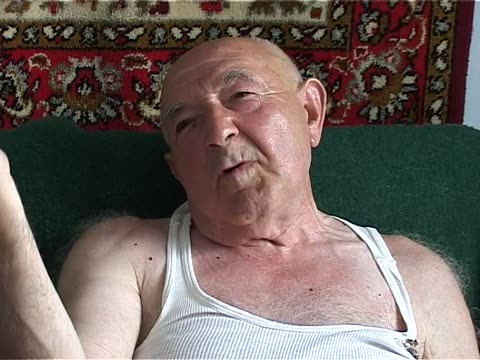
The formal interview with Iosif Abramovich Kogan begins. He provides personal information.
From the machine transcript
Kogan's formal interview begins. He gives his name as Iosif Abramovich Kogan and says he was born in Bershad. Kerler states the date of the interview, 14 July, and Kogan gives his address in Tul'chyn.
Kogan provides personal information and discusses his family. His father passed away during the Great Hunger in 1933. Kogan's father was also born in Bershad and was a soap-maker. His mother was also born in Bershad and was a candy-maker. Kogan moved to Tulchyn from Zhabokrych in 1960. Kogan lists the kind of candy his mother would make.
From the machine transcript
Kogan gives his Yiddish name as Yosl and his birth as 12 August 1927 in Bershad. He lived there until the war. His parents were both from Bershad. His father was a soap-maker who died of hunger. His mother, Gitl, was a candy-maker whose sweets he describes, and she died in the 1960s. He moved to Tul'chyn in 1960 and has lived there about thirty years (the figure is unclear).
The transcript gives Kogan's Yiddish name, his mother's name Gitl and the candies she made, and her death in the 1960s.
Kogan speaks about his siblings. He grew up with a half-brother and a sister.
From the machine transcript
Kogan talks about his siblings. His half-brother Peyshe was from his mother's other husband and went to Iași. His mother had two husbands, and Kogan is from the second, Avrom.
Kogan addresses prewar Jewish life in Bershad, including Jewish and non-Jewish relations. Kogan also recalls non-Jews who spoke Yiddish. He then talks about the local Yiddish school in Bershad. According to him, non-Jews also attended the school. Kogan then addresses his school education.
From the machine transcript
Kogan introduces Bershad' as a Jewish town. He recalls non-Jewish locals who spoke Yiddish better than he did and names some friends. He then talks about the Yiddish school there, where Yiddish itself was not taught, and about the subjects he studied and the languages he knows.
Kogan gives the school curriculum, and Kerler asks for names of Yiddish-speaking non-Jews.
Kogan talks about Jewish life in Bershad during World War II and recalls refugees arriving in the ghetto. Kogan was imprisoned in the Bershad and Pishchanka ghettos. He describes the journey from Bershad to Pishchanka, as well as the living conditions in the Pishchanka ghetto.
From the machine transcript
Kogan recalls being driven from Bershad' to Pishchanka on foot during the war and a night's walk there. He describes the hunger in the Pishchanka ghetto and sleeping on cement floors. Kerler's questions appear briefly, and the transcript is partly unclear.
Refugees from Bukovina are mentioned in passing.
Kogan speaks about his life during the war, particularly the escape from the Pishchanka ghetto and return to Bershad in fall 1943. Kogan describes the period, when he hid in a chimney at a neighbor's house.
From the machine transcript
Kogan recounts escaping from Pishchanka and returning to Bershad', where his mother was still alive. He hid in a chimney and then in a non-Jew's attic for about a week. He mentions being drafted at seventeen and spending two months at the front, reaching Berlin. The year is given as 1944, with Kerler adding the month.
Kogan also mentions the Romanian guards and being drafted at seventeen.
Kogan speaks about his life during the war, when he served in the Red Army and fought at the front for two months. He was drafted at the age of seventeen. Kogan then speaks about his experiences in Berlin in 1945, before he discusses socio-political terminology.
From the machine transcript
Kogan tells an episode of his time in Berlin. He then answers Kerler on why one should say peasants rather than a word for a non-Jew, and on the Russian word for a Jew. He talks about antisemitism, and an anecdote set in Tashkent.
Kogan speaks about his wife's experiences during the war. She was born in Zhabokrych and imprisoned in the Zhabokrych ghetto. According to Kogan, only three people survived the massacre in Zhabokrych. Kogan also speaks about their life today.
From the machine transcript
Kogan speaks about his wife, who was born in Zhabokrych. He describes the massacre of the town's Jews and how only a few people survived by hiding in a cellar and an attic. Kerler asks for the town's name and district and about children, and Kogan answers that he has none.
Kogan also says he and his wife have no children.
Kogan talks about the daily life in the Bershad ghetto and addresses the fate of refugees. He then speaks about postwar religious life in Bershad, before addressing prewar Passover celebrations.
From the machine transcript
Kogan describes conditions for refugees from Bukovina and Bessarabia in the Bershad' ghetto. He recalls going to the synagogue under Soviet rule and saying Kaddish for his father. Kerler asks about prayer houses, and Kogan recalls Passover observance in private homes before the war.
Kogan talks about postwar Jewish life, after his return to Bershad. He recalls how the community gave secret donations to keep the synagogue open. Kogan then addresses his life in Tulchyn, where he worked in a procurement office.
From the machine transcript
Answering Kerler about Bershad' after the war, Kogan recalls Jews gathering and paying money to keep the synagogue going under Soviet rule. He says he came from Zhabokrych to Tul'chyn around 1960. He worked in a procurement office, and he also recalls saying Kaddish for his father.
Kogan describes his work in a procurement office.
Kogan talks about his life and religious customs in Bershad before the war. According to Kogan, there were three synagogues. He then addresses Passover celebrations at home, as well as his family.
From the machine transcript
Kogan recalls that a man taught him to say Kaddish after his father died in 1933 and that there were three synagogues in prewar Bershad'. He describes who prayed in the study house and how Passover seders were held in private homes. Not every family kept Passover. S2 asks about Passover observance, Kerler asks about the four questions, and Kogan says he no longer remembers them.
Kogan names the three prewar synagogues and discusses Passover observance.
Kogan talks about his time in the Red Army and mentions fellow Jews. He then addresses his Yiddish songs, which he wrote during the German occupation.
From the machine transcript
Kerler asks whether Kogan remembers Chad gadya and asks about the songs he wrote. Kogan says he wrote many Yiddish songs, including during the occupation, and talks about the ghetto and the camp as their subject. He also speaks of his parents and his Red Army service, and mentions a Hanukkah song written by someone else.
Kogan names his own songs, with the ghetto and camp, as the subject of what he wrote.
Kogan recites the Yiddish song "Chanike" (Hanukkah), written by Ester Ostrovksy.
From the machine transcript
Kogan recites the Yiddish Hanukkah song, which he says was written by a woman named Ester Ostrovsky who later emigrated to Israel. He then begins a song of his own about the front and Jewish hopes.
Kogan recites his Yiddish song about the Jewish fate and hopes during the war.
From the machine transcript
Kogan continues reciting his Yiddish song expressing the Jews' hope for deliverance, the rest being poorly captured. Kerler then says he has only a few short questions left.
Kogan answers dialectological questions from the AHEYM Yiddish linguistic questionnaire. He then talks about his life today.
From the machine transcript
Kerler puts questionnaire items to Kogan, who gives words for "face" and the Hebrew term tsere, and for "probably", "back" and "also". Kogan answers partly with Russian equivalents, and Kerler asks him to sing further songs. Kogan then speaks about his health and a fall that injured his hand.
The segment also includes Kogan's account of his health and an injury.
Kogan sings his Yiddish song "Aheym briderlekh aheym" (homeward, brother, homeward).
From the machine transcript
Kogan sings his Yiddish song "Aheym, briderlekh, aheym", about Jews returning to their homeland and the hope that all Jews will be freed. He then says he will sing another song about the camp.
Kogan sings his Yiddish song "Dos lagerl" (the camp), which he tailored to the Bershad ghetto experience.
From the machine transcript
Kogan explains that he composed his song about the camp to a tune known from Bershad' after the Pechora camp. He sings it, with its refrain and its verses about the town and the Bershad' cemetery.
Kogan sings again "Dos lagerl."
From the machine transcript
Kogan sings or recites the song about the camp near Bershad, with its refrain about Jews fasting and the Sabbath-eve atonement chicken. Kerler asks to record it again later. Kogan chats briefly with the interviewers about the notebook he reads from, then starts reciting another song, "Aheym, briderlekh, aheym."
Kogan sings again his song "Aheym, briderlekh, aheym." He then explains how he wrote this song.
From the machine transcript
Kogan sings "Aheym, briderlekh, aheym," a song about the Jewish people's return and eventual liberation. He then says that he wrote the songs during the occupation, fearing he would be arrested or killed. He mentions being sent to a place whose name is unclear in the transcript (Pishtyanka?) and then begins to read another song.
Kogan also says when and why he wrote the songs, in the occupation and in fear of arrest.
Kogan recites the words for his Yiddish song "Tsezeyt un tseshpreyt" (scattered and dispersed) about his Bershad ghetto experience upon the arrival of refugees.
From the machine transcript
Kogan recites his song "Tsezeyt un tseshpreyt," about Jewish refugees from Bukovina and Bessarabia arriving in the Bershad ghetto. They arrive hungry and cold, with bundles and small children, and the song hopes for liberation. He then starts to introduce a poem he took from a Jewish writer whose name he cannot recall.
Kogan recites "Zog Nit Keyn Mol" (never say never), written by Hirsh Glick.
From the machine transcript
Kogan recites the partisan song "Zog nit keyn mol," and with Kerler's help tries to recall who wrote it. Kerler says he wants to hear Kogan's own songs. Kogan starts the Bershad camp song again.
Kogan sings again "Dos lagerl."
From the machine transcript
Kogan sings the whole camp song again. The verses are about Jews in the camp, the shoykhet Gedalye at the gate, the Bershad cemetery and the refrain about atonement chickens. He then starts "Aheym, briderlekh, aheym."
Kogan sings again "Aheym, briderlekh, aheym," before he sings again "tsezeyt un tseshpreyt."
From the machine transcript
Kogan sings "Aheym, briderlekh, aheym" again and, answering Kerler, says that he wrote it in 1942 (?). He then sings the first lines of "Tsezeyt un tseshpreyt," about the ghetto and the fence around the town.
Kogan gives the year of composition.
Kogan briefly talks about his life after the war, as well as his education at a Yiddish school in Bershad. Kogan enjoyed six years of Yiddish education. He also recalls his teachers and lists Yiddish writers.
From the machine transcript
Kerler asks whether Kogan wrote songs after the war. Kogan says he spent seven years in the army and stopped writing. He then discusses his Yiddish schooling in Bershad, six years of Yiddish before Ukrainian, Russian and German in the seventh. He names two teachers, one of them Soprun (?), recalls Soviet-era Yiddish literature and grammar, and lists Mendele, Sholem Aleichem and others, with translations from Ukrainian authors.
Covers his army years and the Yiddish literature he read and the translations from Ukrainian.
Kogan speaks about prewar Jewish life in Bershad, including locals. He then briefly addresses prewar holiday celebration at home, as well as his family. Kogan's father visited America before World War I. He grew up with one brother, who lives in America and two sisters.
From the machine transcript
Kerler asks about Bershad figures such as a shoykhet and cantor who was killed, and Kogan describes a prayer house that still exists and fear of the militia when baking matzo after the war. He says his father had been in America and returned. A brother (younger) lives in Indianapolis, where Kerler also lives, and he had two sisters who died. The conversation turns to Kogan's contact with his brother, his brother's illness and whether Kerler can carry greetings or a photograph.
Adds the shoykhet and cantor and the prayer house, plus the brother in Indianapolis and the two sisters.
Kogan answers dialectological questions from the AHEYM Yiddish linguistic questionnaire.
From the machine transcript
Kerler puts the dialectological questionnaire to Kogan. The items include the verb forms of a sentence, words for a cross, a baptized Jew, luck and fortune, and a headache. They also cover cold, matzo, 'make' and 'do', 'ask' and 'bed', adverbs such as 'also' and 'again', and body words such as breath, belly and ear. Further items are an idiom for an empty market, 'head' and 'deaf', with some Russian prompts. At the end Kogan returns to family talk about his brother in America.
Kogan talks about his family, before he answers questions about cultural terminology, as well as dialectological questions.
From the machine transcript
Kogan continues talking about his brother in Canada and a niece, and the difficulty of finding him. Kerler returns to the questionnaire: the word golem, and words for quickly, later, near and 'come here', with Kogan giving adverbs and phrases.
The catalogue entry mentions family and terminology, but the transcript shows family talk first and then dialect items such as 'quickly', 'later' and 'near'.