People › Rabbi Shloyme Wilgelm › conversation

Rabbi Shloyme Wilgelm

Zhytomyr 23 May 2003 Interviewed by Dov-Ber Kerler, Dovid Katz 56 min · 1 part on 1 tape uncertain
Loading the player…
  1. MDV 794 0:00–56:24 · 56 min · not online — MCO
Passages

0:00

Prewar life.

before the war Daily life (general) MDV 794 · MCO
From the machine transcript

A story of forgetfulness (misplaced items) told in the first person, then a comparison of how words for 'brain' and 'hand' were said in Pyatka and in Zhytomyr. The speaker's identity is unclear in the transcript.

The transcript shows a story about memory and a Pyatka versus Zhytomyr word comparison rather than prewar life.

2:28

Rabbi Shloyme Wilgelm joins.

Informal MDV 794 · MCO
From the machine transcript

Rabbi Wilgelm joins. Conversation about a large Jewish cemetery in a town (possibly Polonne, unclear), where old gravestones were removed by the Communists and the original ones remain inside. There is also talk of a planned trip to Pyatka after Shavuot and of a learned rabbi; much of the speech is garbled.

The transcript adds the cemetery discussion, a planned trip to Pyatka and talk about a rabbi.

7:06

Dialectology.

From the machine transcript

Dialectological questions about how words were said in Pyatka. They cover greetings by time of day, meal names (breakfast), body and animal words (belly, mouse, pigeon), 'woman', 'wife', 'luck', pepper, window glass, groats, and the words for 'house' and 'room'.

14:51

History of Zhytomyr synagogue.

From the machine transcript

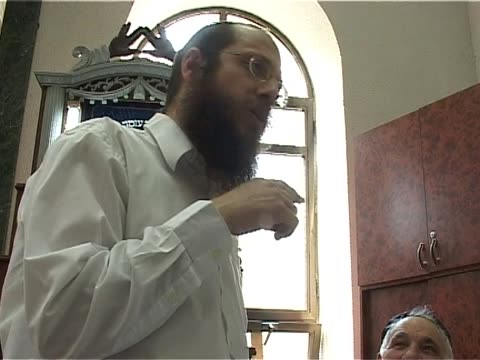
A short account of the history of the renovated Zhytomyr synagogue. It was built about 130 years ago on a street with other synagogues and was used by traders. It was open until 1941, when the Germans used it as a warehouse, and was handed back to the community in the early 1990s. During repairs, prayer books and the names of women were found hidden in the walls. The speaker describes today's community, with a daily minyan, a school and an orphanage. Informal talk follows about the cantor Krinsky, hearing the Megillah on Purim, and Lithuanian versus Hasidic towns in the region (Rovno, Lutsk, Slavuta, Yampol).

The transcript adds talk about Krinsky, Purim in a theater, and Hasidic versus Lithuanian towns.
22:55

Discussion with Chane Gitl Stipanskaya and Zhenia Koyfman.

Informal MDV 794 · MCO
From the machine transcript

Introductions and conversation with Chane Gitl and Zhenia Koyfman. Koyfman was born in Chernyakhiv, a shtetl about 30 km from Zhytomyr; her father was from Zhytomyr and her parents were bookkeepers. She says her parents told of a large synagogue that later became a theater and cinema. She recalls holiday gatherings in homes, matzo baked secretly behind closed doors, a Yiddish school in Chernyakhiv, and her family, in which two of six siblings survived (?).

The transcript also shows Koyfman's family and occupations, secret matzo baking and the Yiddish school.

31:27

Holiday celebration and Yiddish skills.

From the machine transcript

Koyfman talks about Yiddish and Jewish life in Chernyakhiv. Few children there spoke Yiddish, there were no Yiddish or Hebrew books, and her parents did not teach her. She remembers a park where old Jews spoke Yiddish, and says only about twenty elderly Jews live there now.

The passage covers her own Yiddish, the lack of books, the town park and the small Jewish population today.

35:02

Jewish life in Zhytomyr after war.

after the war Local Jewish history MDV 794 · MCO
From the machine transcript

Interview with Tsipe Partnaya (née Kamenir), who has lived in Zhytomyr since 1962. She recalls her grandmother's religious household, a small synagogue and a shoykhet, and her grandfather the shoemaker, who sang songs. She also says her daughter knows Yiddish and that the area was called the 'Jewish district'.

40:10

Jewish cultural life.

From the machine transcript

Partnaya answers questions about Jewish cultural life, such as visits to Zhytomyr by singers and actors from America and Moscow and a theater performance she recalls. She also recalls her grandmother's Soviet Yiddish school, three classes.

41:42

Rabbi Wilgelm discusses geography.

From the machine transcript

Discussion of plans for a children's home and a Jewish 'town', which needs a name and about three million dollars. A second woman from Zvil, now Novohrad-Volyns'kyi, is then introduced. Her parents spoke Yiddish at home, and the interviewer explains that the team is collecting material on Yiddish.

The transcript shows talk of a planned children's home and town, and the introduction of Chane Gitl's sister from Zvil.

46:52

Food customs and dialectology.

From the machine transcript

Food customs and dialectological questions with the woman from Zvil. They cover the word for potato, her grandmother's honey cake used with the kiddush wine, gefilte fish and its sweetness, and Passover dishes made from matzo meal. Word questions follow: grandmother (bobeshke), a ladder, and a thing the transcript renders as tsulem (unclear).

50:14

Shraibman joins the conversation.

Informal MDV 794 · MCO
From the machine transcript

Brief remarks about the word for 'ladder', then Geller (probably) gives the history of his hometown's names. It was first Kotozov or Kutuzov, was later named Volodarsk-Volynskyi after a Jewish Bolshevik killed soon after the revolution, and stood next to the former Jewish shtetl Pulin.

The passage is about the history of Geller's hometown names, not Shraibman.

53:19

Brief chat in Russian.

Informal MDV 794 · MCO
From the machine transcript

Mostly Russian conversation outside, about the state of Jewish cemeteries, documentation of cemeteries and mass-shooting sites, and a church being built on a cemetery. It also covers a speaker's name (Sergey, Baruch in Hebrew), a hotel, and farewells in Yiddish. The Yiddish lines are largely garbled.

Questions put in this conversation

Items of the dialect questionnaire asked here; each link plays the moment.