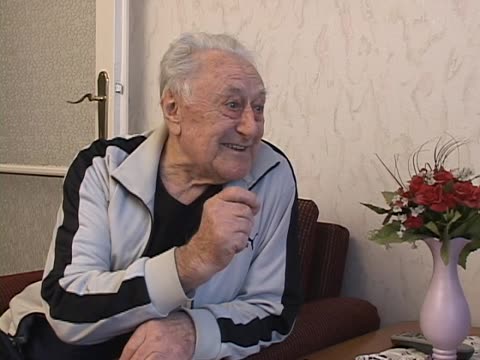
Smajovics provides personal information and addresses his childhood in Vynohradiv (Yiddish: Selish). He attended religious school (cheder) and primary school there.
From the machine transcript
After the opening, Smajovics gives his Yiddish name. He says that Vynohradiv was called Selish in Yiddish, with a different name among non-Jews and a Russian name. He recalls his childhood: he went to cheder and school in the town but lived in a nearby village, Velyka Kopanya (Groys Kopanye), eleven kilometres away.
Gives the village name and distance from town, and the name forms used by Jews, non-Jews and in Russian.
Smajovics addresses prewar Jewish life in his hometown Velyka Kopanya (Groys Kopanye). There were about 60 Jewish families there ("zekhtsik talaysim"). In particular, he addresses the differences between Ashkenazi and Sephardic (= Hasidic) communities.
From the machine transcript
Smajovics describes Jewish life in the village before the war, with its Ashkenazi synagogue and a smaller Sephardic (Hasidic) prayer house. He explains how the two groups differed, including strictness about prayer customs and dress such as the fur hat (shtraymel). He notes that Sephardim predominated further up in the mountains.
Gives the percentages of Ashkenazim and Sephardim in nearby villages and a mention of a dayan; the number of families is not clearly heard.
Smajovics shares an episode from Jewish life during the Hungarian occupation in 1939. He then returns to prewar Jewish life in his hometown and describes arguments regarding Ashkenazi or Sephardic teaching style in cheder. Smajovics then speaks about his life and education before the war, after his father was killed by his own horses. He also speaks about his family. He grew up with seven siblings. Smajovics' brother made aliyah after the war. His father was also born in Velyka Kopanya and his mother's family moved to Velyka Kopanya during her childhood. Smajovics recalls his grandmother's hospitality to strangers.
From the machine transcript
Smajovics recalls conflict in the cheder over Ashkenazi versus Sephardic ways, and starting cheder at four. His father, a carter, was killed by his own horses, leaving the mother with small children. He names his brother, who later emigrated to Israel. He speaks about his grandparents, including his grandfather who had been an officer in the Hungarian army, and his grandmother, who gave overnight lodging to poor travelers. He also tells a story about a bearded man. The family had eight children.
Gives the Italy front for the grandfather and names grandparents; the opening anecdote about a Hungarian doctor is not clear.
Smajovics speaks about his life during World War II. He was sent to a Hungarian forced work camp ("Munka Tabor") within the labor battalion of the Hungarian army, where he reunited with this brother in 1942. Smajovics worked in his profession as blacksmith. He then addresses the reunion with his brother in Israel in 1982, as well as speaks about his family in America and Israel. Smajovics then speaks about his visit to Israel and meeting his family.
From the machine transcript
Smajovics recounts being in a Hungarian forced labor battalion and meeting his brother there, working as a blacksmith. He describes the long separation from his brother and the trip to Israel in 1982 after retirement. He tells of the reunion at the airport, a newspaper reporter, visits to relatives and trips around the country. His nephew fought in the Yom Kippur war. At the end Kerler asks him to list his siblings and their names.
Adds the sibling names Kerler asks for and the fighting in the Yom Kippur war.
Smajovics talks about his prewar education in Vynohradiv. He attended cheder at four and Czech primary school at six. He then describes his daily school routine. After his bar mitzvah, he explains, he switched to small yeshiva, which was initiated by his grandfather. Smajovics studied there until the age of sixteen.
From the machine transcript
Smajovics describes his early schooling: cheder from age four, Czech primary school from six, and a long day of prayer and study starting before dawn. After his bar mitzvah his grandfather placed him in a higher cheder, which he calls a small yeshiva, until the age of sixteen. He distinguishes the talmud torah as a school for children who could not pay.
Names a bar mitzvah meal and the contrast between talmud torah and small yeshiva.
Smajovics speaks about his life shortly before the outbreak of World War II. He did a blacksmith apprenticeship and then worked as locksmith in his hometown until 1942. He then speaks about the beginning of World War II and recalls Polish refugees requesting repairs for their wagons. Smajovics also mentions that he studied at a professional school, where he learned Hungarian poems.
From the machine transcript
Smajovics speaks about the Hungarian takeover of 1939. He left the cheder to apprentice as a smith and repaired wagons for Polish refugees who passed through the village. He attended a trade school with Hungarian instruction. Kerler asks about the Hungarian poem he learned there, and Smajovics tries to recite it and has trouble recalling it. He ends by saying he worked for a master in the village, paid by the day, and came to Budapest in 1942.
Adds the Polish refugees, the trade school and the Hungarian verse Kerler asks about.
Smajovics speaks about his life during the war. He moved to Budapest in 1942 and worked as carpenter, putting in windows. Smajovics explains that he had to return home due to an injury in mid-1943 and after his return, he was deported to Vác. In Vác, Smajovics stayed for three weeks, where he was allotted a forced labor group. Smajovics continues that he worked in oat production.
From the machine transcript
Smajovics tells of his move to Budapest in 1942 and of work in a carpentry or window-making shop paid by the hour. He went home in mid-1943 to prepare winter wood and was then called up to a labor service group with about two hundred men, in which he worked as a smith, tending horses among other tasks. He recalls praying secretly and being nicknamed "the little Russian" or "little partisan" because he was from the Carpathians. Kerler then asks about the languages of his childhood: Yiddish, Ukrainian and Czech, with only Yiddish at home.
Includes the horse-shoeing and nickname episode and the questions about childhood languages.
Smajovics talks about his life before the war and mentions languages spoken at home. He then continues to speak about his life during the war. Smajovics was sent from Vác to the Esztergom forced labor camp. He then describes the living conditions in the camp, where he stayed until the German invasion in March 1944. Smajovics continues that the camp prisoners were led to the local synagogue, where Passover service took place. Under the Germans, Smajovics worked as locksmith in Esztergom and then Budapest. The prisoners were then sent further, he explains, to Ercsi to work at a sugar factory. Smajovics continued to work in his profession as blacksmith. He then addresses fightings between the Red Army and Germans, during which the prisoners were sent to a farmstead in the direction of Budapest.
From the machine transcript
Smajovics mentions the languages spoken in his village, including non-Jews who knew Yiddish, and a gentile who had grown up among Jews. He then describes the labor camp he was sent to, with barracks for 220 men, and the arrival of the Germans in March 1944. He was taken to Esztergom for Passover to a synagogue, and worked as a locksmith for the Germans, who treated the workers well. He tells of being moved to Budapest and then to Ercsi (sugar factory) in 1944, and of the front, the Russian advance and a Hungarian officer. The group was taken to an estate on the way to Budapest.
Begins with talk of Yiddish-speaking non-Jews and languages at home.
Smajovics speaks about his liberation by the Red Army and encounters with Jewish soldiers. Smajovics returned home approximately two weeks later. He then speaks about his return and living conditions in 1944. Smajovics worked at a mill. Smajovics then speaks about the return of his family.
From the machine transcript
Smajovics describes meeting Red Army soldiers, among them Jewish officers who spoke to him in Yiddish and Russian. He helped carry ammunition and saw many dead Germans. About two weeks later he made his way home; in his village he found his house without windows or doors and only four Jews returned. Kerler asks about a mill and the return of the family; Smajovics mentions his sister coming back and his grandfather's house.
Adds the encounter with Jewish soldiers and officers who spoke Yiddish, and the sister's return.
Smajovics speaks about his life after the war. He established his own workshop and was married in 1946. Smajovics he raised two daughters. In the 1950s, Smajovics moved to Vynohradiv and worked as locksmith and clerk in a warehouse. He also mentions that he was imprisoned in Uzhhorod for two and half years.
From the machine transcript
Smajovics recounts his life after the war: he set up his own workshop and married in 1946, and a child was born. Around 1950 he moved to the town as the Jews left the villages and worked in a warehouse, bought a house and had two daughters. He tells of being arrested over a case of bribes and timber shipments, of the investigation and of a sentence of about two and a half years, of which he served roughly seven months. The details of the prison place and the sums are unclear in the transcript.
Adds the corruption case behind the arrest and the length of time actually served.
Smajovics speaks about his life after the war, when he was released from prison. He worked as the head of a mechanic team for cars in Vynohradiv.
From the machine transcript
Smajovics describes his work after release from prison. He obtained a certificate and found work at a motor transport depot, first as a fitter and then as head of a mechanics' column for vehicles in Vynohradiv. He talks about the pressures of the job, such as giving money to workers and the demands of the production plan.
Smajovics speaks about his life and work after the war. He also worked as chauffeur. He then speaks about daily life in in the 1960s and mentions opportunities to make extra money. Smajovics moved to Budapest in 1978.
From the machine transcript
Smajovics recounts his postwar working life as a driver. He worked on a Moskvich car for a director and for a regional consumer union, and moved between jobs and workplaces. He describes earning extra money on the side by writing up meat deliveries and by dealing with a restaurant and a warehouse. He is then asked when he came to Budapest, and the answer is cut off.
Details the meat-trade side income and the Moskvich cars, not only Budapest.
Smajovics talks about contemporary life in Velyka Kopanya, as well as contemporary Jewish life in Vynohradiv. He then answers questions about cultural terminology.
From the machine transcript
Smajovics talks about visits to his home area after the war and about the Jewish cemeteries in Sevlush, one in the town and another outside it. A few Jews remain there. Kerler then asks him for Yiddish words for a Jewish cemetery, a church, a synagogue, a golem, a dybbuk and a good Jew, and Smajovics gives the terms and explanations. Kerler also asks about pouring a glass of water.
The cultural terminology part is a series of questions on terms such as golem and dybbuk.
Smajovics talks about the small yeshiva, he attended before the war. He mentions the teaching schedule and praying customs.
From the machine transcript
Smajovics talks about the small yeshiva, or cheder, he attended before the war. He recalls studying Gemara, Mishnah and the Targum with a bochur teacher, learning prayers and blessings by heart, and the blessing over the new moon. Kerler asks whether the prayers were explained to them, and what tractates they studied.
Names the Gemara and Mishnah texts studied and the blessing customs.
Smajovics addresses food customs for Hanukkah and Purim celebrations at home.
From the machine transcript
Smajovics answers questions about Hanukkah and Purim food. He says fried doughnuts were not a Hanukkah custom at home, though his mother baked at home, and he first met them on arrival in Israel in the 1980s. He talks about latkes and Passover foods. For Purim he describes baked shalakhmones sent to the poor and acquaintances, and children's pastries. He mentions a man named Leizerovich, born in Erdőd (?) in Transylvania, who still lives in Budapest.
Also covers latkes, pancake terms and a man named Leizerovich in Budapest.
Smajovics remembers Purim shpiels and explains how older girls dressed up as gypsies and performed Purim shpiels. He then speaks about Jewish life after the war.
From the machine transcript
Smajovics recalls how a Purim shpil was said when shalakhmones were delivered, performed at homes by children. Older girls dressed up as gypsies and went from house to house collecting money. He then speaks about the Jewish old people's home in Budapest where he sometimes sings Yiddish songs. Kerler asks where he learned his songs, and he says before the war.
Adds the old people's home in Budapest and the question of where he learned his songs.
Smajovics sings a couple of Yiddish love songs. The first one deals with a young man leaving his home to be with his girlfriend and the second song tells a conversation of a young couple that go on a walk together.
From the machine transcript
Smajovics sings two Yiddish love songs. In the first a young man leaves home for his girlfriend; the second is about a couple walking and quarrelling. Kerler asks him to sing slowly and then asks about the meanings of words such as 'sakurn' and 'freiles'. He asks for further songs, about the Messiah and Passover, which Smajovics does not know.
Smajovics sings an ironic Yiddish song about a being good Hassidic follower. He then sings a couple of songs, sang by members of Hashomer Hatzair.
From the machine transcript
Smajovics sings an ironic Yiddish song about being a good Hasidic follower, once sung by older boys before the war, when Hashomer Hatzair pioneers were already active in Transcarpathia. He also sings a song about where a girl slept and what she covered herself with. Kerler asks about the Hungarian words used, such as 'paplan' and 'abrik', and they discuss featherbed and hayloft terms.
Includes discussion of the Hungarian-derived words for bedding and hay.
Smajovics sings a Yiddish song that a wedding jester would perform.
From the machine transcript
Smajovics recites and half-sings a song of the kind a wedding jester (marshalik/gramer) would perform, a rhymed address to the guests. He remembers only parts of it. Kerler asks about the terms for the jester, and Smajovics says the word used in Sevlush.
Smajovics addresses his best moments in life and work during the Soviet period. He also speaks about his family. Smajovics continued to work for six and a half years after his retirement.
From the machine transcript
Asked about the best time of his life, Smajovics says he became a driver after returning from prison (his own word), then a locksmith and truck driver. After moving to Budapest, he continued working as a pipe fitter with a master after retirement for six and a half years. He speaks about his two daughters, one in Budapest and one in America, and about his son-in-law, a businessman in the U.S. with homes in Queens and Miami.
Gives his daughters, his son-in-law in America and the work after retirement.
Smajovics speaks about postwar Jewish life and religious customs in Vynohradiv. According to him, three kosher butchers worked there after the war. Smajovics then speaks about his life today and mentions Yiddish gatherings.
From the machine transcript
Smajovics speaks about postwar Jewish life in Sevlush, saying three shochets served the area and some people kept kosher at home, until the shochets left. He then talks about his life today, praying daily with tefillin and attending a club in Budapest where Yiddish speakers gather about once a month. He names other attendees, including Reizmovich and Tamás Milov (?). He tells an anecdote about a man who is kosher but does not pray, and about reading and writing Yiddish and Hebrew.
Adds the Budapest club, named Yiddish speakers and his Yiddish and Hebrew literacy.
Smajovics addresses Yiddish literature and Soviet Yiddish press. He then briefly touches upon postwar Yiddish culture. Smajovics also speaks about his trip to Israel and mentions Russian literary works.
From the machine transcript
Smajovics speaks about Yiddish reading, including Sholem Aleichem, and Soviet Yiddish press and journals, and mentions Birobidzhan newspapers. He tells of a Yiddish concert by American Jews that he attended in Beregszász (?) or a nearby town in the 1960s (?). He describes a trip to Israel and a taxi ride there. Kerler asks about Sovetish Heymland and Yiddish authors. Smajovics then talks about Russian war books on marshals Vasilevsky, Zhukov and Rokossovsky and the Stalingrad front, before Kerler thanks him.
The passage also covers Russian war memoirs and the story of Zhukov and Stalin at Stalingrad.