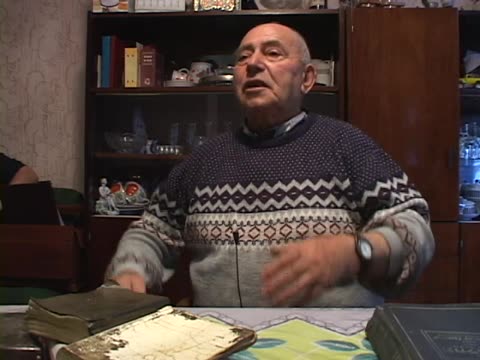
The camera cuts to the next formal interview with Moisei Usherovich Katz, born in Koshelovo in 1926. After the team greets him in his apartment, they set up the interview.
From the machine transcript
The team greets Katz in his apartment and is introduced. Kerler explains that they want to record how he speaks Yiddish and remembers the old way of life, and gives the date, 6 July 2005, and the place, Khust. Katz is from the village of Koshelovo near Khust.
Katz provides personal information and talks about his family. He grew up with six siblings. His father was a coachman with two horses. Katz then talks about prewar Jewish life and childhood memories. He attended religious school (cheder) until his bar mitzvah. Katz then discusses his father’s work as a coachman, transporting wood. Katz supported his father’s work during vacation. In 1939, when his father was "drafted" into the Hungarian army forced labor battalion, Katz continued his father’s work with the help of an assistant. His parents received a plot of land after their marriage.
From the machine transcript
Katz gives his personal details: village near Khust, 8 km away; his names in Russian, Czech and Hungarian; his father Usher; and his birth in December 1926 in Czechoslovakia. His father was a coachman with two horses. He was the eldest of seven children; his mother was a housewife with the maiden name Lazarovich. He names the cheder teachers, the grandparents and the siblings. He describes transporting timber to the Khust station for a factory in Danzig, and helping his father. His father was taken to a labor battalion in 1941 (as heard), and he carried on the work alone. His maternal grandfather Leyzer later died in the Iza ghetto. Both grandmothers were named Etie.
Names the siblings and grandparents and the Danzig timber business, and dates the father's call-up to 1941 rather than 1939.
Katz recalls childhood memories in a town of roughly sixty Jewish families. Katz attended cheder in the mornings and afternoons. Katz then remembers a wedding and discusses Sabbath celebrations at home.
From the machine transcript
Katz recalls his childhood in a village of about sixty Jewish families (heard as 'sixty tallisim'), with two synagogues; Khust had eleven. He describes his daily routine of cheder in the morning and afternoon, with the state school in between, and what was taught in cheder. He answers Kerler's questions about a village wedding: the engagement, the chuppah and the dance with the kerchief. He describes Sabbath meals, cooking cholent and kugel in the clay oven, challah and candles. The passage ends as Kerler asks about the kaddish.
Adds the village school and the village's synagogues and Sabbath cooking.
Katz recites kaddish and discusses holiday celebration of Passover and Purim at home. He then talks about his father’s hard work as a coachman. Katz then explains how children celebrated Purim before the war. Katz was not able to participate in the Purim shpiels because he had to help out with his parents.
From the machine transcript
The passage opens with unclear side talk, partly in Russian, about a book in the room. Katz then describes baking matzo and the seder at home, including the four questions and a Chad Gadya song. He talks about his father's exhausting coachman work. He answers questions about Purim: the reading of the megillah, children going from house to house, and why he himself did not go (he was busy helping at home). He also touches on the decline of Jewish life today and the difference between a town and a shtetl. At the end he turns to the deportation of his family, the camps and the burning of what was left.
Adds the Passover seder, a shift to life today, and the first mention of the camps.
Katz talks about life during and after the war. He was sent to different concentration camps, including Auschwitz, Buchenwald, and Monowitz. After the war, he was drafted into the Red army labor battalion and was assigned to build aerodromes. Katz recalls the terrible conditions during his military service from 1947 through 1950.
From the machine transcript
Katz tells of the camps: Buchenwald, Auschwitz, Monowitz and Birkenau. After liberation he was drafted into a labor battalion (construction) under Stalin, and served for about three years, until the end of 1950, building airfields in Abkhazia, around Novy Afon. He describes the mountain terrain, the monastery and the dacha built for Stalin, and the hard conditions and food. Kerler then asks him to tell what happened to him before the camps, and Katz returns to his father's call-up.
Katz discusses life during the war, after his father was drafted into the Hungarian army in 1939. Katz continued his father’s work as a coachman until 1943. He then talks about his experience delivering wood. His father returned from the army in 1943 due to health reasons and took up his previous work as a coachman. Katz then explains that his uncle and cousin were ultimately taken to the railway station in Khust by the Hungarian police in 1941. The train was headed to Ivano-Frankivsk, before moving further to Khust. Katz explains that they were deported from Khust to the Iza ghetto in 1944 and stayed there for three weeks. He recalls the hardships of acquiring food. After three weeks, Katz continues, they were sent to a brickworks in Khust, going through health check and selection for three days. Katz was then deported to Auschwitz. Katz recalls the first days of undressing/showering and selection at the concentration camp. Katz spent two days in Auschwitz and was then sent to a sub-camp of Auschwitz, Monowitz. Katz worked at a factory there.
From the machine transcript
Katz describes the war years. After his father was called up, he did the coachman work himself, carrying timber and hauling boards, until his father was released ill in 1943. In 1941 Hungarian gendarmes took Jews from the village, and a train went toward Stanislav, where the Poles were said to have been killed. Katz then recalls the Iza ghetto in 1944 (about three weeks), hunger, and how he slipped home at night for food. The family was then taken to the Khust brickworks, with beatings and searches, and sent by train to Auschwitz. He describes the selection, shaving, shower and clothing, then Birkenau, where he received a number, and then Monowitz with his father and the factory work.
The transcript has the family itself taken in 1941, rather than an uncle and cousin, and adds Katz's trips home from Iza for food and the Khust brickworks.
Katz talks about his arrival at Monowitz and the daily routine of going to work. Katz and two relatives were accompanied by prisoner marching band on the way to the factory. Katz explains how they managed to get easier work because of their young age. Katz helped an older German prisoner, carrying boxes. Katz then recalls the help they received from other German prisoners. In January, Katz continues, the camp was bombarded and he was not sent to work, but rather was sent on a death march instead. Katz describes how they had barely any food on the march, and how they eventually reached Gleiwitz. In Gleiwitz, he was forced into a train wagon of 130 people and deported to Buchenwald. As soon as he arrived in the camp, he was supposed to shower and Katz recalls the pleasures of drinking coffee. The following day he was sent to forced labor, carrying rocks. Katz, his and cousin were fortunate enough to be sent to a barrack with other children and did not have to work anymore until the liberation of Buchenwald by the Americans. Katz then discusses the days of liberation. Shortly before the liberation, Katz was forced to leave the barrack.
From the machine transcript
Katz describes his time in Monowitz: assignment to a barrack under a veteran kapo, the daily march to the factory accompanied by a prisoner orchestra, and digging trenches and carrying pipes. He, his cousin and his uncle obtain lighter work in the camp's work offices because they are young, and he helps a German political prisoner who is the block elder. After the bombing he is sent on a winter death march with almost no food, then on a week-long journey in open wagons to Buchenwald, where he recalls coffee and the crowded bunks. He and his cousin end up in the children's barrack and do no more labor until liberation by the Americans on 11 April, after being driven out of the barrack just before the end.
Gives details beyond the catalogue: the uncle's and cousin's names, the guards' flight to the bunkers, and Katz's later unanswered letter about Buchenwald documents.
Katz discusses his life in the liberated camp. He remembers people dying from eating too much after living on starvation rations for so long. Katz and his uncle and cousin registered as Czech and moved toward the Soviet-occupied zone. He describes the way back home and the change from Czech regime to Soviet regime in Ukraine. Katz describes how while staying at a hotel with his cousin and uncle, he was nearly sent to Siberia. Instead, they headed to Budapest, where they stayed and received food, before continuing the journey home. In Budapest, they met a fellow Jew from Khust and spent the night at his house.
From the machine transcript
Katz describes the weeks after liberation: many starved prisoners died from overeating, a quarantine followed, and the surviving boys registered as Czechoslovak citizens. He explains how the family name appears in several forms in his records. He, his uncle and his cousin travel toward home through Prague and Bratislava, meeting Czech and Soviet soldiers and being nearly sent to Siberia. They continue to Budapest, and on the way home they meet a Jew from Khust and spend the night at his house.
Adds the explanation of his surname registration and the encounter with a Jew from Khust, plus Czech attempts to keep the boys there.
Katz discusses his arrival in his home town, Koshelovo. He moved to Khust in 1954. Katz started an apprenticeship at a friend’s bakery for a short time. His cousin recommended learning driving, to become a chauffeur. He was trained from 1947 to 1951. Katz worked as a chauffeur for sixty years.
From the machine transcript
Katz describes settling back in his home village and being offered an apprenticeship at a friend's bakery near Svalyava, to which he drove a cow seventy kilometers. He quits after a week or so and, on his cousin's suggestion, takes a driving course, paying for it himself, and gets his license in the late 1940s (1947 is heard). He drove until he stopped working at about sixty and then retired on a pension. Kerler then asks about his schooling, and Katz says he attended a Subcarpathian Rus' school rather than a Czech one.
Adds the switch to the school question at the end; the length of his working life as a driver is unclear.
Katz mentions his school education at a Russian school, before he discusses his work as a chauffeur and the difference between working for Jews and non-Jews.
From the machine transcript
Katz says he attended an ordinary Russian school, since Czech schools existed only in the cities, and mentions the languages he understood (some Czech, some Hungarian). He remarks on how Hungarians, Gypsies and Czechs viewed Jews. He then talks about working as a driver in a large garage with hundreds of employees, claiming that non-Jewish bosses treated him far better than Jewish ones, and recounts a dispute over delivery documents at a bottling factory. Kerler ends by asking about the synagogue after the war.
Katz discusses Jewish life and religious activity in Khust after the war, where he moved in 1954. The community was supposed to pay taxes for the synagogue in 1953. Katz then turns to the post-Soviet period and explains how a tavern was built near the site of the former synagogue, where the mikva once was. He expresses frustration that the community members were willing to sign over this property to the tavern.
From the machine transcript
Katz explains that he moved to Khust in 1954, found the synagogue closed to him as a Soviet worker, and describes how Khust's eleven synagogues were reduced to one. He tells how old women at night resisted the authorities' attempts to take the building, and recalls the tax demanded of the congregation. He describes the later post-Soviet scheme to build a tavern on the synagogue's grounds near the former mikveh, an attempt involving a congregation head named Itsik Hoyfman. He is bitter that community members signed away the site, and criticizes Jews who buy bread on the Sabbath and the holiday revelry. Kerler asks the meaning of a building term he uses (a gutter or eave) and then starts asking food-term questions.
Adds the 1954 move, the synagogue's closure under Soviet rule, and a first set of questions at the end.
The team asks a number of dialectological questions from the AHEYM Yiddish questionnaire. Katz briefly discusses his religious education (cheder).
From the machine transcript
Kerler asks a short series of questionnaire items, including curses, the words for a Jewish and a non-Jewish cemetery, evil spirits (dybbuk) and the golem, and the word for a rod or whip. Katz also names a rebbe whom his father visited on the High Holy Days, but the rebbe's name is unclear. Katz is invited to talk about his childhood and cheder, answers briefly that songs were not sung there, and says pupils were beaten with a rod.
Katz also gives words for cemeteries, dybbuk and golem, and a rebbe's town (unclear), beyond the cheder topic.
Katz discusses his childhood memories and family. In particular, he recalls holidays, when his mother would read from the tsene rene (Yiddish rendering of the Bible).
From the machine transcript
Katz recalls his grandparents and his childhood home: there was no washing machine and the work was hard. His mother could read on Sabbath from the tsene rene, while girls did not go to cheder and only boys did. The passage ends with a first attempt to find the tsene rene, which is heard partly garbled.
Also mentions girls not attending cheder and the search for the book.
Katz reads an excerpt from the tsene rene. Katz explains that he learned to read in Yiddish when he attended a cheder, but states that he had no time to read because he had to work instead.
From the machine transcript
Katz reads aloud from the tsene rene a passage on the red heifer (parah adumah) and its meaning, and the interviewer reacts to it. Katz then says he learned to read Yiddish in cheder but had no chance to read as a boy because he had to work, including in a labor camp. He mentions that he wears tallit and tefillin daily.
Includes his labor-camp remark and daily tefillin.
Katz talks about life before the war. He worked in berry orchard in a kolkhoz in Ukraine. The last job he did, before World War II broke out, was to load furniture from the factory into the train. On Yom Kippur and Rosh Hashanah, he explained, he would turn off the machines, not work, and attend synagogue. Katz explained that his Jewish superior, Efimovich, tolerated Katz’s decision not to work on holidays. When Efimovich retired, non-Jews directed the factory.
From the machine transcript
Katz talks about his working life: he was sent to a kolkhoz in Ukraine, and the last job before the war was loading furniture from a factory into railway wagons. He describes how he stopped his machine and did not work on Yom Kippur and Rosh Hashanah, attending synagogue instead, with the tolerance of a Jewish superior (Efimovich (?)). After Efimovich retired, non-Jewish managers took over; a Jew now in Israel is also mentioned.
Katz discusses religious life today. His son helped to organize a minyan from neighboring towns, so Katz can observe yahrzeit. The camera records the excerpt of the Parsha Chukat in the tsene rene, which Katz read earlier in the interview.
From the machine transcript
Katz talks about religious life today: before there was a Sabbath and holiday minyan, now it is hard to gather a minyan, so his son arranged for men from neighboring towns to come for a yahrzeit. The tsene rene chapter is again discussed and the camera records the reading. He also describes his prayer books and a woman's Russian-language one, and what he learned in cheder.
Adds that a long stretch (about 19–22 min) is unclear and that he discusses his prayer books.
Katz remembers his cheder education and discusses prewar religious life in general.
From the machine transcript
Katz remembers cheder, where only the Torah was taught and not the meaning of the prayers, and prewar religious life. The interviewer asks whether anyone has written down his account; he says his account of the camp was recorded in Yiddish by someone, and mentions a small book with a Kyiv connection.
Katz shows the Russian book “We only stayed alive: witnesses and documents,” (compiled by Dr. Boris Zabarko) where Katz’ account of World War II is mentioned. Katz’ chapter is entitled “I came to the barrack no. 3.”
From the machine transcript
Katz shows a Russian-language book containing his testimony, edited by Boris Zabarko; the discussion is partly in Russian, about how it was recorded and in what language. The interviewer thanks him and says the account he gave is what matters. The transcript is partly garbled and includes a recogniser loop.
Adds the discussion of how the interview was recorded in Russian.