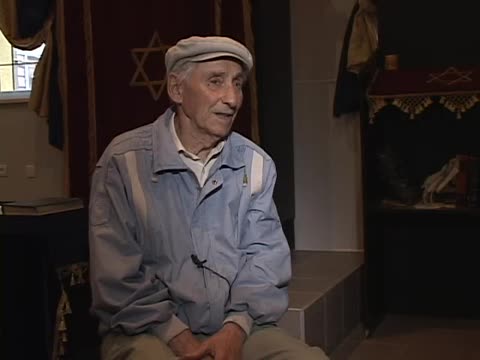
Krotsh sings a Yiddish song about drinking at an inn. He then sings a Zionist song longing for Eretz Israel in the Soviet Union.
From the machine transcript
Krotsh sings a Yiddish song about drinking in an inn and staggering home drunk. Lemster and Kerler ask where he heard it; he says he heard it as a child before the war. He then sings a Zionist song longing for the land of Israel and for an end to exile under Romanian rule. Kerler and Lemster ask him to repeat parts. Lemster asks about further songs about drinking. Krotsh begins another Zionist song at the end.
Includes the interviewers' questions about the songs' origin and a third song starting at the end.
Krotsh sings another Zionist song twice, which was sung shortly before World War II, he explains. He then recalls a song about poverty in the community.
From the machine transcript
Krotsh sings a Zionist marching song twice, saying it was sung shortly before the war, when Jews sensed a coming catastrophe. Lemster asks about songs mixing Yiddish with Romanian words. Krotsh recalls only a few words of a song about a tallis and tefillin bag, and of an orphan's lament at the cemetery. He points out that Romanian Jews said "land" differently from Jews in Ştefăneşti and Bessarabia.
Adds the Yiddish–Romanian mixed song, the orphan song, and a comparison of Romanian and local Yiddish usage.
Krotsh speaks about prewar Jewish life in Ştefăneşti, particularly about the Rabbi Avrohom Mattisyohu Friedman. He states that he remembers the time when the Ştefăneşti rebbe passed away in 1933.
From the machine transcript
Lemster asks about the history of the Ştefăneşti Jews. Krotsh says what he knows of them is from hearsay: the town's famous rebbe, whom people visited even from America, so that crowds filled the town. He was about seven or eight when the rebbe died, which Lemster places in the 1930s. The rebbe's name (Mattisyohu Friedman) is only partly legible.
Adds the visitors from America and the crowds in town.
Krotsh speaks about his apprenticeship at a tailor's shop. He then tells a story about the encounter of the Ştefăneşti rebbe and Krotsh's master craftsman. Another story involves a military tailor who encountered the rebbe (see also MDV 535).
From the machine transcript
Krotsh describes how he came as an apprentice to a tailor in Ştefăneşti. His master was a respected man who went to the rebbe's prayer house and spoke only Yiddish. He tells the master's story of a man who asked the rebbe not to be drafted in the war. He also tells of a military tailor who botched a general's coat and was saved by the rebbe's advice. Lemster asks about other rebbes and about people travelling there from Iaşi and Bălţi.
Gives two stories in full (the draftee and the military tailor), plus questions about other rebbes.
Krotsh mentions that he attended a yeshiva for two years. He then speaks about his father who consulted the rebbe about his trial concerning the imprisonment in a German prison during World War I.
From the machine transcript
Krotsh begins to say he attended a yeshiva. He tells how his father was captured by the Germans in the First World War and later faced a trial. The rebbe told the father not to be present when the trial was held. The trial was in Bucharest (?), and the account is cut off. Lemster and Kerler ask when the rebbe died and about the father's age.
Krotsh speaks about his family. He then talks about his life before the war, particularly education and work. Krotsh explains that he studied at a yeshiva in the mornings and worked as an apprentice in the afternoons.
From the machine transcript
Krotsh gives his father's death year as 1931 and approximate age. Lemster asks about the Jewish library in Ştefăneşti. Krotsh describes studying at the yeshiva in the mornings and working in the afternoons from the age of twelve or thirteen. He also studied Romanian and Hebrew and describes his Romanian teacher. Lemster asks what he sewed. He begins to mention his wartime experience.
Adds the father's death date, the library question, and Romanian schooling.
Krotsh speaks about his life during World War II. He was drafted into the Red Army and worked in military construction in Baku, Azerbaijan. Krotsh explains how he was called to work in his profession as tailor.
From the machine transcript
Krotsh recounts the war years, when he was taken into the army and sent with others to military construction work in Baku, Azerbaijan. The labour was hard and the bread ration small. A Jewish friend told him that he would be put to work as a tailor, and a brigade leader said it had been ordered. He met a Jewish woman who spoke Yiddish with him, and her husband promised him a sewing machine. He ends with a Yiddish saying that Kerler asks him to explain.
Adds the Jewish woman who helped him and the Yiddish saying.
Krotsh discusses his childhood memories and the difficulty to study at a yeshiva and work as apprentice at the same time. Hence, Krotsh continues, he dropped out of the yeshiva. During the war, Krotsh states, his profession helped him to survive.
From the machine transcript
Krotsh recalls how hard it was as a boy to attend yeshiva and work as an apprentice at the same time. He told his father, and the father agreed he should drop one of the two. He remembers an older tailor in the town, Chaim Leib (?). He says that his trade later helped him to survive the war. Lemster asks about songs about tailoring.
Adds the old tailor Chaim Leib and Lemster's question about tailor songs.
Krotsh sings snippets of a tailor song. He then sings a Yiddish song about growing up.
From the machine transcript
Asked about songs on tailoring, Krotsh remembers only snippets of a tailor's song. He then sings a Yiddish song about an orphan girl at the wedding canopy and the three occasions of weeping in a person's life. He repeats it at Kerler's request, and Kerler asks about unclear words. He says his mother loved songs and the theater.
Krotsh talks about prewar cultural life in Ştefăneşti, particularly theater performances. He recalls concerts by Sidi Tal.
From the machine transcript
Lemster asks about theater in Ştefăneşti. Krotsh says Yiddish theater troupes came regularly and staged plays, the Akeydes Yitskhok among them. Lemster asks about the director Yankl Sternberg from Bucharest, and Krotsh says he does not recall him. Krotsh describes the town's Jewish population and theatre posters, and Kerler asks whether such plays were done at Purim.
Adds the Sternberg question and a Purim-play question.
Krotsh speaks about his work before World War II. He then sings Purim songs, he remembers from his childhood. Krotsh recalls Purim celebrations, particularly he mentions that he dressed up as rich man.
From the machine transcript
Krotsh explains that he was too young for weddings, so did not hear a badkhn. Lemster asks about Purim. Krotsh recalls going door to door as a child singing Purim songs, and performs one about the Torah being offered to the nations. He describes dressing up in simple masks and as a rich man, and the traditional Purim plays. He also sings a short rhyme about a man who comes late from synagogue.
Adds the badkhn question and the work-before-the-war topic.
Krotsh recites three Purim shpiels.
From the machine transcript
At Kerler's request Krotsh repeats and sings Purim rhymes: first the verse about the forty days Moses spent in heaven and the Torah offered to the nations, then a second verse where the householder gives only a small coin. Kerler asks him to explain words and to sing the last verse. At the end Lemster asks whether he has heard of Itsik Manger.
Krotsh speaks about prewar religious life. He then speaks about his life and work after the war. He got married to a non-Jewish woman in 1949. Krotsh lists the places he lived after the war, including Kuban, Russia, 56:49. He moved to Kolomyya in 1949.
From the machine transcript
Krotsh says he does not know Itsik Manger. He mentions a Hasidic man in Ştefăneşti, Chaim (surname unclear), who was close to the rebbe and was sent to Transcarpathia after the war. He says he married in 1949 a woman from Russia and came to Kolomyya the same year. He lists the places he lived and worked as a tailor, among them Balta, Kuban and others; the transcript is unclear on several of them.
Adds the Hasidic man, the wife from Russia, and the lists of postwar places.
Krotsh speaks about Jewish life in the immediate postwar period in Kolomyya. He recalls secret services on holidays and importing matzos from Odesa and Chişinău. In Kolomyya, Krotsh worked for a military auction 59:00. He also mentions Romanian songs.
From the machine transcript
Asked by Lemster about Jewish life in postwar Kolomyya, Krotsh says Jews gathered cautiously, for example on Yom Kippur, and the authorities knew. He worked at a military auction. He says he was nearly the only one to eat matzo on Passover. Kerler asks whether Jews still spoke Yiddish, and Krotsh says that many did, in the street and when playing games. Lemster ends by asking about Romanian songs, and Krotsh names a few.
Adds the Yiddish-language question and Romanian songs.
Krotsh speaks about prewar Jewish life in Ştefăneşti. He then talks about his life during World War II and family. His father was a cobbler and also born in Ştefăneşti. Krotsh's mother was born in Săveni.
From the machine transcript
Krotsh answers questions about Communists coming from Bessarabia to Ştefăneşti and the anger at Jews there. He recalls his father not letting his sister go, and his brother leaving for work. He says he did not know his grandfathers or grandmothers. His father was a tailor or cobbler (the transcript shows both), born in Ştefăneşti, while his mother was from Săveni.
Also covers Bessarabian arrivals and a pogrom-like attack in the town, and his sister and brother.
Krotsh tells a story concerning family friends and military draft under Tsarism he heard from his father.
From the machine transcript
Krotsh tells a story he heard from his father about the Tsarist draft of twenty-five years. Young men were smuggled across the border to Romania. One man, Leyb Gershon, became a rich grain dealer. Years later, on night watch, he met his long-lost brother, and they recognized each other. Kerler asks about the dates.
Mentions the Jewish night watch of the shtetl and gives the story's setting at the Prut border.
Krotsh talks about prewar Jewish life in Ştefăneşti, including the wealthy and his master craftsman. He also speaks about his education at a yeshiva and his family.
From the machine transcript
Krotsh names the wealthy men of Ştefăneşti and their trades in grain, timber and cloth. He recalls one rich man's fine house, and the Yiddish books and newspapers in his home. He describes his yeshiva study of Talmud and Mishnah, studying with a partner, and his brother, a master tailor who refused to get rich. He also tells about a Romanian thief known by a nickname.
Includes a Romanian thief and his songs, and his brother the master tailor.
Krotsh answers linguistic questions. He then speaks about his life after the war and visits to Lviv.
From the machine transcript
Krotsh answers Kerler's questions about the meaning of words he used, such as the watch, Romanian-derived words and a Hebrew-Yiddish phrase. He then talks about Romanian Jews in contrast to Bessarabian Jews, and his trips to Lviv after the war as a tailor. He mentions that there is no one in Kolomyya to speak Yiddish with, and recalls songs he heard in 1946.
Contains elicitation of word meanings and a comparison of Romanian and Bessarabian Jews.
Krotsh recalls Soviet Yiddish songs about drinking. He then remembers postwar Yiddish press and non-Jews who spoke Yiddish before the war. In particular, Krotsh remembers how non-Jewish and Jewish children played and celebrated holidays together.
From the machine transcript
Krotsh recalls a Soviet song with a toast about the Revolution and the Constitution, and answers questions about the Birobidzhan press. He then discusses non-Jewish Romanians in Ştefăneşti who spoke Yiddish. Jewish and non-Jewish children played football and kept holidays together. He also explains the meaning of the name Maccabi.
Kroth discusses prewar organizations and politicians, including Maccabi, Gordonia,andquot;Dos yidish kindandquot; (the Jewish child).
From the machine transcript
Krotsh describes the prewar Maccabi sports and cultural organization, with its football team, concerts and the girls' costumes. He lists other Zionist organizations such as Gordonia. Lemster asks whether any Jewish member of the Romanian parliament came from the area. Krotsh names a rabbi from Kishinev (?) as a deputy, and Kerler turns the talk to Jews' secret language.
Includes the Jewish deputy, the rabbi from Kishinev.
Krotsh speaks about prewar life and communication. Krotsh then recites a Yiddish song about a journalist, he learned from a friend.
From the machine transcript
Krotsh describes how Jews inserted Hebrew words in Yiddish so that non-Jews would not understand. He discusses a word for money, and a song about a Iaşi newspaper man that a young man from Iaşi taught him in the army. Kerler and Lemster ask about Mihai Eminescu (?) and the old Moldova. He also mentions that Bialik was known from the school.
Includes the recitation of a song and a discussion of Moldova and Eminescu.
Krotsh lists Yiddish and other Jewish writers.
From the machine transcript
Krotsh names Yiddish writers whose books he read, among them Sholem Aleichem and Mendele Moykher Sforim. Lemster asks about the origin of Yakov Fikhman and Kerler about Leyb Goldin. Krotsh then recites a Hebrew school song of a holiday several times, and Kerler asks to have every word repeated so he can write it down.
Krotsh speaks about his school education at a Romanian Jewish school. He states that pupils studied in Hebrew and Romanian. Krotsh also writes down a song he remembers from school.
From the machine transcript
Krotsh says that he learned the song in the Jewish school in Romanian, half a day in Hebrew and half in Romanian, and gives the school's name in Romanian. He recites the song again, and Kerler repeats it line by line. Lemster then asks whether Jews made their own wine.
Includes the repeated dictation of the Hebrew song.
Krotsh addresses prewar Jewish life and wine production. He then sings a Yiddish song about drinking.
From the machine transcript
Krotsh answers Lemster's question on whether Jews made wine and says the rich man Leyb Gershon had his own vineyards and wine cellars. He tells a song about a drunkard coming home to his wife and children, and recalls that there were few drunks and thieves in the shtetl. Lemster and Kerler ask about water carriers and the fire brigade, which was non-Jewish, and about love songs.
Contains the fire brigade and the water carriers.
The team concludes the formal part of the interview with Krotsh and plays him Yiddish songs.
From the machine transcript
The interviewers thank Krotsh for the interview, and the team plays him recorded Yiddish songs on a device. Kerler says one dates from the time of the war, and Krotsh tries to recall it. A third person (S3) then recites a Yiddish song about longing for home. Krotsh begins to sing a song about a boy he loved.
Concerns the playing of recorded songs and a song about longing for home.
Krotsh sings Yiddish songs about loving a boy and then about childhood memories.
From the machine transcript
Krotsh sings a Yiddish song about being abandoned by a boy he loved and wandering alone, and then repeats it. Kerler and Lemster ask whether they heard every word. He then sings a Kishinev (?) song about the little streets, which he says is sung with weeping. Kerler praises it, and the talk turns to praying alone on the road.
Gives the songs sung (a love song and a Kishinev song of the streets).
Krotsh talks about contemporary Jewish life in the region. The camera then collects outside footage of the synagogue, while the team walks with Krotsh to Vider's home.
From the machine transcript
The speakers talk about a woman and her husband, and Lemster asks Krotsh about Romanian and Bessarabian Jews. The talk is then largely garbled, with a recogniser loop and a Russian line, so little can be read. The camera records outside footage of the synagogue and the team walks with Krotsh to Vider's home, but this is not clear in the transcript.
Most of the transcript is garbled, and the walk to Vider's home is not confirmed.