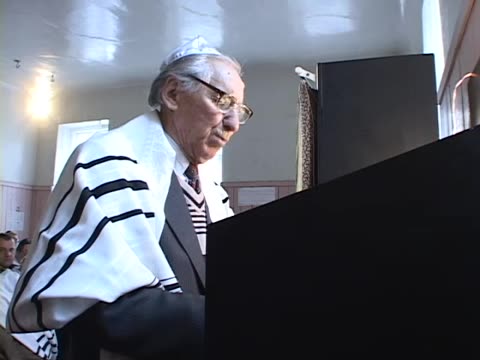
This tape begins with a continuation of shabes (Sabbath) services in the Kolomyya synagogue.
From the machine transcript
Continuation of the Sabbath service in the Kolomyya synagogue. Prayers, blessings and singing by the congregants are heard, with brief spoken exchanges. The transcript is largely garbled, so little detail can be made out.
The AHEYM team speaks informally with Semyon Semyonovich Krotsh (b. 1922 in Stefanesti), who speaks about the Rebbe of Stefanesti. David Abramovich Vider (b. 1922 in Sighetu Marmatiei) explains that the synagogue has no one who can "leyn toyre” (read/chant the Torah portion) and therefore it is not read on shabes.
From the machine transcript
Informal conversation with the congregants. Krotsh speaks of the Rebbe of Stefanesti, named as Matisyohu Friedman (?), a great tsadik taken to the Land of Israel and buried there. Kerler says the interviewers want to interview people later. A second man explains that no one is present who can read the Torah, so it is not read at this service. Plans are made to talk later or the next morning.
A second man's remark on the missing Torah reader and plans for an interview.
The AHEYM team has a "kidish” (Kiddush) lunch with the congregation and speaks in Yiddish with everyone. The congregation collectively makes the "shehakoyl” blessing (a generic blessing said over foods and drinks without a specific blessing associated with them). The congregants also sing many Yiddish and Russian songs.
From the machine transcript
Kiddush lunch with the congregation. Kerler, Katz and others talk in Yiddish and Russian, and the congregants make the kiddush. A woman from Soroca and a man who lived in America speak of their origins. Kerler asks for Yiddish songs, including lullabies, and several people sing. The transcript is partly garbled and mixed with Russian.
The kiddush lunch is joined by talk about where people come from and requests for Yiddish songs.
The research team begins a formal interview with Krotsh, speaking first about the interviewers and the AHEYM project in general. Krotsh shares his basic biographical information and speaks about his family life in his childhood. He also speaks about the Stefanester Rebbe, recalling how overcrowded his shtetl (town) became when people came from all over the world to attend his funeral. Krotsh discusses his many siblings and the poverty that characterized their youth. Krotsh was educated in a "kheyder” (traditional religious boys’ school), a Romanian-Modern Hebrew Jewish school, and a yeshiva, where he studied Talmud and other traditional texts. Although Krotsh was an excellent student and remembers everything he once learned in yeshiva, he also studied to be a tailor in order to make a living.
From the machine transcript
Formal interview with Krotsh begins. Kerler introduces himself and the project, and Krotsh gives his name, birth in 1922 in Stefanesti, and the names of his parents and siblings. His father was a shoemaker and his mother a housewife. He recalls the huge crowds that came for the funeral of the Stefanesti Rebbe, Matisyohu Friedman (?). He speaks of the family's hard life, of his cheder, school and yeshiva studies, and of learning tailoring because there was no money. The town committee is explained as the body that paid the shoykhets and the rabbi.
Adds the names of his siblings, a sister in Nahariyya, and the town committee.
Krotsh speaks of the curriculum at his various schools and his successes as a student.
From the machine transcript
Krotsh recalls his cheder years and school studies in Stefanesti. He was the best pupil in the four-class school and remembers what he learned. He talks of his teachers and of studying Mishnah and Gemara. Kerler and Katz ask about the Yiddish word for 'grass' and an expression about writing, and a second man tells an anecdote about writing.
Krotsh shares a fragment of "taytsh” (rote translation) accompanied by its traditional nign (melody) from kheyder, as well as a Lag B’oymer rhyme and song in Modern Hebrew that he learned in his secular school. Sitting next to Krotsh, Vider sings HaTivka. Vider then sings another Hebrew song and Krotsh recites a Hebrew poem.
From the machine transcript
Krotsh recites or sings a fragment of rote translation learned in cheder, a Lag BaOmer rhyme and Hebrew songs from his school. Vider (S2) sings HaTikvah and another Hebrew song, and Krotsh recites a Hebrew poem. They discuss Bialik and other Yiddish and Hebrew writers learned in school, with a poem by Gordon (?) recalled in part.
Krotsh then describes a typical day in his secular school, noting that Yiddish was never a formal subject there, but that he spoke this language at home. Like many others, Krotsh states that he could not speak Romanian until he started attending government schools.
From the machine transcript
Krotsh describes a typical day in the Hebrew school in Stefanesti. Romanian subjects were taught first, then Hebrew, and Yiddish was not taught as a subject, though he knew it from home and cheder. He did not know Romanian until he attended the state school. He tells of his employer, the tailor Yude Leyb, who refused to speak Romanian with his non-Jewish clients, and of poor children being given bread and milk by the committee.
This tape is a continuation of a formal interview with Semyon Semyonovich Krotsh (b. 1922 in Stefanesti). Another AHEYM interviewee, David Abramovich Vider (b. 1922 in Sighetu Marmatiei), is also present. Krotsh discusses prewar Passover observances and celebrations, including a description of the dishes that were used and the foods that were eaten. Krotsh and Vider discuss the nuances of the differences between the terms "erlikh” and "frim”.
From the machine transcript
Krotsh first mentions meeting a stranger who spoke Yiddish, then recalls prewar Passover: his mother's latkes, bringing Passover dishes down from the attic, matzo and matzo meal, and going to synagogue. He worked for a tailor who stopped work for the eight days of the holiday. Kerler, Katz and a second man then discuss the distinction between the Yiddish words for 'erlikh' (honest) and 'frum/frim' (pious), with examples such as helping the poor and learning Torah day and night.
Opens with an anecdote about a Yiddish-speaking stranger and covers the Passover items in more detail than the catalogue states.
Krotsh sings the traditional Passover song "Ekhod mi yoydeyo?” (Who Knows One?).
From the machine transcript
Krotsh is asked for the Passover song and sings 'Ekhod mi yoydeyo' (Who Knows One), with some hesitation about remembering it. Afterwards he says it was sung in Hebrew rather than Yiddish, and there is talk about a prayer book and the Passover home.
Adds the exchange afterward about whether the song was sung in Yiddish.
Krotsh sings another loshn-koydesh (the Hebrew-Aramaic language of traditional Jewish texts) song and describes how he learned the nign (melody) from the tailor with whom he apprenticed.
From the machine transcript
Krotsh sings a Hebrew song and says the tune came from the tailor he worked for. He tells a story about a bearded Jewish tailor who was called up in the First World War and was released after the rebbe's prediction when two generals quarrelled. Kerler asks about the Romanian phrases in the story and then about the Stefanester rebbe's miracles.
Adds the story of the tailor released from army service through the rebbe's blessing.
Krotsh speaks about Jewish-Christian relations in his shtetl (town), noting that many Romanians spoke Yiddish as well as the Jews.
From the machine transcript
Krotsh says that non-Jews never converted to Judaism in his town because Jews lived apart from their neighbors, but that many Romanians spoke Yiddish. Jews were the great majority in Stefanesti. He read in Yiddish and Hebrew in school, including Sholem Aleichem and religious books, and went to yeshiva while also working as a tailor from a young age.
Covers his reading and yeshiva/work as a child, not only relations with non-Jews.
Krotsh discusses the Yiddish songs his parents would sing. Vider and Krotsh then sing a fragment from a song about a Ukrainian shtetl. Krotsh then sings a short Modern Hebrew song to the tune of the Yiddish song "ele-bele”. While there were no Yiddish newspapers in his shtetl, Krotsh notes that there was a rich Jewish organizational life, which included many Zionist groups.
From the machine transcript
Krotsh cannot recall the songs his parents sang, and a second man tells a song about a poor tailor in a Ukrainian shtetl, after which Krotsh talks about pogroms in Ukraine. He sings a Hebrew song to a Yiddish melody. He says there were no Yiddish newspapers in the Romanian-ruled town, only Romanian ones, and that Jewish organizations existed.
The newspapers and Romanian prohibition are covered, plus talk about Ukrainian pogroms.
Krotsh begins answering questions from the AHEYM sociolinguistic and dialectological survey.
From the machine transcript
Krotsh begins answering questions about terminology: the words for a cemetery (including a non-Jewish cemetery), and what 'a good Jew' (a gutn yid) means. He explains that a tsadik is not necessarily a good Jew and that people were sent to a good Jew, the rebbe, for advice with problems such as a daughter's marriage.
Includes the explanation of 'a good Jew' and visits to the rebbe.
Krotsh tells several stories about the miracles performed by the Stefanester Rebbe including one about a "dibek” (dybbuk, possessive spirit).
From the machine transcript
Krotsh recounts stories he heard from his employer about the Stefanester rebbe's miracles, chiefly a tailor ordered to make a coat for a general who warned him by the rebbe's advice, and a prisoner who came to the rebbe. Kerler asks about dybbuks and Krotsh says only that he remembers hearing of them being exorcised.
The tailor/general story is the main narrative; the dybbuk question gets only a vague answer.
Krotsh discusses prewar Jewish life in his shtetl, describing the Rebbe’s court and the town’s synagogues. He relates how the Rebbe solved the town’s problems and disputes, and recalls prewar Jewish wedding customs.
From the machine transcript
Krotsh describes the town as pious, with no unbelievers, and the rebbe's court with a garden and the rebbe's own room for prayer. He names eight prayer houses, including a beit midrash, the high synagogue, the tailors' synagogue and the rebbe's kloyz, and tells how the rebbe settled a cantor dispute. He answers questions about weddings, the badkhn/'gramer', the klezmer musician Khaim Berder (?) and songs.
Krotsh talks about different holiday foods and shares his attitudes towards Yiddish dialects. He then continues with the sociolinguistic and dialectology questionnaire, during which time he also sings the song "Freyen zikh iz git” (Being Happy is Good).
From the machine transcript
Krotsh answers questions about holiday food, such as Hanukkah foods and Passover latkes, and about differences between Yiddish in Romania, Moldova and Ukraine. Kerler then puts questionnaire items with Russian prompts, such as greetings, thanks, a big and small word for a person, a house, a cut, windows, and Krotsh gives Yiddish equivalents and notes loanwords.
Includes the attitudes toward dialects and the questionnaire items.
"Freyen zikh iz git” (Being Happy is Good).
From the machine transcript
Krotsh sings a song he knows from Moldova, after which Kerler continues the questionnaire with Russian prompts: words such as pot, gray, healthy as a house, kissel, ear, deaf, then comparatives (earlier, colder, higher, faster, nearer), 'he knows everything', 'listen to me', roof, ill and sentences about liking and not liking. Krotsh gives the Yiddish forms and comments on Moldavian and Ukrainian loanwords.
Most of the passage is questionnaire work; the song is only at the start.
This tape is a continuation of a formal interview with Semyon Semyonovich Krotsh (b. 1922 in Stefanesti). Another AHEYM interviewee, David Abramovich Vider (b. 1922 in Sighetu Marmatiei), is also present. Krotsh discusses his contemporary health problems, as well as the state of Yiddish in the Kolomyya present-day Jewish community. Krotsh speaks about his marriage and three sons of whom only one is now alive. Krotsh moved to Kolomyya in 1949.
From the machine transcript
Krotsh says he is unwell and talks about having been in the hospital. He mentions a friend who urged him to rest, and a woman he spoke to who could not talk Yiddish, and says few people speak Yiddish today. He laments the destruction of Yiddish and Yiddish books in Poland and elsewhere, and says he teaches himself to read Yiddish. He mentions three years in Israel, his marriage and three sons, only one of whom is still alive, and a son who was a doctor and was killed. Kerler asks when he came to Kolomyya, and Krotsh says 1949.
Also covers Krotsh's views on the loss of Yiddish culture, his time in Israel and the death of his wife.
Krotsh details his experiences during the war years: he went to the Soviet Union and was evacuated from the town of Rîbnita to the Caucasus region of Russia, where he worked on a kolkhoz (collective farm). From there, he was evacuated further into Azerbaijan, and then drafted into the Red Army from 1942 to 1947. Krotsh went to Kolomyya after the war at the suggestion of a friend from the army since it was near Romania, but by the time he got there the border was closed and so he stayed in the town. Krotsh then briefly comments on postwar Jewish life in Kolomyya and how the town’s synagogue was repaired in the 1990s.
From the machine transcript
Krotsh tells of the start of the war in Moldova, flight past Soroca to Rîbnita and evacuation to the Krasnodar region, where he worked on a kolkhoz. He fled further to the Stavropol region and Azerbaijan, then served in the army at Baku until 1947. A friend from Kolomyya persuaded him to go there; he found the border closed and stayed. He recalls the synagogue still marked with Hebrew lettering in 1949, how it was later converted and repaired, and how few Jews remain in Kolomyya, many in mixed marriages. Kerler and Katz ask about the numbers and about some local Jews.
Adds the numbers of Jews now in Kolomyya, mixed marriages, and talk about local individuals.
Krotsh describes the atmosphere in prewar Stefanesti on shabes (the Sabbath) and on holidays. Asked about Purim celebrations, Krotsh twice sings the ditty "40 teg, 40 nakht” (40 Days, 40 Nights) and then a fragment of "shoshanes mordekhay.” He then sings the traditional shabes song "lekhu doydi” (Come My Beloved). Returning to the topic of Purim observances, he sings a fragment of another ditty "vus zoln mir zingen bay deym balebus” (What Should We Sing for the Master) as well as another Purim song.
From the machine transcript
Returning to Stefanesti, Krotsh describes the town as a holy shtetl closed on the Sabbath and holidays, with the rebbe's influence. Asked about Purim, he recalls dressing up as a child and sings the Purim ditty about Moses forty days and nights twice. He sings Lekhu dodi in the way he remembers it. He tells how young men in disguise visited homes and sang for the host, describes mishloyekh-manes gifts, and begins a song about the Sabbath preparations of Jewish wives of long ago.
Adds the Purim visits by disguised young men, mishloyekh-manes gifts and a song about wives of the past.
Krotsh sings the song "Vi nemt men di vaybelekh fin amul” (Where Can You Get a Wife Like the Ones From Back Then) and mentions the importance of Yiddish theater in his shtetl (town). He then sings a variant of the famous song "Lomir ale in eynem” (Let Us All Together), and also discusses Zionist activity in the town.
From the machine transcript
Krotsh sings the song about where one finds wives like those of long ago. He recalls Yiddish theater coming to Stefanesti, his mother's love of it and a famous actress who died in Chernivtsi, and answers Kerler's questions about plays such as Mekhires Yoysef and Akeydes Yitskhok, which he knows from his Bible study rather than from the stage. He sings a variant of Lomir ale in eynem. Asked about Zionist activity, he says halutsim passed through, names several Jewish youth groups, and says there was no Bund or socialist party under the rebbe's influence.
Krotsh sings a Modern Hebrew song about Chanukah, and notes the observances for this and other holidays. He then sings fragments from the "kol nidre” (All Vows) service and the High Holiday liturgy.
From the machine transcript
Asked about Hanukkah, Krotsh talks about dreidels made of lead, a holiday he calls beautiful, and how Rosh Hashanah and Yom Kippur emptied the town streets. He sings or recites fragments of Kol nidre and High Holiday liturgy at Kerler's request. He says he learned Hebrew and could speak with visitors from Israel and America. The passage includes informal exchange with the team and a break, and ends with a High Holiday melody he begins to recall.
Adds a Hanukkah song attempt, talk about Hebrew, and informal chatter about the recording.
He sings another full song from the High Holiday liturgy.
From the machine transcript
Krotsh sings a High Holiday liturgical piece, after which Kerler praises it and Katz begins to talk about inviting him to Vilnius.
The camera cuts to the team talking informally with the interviewees. Vider sings "Ven indzer futer yakoyv iz geleygn afn shteyn” (When Our Father Jacob Laid Down on the Stone).
From the machine transcript
The team talks informally with Krotsh and another man, who may be Vider, about the recording and about preserving what he remembers. They ask about a song on Moses and the other man sings the song about Jacob lying on the stone, which a young cantor performed in concerts. Kerler asks how it was sung, and they discuss making a break and a visit in the evening.
The camera cuts back to a formal interview with Krotsh, who sings more of liturgy, describes holiday customs, describes his shtetl’s public baths, and relates an experience he had speaking Yiddish while travelling in Israel.
From the machine transcript
Back in the formal interview, Krotsh sings more liturgy and describes the Sukkot custom of eating and sleeping in the sukkah. He tells how he sold shmoes for money and how the sexton knocked on shutters to wake people for selikhes. Kerler asks about the bathhouse and mikveh, and Krotsh describes the bath and ritual bath of his shtetl. He tells how he spoke Yiddish at a government office in Israel when the clerk spoke Hebrew.
Adds Sukkot, shmoes-selling and selikhes customs, bathhouse and mikveh, and Krotsh's Israeli office anecdote.
This tape is a continuation of a formal interview with Semyon Semyonovich Krotsh (b. 1922 in Stefanesti). Another AHEYM interviewee, David Abramovich Vider (b. 1922 in Sighetu Marmatiei), is also present. Krotsh answers questions from the AHEYM sociolinguistic and dialectological survey.
From the machine transcript
Questionnaire work with the elderly Yiddish speaker: Kerler gives words and short sentences, often in Russian, and asks how they were said in his Yiddish. Items include 'to run away', honest, pious or holy person, the sign of the cross and crossing oneself, non-Jew, 'my head hurts', 'where are you from', 'please', a bouquet or garden of flowers, vodka versus brandy, 'in three days', 'you are right', 'to pray', and 'grandmother/midwife'. The speaker also says which words they did or did not use at home.
Gives the actual items of the questionnaire (religious terms, body ache, directions, midwife) rather than just calling it a survey.
Krotsh discusses folk medicine and tells a personal story from his childhood of how his leg was healed by a blind folk healer woman named Molke Spodik.
From the machine transcript
The speaker explains that an old midwife-healer in his home town could say a charm or cure ('apshprekhenish') and describes how, as a boy of about thirteen, he hurt his leg while sledding down a hill near the town. After doctors, plaster and other treatments had not helped, his father took him to a blind folk healer named Molke Spodik (?). She felt the leg, heated it with hot water, and set it, after which he could walk. Kerler comments on the story and asks about the healer's name.
The healer is blind and the injury happened while sledding; also mentions an older woman healer (Rivke) and the doctors who failed to cure him.
Krotsh answers questions from the AHEYM sociolinguistic and dialectological survey.
From the machine transcript
The questionnaire continues, with Kerler and then Katz giving Russian and Yiddish prompts. Items include prepositions and pronoun sentences ('I speak with mother', 'I see her badly', 'I don't hear him'), words for well, potato, flowers, fence, attic, bridge, and a face; 'suddenly', 'someone', 'then', 'enemy', and the plural of 'wagon'; and a few phrases such as 'in the street' and 'five persons'. The speaker comments on which variants were used in Stefanesti and Moldova. Katz also asks about burrs thrown at girls' hair and about a death phrase. At the end Kerler thanks the speaker, and the passage runs into the start of the Russian interview.
The camera cuts to a formal interview conducted in Russian with Roman Bileichuk (b. 1963 in Kolomyya), an aspiring convert to Judaism. Bileichuk shares his basic biographical information, describing his childhood without a father, and his education and early career path. After an extended period of religious exploration, Bileichuk recalls how one sleepless night after reading the Torah he somehow wandered three kilometers to Kolomyya’s synagogue, a place he was totally unfamiliar with before, and joined the Rosh Hashone (New Years) services that were then taking place. Despite conflict with his family, Biliechuk has been attending the services at the synagogue and observing Judaism for about 2.5 years, and has written to several rabbis in Kyiv about the possibility of formal conversion. Meanwhile, he states that he is trying to follow all Jewish religious laws and reads Jewish journals and traditional texts, trying, "like everybody else” to find Truth in the world.
From the machine transcript
Roman Bileichuk, interviewed in Russian, gives his surname and says he is from Kolomyya. He grew up without a father, with his mother working shifts in a weaving factory, and spent time in a boarding school. He finished eight classes and became a shoemaker at a shoe factory at about 17. He was an Orthodox Christian who obeyed his parents. After reading the Bible he began to doubt and read the Torah. One sleepless night he walked about three kilometres to the Kolomyya synagogue on Rosh Hashanah, where the gabbai Sasha received him. He has attended for two and a half years despite quarrels with his mother, and has written to Kyiv about conversion. He tries to keep Sabbath and the laws and reads Jewish papers and a prayer book.
Gives his birthplace, upbringing without father, work as shoemaker, Rosh Hashanah visit, plus his reading of Jewish press and prayer book.
Bileichuk discusses his family life and shares his attitudes towards Subbotniki, Christian Protestant sects and other faiths. He also discusses why he sees as the inherent truth in Judaism, the "stealing” of its principles by other faiths and his personal religious journey.
From the machine transcript
Bileichuk speaks about his mother's Christian confession and his own earlier interest in Sabbatarian (Subbotniki) and other Protestant groups. He says he read their literature and concluded that they take from the Torah and misuse it, including tithing, and he describes arguments with them. He mentions studying with Sasha Babichenko and Kolesnikov at the synagogue, reading the weekly Torah portion, and feeling that he as a non-Jew has no right yet to teach others. He answers Kerler's questions about the Subbotniki, the New Testament and the groups he met.
Covers his mother's Christian confession and a detailed account of his own reading of Subbotnik literature and Torah study.
Bileichuk states that he knows how to pray Jewishly and does so at home when there are not services in the synagogue. Bileichuk also shares his attitudes toward Israel, noting that "New” Israel is not as good as "Old” Israel, since the new state lacks the Temple in addition to being filled with morally questionable people and problems, such as unbelievers and prostitution.
From the machine transcript
Bileichuk says he prays at home and wants the camera to tell people to look for truth in the God of the Jews. He prays for the Temple and for the sick and comments on 'old' and 'new' Israel. He values the old Israel with its Temple and finds the new one troubled by doubts, mosques, terrorism, and the lack of morality, including prostitution and the behaviour of rabbis and officials. He comes back to one God and to the binding of Isaac.
Includes his general call to the world to seek truth in Judaism and a critical view of Israeli officials.
Bileichuk further details the conflict he has had with his family over his new faith and notes the paradox of how the commandment to "honor thy mother and father” in this case would compromise his faith. He also describes how he prays at home with a homemade "bima” (prayer lectern). Bileichuk states that he keeps all commandments to the extent possible, and reports on what he calls the deceptive nature of the Catholic and Christian Bible, wanting the world to recognize the truth in Judaism. Bileichuk began his religious journey 4-5 years ago starting asking these religious questions, noting that he had a very Christian upbringing and was always of a very spiritual orientation. He also comments on his relations within the community, and, comparing himself to Abraham who took on G-d’s covenant at a late age, states that he will let no one deny him his right to convert. Bileichuk mentions his relationship with a non-Jewish woman who is also an aspiring convert and with whom he has a son. Bileichuk also complains about the politics of conversion and its connection to bribery in Israel.
From the machine transcript
Bileichuk describes the war in his family over his new faith: his mother observes Sunday, he cleans on Thursday for Sabbath, and he makes havdalah and prays alone at a small homemade bima facing Jerusalem, with a compass. He says the Christian Bible is distorted and wants the world to read the Torah. He dates his search to four or five years ago and recalls how a friend's New Testament and the Sabbatarians led him to the Torah. He says nobody may forbid his conversion, compares himself to Abraham, and mentions a woman partner and their wish to have a son. He criticizes conversion in Israel as a matter of money and bribery, and Kerler thanks him at the end.
Gives the early Christian and Sabbatarian steps of his search, a partner and planned son, and the criticism of rabbis taking money for conversion.