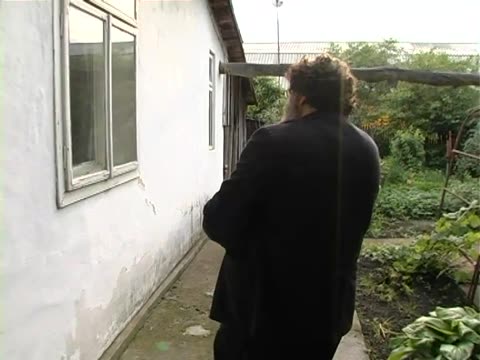
The camera collects town footage of Novoseltsy.
From the machine transcript
Town footage and talk at a house door as the group tries to reach someone, with Russian phone-number dictation. Kerler says in English that they will keep calling and that he will buy beer for everyone. The Yiddish exchange with the people at the door is largely unintelligible.
The camera cuts to the interview with Krotsh. They speak about contemporary religious life.
From the machine transcript
Krotsh and Kerler discuss a young Russian man who has become religious and wants to convert, and who travels to the rebbe. Krotsh recalls the Ştefăneşti rebbe's descendant and a visit years earlier. He mentions saying psalms while waiting for visitors who did not come at the expected time.
The transcript shows talk of a Russian would-be convert and a visiting group, not a general account of religious life.
Krotsh speaks about his yeshiva education in Ştefăneşti, where he lived until 1940. He also addresses his language education and mentions that students from surrounding towns attended the yeshiva.
From the machine transcript
Krotsh says he studied at the yeshiva in Ştefăneşti until 1940. Kerler asks about a word for studying, and Krotsh recalls being chosen to show off the students' learning to visitors. He talks about learning Romanian more poorly than Yiddish and remembers tractates of Talmud he studied. He says boys from nearby towns came to the yeshiva, then mentions an uncle's family who were killed.
Kerler asks about a Yiddish term for studying, and Krotsh mentions an uncle's family killed.
Krotsh speaks about his family's life during World War II. His parents were imprisoned in the Botoșani ghetto. He then speaks about his life during the war. Krotsh joined the Red Army with his younger brother. He grew up with three sisters and two brothers. Krotsh's older brother served in the Romanian army.
From the machine transcript
Krotsh recalls that his parents' town was wiped out and the Jews were driven to Botoşani. He had by then crossed over to the Russians, with his middle brother Michl. He names his sisters and brothers, and says his older brother served in the Romanian army or gendarmerie. He also mentions a cousin or niece now living in Israel.
The transcript also shows a relative in Israel and the older brother's service, which is unclear whether army or gendarmerie.
Krotsh discusses his childhood memories. He then speaks about prewar Jewish life in Ştefăneşti. Krotsh describes how the community remembers the victims of World War I and repeats the story about Kroth's master craftsman's encounter with the Ştefăneşti rebbe.
From the machine transcript
Krotsh says he spoke only Yiddish with friends and at home, and knew some Romanian. He describes the town's many synagogues and the rebbe's large court, which drew visitors from abroad. He retells a story from his master tailor about a Jew drafted in the First World War whom the rebbe said would not be taken. Two Romanian generals then picked other men to take him as an orderly, and he was sent home.
Most of the passage is the master tailor's story about the rebbe and the draft, and it also covers language use at home.
Krotsh speaks about the Ştefăneşti rebbe's court, as well as holiday celebration. Krotsh recalls Purim celebrations with cantor Gedaliye.
From the machine transcript
Krotsh describes the rebbe's court, with rooms for guests and for horses. He recalls that matzo was not baked there but special shmura matzo was. He tells of a Rosh Hashanah when the cantor overslept and the rebbe proposed Gedaliye, a singer who drew people from far away. He then names a great tsadik of Iași (?) and his father.
The passage's holiday content is mainly Passover shmura matzo and Rosh Hashanah, with no Purim in the transcript.
Krotsh speaks about his family. His mother was born in Săveni. Krotsh describes how his mother sought advice with the Ştefăneşti rebbe. He then speaks about contemporary life.
From the machine transcript
Krotsh tells how his father had siblings in America and went there alone, while his mother did not want to leave her family. The rebbe told her they would not go and the father would return. He and Kerler talk about a visitor who died a year earlier and the widow's yahrzeit. They also discuss the would-be convert and his plans to travel to Kyiv.
The transcript shows the father's trip to America and return, and talk of a deceased visitor's widow.
Krotsh speaks about his education. He attended a religious school (cheder) until he was seven years old. He then studied at a Romanian Jewish school, before learning at a yeshiva. Krotsh recalls a rabbi's speech on Sabbath and speaks about his tailor apprenticeship.
From the machine transcript
Krotsh answers questions about his schooling. He attended cheder from about age three, then a Romanian school where half the day was Romanian and half Hebrew, then the yeshiva. He mentions the free bread and milk the school gave poor children and where out-of-town yeshiva boys lodged. He describes the rabbi's Sabbath speeches urging observance and the kosher food his master tailor insisted on for workers.
The transcript also covers the school meals for poor children and the kosher rules in his master's workshop.
Krotsh recalls non-Jews who spoke Yiddish and addresses prewar religious life. He also speaks about the yeshiva students and mentions story about the Ştefăneşti rebbe and a military tailor. Krotsh recalls the story from his master craftsman.
From the machine transcript
Krotsh recalls non-Jews who spoke Yiddish so well that one could not tell them apart from Jews. He discusses the difference between a rav and a rebbe, the memorial yeshiva in Israel, and a rabbi's descendant who claimed to be a rebbe in America. He also tells at length the story from his master tailor: a poor military tailor makes a cloak for a general and the rebbe advises him. Kerler and Krotsh then discuss the Romanian word for a gift or tip and Russian equivalents, and Kerler introduces the topic of a Purim play.
Beyond non-Jews who spoke Yiddish, the transcript shows a long tailor story and a discussion of a Romanian-origin word.
Krotsh speaks about prewar Purim celebrations. He sings a couple of Purim songs in Yiddish and Hebrew. The first one is about non-Jews not understanding conversations among Jews.
From the machine transcript
Krotsh recalls dressing up as a child at Purim in costume and singing. He sings a Yiddish Purim song about non-Jews not understanding what Jews say among themselves. He says such songs were not sung at Shavuot, and recalls school outings to the forest. He then sings a Hebrew-and-Yiddish song, mostly garbled, and remarks on a man in Israel putting on a tallit and going to synagogue.
Krotsh sings again the song about non-Jews not understanding conversations among Jews. He then speaks about prewar religious life in the region, as well as his life before the war. Krotsh also mentions how his father decided for him to drop out of the yeshiva.
From the machine transcript
Krotsh repeats a Yiddish song about the Jews at Sinai, whom the non-Jews could not understand. Kerler then asks about the phrase 'good Jews' for rebbes' followers and about rebbes, including the Podolier rebbe, whom crowds went out of town to welcome. Krotsh says he studied at a yeshiva for half the day and learned a trade for the other half. He was about thirteen when his father, advised by an older man, decided he should leave the yeshiva for tailoring.
Also covers the term 'good Jews' for hasidim and the rebbes' visits.
Krotsh speaks about his life during World War II, particularly the time he was drafted into the Red Army in Kirovabad (today: Ganja). Krotsh also describes the work in military construction and then as tailor. Krotsh maintains that he survived the war due to his profession.
From the machine transcript
Krotsh describes the war years, when he was drafted into the Red Army at Kirovabad. He did heavy military construction work there, with hunger and thin soup, and was then put to work as a tailor. He tells of meeting a Jewish workshop head, getting a sewing machine, and being helped by a senior party woman, so that tailoring saved him. Kerler asks whether he went to a rebbe, and Krotsh answers that perhaps his father's blessing helped.
Also includes the encounter with a Jewish workshop head and Kerler's question about rebbes' blessings.
Krotsh speaks about his father's observance and visits of rebbes after the war.
From the machine transcript
Krotsh speaks about his father's visits to rebbes, mentioning the Podolier rebbe. Kerler asks when he last saw his father and the family, and they place it in the 1950s–60s. Kerler then asks Krotsh to sing something, perhaps a Romanian song.
Krotsh sings a Yiddish song about a good homemaker. He then speaks about prewar Yiddish culture, particularly theater performances. Krotsh remembers a tailor who became an actor.
From the machine transcript
Krotsh sings a humorous Yiddish song about a housewife and women who cook on the Sabbath. Kerler asks whether Yiddish theater visited, and Krotsh recalls touring troupes, posters and street advertising, and actors coming from other towns. He also tells of a tailor mistaken for an actor who was taken to the front as one.
Also includes the story of a tailor taken for an actor.
Krotsh recites a poem in Hebrew he recalls from his school education. He then sings a Purim shpiel and discusses prewar Purim celebrations.
From the machine transcript
Krotsh recites a Hebrew poem or school text he learned at school and describes its content. He explains how Purim singers visited householders and received money, and discusses the word for money used in these songs.
Krotsh speaks about his tailor apprenticeship and his master craftsman.
From the machine transcript
Krotsh talks about his tailor master, who worked for wealthy Romanian clients such as lawyers and a prefect. Krotsh went along and interpreted for the master, who knew Romanian but did not want to speak it.
Krotsh speaks about prewar life, particularly the priest's son.
From the machine transcript
Krotsh tells of an Orthodox priest and his son, in which Romanian words insulting Jews turned up in a note. He then reflects that life under Romanian rule was very hard, though good for the rich.
Krotsh discusses Yiddish literature. He then shares a story about a traditional family and how the son became a tailor's apprentice.
From the machine transcript
Krotsh discusses reading Sholem Aleichem and the story of the little knife (?) in Yiddish. He tells a long story of a village blacksmith whose son was apprenticed to a tailor, and the boy's mother, who came to the shop. A visitor interrupts in Russian for a stretch. Kerler asks about a dialect word for beating.
Also includes Russian talk with a visitor and the word for beating.
Krotsh speaks about his life in Moldova before the war and addresses linguistic differences.
From the machine transcript
Krotsh talks about his year in Bessarabia, where Moldovan girls laughed at his Romanian greeting. He explains local Moldovan expressions and what he learned from them. Kerler asks about Yiddish words such as 'tsunoyfshpaden' (?), which Krotsh links to Russian and to his tailoring.
Also includes questions on the word 'tsunoyfshpaden' (?).
Krotsh sings a song in Romanian. He then recalls a a Purim shpiel, which is about missing the holiday.
From the machine transcript
Krotsh recites a Romanian song and explains its words with Kerler. He then gives a short Purim-shpiel scene about a couple who come home late and find that the Megillah has already been read. They discuss when such pieces were sung.
Krotsh speaks about contemporary religious life and non-Jews submitting notes. He also talks about visitors from abroad.
From the machine transcript
Krotsh describes how, in the synagogue today, non-Jews and others leave slips with names and money, in the belief that it helps, and he wonders whether this is permitted. They talk about visitors from America who come for the holidays and send photographs, and Krotsh mentions two visitors named Mendel (?) and Nachman (?). Kerler then asks for another song and Krotsh begins a drinking song.
Also mentions visitors from America.
Krotsh sings a Yiddish song about drinking at an inn.
From the machine transcript
Krotsh sings a Yiddish song about a drunkard in a tavern, to whom the streets seem drunk. He says he remembers more verses and other songs only partly. They talk about songs that tailors sang while sewing.
Krotsh sings a song in Romanian.
From the machine transcript
Krotsh sings a Romanian song and comments that many beautiful Romanian songs were sung in 1940.
Krotsh sings a song in Romanian, before he addresses contemporary Jewish life in the region.
From the machine transcript
Krotsh begins by performing a song in Romanian, saying he does not remember it in full. Kerler then talks with him about fieldwork in Romanian Moldavia and Bukovina. They discuss the few Yiddish speakers found there, the town's Jewish committee head, the synagogue in Rădăuţi (?), and an older woman who would not give her age.
Most of the passage is Kerler's account of his fieldwork in Romania and the Rădăuţi synagogue, rather than Krotsh's own contemporary Jewish life.
Krotsh talks about his family and visit to the Rădăuţi synagogue. They then address non-Jews who speak Yiddish.
From the machine transcript
Krotsh recalls visiting Rădăuţi as a boy (about ten or twelve years old) and attending the synagogue there on a Sabbath with a yahrzeit. He describes the old, heavy prayer shawls, the building and his wish to see it once more. Kerler then tells of Mykhailenets, a border village where he found a non-Jewish woman who speaks fluent Yiddish learned from Jewish neighbours.
Krotsh answers dialectological questions from the AHEYM Yiddish linguistic questionnaire. He also addresses regional dialects.
From the machine transcript
Krotsh answers questions about how things were said in Ştefăneşti Yiddish, including words for going, a person who is weak or ill, and a pious or honest person, with forms of 'we go' compared to Bessarabia and Lithuanian Yiddish. Kerler also asks about verb forms (broken, brought) and kin words such as father and mother. Krotsh says he now has no one to speak Yiddish with.
The passage is a questionnaire on word forms, and the regional comparison (Bessarabia, Lithuanian Yiddish) is a side topic.
Krotsh speaks about his life today.
From the machine transcript
Krotsh says that no one is left with whom to speak Yiddish. He tells of an acquaintance who has died and others who emigrated to Israel, and says he now talks to himself at home. Kerler jokes about this and asks whether he read Yiddish booklets in Ştefăneşti.
Krotsh addresses his life before the war and contacts with local Communists. He then speaks about his work life after the war, particularly communicating in Yiddish in Mukachevo, Ukraine, early 1950s. Krotsh went to further training in military tailoring in Moscow in the early 1950s.
From the machine transcript
Krotsh recalls that before the war his father and family had no dealings with Communists, and tells how Bessarabian youth later asked whether he had done 'political work'. He says that after the war he spoke Yiddish at work even with some non-Jews, and tells a long story from Mukachevo about a man called Menashe who fled from Czechoslovakia and was caught. He mentions that he went to Moscow around 1952–53 for training in cutting, military tailoring. He says that for decades he saw no Torah and lost his religious practice.
The passage also contains an extended anecdote about a man named Menashe, a Yiddish-speaking workmate's name story, and the loss of Jewish observance in Soviet decades.
Krotsh speaks about postwar Jewish life, including a brief history on synagogue buildings. He states that the synagogue the interview is conducted in was used as gymnasium.
From the machine transcript
Krotsh says he came to Kolomyya in 1949 and describes what happened to the town's synagogues, saying the large synagogue was broken up and turned into a club or sports hall. He recalls that the word 'Jerusalem' stayed painted on the building through German and Soviet times. He and Kerler discuss the building's renovation, its windows and women's gallery, and compare it with the synagogue in Mukachevo.
The passage also covers women's galleries and Kerler's comparison with Mukachevo's synagogue, and Jewish emigration from Mukachevo.
Krotsh addresses his visit to Ştefăneşti and they address books regarding the Jewish history of Ştefăneşti.
From the machine transcript
Krotsh describes going back to Ştefăneşti, where the town has been largely wiped away except for the school and the area by the rebbe's house, and explains the term for the surrounding quarter (a Turkish-derived word). Kerler asks about a Turkish-origin word in Yiddish, and they mention an English-language ethnographic booklet and a Yiddish book on Ştefăneşti's Jewish history, which a relative in Israel has.
Krotsh speaks about his family, particularly his son. Krotsh also mentions people with whom he communicated in Yiddish after the war.
From the machine transcript
Krotsh says his son lives in Kolomyya and does not know Yiddish, and tells an anecdote about being asked whom he was talking to at home. Kerler asks about people he spoke Yiddish with after the war. Krotsh recalls a Jewish workmate in Baku, the Russian-speaking environment there, and his team of workers; Kerler asks about a song, which Krotsh does not know.
Krotsh speaks about postwar Jewish life in Kolomyya. Krotsh moved to Kolomyya in 1949. In particular, he describes secret Purim services and mentions Yiddish theater performances.
From the machine transcript
Krotsh describes Jewish life in Kolomyya after he came in 1949, with many returning Polish Jews, Bessarabian Jews and others from evacuation and no open synagogue. He tells of secret gatherings in a private home for Yom Kippur memorial prayers and a Purim reading of the Megillah, held in fear of the authorities. He also mentions a covert Yiddish theatre that visitors from Chernivtsi (?) staged, until it was closed.
Krotsh talks about postwar weddings in Kolomyya. They then addresses contemporary Jewish life in the region and Soviet Yiddish press.
From the machine transcript
Krotsh describes postwar Jewish weddings in Kolomyya, which had klezmer and Yiddish songs but no rabbi or religious ceremony. Kerler then speaks of Jews who came to Chernivtsi and of the one remaining synagogue there, and they discuss Stanislav (Ivano-Frankivsk) and a Jew from Romania who has died. Krotsh answers questions about reading the Soviet Yiddish journal and 'Birobidzhaner Shtern', and agrees to read Yiddish materials Kerler will send.
The passage also covers Soviet Yiddish periodicals (the Birobidzhan paper) and Krotsh's willingness to read Yiddish mail.
They speak about life today.
From the machine transcript
The conversation turns to the interviewers' onward travel. Kerler explains the route by way of Vinnytsia, Berdychiv and Kyiv, and the two exchange farewells and hope to meet again. Krotsh also mentions a periodical, and Kerler mentions something he has published for reading.