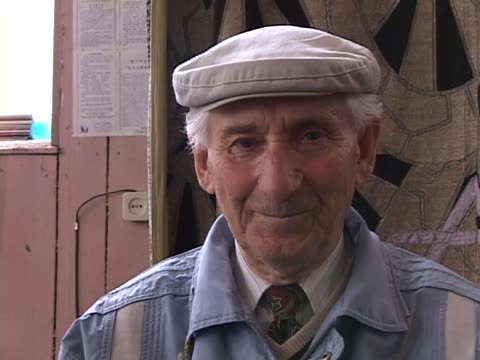
The camera cuts to a formal interview with Semyon Semyonovich Krotsh (b. 1922 in Stefanesti). Krotsh answers questions from the AHEYM dialectological and sociolinguistic questionnaire and speaks about the influence of Romanian and other languages in Yiddish.
From the machine transcript
At the start of his interview, Krotsh answers Kerler's questions on language differences between towns and on Romanian loanwords used in Yiddish. He names the word for the wash tub (magalnitsa), the pharmacy, the railway station and the word for certainly (?), and explains that flowers were not brought as gifts. At a wedding the gift was money.
Krotsh briefly discusses prewar Jewish weddings that he remembers from his youth and describes his shtetl’s various synagogues. He also shares memories of religious life and particular customs, such "leygn tfiln” (putting on phylacteries) and going to the "mikve” (ritual baths).
From the machine transcript
Krotsh describes a prewar wedding canopy set up in the middle of town near the synagogue. He talks about the town's synagogues, including a two-storey high synagogue, and the nearby mikveh. His father taught him to put on tefillin, and his bar mitzvah took place in a synagogue with cake and brandy.
Krotsh recites the words from a song entitled "In a kleyn shteytele” (In a Small Shtetl) that he heard from Ukrainian Jews. He then sings a short fragment of the song.
From the machine transcript
Krotsh recalls the words of a song about a small shtetl, a tailor and his beautiful daughter, attacked by bandits, and recites its plea to God. He says he heard the song in Ukraine and learned it from Vider's performance the day before. He sings a short fragment.
Krotsh answers other questions related to Yiddish linguistics, discussing religious customs, such as "tashlikh” (going to the river on the Jewish New Year to rid oneself of sins). He also speaks about his visit to his hometown in Romania in the postwar period and begins to detail his family’s wartime experiences.
From the machine transcript
Krotsh answers questions on old words and tashlikh, and names the small river at Ștefănești. He describes visiting his hometown at the Prut border in the early 1960s, after 17 years away, and the paperwork problems he had getting a passport. He begins his wartime account: in 1940 he and a brother crossed to the Soviets while his father and mother stayed.
This tape consists of a formal interview with Semyon Semyonovich Krotsh (b. 1922 in Stefanesti). He speaks about his visit to Botoșani in Romania in the postwar period where his father lived after the war. Krotsh visited the town again most recently about five years ago, and reports that there are no Jews left there or in any other small towns. Krotsh also speaks in general about Romanian Jewry after the war and their mass emigration to Israel.
From the machine transcript
Krotsh recalls his father, a gabbai in Botoșani, and the father's friendships with rebbes and his hope of seeing his children again. He says no Jews are left in Botoșani or in the small towns of Romania, apart from perhaps a few in Iași and Bucharest. He describes how Jews left Ștefănești for Israel after the war, with the militia itself urging the last ones to go.
Also covers his father's rebbes and a Sabbath/holiday drink custom.
Krotsh details how he came to live in the Soviet Union beginning in 1940. Krotsh left Romania for the USSR in order to be with brother and other friends who were already in that country. He worked in a Moldovan village as a tailor for a year before the war broke out, and was then evacuated to the Caucasus region, working in several kolkhozes (collective farms). When the Germans took Rostov-na-Donu, he was evacuated further into Azerbaijan where he got sick with malaria while working on yet another kolkhoz.
From the machine transcript
Krotsh tells how in 1940 he left Romania, at seventeen, to join his brother in Soviet Bessarabia, and how he crossed the border at night with the parents' blessing. He describes the Soviet officers' order to leave the border zone and a year of work in Moldovan villages. After the war began he describes the flight eastward through kolkhozes to Azerbaijan, where he caught malaria and was hospitalised.
Gives the border crossing and the family farewell in detail.
Krotsh then discusses life on this latter kolkhoz in detail. He talks about his work in a dairy factory as well as the difficulties he and many other Jews faced in their agricultural labor.
From the machine transcript
Krotsh talks about kolkhoz life in the Krasnodar region. As a tailor with no Russian and no farm experience, he was sent to drive oxen. A Jewish brigadier and chairman from Bessarabia taught him the work, and he came to be shown off as a model kolkhoz worker. He then describes leaving the kolkhoz with his brother and working at an oil factory before being drafted.
Includes the language difficulty and the Jewish chairman who taught him.
Krotsh was drafted into the Red Army in 1942, at which time he left the kolkhoz for Baki Sähäri (Baku) where he was cured of his malaria. Krotsh talks about life and work in the city, telling stories about his initial assignment as a factory laborer and then as tailor under the direction of a Jewish couple.
From the machine transcript
Krotsh describes being drafted and sent to Baku, where he was cured of illness and worked hard on little bread. He tells of being registered as a tailor, an argument over the order to stop working, and meeting a Jewish couple, the Levitskys, who gave him work. He also recalls a Jewish woman's home with portraits of Lenin and Stalin and says he became a well-known tailor there.
Adds the Jewish couple and Russian-language dialogue he quotes.
Krotsh was demobilized in 1947, after which he worked two more years in Baku. After a brief stay in Chernivtsi, he was convinced to move to Kolomyya. He then shares other stories about work and life in Baku in the immediate postwar period.
From the machine transcript
Krotsh recalls being demobilised in 1947 and that he returned to work in Baku. He tells of a theft at his workshop and how he declined an offer from the owner. He speaks of making a coat for a woman whose husband turned out to be a Romanian-born acquaintance, who tried to persuade him to stay. He decided to travel to Chernivtsi rather than Odesa. Kerler comments on Chernivtsi as a Jewish centre; they close with his belief in fate.
Gives the reasons for his choice of Chernivtsi and some stories of work in Baku.
Krotsh shares his views on fate, G-d and religion. He discusses postwar Jewish religious life in Kolomyya, mentioning the clandestine prayer groups that would come together in private homes on holidays and important communal dates. He then speaks about the history of Kolomyya’s various synagogues.
From the machine transcript
Krotsh speaks about fate and about his standing in the community, and recalls secret prayer groups in private homes in Kolomyya for yortsayt and other occasions. He remembers a cantor named Pinsky and a Purim megillah reading. He then describes Kolomyya's former synagogues, the buildings that remain, and how to reach them by street, with Kerler asking about their location.
Adds a Purim megillah reading and directions to the surviving synagogue buildings.
Krotsh shares his views towards Christianity and discusses the Yiddish terms he knows for Jesus.
From the machine transcript
Kerler asks how Yiddish speakers refer to Jesus. Krotsh says there was no such term for a son of God and gives a name (?) which he recalls from Pinsky, while the Romanian form is quite different. The talk turns back to what Pinsky said about the yeshiva.
Another AHEYM interviewee, David Abramovich Vider (b. 1922 in Sighetu Marmatiei), joins the conversation. Krotsh sings a fragment of the song "Ot Azoy” (Just Like That) and Vider sings a fragment of the song "Ikh ken a maysele” (I Know a Short Story).
From the machine transcript
Kerler asks Krotsh for a song and prompts him, but Krotsh says he does not remember the songs. A second interviewee then tells a story, of a poor tailor and his daughter attacked by a bandit, and Kerler asks questions about it. Other talk concerns signing a paper and a wedding saying. The transcript does not clearly show the songs named in the catalogue.
Adds a story told by Vider, in addition to the song request.
This tape is a continuation of a formal interview with Semyon Semyonovich Krotsh (b. 1922 in Stefanesti) and David Abramovich Vider (b. 1922 in Sighetu Marmatiei). The group talks about the researchers’ potential future visits and what gifts they should bring for the interviewees. Krotsh and Vider pose for photos.
From the machine transcript
Closing talk in the synagogue about a video of the singing and prayer, and the possibility of sending it to the participants, plus the cassettes of Jewish music that were promised and brought. Kerler says he hopes to come again, then photographs are taken of the two men together, who are addressed as fellow countrymen, and the group goes off for a meal.
Adds Kerler's talk of sending a video and cassettes of Jewish music, and his hope to return.
The group leaves the synagogue for lunch, while the camera follows Krotsh, Vider and the AHEYM team chatting and walking through the streets of Kolomyya.
From the machine transcript
The group walks through the streets of Kolomyya towards a restaurant. One of the men briefly recalls performing in a Purim play, and there is chat in Yiddish and Russian about directions and ordering pizza. Katz asks someone to repeat a question about how something was said.
Adds a mention of a Purim play and Kerler's invitation of the guests into a restaurant.
Once in a restaurant, Vider tells anecdotes and talks about recent changes in the city. Krotsh tells an anecdote about Christian-Jewish relations.
From the machine transcript
In the restaurant one man tells a story about a worker who drank in a factory office to get hired and found two drunk directors, and another tells about repairs of the city streets paid by money from Americans from Kolomyya. S3 then tells a story about a Christian woodcutter who is invited to a Jewish Sabbath-eve table, eats the fish and kugel and asks the Jew why he studies the prayer book so much. Kerler comments on the answer.
Adds the anecdote about the drunk job-seeker and the funded street repairs, and the Sabbath-table story.
The camera cuts to the team driving to the home of the next interviewee in the village of Popel’niki.
From the machine transcript
Short, partly garbled stretch while the team drives to the next interviewee's home in Popel'nyky. Katz and others repeat a phrase about Beis-Yaakov, then Kerler introduces himself and his colleague to the new host.
Formal interview begins with Aron (Urn) Kalmanovich Biter (b. 1918 in Popel’niki). He discusses the prewar history of the village and its eighteen Jewish families. He also talks about his education in a "kheyder” (traditional Jewish religious boys’ school) and a Polish-language gymnasium. Biter shares his memories of prewar family life, noting that his father served in the Austro-Hungarian army during the First World War and how his family changed their surname from "Shafir” to the less Jewish-sounding "Biter”.
From the machine transcript
Biter says he was born in Popel'nyky, where there were eighteen Jewish families, in what was then Poland, and that he finished a Polish gymnasium after cheder. He explains the change of his name from Shafir to Biter, which was required by lawyers and the diploma, and mentions his father Kolmen, who served as a corporal in the Austro-Hungarian army in Italy. His grandfather was a tavern lessee and his maternal grandfather a lawyer in Snyatyn. Kerler also asks distances to Kolomyya, Zabolotiv and Snyatyn and the interview date.
Adds the distances to nearby towns, the date, and Kerler's talk about his own dress and background.
Biter speaks in greater detail about his family’s name change and the work his parents, Kolmen and Yeti had before the war. He then shares his wartime experiences, beginning with a pogrom in the village in 1941 led by local Ukrainian nationalists before the Germans invaded the town. When the town’s Jews were deported, Biter jumped from a train window and wandered from village to village, surviving with the help of non-Jewish friends. Biter was eventually able to arrange false papers that stated he was an ethnic Ukrainian and worked for the Germans in a village for the rest of the war.
From the machine transcript
Biter explains the reason for the name Biter, gives his birth year as 1918 and names his parents Kolmen and Yeti and his grandfathers; his father was a middle landowner. He describes the 1941 pogrom by Ukrainian nationalists, forced labor, deportation to Snyatyn and a train toward Ivano-Frankivs'k, from which he jumped through a window. He was helped by three student friends, got papers as a Ukrainian under a different name and worked for a German estate until the end of the war.
Adds the details of the parents' work, the three friends and the false papers.
When the town was liberated by the Soviets, Biter was accused of collaboration and exiled to Siberia where he labored in the city of Noril'sk from 1944 to 1952. When he returned to his native village, Biter learned that the other Jews of the town had all been killed. In the postwar period, Biter worked as an accountant on a kolkhoz (collective farm) in the surrounding five villages.
From the machine transcript
After the Soviets returned Biter was questioned about how he survived and was accused of working for the Germans. He was sent to Norilsk, where he says he was held from 1944 to 1952, first at hard labor and later as an accountant. On his return he found his family murdered and houses destroyed, and then worked as an economist on a collective farm covering five villages.
Adds the detail of the later work as accountant and economist on the collective farm.
Biter speaks in greater detail about prewar family life mentioning that his father immigrated to Canada, where he lived for three years and worked on the land. His grandfather held an arrenda (leasing right) and operated a tavern. Discussing prewar religious life in his village, Biter states that there were two "minyonim” (prayer groups of ten or more adult men) in his village; as such, communal functionaries, such as a shoykhet (kosher butcher) and kheyder teacher visited regularly from nearby villages. Biter briefly describes how he was given his "lapsterdekl” (lit. "small coat,” i.e. "talis kotn,” or Jewish male ritual garment) at the age of thirteen. Biter explains that his father wanted him to be a religious Jew, but his maternal grandfather, who was a Reformist and worked as a lawyer insisted he attend the nearest gymnasium in Snyatyn. Graduating in 1938, Biter then attended an agricultural lyceum.
From the machine transcript
Biter returns to his family: sisters Rachel and Siman, his mother as housewife, and his father's three years in Canada. His grandfather Abraham leased and ran a tavern in the village, there were two minyans, and the cheder teacher and a shoykhet came from nearby villages. He received the lapserdak at thirteen; his father wanted him religious but his maternal grandfather, a reform-minded lawyer, sent him to the Snyatyn gymnasium, 1934–38, and then he spent three years at an agricultural lyceum near L'viv.
Adds the lyceum, the shoykhet from a neighboring village and the grandfather's reformist views.