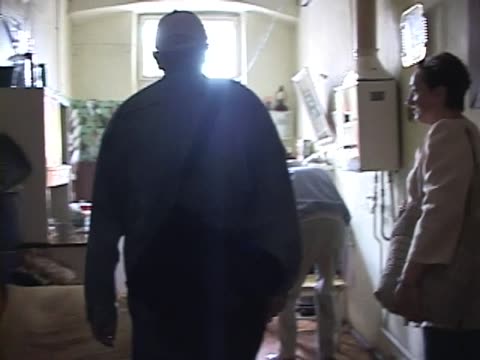
Krotsh takes the team to the next interview with Vider. The team greets Vider at the front door of his house. They then go inside to set up the interview with Vider.
From the machine transcript
The team greets Vider at his door and goes inside. Kerler recalls their trip to Hîrlău, where they found a very old Jew and the one synagogue still standing. The Yiddish is mixed with Russian remarks about filming and the rain, and Kerler remembers a song Vider used to sing.
The team also talks with Vider about Hîrlău and its surviving synagogue.
Vider speaks about his life today. He then mentions that he studied at a yeshiva in Iaşi, as well as speaks about his family. Vider states that his father died in a pogrom before the war.
From the machine transcript
Vider talks about his health and about past synagogue life, including Rosh Hashanah and being called to the Torah. He confirms that he studied at a yeshiva in Iași, which he calls a beautiful city. Kerler asks about the 1939 pogrom there, and Vider speaks of killings by Cuzists and someone being shot; the transcript does not make clear who. Much of the rest is wishes for health, talk of gifts and medicine, and Russian side remarks.
The transcript also shows synagogue and Rosh Hashanah memories, and that the pogrom account is unclear on who was killed.
Vider speaks about his life today. The team then shows Vider his own recording about a Purim shpiel.
From the machine transcript
Vider talks about his illness and condition today while Kerler prepares to show him a recording of himself performing in a Purim shpiel. Vider also tells of being a matchmaker and of knowing a little Gemara. He tells how a house near the station in Kolomyya was sold and a skeleton, said to be of Jews about two hundred years old, was found in its cellar; he names Shloyme as his source.
Vider also tells of a skeleton of Jews found in a cellar of a house sold in Kolomyya.
Vider sings a Yiddish song about a Ukrainian town. The team also plays Vider a recording of the song.
From the machine transcript
Vider begins to sing a Yiddish song about a poor tailor and his daughter in a small Ukrainian town, but breaks off because he cannot remember the rest. Kerler then looks for and plays an old, poor-quality recording of the song for him.
The team plays Vider his recording of andquot;Yom Purim.andquot; Vider then recites a Romanian song he remembers from his school education. He also speaks about Moldovan visitors to his hometown before the war.
From the machine transcript
Kerler plays Vider his recording of a Hebrew Purim item, and Vider says he remembers it. Vider recalls the Romanian songs he learned at school and sings several, and Lemster, who speaks Romanian, asks who wrote one; the poet's name is unclear in the transcript. Vider also recalls Moldovan wine-grape sellers who came to the market before the war. Lemster asks whether there were Romanian songs about Jews.
The passage also covers the Moldovan grape sellers and Lemster's question about Romanian songs on Jews.
Vider sings another Romanian song from his childhood.
From the machine transcript
Vider sings more Romanian songs, apparently learned in childhood, and says he has forgotten parts of them. Lemster and Kerler comment, and a woman offers him something to take.
Vider speaks about his first wife who was Jewish and his life after the war. He also mentions his sister's family.
From the machine transcript
Vider speaks about his first wife, who was Jewish and a communist and worked in Germany until the end of the war. He says he could not live with her. He recalls his sister and brother-in-law, who died, and how he took over their house and cooked and baked, including gefilte fish, for a family wedding. Some details are unclear in the transcript.
Vider speaks about his family. His father was a kosher butcher and religious teacher (melamed). He then addresses Hershl Ostropoler stories.
From the machine transcript
Vider tells that his father was a shoykhet who pitied the animals, and that the family had six children. His father also served as cantor in the synagogue on Simchat Torah in Iași. Lemster asks whether he knows of Zelig Barditshever. Vider recalls reading Hershl Ostropoler stories in Romania and describes a tailor neighbor who was a freethinker. Lemster also asks about a Romanian song on the tallis.
The passage also covers Lemster's question about Zelig Barditshever and a freethinking tailor neighbor.
Vider speaks about his life before the war. He states that he was hasid of the Botoșani rebbe. Vider also recalls prewar cultural performances by a cantor.
From the machine transcript
Vider says he was a hasid of the Botoșani rebbe, whose name he no longer remembers. Kerler asks about the Ribnitser rebbe, and Vider says many rebbes visited for Sabbath and holidays and took pidyonot. Lemster asks about Yiddish theater in Iași, which was crowded, but Vider says he did not go. He preferred listening to cantors and still plays the cantorial cassettes Kerler gave him.
Vider briefly speaks about his life during the war in Russia. He then speaks about his life and friends before the war. Vider moved to Hîrlău from his birth town Sighetu Marmaţiei at the age of three. Vider lived in Hîrlău for ten years and then moved to Iaşi, where he attended a yeshiva and learned carpentry. Vider then explains how his mother convinced him to learn an easier profession and hence became a tailor.
From the machine transcript
Vider briefly tells of the war in Russia, where Jews were at first not taken into the army, and says he fell ill and the doctors would not let him go. Lemster asks about Itsik Manger and drinking songs. Vider says he was born in Sighet, moved to Hîrlău at age three and stayed about ten years. He mentions a younger brother who was killed, then went to Iași to study at a yeshiva. He wanted to learn carpentry, but his mother, helped by relatives in America, persuaded him to learn tailoring as an easier trade.
The passage also includes Lemster's questions about Itsik Manger and drinking songs, and a younger brother who was killed.
Vider describes how he worked with Krotsh in the 1950s. The team then concludes the formal part of the interview with Vider.
From the machine transcript
Vider speaks about working as a tailor in the 1950s alongside others, and Kerler asks whether the others were Jewish. Before leaving, Kerler asks what more Vider wants to say about Iași, Sighet or Hîrlău, and the formal interview ends with thanks.
The camera records Krotsh's singing outside. He sings about a woman cheating on her husband. The team then bids farewell to Krotsh and the camera collects town footage of Kolomyya.
From the machine transcript
Another man, probably the local contact the catalogue calls Krotsh (?), sings a comic Yiddish song about a wife who is unfaithful to her husband, and Lemster and Kerler comment on it. The team then says goodbye to the participants with thanks and wishes for health, in Yiddish and Russian. At the end Kerler talks about a Yiddish word for scanning.
The singer in the transcript is the second man, S2, and the passage ends in farewells and a short discussion of a word.