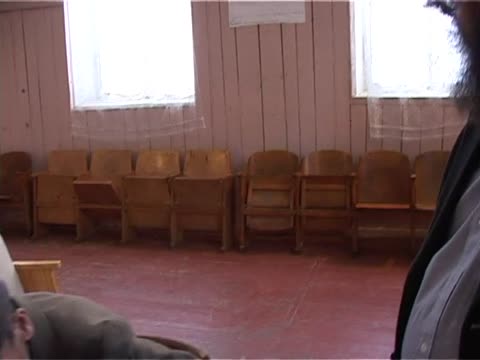
This tape consists of a formal interview with David (Duvid-Hersh, or sometimes Duvid-Tsvi when called up to the Torah) Abramovich Vider (b. 1922 in Sighetu Marmatiei). He provides Professor Kerler with a brief tour of the synagogue and a look at its old Torah scrolls, and discusses Kolomyya’s contemporary Jewish religious community. Vider talks about his traditional religious education in a yeshiva, where he learned to speak Hebrew. Vider’s father Avrum-Mayer worked many jobs as a shoykhet (kosher butcher), melamed (religious teacher) and a khazn/bal-tfile (cantor and/or prayer leader). Vider states that he remembers all the prayers and liturgy he learned. He briefly describes how he and his father once led Simkhes-Toyre (Simchat Torah) celebrations together. Vider then shares his and his family’s basic biographical details. He was born in the town of Sighetu Marmatiei, moved with his family at the age of three to Hîrlau, and then moved again around the age of twelve to Iași where he attended yeshiva.
From the machine transcript
Greetings and introductions at the synagogue in Kolomyya, then a short look at the synagogue: Vider says few Jews are left, that a minyan is possible mainly on holidays and sometimes on Sabbath, and that there are two old Torah scrolls. He mentions the community's prayer leaders and his own study of Hebrew in yeshiva in Hîrlău and Iași, and his father's work as shoykhet, teacher and cantor. He gives his birth in Sighet in 1923 (?), the move to Hîrlău at three and to Iași at about twelve, his family name and double name, and his father's name Avrum-Mayer, and he states his address and telephone number. At the end he begins to talk about going to Russia.
Also covers his names, family names, address and telephone, and the grandfathers' names.
After some audio and logistical problems, Vider continues, explaining that he moved to Russia in 1940 without knowing any Russian. At the age of eighteen, he began working in a mining town in the Urals and then worked for some time as a mechanic in the Garagum (Kara-kum) desert in Turkmenistan, where he earned a decent living, but hated living in that area. After that job, he worked in a mine in the L’viv area, staying there until the age of seventy, at which time he retired to Kolomyya, a town he had visited often as his sister lived there. Vider learned how to cook and bake a whole repertoire of traditional Jewish foods from his sister, and he shares a recipe for chicken liver.
From the machine transcript
Vider recalls moving to Russia in 1940 without knowing Russian. He worked in a coal mine in the Urals from about eighteen, spent years as a mechanic in the Karakum desert in the heat, and then worked in a mine in the Lviv region until retiring at seventy. He retired to Kolomyya, where his sister and brother-in-law lived and died, and where he learned cooking and baking from her; he describes how he prepares fish and fills a chicken neck, and remembers his parents' cooking and his father's Sabbath challahs.
Adds his mother's and father's cooking and baking and his siblings' deaths.
Vider returns to the subject of his family life before he moved to the Soviet Union, richly describing shabes (Sabbath) and Passover celebrations, as well as his five siblings’ life stories.
From the machine transcript
Vider describes the Sabbath and Passover at his parents' home before he left: the candles, kiddush, the challahs, the father seated at the seder, and the four questions, with poor guests staying over. He names his brothers and sisters, their fates and nicknames, including a brother killed in Palestine and a father and another brother shot in 1940 (?). He also talks about cholent kept in the oven and about kugel, for which Kerler asks the Yiddish word.
Adds the siblings' names, the seder, and the kugel/babke terminology question.
Vider shares his recipe for tshulnt (cholent, slow-cooked shabes stew) and discusses shoykhtim (kosher butchers) and the different kinds of meat dishes, including pastrami and geese that they would prepare.
From the machine transcript
Vider tells what went into the Sabbath cholent and speaks of the kosher butchers and slaughter in his hometown, including separate shoykhtim for poultry and for cattle. He recalls a Jew who fattened geese and made pastrami and smoked meat, and describes how he now prepares meat himself, stuffing it with garlic and pepper; Kerler asks for the Yiddish word for the bread box.
He sings a loshn-koydesh (the Hebrew-Aramaic "holy tongue” of prayer and liturgy) song that he learned while a student in the Beys-Arn Yeshiva. He describes the yeshiva’s teachers and curriculum, and recites some of the Hebrew grammar and verb conjugations that he remembers. Vider also explains the difference between a "rebe” and a "ruv”.
From the machine transcript
Vider sings a Hebrew song from his time in the Beys-Arn yeshiva in Iași and talks about its teachers, naming a rebbe (the name is uncertain in the transcript), and about the modern Hebrew he studied, reciting some grammar and verb forms. His sister later tried to study Hebrew in Palestine. He then explains the difference between a rebbe and a rov: a rov is asked questions of law, such as whether an animal is kosher, while a rebbe is a Hasidic rebbe.
Adds the rebbe/rov distinction and his sister's attempt at Hebrew studies in Palestine.
Growing up, Vider was a khusid (Hasid, follower) of the Botoshaner Rebbe who lived in Iași. He and his family would go to the Rebbe for the high holidays. Vider studied for three years to become a tailor, but he did not enjoy the work, so he moved to the Soviet Union, where he thought he could earn a better living.
From the machine transcript
Vider says he was a Hasid of the Botoshaner Rebbe in Iași and went to him for the High Holidays and for selikhes, and took part in prayers there. After the yeshiva he trained three years as a tailor in Iași, disliked it, and left for the Soviet Union. He also recalls working as a tailor during the war and sharing bread with hungry people.
Adds the wartime bread-sharing episode.
Vider further describes the court of the Botoshaner Rebbe in Iași, detailing the baking of matzos and making of wine there. Vider then shares a fragment of the Rebbe’s "nign” (wordless melody) and sings a special "shir hamaloys”. Vider states that he used to sing this song and others when he went fishing and that is how he has remembered everything.
From the machine transcript
Asked by Kerler, Vider describes the Botoshaner Rebbe's court in Iași, with its garden, the baking of shmure matzo before Passover and the making of wine in autumn. He begins to sing one of the Rebbe's melodies and says he remembers other niguns; Kerler asks to hear more.
Adds the wine-making detail.
"Shir Hamaloys” (Song of Ascents).
From the machine transcript
Vider sings a Hebrew Psalm-like song, probably a shir hamaloys, in a long stretch of sung Hebrew that the transcript renders poorly. Afterwards he explains that he remembered such songs from his years in Chervonohrad, where he went fishing on the river Buh by bicycle, singing as he rode. Kerler then asks about Sabbath zmires.
He sings fragments from several shabes zmires (paraliturgical songs), including "Ko ribon,” and "tsur misheloy”.
From the machine transcript
Vider sings brief fragments from the Sabbath songs (zmires) in response to Kerler's questions, saying he remembers a lot but that his memory is going. He says he is now eighty-something.
Vider talks about his prewar family life, focusing on his mother and father’s work, the family house in Hîrlau, and that town’s geography. He comments on the Yiddish dialect differences in the places he lived in his youth, and speaks about Kolomyya’s synagogue and contemporary Jewish community. Vider reports that he reads and writes in Yiddish. He shares his attitudes towards different dialects and talks about different people in Kolomyya with whom he speaks in Yiddish.
From the machine transcript
Vider speaks about his mother as housewife and his father's work, and about the family house in Hîrlău, which was washed away in a flood, and his father's business as a forest leaseholder. He compares his Transylvanian Yiddish to what he met in Iași, says he reads Yiddish and had a fine Yiddish script, and discusses Kolomyya Jews who speak Yiddish and the Podolian visitors' speech. The passage ends with Kerler asking about a Kolomyya man named Greif, born there, and the telephone numbers of local Yiddish speakers, and then returning to the Rebbe's court.
Adds the Yiddish speakers of Kolomyya and Kerler's search for a local-born speaker.
Vider discusses his family relationship with the Botoshaner Rebbe, noting that he officiated his sister’s religious wedding. He also speaks about Jewish weddings and match-making in general. Vider also shares his memories about the Rebbe’s wife, family and court, and mentions that his mother’s cousin, Reb Mayer was a khazn (cantor) and tsadik (righteous holy man).
From the machine transcript
Vider tells how his parents, before they were married, were brought to the Botoshaner Rebbe, who gave them a religious wedding, while the civil registration was done separately. He says he was too young to remember Jewish weddings or a badkhn well, and recalls matchmakers, the Rebbe's gabbai and payments and gifts to the Rebbe. He tells of a cousin of his mother, Reb Mayer, a cantor and righteous man who owned a mill and was paid well for singing in Iași, and of the Rebbe's wife and three children, whose names he gives; he cannot recall the Rebbe's full name.
Adds the Rebbe's wife and daughters' names and the gabbai's fundraising.
This tape is a continuation of a formal interview with David Abramovich Vider (b. 1922 in Sighetu Marmatiei). The tape begins with a discussion of the concept of "a giter yid,” (lit. "a good Jew) to whom Jews and non-Jews would go on pilgrimage to receive advice and/or healing. Vider describes how Orthodox Christians from around the region today come to him, calling him "dobryi evrei” ("a good Jew”), paying him, so the Jews in the Kolomyya synagogue will pray for them and thus solve their problems. Telling a few stories of such "pilgrims,” Vider explains that he writes the names of these Christians down in a special notebook and uses their money to pay for community celebrations.
From the machine transcript
Kerler asks what 'a good Jew' means; Vider explains that Orthodox Christians from Kosiv, Kolomyya and nearby villages come to him, knock on his window, and ask him to write down their names so that prayers are said for their troubles, such as illness, a failed love or a wedding. They pay him a few rubles, and he uses the money for the Sabbath kiddush after prayers in the synagogue. He tells several stories of such visitors, says he gives no guarantees, and mentions the rabbi who came to the synagogue.
Also covers the kiddush gatherings, a visitor who promised a gift after his wedding or a trip to America, and the rabbi's role.
Vider briefly shares the history of the Kolomyya synagogue and how these pilgrimages began. He also talks about his two marriages: Vider’s first marriage was to a Communist Jewish woman; he is now married to a Christian woman from Kolomyya. Vider had no children with his first wife, nor did they get married under a "khipe” (wedding canopy) as she was a committed Communist. He shares some details of his difficult relationship with his first wife. Vider also mentions that he enthusiastically listens to records of cantorial music.
From the machine transcript
Vider says when the synagogue reopened and how the first Christian visitors came, including an old woman from Kosiv with a sick child. He talks about his two marriages: twenty-eight years with a Jewish Communist wife, with no children and no wedding canopy, and a difficult relationship in which they lived apart for four years. His present wife is a Christian woman who attends the Hesed centre and is liked there. He listens to cantorial recordings at home.
Adds the opening date of the synagogue (unclear figure), the Hesed centre, the second wife's name, and the cantor recordings.
Vider details his early education in the Jewish schools in Hîrlau where he studied in Yididsh in the morning and in Hebrew in the afternoon. School met six days a week, according to Vider, and taught Modern Hebrew similar to what is now spoken in Israel. Vider then sings HaTivka.
From the machine transcript
Vider describes his Jewish schooling in Hîrlau, a Romanian-Jewish school where Yiddish and Hebrew were taught and the old pronunciation of Hebrew used. He studied until about age twelve, then moved to Iași. He recalls singing Hatikvah there and sings part of it for Kerler.
Adds the hours of Yiddish and Hebrew instruction and the school's name and head.
He briefly mentions his "bal-mitsve” ("bar mitzvah,” or coming of age ceremony).
From the machine transcript
Vider talks briefly about his bar mitzvah. Rabbis came from Palestine, and he had a tallit but no tefillin yet. He says he cannot recite the whole prayer.
Vider states that he remembers and recites the traditional blessings to be said upon hearing thunder, seeing lightening or a rainbow, and on other occasions.
From the machine transcript
Vider speaks about the blessings said on seeing a rainbow, hearing thunder, seeing lightning and similar occasions, and recites some of them. Kerler asks about the grace after meals, but Vider does not remember a tune for it.
Vider describes a "pirimshpil” (Purim play) that he would put on with his brother in which he played a chimney-sweep and his brother dressed as a woman. He then recites the whole rhyming ditty they would sing and repeats it again for the sake of clairty. He explains how they performed this skit around the neighborhood in Hîrlau and Iași, and received money, candies and wine for their efforts.
From the machine transcript
Vider describes a Purim play he performed with his brother in Hîrlau and Iași, in which he was dressed as a chimney-sweep and his brother as a woman. He recites the rhymed dialogue (a chimney-sweep seeking a bride from a fine family) and repeats it more slowly at Kerler's request. They received money, sweets and wine from the households they visited.
Vider recites what he refers to as another "pirimsphil,” a loshn-koydesh (Hebrew-Aramaic) and Yiddish song called "A gemakhtn got hobn zey” ("They have a manmade god”) based on a part of the Hallel service.
From the machine transcript
Vider recites a Purim piece in Hebrew and Yiddish, based on a passage of Hallel, that mocks idols made by human hands. Kerler interrupts to ask him to sing the entire song.
He discusses his current health problems.
From the machine transcript
Vider briefly talks about his current health: a throat problem and a cold, medicines he buys, and a doctor who visits twice a month.
Vider recites the lyrics and then sings a song entitled "Ven futer yakoyv iz geleygn oyf deym shteyn” ("When the Patriach Jacob Slept on the Stone”) which he remembers hearing from a cantor at a concert.
From the machine transcript
Vider recites and then sings a song about the patriarch Jacob sleeping on the stone, a song about a dying father and an orphan asking the cantor to say kaddish with him. He remembers it from a cantor's concert in his childhood in Hîrlau. At the end he starts another song.
Vider sings another song in Yiddish, consisting of a dialogue between a daughter and mother.
From the machine transcript
Vider sings a Yiddish song consisting of a dialogue between a daughter at night and her mother, who refuses to let her in. Kerler praises how well he remembers it and asks about another song his father taught him.
Professor Kerler discusses the logistics of finding other interviewees with a woman from Hesed.
From the machine transcript
Vider says the song he mentioned belongs to the morning prayer, and Kerler tries to look it up. The rest is mostly Russian talk between Kerler and a woman from the Hesed about finding other interviewees: telephone numbers, a minibus outside, and an elderly woman. She praises Vider's talents, character and cooking, and Kerler explains why dialect speakers from the Kolomyya region matter.
Adds Vider's remark about the prayer and the Hesed woman's praise of Vider.
Vider reads the loshn-koydesh portion of "A gemakhtn got hobn zey” from a prayerbook and then sings the song once more in full.
From the machine transcript
Vider reads the Hebrew portion of the song about the idols from a prayerbook, then sings the Yiddish song in full. Kerler asks whether he remembers it from Hîrlau, and Vider says yes.
He then sing another "pirimshpil” entitled "Got hot indz gegebn tsvey gite simunim” ("G-d gave us two signs”) that he and his brother used to sing while performing another skit dressed as a rabbi and his wife. Vider states that he learned all these songs and ditties from his father, who was well-educated and encouraged his children’s learning. Vider’s father was especially adept at mathematics, and Vider shows Professor Kerler how his father counted on his fingers in a special way. Vider then switches into Russian to demonstrate another mathematical trick that he learned from his father.
From the machine transcript
Vider sings another Purim piece, about God sending Moses as a matchmaker for a wedding, which he and his brother performed dressed as a rabbi and a rebbetzin. He says he learned these songs from his father, a learned man and mathematician, and shows Kerler his father's finger-counting method for multiplication. He then switches into Russian to demonstrate another arithmetic trick with three-digit numbers learned from his father.
Vider answers questions from Professor Kerler’s sociolinguistic and dialectological questionnaire. He also speaks about how his mother made "khale” (special bread for the Sabbath).
From the machine transcript
Answers Kerler's questionnaire items on the Yiddish word for a Romanian-borrowed term ("mult"/"mai mult"-type words for 'more'; Romanian equivalents are discussed), and on the parashah of his bar mitzvah, which he does not remember. He then describes how his mother baked challah in Hîrlau and Iași: the Thursday-night dough, the braiding on Friday morning, the blessing and the piece thrown in the fire. He mentions the outdoor oven and cholent put in it.
The elicitation also covers a Romanian equivalent and the bar mitzvah portion, and the mother's baking is placed in both Hîrlau and Iași.
Vider describes holiday observances in great detail, focusing first on Rosh Hashone, Yom Kippur and the recitation of slikhes (penitential prayers) done during that season. He also explains how sikes (Sukkoth, the Feast of Tabernacles) was celebrated and sings part of the "hoshone robe” services he remembers, comparing these observances to contemporary celebrations of the holiday. He also talks about how Chanukah and Purim were celebrated and the food and games that went with this respective holidays.
From the machine transcript
Vider answers Kerler's questions about the Jewish year as he remembers it from Hîrlau: the days before Rosh Hashanah and Yom Kippur with slikhes, going to synagogue with his father, the pre-fast meal, tashlikh, and shmura matzo baked at the rebbe's. For Sukkot he describes the sukkah and its roofing, the etrog and lulav, and the hoshana rabbah/Simchat Torah hakafot, singing a few lines. He then speaks of Hanukkah candles, songs and money, and foods for Hanukkah and Purim (latkes, pancakes of potato or flour, krepl), and the dreidel.
Also covers the food terms (latkes, panchikes, krepl, ripleniks) and the baking of potato dishes in an earthen pot, with Transylvanian origin of some terms.
Vider explains "shpiln in nis,” a gambling game involving nuts played by children during Passover and Sikes (Sukkoth). Vider talks about the different dairy food eaten during shvies (Shavuot) and shares a recipes for "plitnikes” (a sort of blintz).
From the machine transcript
Vider explains the children's nut game played in a hole during Passover and Sukkot, including the eight-nut rule for the stakes. Asked about Shavuot, he says only dairy dishes were eaten, among them blintzes, which in Hîrlau were called plitnikes (the word is repeated and checked). He gives a detailed recipe: batter of flour and milk with salt and oil, poured thinly in the pan and turned like a pancake, and filled with cheese.
Vider shares his attitudes towards different dialects of Yiddish, and mentions the many Yiddish-speaking non-Jews he met both in Romanian and the Garagum (Kara-kum) desert in the Soviet Union.
From the machine transcript
Vider talks about Yiddish dialects and accents, including how Jews and non-Jews spoke it. He recalls Romanian non-Jews in Hîrlau who spoke Yiddish, such as servants in Jewish homes, and a Polish Christian cook whom he met in Yiddish-speaking circles. He also mentions actors, apparently on Russian-language stage and screen, who speak Yiddish-like speech. Kerler asks whether he spoke differently at home.
Adds a remark about the speech of actors, apparently Russian-language stage and screen performers, and the specific Polish woman who spoke Yiddish.
Vider recalls the local and visiting Yiddish theater troupes and circles in Hîrlau. He also describes the Yiddish and Romanian-language newspapers that were read in his youth and discusses Jewish interactions with Romanian anti-Semitic and fascist organizations in the prewar period. He mentions that there were many Zionists group in the towns in which he lived, including Gordonia (of which he was a member), and Shomer HaTsa’ir and Makabi (to which his brother belong). Vider then tells the short story of how his brother emigrated to Palestine after the war.
From the machine transcript
Vider recalls Yiddish children's theater in a cellar and school festivals in Hebrew, Yiddish and Romanian in Hîrlau, then visiting cantors and an actors' club (the Dybbuk is mentioned). He talks about Yiddish newspapers, one of them illegal, and about the Cuzist (Cuza/Codreanu) antisemites who in 1939 (?) wanted to burn synagogues and whom Jews resisted. He says he belonged to Gordonia, while his brother was in Maccabi and later Betar and a chalutz who could not emigrate until after the war.
Adds antisemitic Cuzists and Iron Guard-type groups, children's cellar theater, and the brother's emigration.
Vider briefly discusses the Jewish bathhouse in his shtetl that was used as a mikve (ritual bath) by the town’s men on Friday night before shabes. From this topic, Vider and Professor Kerler discuss the origins and uses of the idiom "firn in bud arayn” (lit. "to lead somone into the baths”). Vider reminisces about the nignum (traditional wordless melodies) sung by his Rebbe. He then sings a loshn-koydesh (the Hebrew-Aramaic language of prayer and liturgy) song that his father would sing at the third meal before the end of shabes.
From the machine transcript
Vider and Kerler discuss the bathhouse with its mikveh in his town and the idiom about leading someone into the bath, which Vider explains as meaning that someone who is not pleasant gets no good treatment. Asked for a wordless niggun of his rebbe, he does not recall one. He sings a Hebrew song his father sang at the third Sabbath meal in the synagogue, beginning with the line "Yedid nefesh"-type text, followed by a few words on a sentence Kerler elicits about the word rov.
The transcript shows the explanation of the idiom and a song actually sung by Vider after attributing it to his father, with lines mostly garbled.
Vider answers more questions relating to sociolinguistics and dialectology.
From the machine transcript
Vider answers Kerler's questionnaire on plural forms of rov/rebbe (rabonim, rebbes) and on the Yiddish term for a good place as a euphemism for a cemetery. He says a cemetery was called a holy place or house of life. They then discuss the word Litvak, Lithuanian Jews and their Yiddish pronunciation, an anecdote about a Lithuanian youth praying in a local synagogue, the word misnaged, and whether he had heard of the Vilna Gaon and the Baal Shem Tov.
Vider reports that he read a good deal of Yiddish literature in his youth in Romania, as his mother had poor vision and he would often read aloud to her. Vider’s mother was a "firzugerin” (women’s prayer leader) in the synagogue, and he describes how the women used to pray.
From the machine transcript
Vider says he read a good deal of Yiddish in his youth, such as Mendele Moykher Sforim. His mother's eyesight was poor, so he read to her. His mother was a leader of the women in the synagogue, the firzogerin: she read the tkhine aloud on holidays and the women cried. He describes the women's section and the praying.
Vider also names Mendele as one of the authors he read; the mother's eyesight is mentioned, but later (s0010) he disputes it.
Professor Kerler and Vider return to the sociolinguistic/dialectological questionnaire. Vider also details how he mother cooked and shares his recipes for "gefilte fish” and other foods.
From the machine transcript
Kerler returns to the questionnaire (the word Galitsianer, and Galicia as then and now Halych) and then asks about Vider's mother's cooking. Vider describes making gefilte fish from pike and carp in detail: choosing fish, onions with sugar and soda, the skin and bones used for the jelly, and his remark that he learned to make it himself. Kerler also asks about petshe (calf's-foot jelly) and about the term brezl (sukhariki).
Also covers questionnaire words (Galitsianer, brezl, petshe) and the story of cooking gefilte fish for a woman who did not know it.
Vider briefly mentions what Yiddish literature he read before and after the war.
From the machine transcript
Vider answers Kerler's questions about the Yiddish books he read: Mendele's Fishke der krumer and other works, which his father also read aloud, Sholem Aleichem, Shmuel Gordon's booklets after the war, and Peretz. He says he took books to the mine, and that Sovetish Heymland came after the war. He adds that after the war he was afraid of the Communists and did not keep a siddur at home. Some details about his mother's eyes are contradicted by Kerler's question.
Vider tells the story of how he learned to speak Russian and, on a related note, how he became a miner in the Soviet Union, in addition tot he other jobs he held. Vider answers further questions from Professor Kerler’s sociolinguistic survey.
From the machine transcript
Vider tells how in 1940 (?) he crossed the border and in Kizel, a mining town, was left alone in the house by a woman who traveled to Belarus. A neighbor, a pharmacist, asked him to alter a coat, and in exchange taught him Russian from a primer, so that he learned to read and write. He worked for ten years in the mines, then did many jobs, including locksmith, carpenter and electrician. Kerler asks questionnaire words from this time: the word for a quilt or bedspread, Yiddish zikhl/tikhl, tvarik, and the residue left after making butter.
Adds the questionnaire items at the end, about terms for bedding and the byproduct of butter making.
This tape is a continuation of a formal interview with David Abramovich Vider (b. 1922 in Sighetu Marmatiei). It begins with the interviewee answering questions from Professor Kerler’s sociolinguistic and dialectological questionnaire. He also recites a fragment from the Yiddish rhyming folk cure "dray vayber zitsn af a shteyn” ("three women sit on a stone”) and shares an anecdote about a Jew in Odesa to explain the idiom "fargoylemen zikh”.
From the machine transcript
Continuation of Kerler's dialectological and sociolinguistic questionnaire with the informant. Items cover vegetable, food and household words (tomato, sausage, brandy, hat, pigeon, building, synagogue), adverbs, kinship words such as 'bobe', the thousand and years, and Russian sentences to translate with pronouns, cases and 'all'. The informant also comments on Romanian and Ukrainian loanwords, the folk belief of the evil eye and a three-women incantation, a dybbuk and a golem, and explains the idiom 'fargoylemen zikh' with an anecdote about a visitor to Odesa.
Also covers a long run of grammatical sentences, Romanian and Ukrainian loanwords, and attitudes to what counts as native Yiddish speech.
Vider speaks about the passing of another David, the current Kolomyya synagogue’s former "bal-tfile” (prayer leader) and shares a few idioms of what is said when a deceased person is mentioned. Vider sings a Romanian song he remembers from his youth. He also talks about other potential interviewees in the town, and shares his views towards Jewish politics in America, Israel and post-Soviet Ukraine.
From the machine transcript
The informant speaks of a David, formerly the prayer leader of the Kolomyya synagogue, and of the blessings said when a deceased person is mentioned. He discusses the two other possible Yiddish speakers in town, how visitors from Israel and America speak Yiddish, and sings a Romanian song from his youth. He gives his views on Jews in America and Israel, on past enemies of the Jews, and on how life under the post-Soviet regime compares with Soviet times, with remarks on the freedom to attend synagogue. He also mentions a niece in Brooklyn and whether Kerler could write to him in Yiddish.
Also covers other possible interviewees and the niece in Brooklyn.