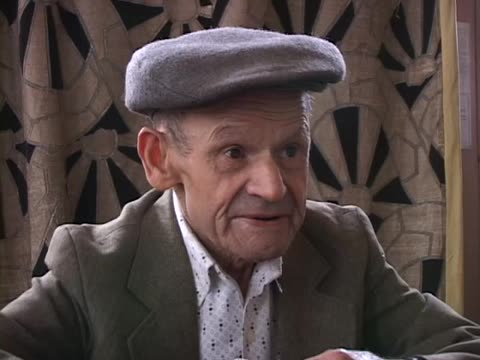
This tape consists of a formal interview with David Abramovich Vider (b. 1922 in Sighetu Marmatiei). He speaks about the contemporary Jewish community in Kolomyya, their holiday celebrations and weekly school for children. In particular, he details their Passover celebrations that are conducted with help from Chabad rabbis from Zhytomyr.
From the machine transcript
Vider describes the present-day Passover seder in Kolomyya, which forty or fifty people attend, many of them children. Two young men from Israel and America sent via Zhytomyr come to help, buy provisions at the market, make the kitchen kosher and burn the chametz. He also mentions the Sunday school for Jewish children at noon at the club, where they dance and learn.
Sunday school for children and the seder helpers from Israel and America are mentioned; the helpers are sent from Zhytomyr.
Vider talks about the song "Ven indzer futer yakoyv iz geleygn afn shteyn” (When Our Father Jacob Laid Down on the Stone), which he heard from a cantor at an evening concert in Iași. He then speaks about how his father used to practice and then read from the Torah on shabes (the Sabbath) with the proper "trop” or cantilation.
From the machine transcript
Asked by Kerler about songs he sang earlier, Vider talks about the song about Jacob lying on the stone, which he heard from a young cantor and yeshiva student at an evening concert in Iași. He says he cannot sing it well now. He recalls his father's Torah reading and cantillation and how he himself prayed and read Torah. He mentions Romanian songs learned at school and a circle of young people dancing in Gordonia.
Adds the father's Torah-reading and cantillation; the song's name is only partly given.
Vider recalls the Modern Hebrew songs and dances he learned in the Gordonia Zionist group in his youth.
From the machine transcript
Vider recalls a Hebrew song from Gordonia, explaining its words about the gates of heaven, and tries to remember another song. Kerler then asks him again to sing the song about Father Jacob, and Vider begins it. The recognised text is partly garbled.
Vider then sings two songs: andquot;Ven indzer futer yakoyv iz geleygn afn shteynandquot; (When Our Father Jacob Laid Down on the Stone) and "Got hot indz gegeybn tvsey gite simunim” (G-d Gave Us Two Good Signs). He heard the latter song from his father.
From the machine transcript
Vider sings the song of Jacob lying on the stone, a story of a sick father, his family praying and a boy asking the cantor to say kaddish with him. Kerler then asks about another song, which Vider sings: a wedding-matchmaking song about two in-laws and Moshe Rabeinu as matchmaker. He says he learned it from his father.
Gives the content of the two songs and says the second was learned from his father.
Vider sings andquot;Zeyger tsvelefandquot; (Twelve O'Clock), a song that he heard from his older sister in which there is a dialogue between a mother and a daughter.
From the machine transcript
Vider sings a Yiddish song learned from his older sister, a dialogue in which a dead daughter comes to her mother's door at night asking where she may go and who will cover and wake her. He explains the story. Kerler asks about his sister, who was two years older, and the family, which had six children, and then asks him to talk about his father.
Adds that the sister was two years older and the family had six children.
Vider’s father failed at being a "shoykhet” (kosher butcher) because he had too much sympathy for the animals. Vider’s father served four years in the Austro-Hungarian army after he finished yeshiva and was wounded during the First World War. Vides briefly discusses the fate of his father and brother, who were killed during the Second World War while he was in the Soviet Union.
From the machine transcript
Vider talks about his father, who studied at a yeshiva and qualified as a shoykhet but gave up after a half year because he pitied the animals. He served in the Austro-Hungarian army under Franz Joseph and was wounded in the leg. Vider left Romania in 1940; his mother had died earlier, and his father and brother were killed after the Germans arrived, as his brother-in-law, who served in Moscow, learned after the war. His two siblings were taken to Israel by the Red Cross.
The catalogue's statement that the father and brother died while Vider was in the USSR is clear; adds the mother's earlier death and the siblings' rescue to Israel.
During the war, Vider worked in the oil fields in Turkmenistan rather than serve on the front. He describes how this work in the fields and later in the mines was organized.
From the machine transcript
Asked whether he served in the army, Vider says he worked in the oil industry in Turkmenistan, from where no one was drafted. He describes the shift system in the mine over four weeks, the showers and bus after work, and being photographed on the board of shock workers. He also mentions giving blood as a donor for ten years.
Adds shift schedules, shock-worker photograph and blood donation.
Vider shares his memories of how his father educated him at home taught him the Jewish alphabet and basic prayers before he started school. He also shows the researchers his father’s unique finger counting system and several other math tricks he learned from his father.
From the machine transcript
Returning to his father, Vider says he taught the children the alphabet and prayers from an early age. He also talks about the Hebrew teacher at school, and answers Kerler's question about the rebbe and Hasidim of Hîrlau. He then at length demonstrates his father's finger-counting method for multiplication and other number-guessing tricks with written digits, which Kerler tries on paper. Later he describes using such tricks and a counting game in the mine. Kerler finally asks about Yiddish theater in Iași, and Vider says none existed there.
Adds a visit to Hîrlau's rebbe and Hasidim and a question about Iași theater; most of the passage is the arithmetic demonstration.
Professor Kerler shows Vider his previous interview on the computer, in which he sings a "purimshpil,” or Purim ditty.
From the machine transcript
Kerler and Vider discuss the earlier recording of Vider and the people who photographed and filmed him, who asked about his father. Vider says he has a portrait of his father and mother at home, and Kerler asks him to show it. The passage also includes a Purim-type ditty from the recording. The transcript is too garbled to confirm what was shown on the computer.
Adds the parents' portrait at home and Vider's account of being filmed.
Vider tells a joke about a conversation between a hunter, a sailor and a doctor.
From the machine transcript
Vider tells a long joke, first heard in Russian, about three friends, a hunter, a sailor and a doctor, who sit at a table and try to outdo each other with tall tales. The hunter shoots two hares at a distance and the sailor swims two hundred metres to a mine. The doctor, being cultured, says nothing until he turns the lie against them.
This tape is a continuation of a formal interview with David Abramovich Vider (b. 1922 in Sighetu Marmatiei). He answers questions from the AHEYM dialectological and sociolinguistic questionnaire.
From the machine transcript
Vider answers questionnaire items on how his Transylvanian-born parents spoke, contrasting Sighet usage with that of Iași and Hîrlău. Items include the words for potatoes, honest, pious, cross, sick, sleep, breath, dove, house, groats, mouse, luck, wife, and non-Jew or Christian, along with greetings and thanks. He also names the trades of Hîrlău and tells of the midwife.
Also covers Hîrlău trades and the midwife, beyond the questionnaire.
Vider speaks briefly about folk remedies for a "git oyg” (the "Evil Eye,” lit. "A Good Eye”) including "leyshn koyln” ("extinguishing coals”). He then continues with the linguistic questionnaire.
From the machine transcript
Vider says he does not believe in the evil eye, but recalls that his mother extinguished coals to drive it away. The questionnaire continues with words for shop, flowers, well, attic, scaffolding or beam and corpse, with answers distinguishing Transylvanian and Iași usage. Kerler then asks him to repeat the song his sister sang.
Includes further questionnaire words on shop, well and attic.
Vider sings a song that he has performed in previous AHEYM interviews that he heard from his sister. The song consists of a dialogue between a mother and daughter.
From the machine transcript
Vider sings a song he learned from his sister, a dialogue between a daughter at her mother's door and the mother. Kerler asks about its origin and has him repeat part of it.
Vider sings "Ven der futer Yakoyv iz geleygn oyf deym shteyn” (When Our Father Jacob Laid Down on the Stone) and tells an extended joke.
From the machine transcript
Vider sings the song about Jacob lying on the stone, with an orphan boy asking the cantor to say kaddish with him. Kerler thanks him, and Vider then begins telling a joke about a worker who drinks before going in to see the factory director.