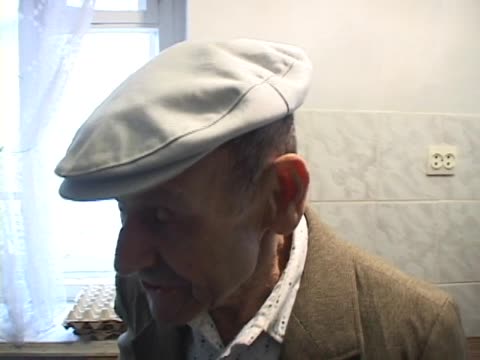
This tape consists of a formal interview with David Abramovich Vider (b. 1922 in Sighetu Marmatiei). He recites a "pirimshpil” (rhyming Purim play) about a chimney-sweep and a woman that he and his brother performed in his youth. Vider also speaks about his early childhood in Sighetu Marmatiei and Iași. Speaking about his family life in general, Vider mentions that his father was a "shoykhet” (kosher butcher), but pitied the animals too much and so worked as a "khazn” (cantor).
From the machine transcript
Vider performs a rhyming Purim-style play about a chimney-sweep and a girl, which he says he learned from his father, with Kerler prompting a restart. Kerler and Katz ask where it was performed, and Vider names Iași and Sighetu Marmatiei as his birthplace. He recounts his family: his father studied in a yeshiva and was a shoykhet but pitied the animals and became a cantor, and Vider also sang in the synagogue from age thirteen. His mother wore a wig and had been to America and returned.
A Purim play recital opens the tape, and the passage covers his mother's time in America and his own sickness affecting his voice.
The interview moves into the interior of the Kolomyya synagogue. There, Vider shares the details of his career as a miner and refrigerator mechanic, explaining how he moved to the Soviet Union in 1940 at the age of 17.
From the machine transcript
Vider talks about his working life: he worked about twenty-six years in a coal mine near Chervonohrad, ten of them underground, and nineteen years as a mechanic on large refrigeration units producing ice. He says he came to the Soviet Union in 1940 aged seventeen, went to the Urals for mine work, and later worked in Turkmenistan in the oil industry until 1961, when he came to Kolomyya. He says he was valued as a Communist labour model and was asked to return after retiring.
He also describes the war years in Turkmenistan and his time as a refrigerator mechanic.
Vider shares his earliest childhood memories, noting that although he did not attend kheyder (religious boys’ school) his father taught him privately at home. Vider also recalls helping his father with his cantorial duties, and describes his later education in a Yeshiva as well as in a Jewish school where Romanian and Modern Hebrew were taught.
From the machine transcript
Vider recalls his earliest childhood memory, of train tunnels, and says he was born in 1922 in Sighetu Marmatiei and left at age three for Hîrlau. He did not attend kheyder because his father taught him at home, and he became bar mitzvah in Iași and helped his father as cantor. Answering Kerler's questions, he describes the Jewish school in Hîrlau, where Romanian and Hebrew were taught, including the hours, the subjects and the teachers, and says he spoke Yiddish at home.
Adds the move to Hîrlau at age three, his bar mitzvah in Iași, and the school timetable and languages.
Vider talks about his many siblings and about their fates both during and after the war. He also describes the curriculum of his Jewish school and states that he remembers so many Jewish songs and traditions because he would sing to himself on long fishing trips.
From the machine transcript
Vider names his siblings (two sisters and four brothers) and what became of them: his father and a younger brother were killed, a sister was taken to Palestine by the Red Cross, and an older brother fled Romania before the war and ended up in Palestine as a tractor driver. Kerler asks what Jewish history he learned in school, and Vider says mostly ancient history such as Samson. Vider says he remembers cantorial melodies because he sang them to himself on long cycling trips to fish, and begins to sing.
Adds Kerler's questions about the school's Jewish history syllabus and Vider's attempts to sing liturgical melodies.
Vider recites various parts of the traditional liturgy including the "shir hayoym” (Song of the Day) for Sunday and "kadish” (memorial prayer).
From the machine transcript
Vider chants or sings liturgical pieces, apparently including the psalm of the day for Sunday and the Kaddish, with Katz asking whether he remembers Kaddish. The transcript is very garbled, so the pieces rest on the catalogue.
Vider briefly discusses the day-to-day operations of Kolomyya’s current synagogue, including its system of donations and the kinds of people who come. He also states that he learned traditional Jewish cooking from his sister.
From the machine transcript
Vider describes how the Kolomyya synagogue works now: non-Jews, including a Sabbath-keeper who wants to convert, come to be entered in the prayers, and he pays a weekly sum from the donations to a young man who helps in the synagogue. He says he cooks well and learned from his sister, who baked and made gefilte fish, and tells how she, a non-Jewish woman, reacted when first eating it.
Adds the would-be convert and the help-for-pay arrangement, and the gefilte fish story.
Vider recites "el mole rachamim” and "kadish” (two funereal prayers), as well as parts of what he identifies as the "halel” (Praise) service.
From the machine transcript
Vider sings or chants the memorial prayer El Male Rachamim and the Kaddish, and parts of what is identified as Hallel, mentioning the cantor Moshe Kusevitsky. He then sings festival melodies for Rosh Hashanah and Yom Kippur. The text is very garbled and the items rest on the catalogue.
Vider sings a loshn-koydesh (the Hebrew-Aramaic language of traditional Jewish texts) song that starts as a holiday version of "adoyn oylom” (Eternal Lord). He then sings the shabes (Sabbath) song "lekhu doydi” (Come My Beloved) and provides a full description of how "sholem-aleykhem” (Peace Be Upon You) was sung and shabes was celebrated in his childhood home. He then makes "kidish” (the shabes blessing over wine).
From the machine transcript
Vider sings liturgical pieces, a holiday version of Adon Olam and then Lekhu Dodi, and Kerler asks whether he remembers Kol Nidre. Vider then describes the Friday-night Sabbath in his childhood home: coming back from synagogue with his father, greeting the angels at the door, and the mother's challahs for the family. He starts the Kiddush, which he then says he has forgotten.
Adds Kerler's question about Kol Nidre and the details of the Friday-night greeting and challahs.
Vider recites the "fir kashes” (Four Questions of Passover) and sings "A gemakhtn got hobn zey” (They Have a Man-made God), a song based on a part of halel; then another "pirimshpil” called "dray simunim,” (Three Signs) and a Purim song in Modern Hebrew that he learned in his Jewish school in Hîrlau.
From the machine transcript
Vider recites the Four Questions and sings the Passover song about the man-made gods, and Kerler and Katz ask about a Haggadah. He tells how his father taught him a Purim play about a match between two in-laws, one rich and one poor, in Hîrlau, and he sings a Hebrew Purim song learned in the Jewish school. He recalls school festivals, a Hebrew play in which he performed, the Hebrew teachers Papelinger and Reicher, and some Shavuot verses.
Adds the school festivals, the Hebrew play, and the teachers' names.
Vider recalls prewar Simkhes-toyre (Simchat Torah) and Sikes (Succoth) observances. He then details the contemporary phenomenon of non-Jewish pilgrims who come to him and, giving a small donation, ask the congregation to pray for the resolution of health, business or personal problems. He tells one specific story about one woman who, after having received Vider’s blessing, got married and had a child. Vider says he thinks about these people when he prays, asking that G-d should help them as He helps him.
From the machine transcript
Vider recalls how Simchat Torah and Sukkot were observed, including Torah reading and a rebbe's visit. In answer to Kerler's questions, he describes the non-Christian pilgrims, mostly women but also men, who come to him with small donations and ask that their names be prayed for over health, business or family trouble. He tells at length of a woman whose husband returned after her visit, who then married and had a child, and with the help of Russian he says he writes their names and thinks of them in his prayers, asking that God help them as He helps him.
Adds the Simchat Torah and Sukkot recollections, and the account of the visiting rebbe's view of the practice.
This tape is a continuation of a formal interview with David Abramovich Vider (b. 1922 in Sighetu Marmatiei). He describes the Yiddish books he read in his youth and after the war, including translations of Robinson Crusoe, fiction by Shmuel Gordon, and the stories of Hershele Ostropolyer. He then tells a few Hershele stories.
From the machine transcript
Vider talks about a visitor he spoke with about Yiddish and Russian and about books he read in Yiddish: Robinson Crusoe (Der alter leyb), Shmuel Gordon. Kerler asks what he read at the Yiddish school. He then retells several Hershele Ostropolyer stories, including the one about dumplings in the pot and the eggs in the coat-tail.
Opens with Vider's account of a visitor who spoke Yiddish and Russian, and of reading Robinson Crusoe in Yiddish.
Vider then shares a few Khelm (Chelm) stories.
From the machine transcript
Vider recalls Khelm stories he read, such as the townspeople hiding the moon in a barrel and carrying people to services on their shoulders so as not to spoil the snow. Kerler prompts with questions.
He tells a brief story about finding Yiddish books in a library in the postwar period and shock that some people felt when they saw him reading.
From the machine transcript
Vider recalls finding a Yiddish book in a Soviet bookshop or library on a trip from Chervonohrad to Kolomyya, and how people were astonished at a Jew reading it. Kerler asks about his reading in Romanian, history lessons and romances. He mentions Romanian historical songs.
Also covers his Romanian-language reading and schooling.
Vider tells a story about his friend Semyon Semyonovich Krotsh (b. 1922 in Stefanesti; another AHEYM interviewee) who in Soviet times would use his knowledge of Romanian and songs based on the poetry of Mihai Eminescu to illegally obtain fresh fruit and other produce from traders across the border. Vider then sings a Romanian love song.
From the machine transcript
Vider speaks of a friend from Iași, Shloyme (Krotsh), who also speaks Romanian and in Soviet times got fruit from sellers from Moldova by speaking Romanian and quoting a poem on the beauty of the language. He then sings a Romanian love song, naming the singer Tamara Ceaban (?), after Kerler asks for a favourite.
Vider's own singing of the song is on the tape, and the Romanian poem is quoted.
Vider talks about how he studied to be a tailor, and shares his memories of the Botoshaner Rebbe, who lived in a neighboring courtyard from his family’s home. He also tells a joke about a man who was tricked into paying extra donations to his synagogue.
From the machine transcript
Vider tells how he left the yeshiva in Iași to learn tailoring with a neighbour, against his father's wishes (his father was a shoykhet, his mother Nekhama), and went to the USSR at seventeen as a communist. He recalls the Botoshaner Rebbe, who lived in the neighbouring courtyard, selikhes, the rebbe's table, notes and wedding of his sister. He ends with a joke about a man tricked into paying yortsayt money three times.
Adds his father's wishes, leaving for the USSR as a communist, and rebbe's role at his sister's wedding.
Vider briefly discusses the day-to-day operations of Kolomyya’s current synagogue, including the kinds of people who come to services.
From the machine transcript
Vider briefly describes how the Kolomyya synagogue works now: few regular worshippers, a minyan expected the next morning, and people who come for yortsayt. Kerler arranges to meet the next day and speaks of Krotsh and Greyf. Others joke about cooking and Sabbath.
The camera cuts to footage of shabes services in the synagogue led by Semyon Krotsh.
From the machine transcript
Camera footage of a Sabbath service in the Kolomyya synagogue, chiefly prayer and chant with a few remarks between, hardly recognisable in the transcript. Katz and Kerler are heard now and then.