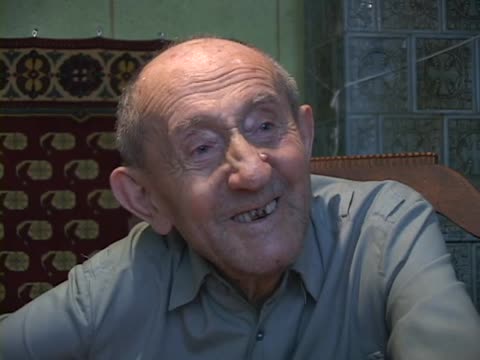
The team and Dorfman greet Leibel in his apartment. They then set up the interview with him.
From the machine transcript
The team and Dorfman come to Leibel's apartment and are greeted. They explain the project of recording Yiddish speakers (from an American university) and mention that they recorded Brandler the day before. They discuss how hard it is to find Jews to interview, and fit the microphone.
The formal interview with Leibel begins. He provides personal information.
From the machine transcript
The formal interview with Leibel begins. He gives his surname and first name, and says he was called Volf at home and by an older name (unclear in the transcript).
Leibel provides personal information. He also talks about prewar Jewish life in his hometown Rivne. Leibel also addresses his childhood memories and family. Leibel's father was a scrap dealer. Leibel attended a Polish school until 1939, before attending the university for two years.
From the machine transcript
Leibel gives his birth year (not clear in the transcript) and recalls prewar Rivne as a Jewish town with many small synagogues, and the street where he lived. His grandfather Moshe was a tinsmith and his father kept a cellar shop dealing in old things. He describes the state gymnasium, where he sat at the last bench next to a prince's son, a religion lesson and a discussion on Zionism. He finished in 1939, expected to go to Warsaw, and after the Soviet entry studied for two years before being drafted.
Adds the gymnasium, the religion lesson and the Zionism discussion; the university detail in the catalogue is not clear.
Leibel speaks about his life during World War II. He was drafted into the Red Army and came through Berezhtsi, near Kremenets, Pochaiv, Kharkiv province in 1942. Leibel describes the situation Berezhtsi under German occupation. Leibel was sent to the front from Kharkiv province. He was the commander of a division within the cavalry. In February 1945, Leibel explains, he was sent to a military training school for lieutenants.
From the machine transcript
Leibel recalls being sent to the front with the Red Army and seeing German vehicles near Berezhtsi (near Kremenets), where he saw a Jew praying in a window, and reaching Pochaiv. He was taken to the Kharkiv region and, in 1941–42, to Sweden-bound (?) Polish Jews were sent east; he became a sergeant and fought at the Third Ukrainian Front, where he was wounded and commanded a unit. In 1945 he was sent to a lieutenants' school, which was then disbanded, and he was demobilized.
Gives detail on a fellow soldier from Łódź and on the cadet school's disbandment.
Leibel speaks about his life after the war. He returned to Lviv and graduated from military school. Leibel then speaks about his family. He met his wife in 1948 and raised a son.
From the machine transcript
Leibel speaks about his return to the institute in L'viv and finishing his studies, after which he was assigned to work. He met his wife in 1948 in a Jewish family; she taught Yiddish. They had a son, and both the son and wife have since died. Kerler clarifies that a woman relative is a cousin of the wife. Leibel then begins to say he attended synagogue on holidays and fasted on Yom Kippur in Soviet times.
Leibel addresses postwar religious life and his observance. Leibel worked at a municipal office for 43 years.
From the machine transcript
Leibel addresses his observance in Soviet times, when he fasted on Yom Kippur and took off as much time from work as possible. He worked at one institution for 43 years and was kept on after reaching seventy; after retirement he went to synagogue daily. A Ukrainian friend warned him he was being watched, but Leibel regards the synagogue as a piece of the Land of Israel.
Gives the duration of employment (43 years) and the warning about surveillance.
Leibel speaks about his family. He grew up with two sisters. Leibel also shares an episode from his childhood. Leibel's father was born in Rivne.
From the machine transcript
Leibel begins mid-thought about being taken into the army and leaving his elderly parents alone, and about how much they suffered. He gives the names of his parents and two sisters and says he was the only son. He states that his father was born in Rivne, without a year, and names grandparents and a grandfather, some of the names unclear in the transcript. He also mentions a rebbe from a village visiting the synagogue on a Sabbath.
names parents, sisters and grandparents, and begins with his parents left alone when he was drafted
Leibel sings "Echad Mi Yodea" (who knows one; a traditional haggadic song, sang on Passover). He also addresses other prayer customs on Passover.
From the machine transcript
Leibel sings the Passover song "Echad Mi Yodea" and then the end of the Seder song about the kid (Chad Gadya), at Kerler's request. Kerler asks about the sense of a word in the song and about Yiddish words for prison, and Leibel answers. He then recalls singing zemirot on Friday night.
includes Kerler's word questions and Friday-night zemirot
Leibel remembers Sabbath songs (zemirot) and recalls peasants stopping at their house on Sabbath and humming zemirot melodies.
From the machine transcript
Leibel recalls Sabbath songs and says peasants passing from the town to the village would stop by their house and hear the family singing on Friday night. Kerler asks him to sing again and asks what other songs they sang. Leibel then begins a story about getting up early before gymnasium with his tefillin bag.
adds the tefillin bag and morning routine before gymnasium
Leibel discusses his childhood memories in a traditional home. He then lists prewar youth organizations, including Betar, Hashomer Hatzair and Agudat Yisrael. Leibel states that the Polish school did not allow him to join any organization.
From the machine transcript
Leibel speaks about his traditional childhood home and about his father working in the cellar of a textile store. He lists organizations in Rivne, including Betar, a Zionist group (names garbled) and a Hasmonea football club, and a Maccabi club. He explains that gymnasium pupils were forbidden to join political organizations and had to study. Kerler asks in what language the Betar and Bund booklets were written; Leibel says Yiddish.
adds his father's work and the Hasmonea and Maccabi clubs
Leibel addresses his education at a religious school (cheder) and Polish school. Leibel explains that he studied with a private religious tutor at home during his primary education.
From the machine transcript
Leibel describes his early education: cheder with Reb Nisl, whose wife was Breydl, then Polish school. In the evenings a Jewish tutor named Mandelbaum came to teach him at home. Kerler asks about the language of his reading, and Leibel recalls Hebrew texts, a Talmud story about Kamtsa and Bar Kamtsa, and writing letters in Yiddish.
Leibel speaks about prewar press and then his family. In particular, he addresses his parent's work and recalls poverty.
From the machine transcript
Leibel mentions Yiddish and Zionist newspapers before the war. He says his uncle was a tailor and that his parents worked in a shop all day, warming themselves with a pot of coals in winter, supporting the family on very little. He then recalls returning to Rivne after demobilization, finding few Jews left, and mentions a milkman who remained.
Leibel talks about postwar community in Rivne, after his demobilization. He then addresses his father's observance, briefly touching upon the Polish school.
From the machine transcript
Leibel talks about Rivne after the war: the Jewish street was nearly empty, a local milkman traded with peasants, and he felt a longing to return there. He then answers Kerler about his father's prayer habits, recalling carrying the tallis bag beside him as a child. He also mentions the special cap required at his gymnasium.
Leibel speaks about prewar Purim celebrations at the local Polish-Jewish secondary school and other organizations in town. Leibel describes how his father examined him on Sabbath.
From the machine transcript
Leibel talks about Purim and holiday celebrations at the Jewish gymnasium, which taught in Polish, with choir, young people and outings to the woods. He describes a library, apparently the "Matsha Shkolna" (?), where he borrowed books daily. He says his father examined him on Sabbath on what he had to recite. Kerler then asks how people spoke Yiddish in Kremenets as against Rivne.
adds the library and the father's Sabbath examination
Leibel talks about Yiddish dialects, the local library and prewar press.
From the machine transcript
Answering Kerler's questions, Leibel says there was no Yiddish library, only a Polish one, and that he read Polish books at home while his parents were at work. He recalls Yiddish newspapers read in connection with the synagogue. Kerler asks about dialect forms, the verb "to come" and a word for Purim, and about the word "tsenerene" (?).
includes Kerler's dialect-form and word questions
Leibel addresses Sabbath food customs and celebrations at home before the war. He then speaks about his family.
From the machine transcript
Leibel describes his mother baking for the Sabbath on Friday morning, with challah and cakes, going to the synagogue women's section, and lighting candles. Asked about his grandmothers, he remembers Khaye Hinde, who sold hay (?) in small quantities by weight for her living. He says he does not remember much of Sabbath at his grandparents' but that Jewish life was good though not easy.
Leibel answers questions about cultural terminology and speaks about his family. He then talks about prewar cultural life, particularly Yiddish theater performances and cinemas. Leibel describes how his school organized trips to the theater and recalls the play "The Dybbuk."
From the machine transcript
Leibel explains what an honest, good Jew means in his Yiddish, while Kerler adds comments on the Temple and the messiah. He recalls his grandmother Rivke and says his grandfather Avrom died earlier. He then describes Yiddish theater and films in Rivne, including a performance of The Dybbuk, two cinemas, and a film Jews boycotted, and then answers about cheder until age seven.
adds the grandparents, the two cinemas and the film boycott
Leibel addresses his school education. He attended a cheder until the age of seven, when he joined the Polish primary school. He explains how a Jewish and non-Jewish team played again each other soccer.
From the machine transcript
Leibel says he attended cheder until age seven and was then sent to the Polish primary school, after which he continued in the Polish system. He recalls playing football against Christian teams at school, with a Jewish side against non-Jewish boys, and a fight with a non-Jewish boy.
Leibel sings a Yiddish drinking song and then briefly touches upon his cheder education.
From the machine transcript
Leibel sings a Yiddish drinking song, in which a Jew enters a tavern and a non-Jew gets drunk. Talk of Sabbath challah follows. Kerler asks about a toilet, and a second voice asks whether the cheder was a good one. The rest is largely garbled.
adds Kerler's side questions and the challah talk
Leibel speaks about food customs, specifically gefilte fish. He then shares an episode from Yom Kippur 1939, when the Red Army occupied Rivne.
From the machine transcript
Kerler asks about the taste of his mother's gefilte fish. Leibel then tells how the Red Army arrived in Rivne in 1939 just before Yom Kippur. After synagogue he met a young Jew from Poland who had not eaten for two days, and took him home and fed him. Kerler asks whether the grandparents stayed in Rivne, and the rest is chat about refreshments.
adds the Yom Kippur episode and the Polish refugee, and ends with drinks being offered
Leibel addresses prewar holiday celebration and Yiddish dialects.
From the machine transcript
Asked what was drunk on Purim, Leibel says he does not remember, and talks about observing kosher rules and the words for dairy and meat. Kerler asks about differences between Yiddish in Lviv and in Rivne, and about kleyn and shayn. A second voice asks about songs with Hebrew and Yiddish words. Cake and drinks are also being offered.
adds kosher terms and Lviv versus Rivne Yiddish
Leibel sings a song about Yidishkayt and suppression of religious life during the postwar Soviet period. Leibel then talks about prewar Yiddish culture and life in Rivne before the war. Leibel also remembers traditional weddings at the Lviv rebbe's home before the war. Leibel mentions that his father hired a musical instructor to teach him clarinet.
From the machine transcript
Leibel sings a Yiddish song about Hasidic and wealthy Jews, and says the Soviet regime closed synagogues so that people prayed in small minyanim in homes. Asked about klezmer, he says his father once wanted him to learn the clarinet. He describes his own wedding under a canopy at the Lviv rebbe's house, with two witnesses, and answers Kerler on weddings, matchmakers and the absence of Yiddish-speaking non-Jews in Rivne.
adds his own wedding at the Lviv rebbe's house, the witnesses, and the matchmakers
Leibel sings a Polish song and recalls Polish poems. He then addresses prewar Jewish and non-Jewish relations in prewar Rivne, as well as his non-Jewish classmate.
From the machine transcript
Leibel recites lines of Polish poetry from his school years and names a Polish poet. Questions follow on relations between Jews and non-Jews in the gymnasium. He says each was proud of his own background, that they studied together and were friends but not close ones, with a non-Jewish classmate who may have been a Nazi sympathizer (?). Kerler then asks about Purim players.
adds the Polish poems and the classmate's identity
Leibel recalls Purim shpiels.
From the machine transcript
Leibel recalls Purim players going from house to house and being given coins. Kerler asks whether there were longer plays. The passage then turns to Russian talk and refreshments: Kerler tells a Russian-speaking person present that the visitors are from America and are recording Yiddish, and drink is offered.
adds the Russian-language exchange and refreshments
The camera records footage of Leibel's apartment.
From the machine transcript
Kerler, Leibel and a second voice talk about something being handed over or set up, partly in Russian, with remarks about the view. The catalogue says the camera records Leibel's apartment, but the transcript shows only this talk.
adds the conversation heard over the footage
[unidentified content]
From the machine transcript
A few seconds of unclear exchange between Leibel and a second voice; the transcript does not show what is being said or that an interview is being set up.