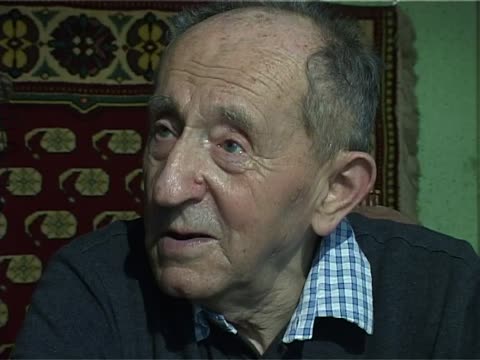
The first part of the tape is a continuation of a formal interview with Volf Tsalevich Leibel, recorded in Lviv. Leibel, born 1921 in Rivne, answers a number of dialectological questions from the AHEYM Yiddish questionnaire.
From the machine transcript
Leibel answers dialectological questionnaire items from Kerler. Items include Yiddish words for a cemetery, a ghost or dybbuk, house, belly and groats, the word for window panes, colours, and a mouse. The questions also cover building words such as wall, brick and stone, and adverbs and adjectives such as late, early, cold, high, fast and near. They go on to kinship words, pronouns, numerals, short sentences to translate, the words for honest and enemy, and the word for room.
Beyond the dialectological questions, Leibel also comments on Polish, Ukrainian and Russian words that do not count as Yiddish.
The team concludes the interview with Leibel.
The second part of the tape includes a formal interview, conducted in Yiddish, Russian, and German with Mosei (Moyshe, Mauritze) Leonovich Weiss, born 1915 in Vienna, Austria. Weiss provides personal information and talks about his life during World War I. His father served in the Austro-Hungarian army and his mother evacuated to Vienna. He then talks about his family, who lived in Vienna for ten years and moved to Drohobych 1925. His mother was born in Drohobych and his father in Boryslav. He grew up with two brothers.
From the machine transcript
Weiss gives his name, spelling and birth in Vienna in 1915, and his Drohobych address. He explains that his father served in the Austro-Hungarian army in the First World War while his mother was evacuated to Vienna. The family lived in Vienna for ten years and came to Drohobych in 1925. His mother Sabina (Sara Hendl) was from Drohobych and his father Avrom Leyb from Boryslav, ten kilometres away.
Gives his parents' names and a contact exchange with Kerler at the start.
Weiss talks about his life before World War II, in particular his education. He attended a Polish school and studied with the Polish-Jewish writer Bruno Schulz there. Weiss studied at the polytechnic institute in Lviv in the field of manufacturing systems engineering. Weiss could not find work in his field of studies. He explains how his uncle from America came to visit him and made arrangements for Weiss to continue his studies in America. His uncle sent Weiss’ papers to the consulate in Warsaw in 1939, but the papers were lost because of the outbreak of World War II. Weiss continues that he could not leave Drohobych during the war when the town came under Soviet occupation. He worked as the assistant accountant at the regional bank until 1941.
From the machine transcript
Weiss talks about his schooling in Drohobych and his studies at the Polish polytechnic in Lviv, where he trained as a mechanical engineer. He could hardly find work in his field. An uncle from America arranged for him to study abroad and sent papers to the consulate in Warsaw in 1939, which were lost at the outbreak of war. Under Soviet rule he was unable to leave and worked as assistant cashier at the regional bank until mobilisation in 1941. His parents and youngest brother were killed.
Gives details of the failed emigration to America and of work at the Soviet bank.
Weiss talks about his life during the war. He was drafted into the Red Army early 1941. His parents perished in the Broniza Woods near Drohobych, along with 12,500 fellow Jews during a mass execution. Weiss’ youngest brother died in the Plaszow Concentration Camp in Poland. Weiss describes the memorialization of the mass grave in the Broniza Woods. Weiss then talks about his military service when he served in the artillery division. 38:38 – 43:00 description (moving toward Urals and worked as ?) Weiss moved with his division to the Urals and there he became sick. In his battalion, Weiss worked financial assignments and explains the difficult conditions due to great hunger. Weiss continues that the commander-in-chief allowed him to leave after a few months. Weiss then worked in a factory, which produced military goods under the leadership of a Jewish director. He worked there until 1946. He explains how difficult it was to leave his position because he knew about the internal matters of the factory.
From the machine transcript
Weiss names his brother Edmund, who died in Plaszow, and says his parents lie in the Broniza woods ten kilometres from Drohobych. He describes the mass grave and the memorial erected with funds from a wealthy Tel Aviv man. He then recounts serving in anti-aircraft artillery, retreating, and being sent to the Urals. There he was ill and starving in a forest labour unit with bread rations tied to work norms. After being released he worked at an evacuated factory under a Jewish director until 1946, and recalls a Zionist youth leadership role in Drohobych before the war.
Adds the recollection of Zionist youth work before the war and the forced forest labour.
Weiss talks about his after the war, when he returned to Drohobych in 1946. Weiss studied at the technical institute in Kyiv and worked as an engineering economist. He then worked as the deputy director of the ceramics plant in Drohobych for twenty-four years. After his retirement, Weiss worked at the truck crane (avtokran) factory as the deputy head for sales for eleven years.
From the machine transcript
Weiss says he returned to Drohobych in 1946 to find everything destroyed and his parents dead. He studied at an institute in Kyiv and worked as an engineer-economist. He was deputy director of the ceramics plant for twenty-four years, then after retirement worked eleven years at the truck-crane factory in a deputy post.
Weiss talks about Jewish life after the fall of the Soviet Union in 1991, when the Jewish community was officially re-established. Weiss was elected three times as the head of the community and also serves as an assistant rabbi. He then talks about how the community got back and fixed up their 160 year-old synagogue, which was used as a furniture store during the Soviet period.
From the machine transcript
Weiss speaks of Jewish community life after the fall of the Soviet Union. The community was re-founded, and he has been its chairman three times and is also deputy to the rabbi. The synagogue, about 160 years old, had been used as a furniture store and was in poor condition when returned. Work was done to repair and reopen it.
Adds Weiss's own role as community chairman and deputy rabbi.
Weiss shows a couple of photographs of his school class and the synagogue, taken before the war. He then talks about contemporary Jewish life and antisemitism. In particular, he mentions the second local synagogue, which functioned until 1995. It was closed down that year due to four antisemitic attacks, according to Weiss. It was set on fire in 1998. Weiss explains the efforts of the community to rebuild the synagogue. Weiss continues talking about contemporary Jewish life and Yiddish-speakers of the region.
From the machine transcript
Weiss shows photographs to Kerler, including the school class and the synagogue before the war. He discusses the second synagogue, which functioned until 1995 and was closed after four antisemitic attacks, then set on fire in 1998. He describes community efforts to rebuild it, the Hesed centre, and a community of around 350 mostly elderly, poor people, many having emigrated. Asked about Drohobych-born Jews who remain, he names two or three people, none Yiddish-speaking.
Adds the Joint-supported Hesed, the shrinking elderly community and the question of remaining Yiddish speakers.
Weiss talks about prewar Jewish life in Drohobych with approximately 19,500 people. According to Weiss, there were two synagogues and twenty prayer houses.
From the machine transcript
Asked to describe prewar Jewish life in Drohobych, Weiss gives the Jewish population as about nineteen thousand five hundred out of a larger total population. He says there were two synagogues and about twenty prayer houses, and answers questions about the Yiddish name for them.