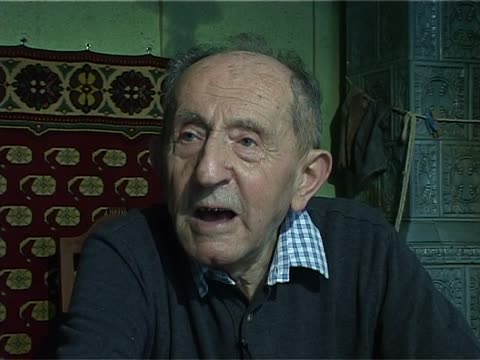
The formal interview with Leibel begins. He provides personal information.
From the machine transcript
The interview with Leibel begins. Kerler records the date, and Leibel gives his names: Volf in Russian and Polish documents, Zev in the synagogue, his patronymic spelled Tsalevich after his father Betsalel, and the family name Leibel. His address is asked about.
Leibel provides personal information. He then speaks about his family and mentions cousins who made aliyah in the 1930s. Leibel's father was a merchant and his mother helped him. Leibel's parents died in the Rivne ghetto.
From the machine transcript
Leibel gives personal information, including the Yiddish forms of his first and family names, with Kerler discussing diminutives. He mentions cousins who went to Palestine as pioneers in the 1930s. His family was poor: his father was a petty trader and his mother helped him. Two sisters, Gitl and Faygele, are named. His parents and sisters all died in the Rivne ghetto while he was in the army.
Adds the discussion of Yiddish forms of his names and the names of his sisters.
Leibel speaks about his life before the war. He studied at an institute in Lviv in 1939. At the beginning of the war, he was drafted into the Red Army. Leibel then speaks about his family.
From the machine transcript
Leibel says he studied at an institute in L'viv and survived the war, and that he was born in 1921. He names grandparents on his mother's side: a carpenter grandfather and a grandmother who sold yeast to poor Jews from a small scale. He also explains what their names were and where she sat in the town. The war's start and army call-up are mentioned only briefly.
Focuses on his maternal grandparents and their trades, which the catalogue summary only calls 'family'.
Leibel speaks about daily life in Rivne before the war. In particular, he remembers how his mother bathed him on Friday and local bookstores. Leibel also addresses his family. His father was a POW held by the Austrian army during World War I. Leibel grew up with two sisters. His parents were also born in Rivne.
From the machine transcript
Leibel talks about Rivne before the war: a small town, the streets, the large stores and a small bookshop that sold school texts and serial novels read by Jews, and his memory of Friday night. He names his mother Golda and recalls his father as a soldier in the First World War who told stories about Jews freed to attend synagogue on the High Holidays. His grandfathers, a carpenter and a tinsmith, are named. He grew up with two sisters, and his parents and grandparents were born in Rivne. Kerler also notes that his own great-grandfather came from Rivne.
Adds the bookshop, Kerler's family tie to Rivne, and discussion of his father's army years.
Leibel speaks about his life before the war. In 1939, he graduated from a Polish school. Leibel then recites a Polish poem by Adam Bernard Mickiewicz. He then speaks about his education, particularly at a religious school (cheder). Leibel mentions that his younger sister went to a Yiddish kindergarten before the war.
From the machine transcript
Leibel says he finished the Polish gymnasium (lyceum) in Rivne in 1939. He recalls the Polish poets and recites a Polish verse in answer to Kerler. He names his first cheder teacher, Rabbi Nisl, and describes the rabbi's discipline. He mentions that his youngest sister went to a Yiddish kindergarten led by someone named Erlikh.
Leibel recalls a Yiddish song his sister would sing in the kindergarten. He then speaks about prewar life in Rivne, including local institutions and figures.
From the machine transcript
Leibel recalls a song his sister sang at the Yiddish kindergarten, remembering only the first lines. He describes the Rivne street where he lived, its Jewish and Polish neighbors, the synagogue on the hill, and local figures including a children's doctor who survived the war. He names a professor and an economic figure or factory owner. A neighbor later hid people in a hideout (?).
Adds non-Jewish neighbors and a hideout account.
Leibel speaks about his leisure activities before the war. He describes how he attended dinners at local Jewish schools on Purim and Hanukkah. Leibel then addresses his school education. Leibel mentions Sabbath celebrations and prayers at the cheder. Leibel studied at a cheder until the age of seven, a Polish primary school until fourteen and a Polish secondary school until eighteen. Leibel also studied with a private Yiddish teacher in the evenings, he explains.
From the machine transcript
Leibel recalls going to Jewish gymnasium Purim and Hanukkah evenings even though he attended a Polish gymnasium, and mentions a doctor's family whose daughter died in the war. He describes his cheder years from about age three or four to seven, the Friday blessing and kiddush, the Polish primary school of seven classes and then the gymnasium, and a private Yiddish teacher named Mandelboym who came in the evening. He also recalls Polish-language religion lessons, and teachers including Balaban (?).
Adds the Polish-language religion lessons and Balaban's role as teacher.
Leibel speaks about prewar organizations, including the soccer clubs Hasmonea Lviv and Maccabi. He also recalls visits by Ze'ev Jabotinsky. Leibel states that his school did not allow him to join organizations.
From the machine transcript
Leibel remembers the Hasmonea and Maccabi soccer clubs in Rivne, the sports hall on Zamkova Street, and the Jewish flag carried at parades. He recalls Jabotinsky visiting Rivne in the late 1930s and a Betar parade. He explains that gymnasium pupils were not allowed to belong to political organizations, and that he was absorbed in study and in Jewish observance at home.
Also mentions his father saying Kaddish and sports hall details.
Leibel talks about his family and observance. He then addresses the relationship between Jews and non-Jews before the war.
From the machine transcript
Leibel describes his family's observance, including his father saying Kaddish for the grandfather. Asked about antisemitism, he says it grew strong only before the war and especially in the late 1940s. He mentions Endek (National Democratic) agitation against Jews and the killing of a Jewish student in L'viv. He also recalls Jewish and non-Jewish children playing football on his street and against the gymnasium team.
Adds the Kaddish detail, the kosher slaughter issue, and the football games with non-Jewish children.
Leibel talks about his childhood memories and games. In particular, he remembers playing soccer matches and describes the Hasmonean team. He then explains how children went to the synagogue on national holidays, where they played "Hatikvah" on the organ. Leibel then sings "Hatikvah."
From the machine transcript
Leibel talks about children's games, above all football with a homemade ball, and about the Maccabi and Hasmonean flags. He recalls an organ installed in the Great Synagogue in the last years, where children came on national holidays and Hatikvah was played. A voice in the room then sings Hatikvah.
Leibel speaks about Zionist organizations in Rivne. He describes a meeting at Trumbeldor.
From the machine transcript
Leibel talks about the strong influence of Zionists in Rivne. He recalls once visiting the Trumpeldor group, where an emissary from Palestine gathered children and taught Hebrew songs, and he notes that many who emigrated survived. He also says he was a poor student absorbed in his studies and recalls sitting at the back of the class next to a Polish count's son.
Leibel speaks about his education, particularly his private religious tutor, who studied with him in the evenings. He also addresses his parent's observance.
From the machine transcript
Leibel describes his private religious tutor who came in the evenings after the Polish school, teaching Hebrew, Humash and some Gemara. He recalls puzzling over a Talmud passage as a child. He and Kerler then discuss the books his parents read and his parents' observance, including his father at synagogue and his mother attending on holidays.
Adds the books read at home and his mother's synagogue attendance.
Leibel discusses his childhood memories of Jewish life in Lviv. He also speaks about literature/press and cultural institutions, including a Polish library.
From the machine transcript
Leibel recalls Jewish life in L'viv or Rivne in childhood: a well in the street, children sledding in winter, and gymnasium uniform caps. He discusses libraries, both the Polish and a Jewish one, and the Yiddish papers his father bought for Sabbath. He explains that he read in Polish at the gymnasium, and that Jewish shops were closed on Sabbath.
Adds winter sledding, school uniform caps, and the Sabbath closing of shops.
Leibel talks about prewar cultural performances. Particularly, he remembers the play "The Dybbuk." Leibel mentions the Safran and Berent cinemas and explains how the community boycotted a film showing, due to supposedly antisemitic content.
From the machine transcript
Leibel recalls the two cinema-theaters, Safran and Berent, with Berent staging a play (apparently on Golgotha) that Jews boycotted as antisemitic. He gives the early 1930s as the time and mentions Safran's advertising slogans. The Dybbuk named in the catalogue is hard to make out.
Leibel describes a theater performance at a Polish school. Leibel states that he played a Jew.
From the machine transcript
Leibel recalls a puppet-theater show for winter festivities at his Polish school, where he was given the part of a Jew and the Polish children beat him in the play. Kerler asks about the genre and the Yiddish word for it. He also recalls a Russian singer performing a Yiddish song at the Safran cinema.
Adds the Russian singer with a Yiddish song at the Safran cinema.
Leibel addresses prewar antisemitism, before speaking about religious life. Leibel recalls performances of the cantor Moshe Koussevitzky at the Great Synagogue. Leibel also discusses his childhood memories.
From the machine transcript
Leibel says antisemitism grew before the war but Rivne was a Jewish city whose Jews held their heads high. He recalls the cantor Koussevitzky singing at the Great Synagogue on Shkilna Street, where his mother took him. He describes his family as observant but not fanatical, and himself as the most pious, putting on tefillin in the morning.
Adds his mother's taking him and his own piety.
Leibel recites the morning prayer "Modeh Ani." He then speaks about his religious observance during the postwar Soviet era. Leibel then addresses prewar holiday celebration.
From the machine transcript
Asked to recite Modeh Ani, Leibel says he says it daily today but does not recite it here. He says he put on tefillin until 1939, when he went to study in L'viv, and that under Soviet rule he still went to synagogue on the holidays. Kerler asks about a Shenkar family, which Leibel does not recall, and then about the High Holy Days, including fasting and fainting in synagogue.
Adds the Shenkar question and the fainting on the fast day.
Leibel shares an episode about a Polish refugee, who was hungry on Yom Kippur in Lviv in 1939. He also discusses dialects.
From the machine transcript
Leibel tells of a hungry Polish Jewish refugee he met on the street on Yom Kippur in L'viv in 1939 and fed at home. Kerler asks about the refugee's Yiddish, which Leibel does not recall as different. Leibel then mentions a book he read, and the terms Sephardi and Ashkenazi. Kerler turns to Hoshana Rabbah.
Adds the Sephardi/Ashkenazi terms and the question about the refugee's Yiddish.
Leibel addresses holiday celebration, particularly Hoshana Rabbah ("Great Supplication," seventh day on Sukkot) and food customs.
From the machine transcript
Leibel recalls Hoshana Rabbah in his home, with the synagogue attendant bringing the lulav and willow branches, and he answers Kerler's questions about it. They discuss Hanukkah food and his mother's Friday baking of challah in a big oven. They go over the shape of the challah (not braided), and the food eaten on Purim.
Adds Hanukkah and Purim food and challah shape.
Leibel talks about Purim shpiels and recalls performances by children. He then speaks about the expenses of his school education, before turning to prewar Passover and Shavuot celebrations. Leibel recalls the Four Questions.
From the machine transcript
Leibel talks about Purim players who went door to door, and about the cost of his schooling, which was partly covered by the state and by a Jewish committee. He recalls the Passover seder and the Four Questions, Chad Gadya, and the hiding of the afikoman, and answers Kerler's questions about Shavuot greens. He says he does not remember a Hanukkah play about Joseph.
Adds school costs and funding, the afikoman, and Shavuot greens.
Leibel speaks about his Polish school education. He then speaks about life before the war and a local, who converted to Christianity. Leibel then shares an episode from his childhood and lists local wealthy people.
From the machine transcript
Leibel speaks about his Polish school education and answers whether non-Jews spoke Yiddish, which he does not recall. He tells of a Jewish lawyer who converted and a quarrel with his son over a ball, and names wealthy local Jews. He says the poor never converted while some rich did, naming a doctor family.
Adds the fight over the ball and the discussion of who converted.
Leibel answers questions about cultural terminology. He also recalls Hasidic visitors to the Polish school before the war and addresses religious customs.
From the machine transcript
Leibel answers Kerler's terminology questions on the difference between rav, rebbe and rabbi, tsadik, 'a good Jew', Hasid, plurals of such words, and the words for a cemetery. He then discusses the term Litvak, Galitsianer, misnagid and dybbuk. He also recalls Hasidic visitors to the Polish school and a synagogue discussion with the rabbi about Sarah's childlessness in Genesis.
Adds the synagogue discussion about Sarah and the terminology questions.