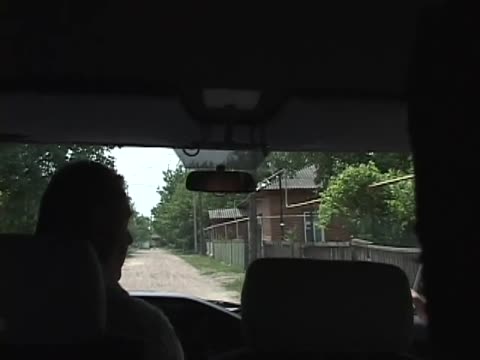
Town footage of Ovruch.
From the machine transcript
Town footage and conversation in the car while the team looks for the way to the informant's house. They ask passers-by in Russian for Sverdlova street, and other places in town are mentioned.
Arrival.
From the machine transcript
The team arrives and Turovskaia greets them. Kerler introduces Lemster as a Yiddish writer. There is talk about driving the car into the yard and about something Kerler sent her.
Family and Yiddish-speakers in the region.
From the machine transcript
Turovskaia talks about Dovid Katz's earlier visit and about her family. Her father died long ago, and relatives were evacuated. They discuss Jews who are no longer in town, including a man named Feldman and a couple from Slavechno (?). She says her children live in Siberia (Kansk, Krasnoyarsk region) and in Pskov, and mentions her late husband, a veterinarian.
adds her children in Siberia and Pskov and the Jews of the region who have died
Her work as a History teacher.
From the machine transcript
Turovskaia says she taught history. Lemster asks which kind, and she answers general history. She then speaks of what she knows of the town's Jews and says she is herself from Veledniki, the home of the holy tzaddik.
Volednicker rebbe and family.
From the machine transcript
Turovskaia asks whether Katz gave Kerler photographs of the Volednicker tzaddik. She tells how her family suffered under the Poles in 1920 and in 1937, and how her father avoided arrest. Her grandmother travelled to a good Jew for a name, and her father was named after the tzaddik Yisroel Dov. Kerler asks about names, and she gives her own Yiddish name as Rochel.
adds the grandmother's trip to a good Jew, her father's naming after the tzaddik and the 1937 arrest
Prewar life in Novyye Veledniki.
From the machine transcript
Turovskaia gives her surname and her maiden name Feldman, and says she lived in Veledniki until the war began. She recalls her girlhood years, including playing the violin and joining a dance circle. She attended a Ukrainian school, and the class newspaper was in Ukrainian.
Yiddish school and family stories during the Civil War.
From the machine transcript
Turovskaia says she finished four grades of Yiddish school and can read and write Yiddish. Her sister in Israel writes to her in Yiddish and Russian. At Lemster's prompting she tells in detail how her father, as a teenager, fell into the hands of bandits, probably from Kobyl'ye, during the Civil War. They cut the owner's fingers for gold, he escaped through a window, and she names the year uncertainly. Other tales follow about his supplying food, and about the grandparents naming him for the tzaddik after a dream. She then turns to a Polish occupation of Ukraine and Cossacks at the door.
adds the Yiddish school and her father's bandit stories
Life during the Civil War.
From the machine transcript
Turovskaia continues the Civil War episode. Cossacks threaten her father with a sabre, and her mother steps between them. She says bandits of every colour plundered, and that 1937 was very hard.
1937
From the machine transcript
Turovskaia recalls 1937, when her father was taken away. She names her sister Ester and brother Fayvl, who has since died, and says another sister lives in Israel. She stresses that as a child she had to study, do housework and work, and that life was hard.
Yiddish school.
From the machine transcript
Kerler asks about the Yiddish school. Turovskaia remembers a teacher named Avrom but not the subjects. Talk turns to a booklet of her father's stories about the tzaddik, which she has prepared for the interviewers. She says the tzaddik knew who came to him and why.
Stories about the Volednicker tzaddik.
From the machine transcript
Turovskaia tells stories about the Volednicker tzaddik. As a boy he was made unfit for the tsar's army. He advised that a dream should be interpreted for the good. In another tale a woman with four daughters and a husband who left for Siberia is told to sell bagels, and the money ends up as the daughters' dowry.
Brief interruption.
From the machine transcript
Kerler asks about a term for a man leaving his wife, and Turovskaia explains that he abandoned her, and that a convert was involved. She says no get was given. He went to Siberia, traded and later came back, and the tzaddik told her what to do.
Continuation of stories.
From the machine transcript
Turovskaia tells how a family on a sleigh lost a child, and the tzaddik sent a wolf to find and warm it. She also tells how her father, resting at a house on the Sabbath, met a vicious dog. The dog was possessed by a dybbuk, and the tzaddik told the man how to deal with it. She mentions her friend Roza Kameranits.
Friends from childhood.
From the machine transcript
Turovskaia talks about her friend Roza, whose father was in the Revolution. Roza was talented and a good speaker, and Turovskaia remembers school events. She tells of Roza's early death and the start of the war, with evacuation. She says she dreams of Roza and says Yizkor for her. She ends with blessings for the interviewers.
Religious customs today.
From the machine transcript
Turovskaia explains how she keeps religious customs today. She says Yizkor for her dead relatives and gathers a minyan, with a Torah laid out when ten are not present. On a yahrzeit she lights a lamp and gives money so that Kaddish is said. She mentions saying Yizkor on the second day of Shavuot and dreams of deceased relatives.
Food customs.
From the machine transcript
Lemster asks whether she makes meat kosher today, and she says no, since her father, a shoykhet, died. She describes how the mother soaked meat and salted it. She then adds a remark about Roza's early death. Kerler asks about the Khapner Trefer.
Khapner trefer.
From the machine transcript
Turovskaia talks about Leybl the Khapner, called the Trefer or the White. He knew who came to him, predicted that the family would survive and that war would come. When the Germans took Khapne, asked who would win, he told them to bring a white and a red rooster to fight. The red rooster won, which meant a Soviet victory. He died a hard death, and Kerler adds his own doubts about the man.
Childhood memories and Jewish life in Novyye Veledniki.
From the machine transcript
Turovskaia describes Veledniki before the war: one hundred and twenty-five Jewish families, perhaps half the town's population, a cheerful shtetl that later became a village. There were a synagogue, a beys medresh, a Polish church and a cloister. Relations with Christians were normal.
Family and childhood memories.
From the machine transcript
Turovskaia describes her family. She lived with parents and siblings, and the family dwelling is described. She names her paternal and maternal grandparents and uncles. Several relatives were killed, among them her brother, shot by Germans, and her uncle Yitskhok, taken into the army. A man from Old Veledniki reported him, as she says. Kerler records the names.
adds the family tree, the brother's death and the childhood home
Religious customs.
From the machine transcript
Turovskaia says she blesses candles and recites the blessings and holiday-candle prayers. Kerler asks about morning prayers and a Yiddish prayer after Sabbath. She says she prays in Yiddish, and that at home Yiddish was spoken, while her father knew Hebrew well. She married in 1949 (?).
Speaking Yiddish among family members.
From the machine transcript
Turovskaia says she and her husband spoke Yiddish at home but did not teach their children in Siberia. Kerler gives a Yiddish saying about being well everywhere. She goes on to the dishes she keeps for Passover.
Celebrating holidays.
From the machine transcript
Turovskaia describes how she prepares for Passover, with a candle, feather and bread crumbs for searching for chametz, which she burns. She keeps Passover dishes. She explains that she has not bought kosher meat since her father died, so as not to make the dishes treyf.
Yiddish proverb and holidays.
From the machine transcript
Lemster asks about tales and songs from her grandmother, and Turovskaia recites a short rhyme heard in school. Kerler asks about Purim. She recalls the megillah, Purim plays, hamantashn baked by her mother, and the family going to synagogue.
Celebrating holidays and food customs.
From the machine transcript
Turovskaia answers questions about Passover and Purim in her childhood home: her father asked the four questions and read and told stories, and she recalls the custom of banging with feet on Purim. She describes her mother's Passover preparations with geese and fat and sending food to a poor neighbor, and her mother's generosity to the needy.
Includes the four questions at the seder and her mother's charity to a poor neighbor.
Childhood memories and religious food customs.
From the machine transcript
Turovskaia recalls collecting money from Jewish houses to help people, and talks about holiday food: geese and ducks, challah baked every Friday, and the custom of throwing a piece of dough into the oven. She describes the seder, her father leading it, the kittel her mother sewed, wine, Elijah's cup and the afikoman, and mentions young yeshiva graduates.
Details of the seder (kittel, Elijah's cup, afikoman) and the yeshiva graduates are beyond the catalogue label.
Religious life today.
From the machine transcript
Turovskaia speaks about two yeshiva graduates and what they could learn about Jews, then about retelling the story of the Exodus, Moses and Aaron and the ten plagues. Lemster then asks about Yiddish writers.
Turns to the Exodus story and Lemster's question on Yiddish writers.
Yiddish writers and prewar years.
From the machine transcript
Turovskaia says she read Sholem Aleichem, then talks about her work as a teacher before the war, with its daily lesson plans and many classes, and her earnings. She goes on to prepare food and answers Lemster's questions about making a vinegar meat dish.
Includes her teaching work and the start of the meat-in-vinegar recipe.
Food customs.
From the machine transcript
Turovskaia answers Lemster's and Kerler's detailed questions about food: meat with onions and vinegar, stuffed derma and intestines, cutlets, and a layered dish she made in Siberia. She also covers Hanukkah latkes made of buckwheat flour and potato pancakes for Passover, with discussion of the Ukrainian word for them and Yiddish terms.
Covers Hanukkah latkes and the Yiddish versus Ukrainian terms for dishes.
Handwritten Yiddish-storybook of Volednicker rebbe.
From the machine transcript
Kerler asks about the book her father wrote down; Turovskaia says he wrote the stories himself from memory and from what he heard, and used to read them to the children. She tells how he was falsely accused of a crime, and recalls his skill in judging cattle; he once wanted to become a shoykhet but his mother would not allow it.
Mentions the father's wish to be a shoykhet and his false accusation, not the book alone.
Family.
From the machine transcript
Turovskaia says her father could have become a shoykhet but was not allowed. She gives death dates of her father and husband, her husband's name and that he too was from Volednik, then the conversation moves to jokes about neighboring towns' Jews.
Names her husband and his Volednik origin.
Prewar Jewish life in Volednick.
From the machine transcript
Turovskaia answers questions about Volednik: nicknames and sayings about neighboring Jews, a Christian classmate in her Yiddish school, and whether non-Jews spoke Yiddish. She comments on antisemitism today and reports a news story about a Jewish student killed in St. Petersburg, then Kerler asks when she returned to the area.
Covers antisemitism today and the news from St. Petersburg.
Life after the war.
From the machine transcript
Turovskaia talks about her return to Ovruch after the war: her mother died after she left on pension, her father was left alone and the family was scattered, and her husband stayed in Siberia for a time. She describes the destruction of the town and the house that was divided in two with several rooms, then the start of the war and what Polish Jewish refugees said about the fascists.
Adds the house divided in two and the beginning of the war.
Anecdotes and childhood memories.
From the machine transcript
Lemster asks for Jewish anecdotes and funny stories from childhood; Turovskaia says there were few to hear and mentions a neighbor family named Zilberman who were leather makers. She describes the well near the old synagogue where water was drawn, and complains about water pollution today. Kerler asks about tales of fools, which she does not know.
Includes the well by the old synagogue and the present-day water problem.
Commemorating the dead and family.
From the machine transcript
Turovskaia explains how her father had her record the yahrzeit dates, and how today's small minyan gathers in her community on Sabbath. She also mentions that Haggadahs come at Passover and describes her father praying as an old man.
Concerns yahrzeit records and today's minyan.
Prewar life and childhood friends.
From the machine transcript
Turovskaia talks about her prewar friends in Volednik, including Reyzl and Manya, and says they spoke Yiddish with Jewish friends and Russian or Ukrainian with Christian classmates. She describes her grandfather's family working a plot of land and how non-Jewish neighbors covered the hay when rain came on the Sabbath. Lemster then asks how she knows of her father's three encounters with bandits.
Adds neighbors helping on the Sabbath and the question about bandits.
Family.
From the machine transcript
Turovskaia explains that she knows from her parents' stories about her father's encounters before the revolution and her uncle Yakov Leyzer's actions at a funeral. She narrates her father's time in the Gulag, working at a brickyard, and being sent into the cold river, with a Russian stretch about sentence and bonus. Her mother then sent him parcels, and the family sent the girls away.
Adds the father's Gulag experience and the uncle's story.
Evacuation.
From the machine transcript
Turovskaia recounts the evacuation: her mother's fear for the girls, her grandmother's refusal to go and the wagon to the last train, kolkhoz work, being separated from her mother and searching for the family. She mentions a gypsy fortune-teller, a telegram, and finding them in Mordovka (?) and later a village in the Buryat ASSR where she worked as a brigadier. Her grandmother died in Siberia, and Lemster asks about the Feldman/Ferdman family name.
Adds the journey, the fortune-teller, the telegram and the work in Buryatia.
Parents' wedding.
From the machine transcript
Turovskaia says her mother's wedding dress is kept in her wardrobe and recalls the wedding with a chuppah in the 1920s among relatives. She begins on 1942, when her father was released.
Father's return home in 1942.
From the machine transcript
Turovskaia describes her father's release from the front in 1942, his swollen state and his time in a hospital with a Jewish surgeon, where he prayed on Yom Kippur. He then went back to the front in Karelia and she recounts an incident about a mine. Lemster and Kerler then ask about the age of the dress.
Adds the Yom Kippur prayer in the hospital and the Karelian front.
Showing her mother's wedding dress and life today.
From the machine transcript
The camera shows Turovskaia's mother's wedding dress, and she and the interviewers comment on its age and condition. Lemster confirms the wedding was in 1920; Turovskaia says she cares for her son and grandchildren, and Kerler asks for her parents' pictures.
Includes her remarks on caring for her son and grandchildren.
Life today and outside footage of her house.
From the machine transcript
Turovskaia and the interviewers talk at the end of the visit about repairs to the house, her son Avraham Khaim (?) and the cost of medicine, and thanks for coming. The conversation moves on to addressing the photographs; the catalogue notes footage of the exterior is mostly camera-only.
The transcript shows talk of house repairs and medicine, not outside footage.
Family photographs.
From the machine transcript
Turovskaia identifies people in family photographs for Kerler and Lemster: her parents, her brother Itsikl, her sister Esther and sister's husband, her grandparents, and pictures from the cemetery. She dates some to after the war, her father's return in 1946, and mentions a relative in St. Petersburg. Much of the passage mixes Yiddish and Russian.
Explanation of photographs
From the machine transcript
Turovskaia goes through family photographs with Kerler and Lemster. She identifies her parents with a grandchild, a sister who lives elsewhere and corresponds with her in Yiddish, and her grandmother Reyzl, who was known as a beauty. She also shows her husband, whom she met through work and who was older than she, her children and a daughter who lives in America. Much of the Russian background talk concerns the filming of the pictures.
Names her husband, sister, children and grandmother and mentions a daughter in America.
Leaving Turovskaia’s home
From the machine transcript
Turovskaia and Kerler take leave of each other with mutual wishes for health and for joy from children and grandchildren. They speak of the interviewer's coming summer in Israel. A Russian exchange follows in which a name is spelled out (Shepelski(?)) and an address is given.
Shows the exchange of a name and address.
Collecting town and scenery footage driving from Ovruch to Berdychiv
Town footage of Berdychiv
(Not described)
Synagogue of Berdychiv
From the machine transcript
In the Berdychiv synagogue Kerler and Lemster speak with several congregants about praying and about a minyan. They recall that the team had visited before, in winter and summer, for interviews, and mention a late rabbi (called a tsadik(?)) who was ill in 2005. A congregant relates that a Jew ran out of a mass-killing pit during the German occupation. A man introduces himself as Berzon, born in Berdychiv, says he lost an older brother, fought at the front and was invalided, and the interviewers ask to speak with him and his wife. Much of the stretch is garbled.