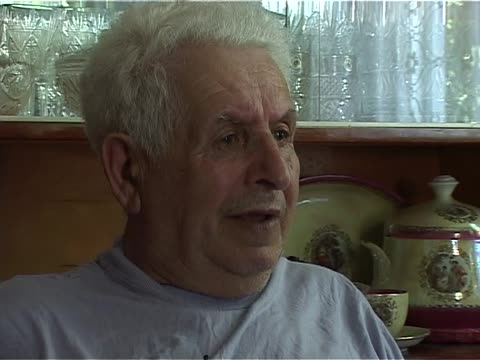
Personal introduction.
From the machine transcript
Opening formalities: Kerler gives the date and Stotland states his name, address, telephone number and birth date (5 August 1926). He says he had no father or mother and lived in an orphanage in Ovruch; his parents came from Narodychi, and his father was a shoemaker and his mother a housewife. He completed five grades in a Yiddish school.
Gives address and parents' names and occupations.
Yiddish school education and childhood memories.
From the machine transcript
Stotland talks about the only Yiddish school in Ovruch, closed a year before the war, and about his childhood in the orphanage. Twelve Jewish children lived there and spoke Yiddish among themselves, switching to Russian or Ukrainian when a teacher came. He names teachers and says subjects were taught in Yiddish. They read Sholem Aleichem and Itzik Pfeffer.
Names teachers and authors read and the number of Jewish orphanage children.
Yiddish songs.
From the machine transcript
Stotland sings a school song about how to make a whistle. He mentions Yiddish translations of Pushkin and Shevchenko. He then describes the evacuation of the orphanage by horse cart, its bombing by German aircraft, and the few survivors. He names his brother and two sisters, one of whom emigrated to America and another to Israel.
Also gives details on his siblings and the bombing.
Celebrating holidays and prewar Jewish life.
From the machine transcript
Stotland says Jewish holidays were not marked in the orphanage. As a child he and others ran away to his maternal aunt and uncle in town for Passover. He recalls five synagogues in Ovruch, including a large wooden one near the orphanage, where the children went for treats. The aunt and uncle were poor, with five small children.
Also covers the synagogues and his aunt and uncle's poverty.
Life during war.
From the machine transcript
Stotland tells of his wartime experience: after the bombing he wandered, arrived at the railway station in Kharkiv, and helped at a field kitchen beside a military train. He then volunteered for the front and served until the end of the war. He was wounded twice and became an invalid. On returning to Ovruch he found no one, worked at a hotel, and met his future wife.
Life after the war.
From the machine transcript
Stotland says he married Beyle, a native of Ovruch, and they were married 52 years until she died. He studied at two institutes in Kyiv and worked as a teacher, then as a school director in Ovruch for some twenty years. He has two sons, one also a teacher.
Family and Jewish life after the war.
From the machine transcript
Stotland says he taught his son Yiddish so he would not forget Jewish culture. He describes Jewish life in Ovruch after the war: returning evacuees found their houses occupied and lived in hardship, with no housing or work. Jews were then still found everywhere and Jewish children and teachers were numerous. Today almost no Jewish children remain in the district, the old have died, young people left, and only a small number of Jews are left, many of them in mixed marriages.
Also covers his son and the present-day shrinking of the Jewish population.
Beginning of war and family.
From the machine transcript
A very brief exchange, apparently about mixed marriages, with only a couple of words from each speaker.
Antisemitism and Yiddish culture before the war.
From the machine transcript
Stotland says that before the war they did not know the word antisemitism and religion was not taught against in school. Yiddish writers visited the Yiddish school, and Yiddish plays were staged in the local theatre by a Yiddish company in Ovruch. He remembers a visit by Itzik Pfeffer.
Also covers antisemitism and the absence of anti-religious teaching.
Weddings and dances.
From the machine transcript
Stotland recalls Jewish weddings and canopies before the war, which children ran to in hope of food. He names a wedding entertainer with a beard, called Shiman (?), and recalls singing and dancing at weddings, including the sher dance. Kerler asks about the badkhn, the mitzvah dance and the rabbi.
Names a wedding entertainer and the sher dance.
Prewar Jewish life and Yiddish press.
From the machine transcript
Stotland speaks of prewar Jewish institutions in Ovruch: the rabbi, two ritual slaughterers (Shiman (?) and Kaptsan (?)), and the Yiddish periodicals Shtern and Emes that reached the school. Children borrowed Yiddish books and held discussions with teachers. The synagogues were demolished in 1937, after which Jews met in private houses. He also mentions Jews from Belarus and Moldova, and visits to Transcarpathia where the Yiddish differed.
Also covers the slaughterers, periodicals, and Transcarpathian Yiddish.
Different Yiddish dialects.
From the machine transcript
Stotland compares Yiddish in Transcarpathia with that of Ovruch, noting that school subjects and oats had different names. Kerler gives examples of Transcarpathian forms for 'pour', 'village' and 'my'. Stotland says that despite differences they could understand each other.
Holiday celebration.
From the machine transcript
Stotland explains how as a child he ran from the orphanage to his poor aunt and uncle, a tailor with many children, for Sabbath and Passover. They gave him a piece of matzo. Katz moves on to the questions that follow.
Cultural terminology and religious customs today.
From the machine transcript
Kerler asks about cultural terms; Stotland explains what a dybbuk and a golem are, and what a good Jew is. He says people have visited the tsadik's grave near Ovruch since the 1990s and that he has been there often. He says there are no Hasidim in Ovruch today, though a religious man who speaks Yiddish and attends the minyan has recently arrived. Kerler also asks about a sanatorium for Chernobyl children.
Also covers the Chernobyl sanatorium and a present-day religious Jew in town.
Dialectology.
From the machine transcript
Dialectological questionnaire: Kerler gives Russian words and sentences for Stotland to translate into Yiddish. Items include household and body words, colours, adverbs of time and place, speed and nearness, greetings, prepositions with 'street', the sun, the bed, numerals, and sentences about the war. Katz adds follow-up questions about the answers. Stotland often notes that he mixes German and Yiddish.
Dialectology and different Yiddish dialects.
From the machine transcript
Questionnaire session with Stotland, in which Katz and Kerler ask for Yiddish equivalents of Russian words and sentences. Items include verb forms and pronouns, words for a river, water well, potato, attic, butcher, shop and shopkeeper, and a toy top. Others cover expressions for the dead, numbers, fractions, and 'enemy' versus 'neighbour'. Stotland says which forms were used in Ovruch and which he does not know, and notes differences in villages near Belarus.
The catalogue says dialects are discussed; the transcript is mostly item-by-item elicitation with comments on regional differences.
Town footage.
From the machine transcript
Short passage with Kerler and Katz speaking about a house and its Jewish residents. They give a number of years, apparently eighty, and wish the occupants good health. The speakers are hard to follow, and the remarks concern language and the house rather than a clear tour.
Informal chat.
From the machine transcript
Informal conversation with women at the Jewish community center in Ovruch. Katz mentions living in Vilnius and Kerler explains that the team records ethnography and language. They ask where the women learned Yiddish, and the women say it was from grandparents but that for years they did not speak it. The women mention relatives in Israel and some Hebrew learning.
Life in Ovruch before the war.
From the machine transcript
Kerler asks who remembers prewar Jewish life. One woman says she was still a child before the war and went to Russian School No. 2, and her parents knew Yiddish.
Yiddish songs and prewar/postwar religious life.
From the machine transcript
The team asks for a Yiddish song and the women say they remember only fragments. They then answer Kerler's questions about prewar religious life, saying that there were several synagogues. After the war, Jews gathered secretly in a house to pray and the militia chased them away.
The transcript shows that a song was requested but mostly not performed.
Informal chat.
From the machine transcript
Informal talk about the decline of Yiddish and the lack of people to speak it with. The women say they are now learning Hebrew. Katz suggests sending Yiddish newspapers from America and asks who might receive one.
Synagogue in Ovruch.
From the machine transcript
Kerler asks about the synagogue in Ovruch, and the women say there was a large one, probably wooden. People from the surrounding villages came to study and pray there.
Potential Yiddish-speakers from the region.
From the machine transcript
The women suggest possible interviewees, among them an old man called Binyomin (?) who is ninety-nine and still remembers how to pray, and a man named Friedman. They also mention a woman whose father was learned. They discuss ages and which people would speak Yiddish, and say that Ovruch was a Jewish town and that many Jews have since left or died.
Anecdote and non-Jews speaking Yiddish.
From the machine transcript
One of the women tells an anecdote about a relative from the Crimea, a 'krimer eydem' (?), who spoke Yiddish when she assumed he was an invalid. They also discuss non-Jewish neighbors who understood Yiddish, such as the shoemaker and the tailor. The Yiddish they speak today is mixed with Polish, Ukrainian, Belarusian and Russian. Katz mentions a Yiddish summer course in Vilnius.
Life today.
From the machine transcript
Talk about life today and Yiddish among younger people. A woman says her parents were teachers, and children who emigrated to Israel quickly lose Russian. Kerler remarks on his friends and their languages. The passage is partly in Russian.
Informal chat in Russian.
From the machine transcript
Brief exchange in Russian and Yiddish, partly informal, in which a woman speaks about a Yiddish word and Hebrew. The words are mostly unclear.
Holiday celebration and general introduction.
From the machine transcript
Start of the formal interview with Turovskaia, who talks about her work and observing Sabbath and holidays. She says she was born in Veledniki near the holy tsadik's grave. She gives her Yiddish and Russian names, her parents' and grandparents' names, her married name Turovskaia and maiden name Feldman, her address and telephone number. She was born in 1924, three days before Passover, and explains a custom connected with her birth.
The catalogue calls this holiday celebration; the transcript is mostly her names, her address and her birth date.
Prewar religious life and Volednicker rebbe.
From the machine transcript
Turovskaia describes Veledniki as a very Jewish town where a holy tsadik is buried, giving his name (partly unclear) and that of his wife Ester Tsipe. She names her father after the tsadik and says he used to travel to pray at his grave. She also says she completed four grades of Yiddish school.
The transcript adds her father's pilgrimages to the tsadik's grave and that he was named after him.
School education.
From the machine transcript
Turovskaia talks about the Yiddish school in Veledniki, which she attended for four grades. She recalls the subjects, all taught in Yiddish. The school was closed in about 1935 or 1936, and she moved to a Ukrainian school and finished ten grades. She mentions that visitors still come to the tsadik's grave from Moscow, Leningrad and Siberia.
Prewar Jewish life in Novyye Veledniki and life during war.
From the machine transcript
Turovskaia says 125 Jewish families lived in Veledniki, a town in a border zone that required a special permit to enter from Ovruch. She then begins on the start of the war: her father was taken into the army and her grandmother was very ill. Her mother had seven children, of whom four survived.
Family and life during war and kolkhoz.
From the machine transcript
Turovskaia recounts in detail the evacuation of her family. Her grandmother was dying but urged the family to leave, and a teacher neighbor took Turovskaia to Kharkiv. The grandmother was carried to a wagon among pillows and taken to the station and by train toward Chernihiv. Turovskaia dug trenches, then received a telegram saying the family was at a kolkhoz in the Tambov region and traveled with Polish Jewish refugees. At the kolkhoz she found no one, and a woman from Ovruch helped her find her mother. The family later went on to Buryat Mongolia in Siberia. Her father fought at the front and returned in 1946. She describes the destruction of Veledniki when they returned, including the roofs taken by Hungarians.
Return to Novyye Veledniki and move to Ovruch.
From the machine transcript
Turovskaia says she and her family came to Ovruch in 1944. When asked about her father, she gives his birth year as 1898 and says he died in 1991.
Family.
From the machine transcript
Turovskaia talks about her parents. Her mother was born in 1899 or 1897 according to different records, and her father worked in trade, preparing livestock for sale. She praises her mother as a good housewife. She names a brother, Fayvl, who died, and says that seven children were born and four survived, because of a scarlet fever epidemic before the war.
Religious life today and family.
From the machine transcript
Turovskaia says she keeps the yortsayts (memorial days) for her parents and grandparents, as her father told her, and recalls them. She names her maternal grandparents (Reyzl, daughter of Yitskhok, and Binem Shloyme, family name Vaynbrand) and her paternal grandparents (Shloyme and Fayge). Her grandfather had a matzo machine and a wool-carding machine and her father baked matzo. She distinguishes Novyye Veledniki from Staryye Veledniki, her grandparents' village, and says her father knew many tales of the rebbe.
Gives grandparents' names and the grandfather's matzo and wool-carding machines, beyond the mention of the memorial days.
Stories about the Voldednicker rebbe.
From the machine transcript
Turovskaia retells stories her father told about the Volednicker rebbe, who helped people who came to him. One is about a mother whose son was to be conscripted into the army, one about a baby lost in the winter and found alive after a wolf, and one about a Jew who stayed with a robber one Sabbath. The longest is about a woman with several daughters to marry off who sells bagels and loses her money to a lodger, with the rebbe's help. Kerler and Katz ask about Russian and Yiddish words, such as the verb for abandoning a wife. They also discuss photocopying her father's handwritten notebook of the stories.
Includes the tales of the lost child and the bagel-seller, and discussion of photocopying her father's notebook and of Yiddish and Russian words.
Work and family.
From the machine transcript
Turovskaia says she taught history in schools in Ovruch before she married. Her husband was a veterinary doctor, and they went to Siberia, where they worked in schools for thirty years. She returned to Ovruch in the 1980s, after retiring on a pension, to care for her father; her sisters and brothers lived elsewhere. Kerler and Katz ask when her father wrote his notes, and she cannot give a year.
Religious life and tzaddikim.
From the machine transcript
Katz asks about tzaddikim and she names one in Uman and mentions Vilna, saying she only knows that tzaddikim lived there. She also mentions receiving a Jewish newspaper from Opshtshina (?). Most of the passage is Katz and Kerler talking among themselves about finding a photocopying machine for her father's book.
Much of it is the interviewers discussing photocopying the book.
Holiday celebration and food customs.
From the machine transcript
Turovskaia talks about holiday observance and food. She did not eat bread on Passover even in Siberia, and she describes her mother's baking and foods for Rosh Hashanah and the Sabbath. Geese were fattened and their fat rendered for Passover, and matzo was bought in Opshtshina (?). Before the war the family kept their own cow, sold milk to the hospital and neighbors, churned butter, planted potatoes and made wine from currants and cherries.
Adds Yom Kippur fasting and eve food, Sabbath cholent, the cow Pasolye (?), butter-making and homemade wine.
Prewar religious life.
From the machine transcript
Turovskaia describes the two-story beys medresh in Veledniki, with women praying on one floor and men on the other. She also mentions a former Polish church and a Christian cloister, which she says Jews called kloyster. Nothing remains of the study house, the church or the cloister. The interviewers ask for Yiddish terms.
Life during 1920s.
From the machine transcript
Asked about songs from her girlhood, Turovskaia instead describes her childhood: an uncle on her mother's side who died young just before his wedding, her mother's grief, and her own work as the eldest child. She played the fiddle and could play melodies she knew. She says her mother, father, brother and husband have since died.
Adds her fiddle playing and the story of her uncle's death before his wedding, and her family's later deaths.
Customs.
From the machine transcript
Turovskaia says she is not in good health. Kerler asks whether she remembers a charm against the evil eye, and she recites one about three women sitting on a stone, partly in Russian or Ukrainian. The interviewers react appreciatively.
Includes her remarks on her health.
Life today.
From the machine transcript
Turovskaia speaks about her present life and her health. The interviewers say where they come from, Kerler near Chicago and Katz born in New York and living in Vilnius. She says she knows little about Vilna beyond that tzaddikim lived there. Katz tells a story of meeting the Lubavitcher Rebbe and receiving two dollars for charity from him.
Much of it is the interviewers introducing themselves and Katz's story of the Lubavitcher Rebbe.
Prayer and religious tradition.
From the machine transcript
Turovskaia recites blessings, including the candle-lighting blessing for Sabbath and the festivals. She says her father had her write down how many blessings are said on each holiday. She says the mourner's kaddish for relatives, lights memorial candles and sends memorial notes to Opshtshina (?). Katz tests her on Hebrew month names. She asks about the eleven months of kaddish and the leap year, since her husband died on 14 July.
Includes the recited blessings, the Hebrew months and the question about kaddish and the leap year.
Religious life today.
From the machine transcript
The conversation turns to religious life today, including where a rabbi might be consulted: Zhytomyr, or a rabbi who comes on Sabbath. Turovskaia says there is a prayer gathering on Lenin Street, and she names local Jews who live nearby. She recalls how her father led the seder before the war. She says two visitors, one from America and one from Israel, came recently for Passover, with a translator. Kerler asks about the word for translator and then about the dybbuk.
Adds the seder led by her father and the recent visitors from America and Israel.
Cultural terminology and life before the war.
From the machine transcript
Turovskaia says a dybbuk story is among her father's written tales. Katz and Kerler ask what the word means, and she describes something entering a person or animal. They discuss related Yiddish words such as 'apir' (?) and 'efremye' (?). She then mentions Yiddish records: after the war her father brought a record player and they bought records. She says she lived in Siberia until the 1980s.
Adds the Yiddish records and her time in Siberia.
Life after the war and today and family.
From the machine transcript
Turovskaia says where her children live: one in the Krasnoyarsk region of Siberia, one near Leningrad, and a daughter in Brooklyn. She says she is almost the only Jew left on her street. She expresses hopes for her children and criticises Bin Laden and terrorism. Kerler then asks about Sukkot.
Holiday celebration and Yiddish culture.
From the machine transcript
Turovskaia says a sukkah was built in the corridor at her father's house, where the family ate. Answering Kerler, she says there was anti-religious propaganda in Soviet schools, even Yiddish ones, with informers, though believers kept faith. She recalls the war years in Siberia, the death of her grandmother in 1943 (?), and her trips to Mongolia (?).
Adds her remarks on the war years in Siberia.
Family and reciting prayers.
From the machine transcript
Turovskaia describes her memorial practices, including saying the 'El maley rakhamim' prayer, and that people from Kyiv and St Petersburg ask her to say kaddish for their dead. Katz and Kerler ask her to recite the traditional prayer as her father said it, and she hesitates. They ask about other blessings for women, such as the 'modeh ani'. She says her father had her write down the blessings. She recalls her mother's geese, schmaltz and matzo for Passover.
Adds the requests from relatives in other cities to say kaddish and the interviewers' attempt to elicit the prayer.
Prewar Jewish life in Novyye Veledniki.
From the machine transcript
Turovskaia remembers her mother's charity: sharing cherries from their tree, sending food and matzo, and going with other women to collect for the poor. She says her father visited the tzaddik every Elul and, when too old, still kept the practice. She tells how her grandmother's dream gave her mother's name Alte, and of a 'good Jew' (a tzaddik) who gave it. The passage ends with her account of Leybl of Khabne in Polesye, who could foresee events and was approached for advice.
Adds her mother's charity, the dream behind her mother's name, and the tale of Leybl of Khabne.
Stories about the tzaddik.
From the machine transcript
Turovskaia tells how, when the Germans occupied Khabne, the tzaddik Leybl of Khabne was asked who would win and told them to take two roosters, a white and a red one, and see which won. Katz and Kerler ask which rebbe this was; Kerler notes that the town appears in literature (Sholem Aleichem). Katz also asks about the story of the tzaddik who gave blows.
The story concerns the German occupation and a prophecy by two roosters
Childhood memories and life in Siberia.
From the machine transcript
Turovskaia describes a small stream at Velednik and a bathhouse with a mikveh there in the past. She recalls her time in Siberia, where she worked in a school and fasted all day on Yom Kippur, eating only potatoes when she came home.
Also covers a mikveh, and Yom Kippur fasting while working in a school
Life after the war.
From the machine transcript
Asked whether she read anything in Yiddish after the war, Turovskaia says there were no newspapers and there was no time, because she worked, studied and had a household to run. She speaks of hard years and of finally having a home of her own with children. Kerler then asks about a phrase for a good place.
Cultural terminology and remembering family.
From the machine transcript
Kerler and Katz ask about the term for a holy place. Turovskaia speaks of the graves of her grandparents and relatives in Velednik, and of the tzaddik buried there, with Katz and Kerler asking about Hasidic groups (Breslov, Chernobyl, Chabad) behind the restoration of the tomb at Uman(?). She names a rebbe from Kotelnitsh(?). Kerler then asks about visitors who spoke a different kind of Yiddish.
Also lists relatives buried at Velednik, and the question of who restored the tomb
Yiddish dialectology and family.
From the machine transcript
Turovskaia compares the Yiddish of Velednik with that of Korostyshiv or elsewhere, and Katz asks about word forms such as town, the name Moshe, people and come. She then tells of a Lithuanian Jew who once lived there, and of a family whose members were sold into a business, and mentions an address she tried unsuccessfully to obtain from a man from Argentina. The passage ends with Kerler asking about weddings in Velednik.
Includes a story of a Lithuanian Jew and the search for relatives abroad
Weddings.
From the machine transcript
Turovskaia recalls that weddings took place in Velednik, that her father arranged a wedding canopy for her and her husband there, and that klezmer musicians played. As she was still a child she does not remember who led the celebration. She says the shtetl later became a village, and Kerler asks for the Yiddish word for a sitting-position, getting the word for Satan.
Cultural terminology and Yiddish dialectology.
From the machine transcript
A stretch of questionnaire work led by Kerler and Katz, with the answers often discussed in Russian and Ukrainian. The items cover the devil and its epithets, a fool, daily greetings and farewells, house and room words, a porch, a window pane, pots, birds, building and stone wall, the grave of the holy tzaddik, borscht, blind, late, near, words like high and higher, breath and breathing.
Covers daily greetings, house, window, building and adverb items
Informal chat with a neighbor about her father's book.
From the machine transcript
A Russian-language exchange between Kerler and a neighbor, with Turovskaia chiming in, about numbering the pages of a book (her father's, according to the catalogue) and thanks for the loan.
The talk is mostly in Russian about page numbering
Yiddish dialectology.
From the machine transcript
Kerler continues the dialectology questions, asking for words such as run away, honest, pious and religious, honest, and headache. Turovskaia gives answers, adding that one man ran away from the Germans.
Stories about the tzaddik and religious customs at the cemetery.
From the machine transcript
Turovskaia tells of the tzaddik's help, noting that he knew a visitor's story as soon as he entered; he rebuked a man who had struck his mother. She describes traveling to the grave by bus, putting pebbles on graves (a custom she calls by a Hebrew-sounding name) with a spoken message, and pressing a note, as well as the old trees and the monument. Kerler and Katz ask about measuring graves and about notes (kvitlekh).
Includes visits to the grave, leaving pebbles, and questions about kvitlekh and measuring graves
Dialectology.
From the machine transcript
Long dialectology questionnaire led by Kerler, with Katz joining. The items include numbers, vodka, street prepositions, a flowerbed, a bed, a midwife and great-grandmother, plurals, sick and well, potatoes and flowers, a shop, people, another town, half, knowing, using, and adjectives and grammar: how to say 'the way' and 'wagons'. Turovskaia mentions her father's praying and Kol Nidre in synagogue, and Katz asks about gender and diminutive forms. The tape ends with her offering to show her children.