0:00
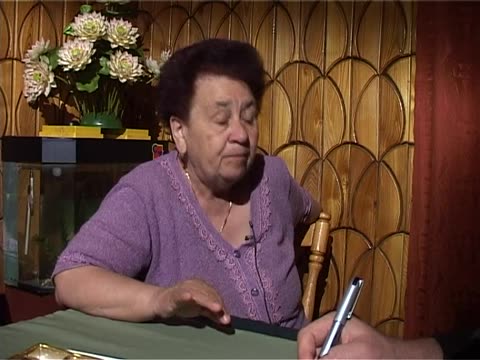
A formal interview of Rita Davidovna Shveibish at a restaurant. She talks about life in Horyshkivka and Tul'chyn before and after the war. She then moves on to discussing today's Horyshkivka. She then discusses the difficulties of working with today’s Jewish institutions in Tul'chyn. She gives a short description of agricultural life before and after the war. She also reflects upon how non-Jews experience postwar times. She talks about pogroms in Horyshkivka and Tul'chyn before the war. The conversation then turns to a series of dialectological questions. She then talks about Jewish food customs and the difficulties of practicing Judaism in today’s Tul'chyn. Shveibish then discusses food customs and recipes. The conversation then moves to the mystical Jewish tradition. The interview concludes with a dialectological questionnaire about the Yiddish language.
Shveibish tells about her husband Itsik's family from Horyshkivka. His father came from Tul'chyn after the pogroms, he was a craftsman, and there were six children. She describes the Romanian-era ghetto in the village club, a sister who was shot at and traumatised, the siblings who emigrated or have died, and the parents' graves in Tomashpil. She talks about Horyshkivka as the model for Sholem Aleichem's Kasrilevke, the Yiddish theatre troupe in which her husband's father acted, and pogroms in Tul'chyn and Khmelnytskyi's time. She then describes Jewish life in Tul'chyn today (the community's difficulties, no shoykhet, no minyan, a memorial, aged pensioners), and Jewish food and holiday customs, with a recipe for gefilte fish. The passage includes dialectological questions on words such as store, courtyard, well, potato dishes, thanks and please, and idioms.
Adds the dialectological questions on vocabulary and the passage on Kasrilevke.