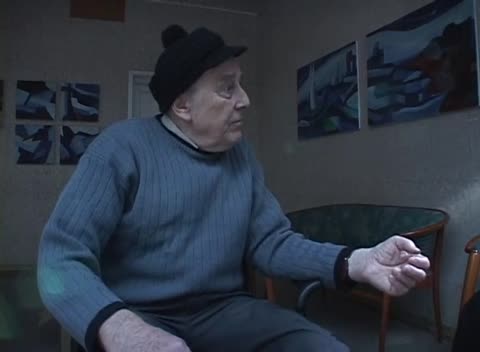
Rezmovits talks about Yiddish poets and why he began reading poetry. Rezmovits raised two children.
From the machine transcript
Rezmovits and Kerler discuss Yiddish poets (Mangar, Latshteyn, Sutskever and others) and Rezmovits's reading of their poems. He says he began writing his Yiddish poems late, after his wife died, when he was anxious about the responsibility for his two children and could not sleep. He adds that he can write better in Hungarian.
Kerler and Rezmovits name specific poets, and Rezmovits explains why he began writing.
Rezmovits speaks about his life in prewar Debrecen. He shares an episode about his mother going to the kosher butcher. Rezmovits then talks about his family and describes his mother's good spirits. He explains how his mother took care of her children, while his father was in prison. Rezmovits grew up with five siblings.
From the machine transcript
Rezmovits talks about prewar Debrecen and his Jewish community, including an episode of his mother and the ritual slaughterer. He describes his mother's humor and patience, and how she managed six children while his father was in forced labor. The family lived in a long courtyard on a street in Debrecen. He and Kerler discuss the word for a snack (a Hungarian-Yiddish word, "yaznt").
Includes the word for a snack and the family's courtyard address.
Rezmovits discusses his childhood memories and describes poverty in town. He also recalls how his father described locals.
From the machine transcript
Rezmovits recalls poverty in childhood: bread spread with lard and paprika as a snack. He describes his father's attitude toward self-important people in the community, and the nickname "karpn-kop" (carp head) his father used for them. He and Kerler compare the fish word in Hungarian and in other Yiddish dialects.
Covers the nickname and fish terminology rather than only childhood memories.
Rezmovits speaks about food customs before the war. He then addresses different regional Yiddish dialects.
From the machine transcript
Rezmovits and Kerler discuss who ate the carp's head with gefilte fish and how customs differed regionally. They then turn to Yiddish dialects: Hungarian-born speakers in Debrecen, the Carpathian region near Beregszász, Munkács and Nyíregyháza, and Budapest speakers' pronunciation. He recalls being annoyed by a Budapest pronunciation of a holiday name.
Rezmovits tells a couple of stories about "Froim der ganeydiker" (Froim the merciful) going to a restaurant and making a contract with a priest. He also addresses prewar Jewish life, particularly the local Jewish secondary school, and recalls antisemitism during his schooldays in Debrecen.
From the machine transcript
Rezmovits tells stories about Froim der ganeydiker (a trickster figure told by his mother), including a restaurant episode and a contract with a priest. He then discusses prewar Debrecen, with antisemitism and fights with non-Jewish boys when leaving cheder, and the large Jewish gymnasium and a famed Jewish athlete from Debrecen. Kerler asks him to write the stories down.
The passage opens with antisemitism and the gymnasium, and ends with Rezmovits's sister in Debrecen.
Rezmovits speaks about his family and their life during World War II. He then tells an episode about his father finding money during the economic crisis in the early 1930s. Rezmovits states that his father was also respected among non-Jews.
From the machine transcript
Rezmovits talks about his family, six children in all, including his sister Gitl, and the deportation of the mother and children, while his father stayed in Hungary on forced labor and kept kosher. He tells how his father found a wallet with 800 pengő during the economic crisis of the 1930s and returned it despite the family's poverty. His father was respected among Jews and non-Jews alike, as many non-Jews came to his funeral.
Includes his sister Gitl and Kerler's question about palinka.
Rezmovits addresses prewar religious life in Debrecen. He also describes his religious school teacher (melamed), Reb Falkovich, and shares an episode about being caught reading something else. Rezmovits then explains his melamed's teaching style.
From the machine transcript
Rezmovits discusses cheder and prewar religious education in Debrecen, especially his teacher Reb Falkovitsh (?). He recalls being caught reading a novel under the table and the teacher's reaction, and describes his harsh but respected melamed, who taught Humash, Rashi and some Gemara. He mentions other melamed names, and says the last year brought the worst beatings. The Germans occupied Hungary on March 19, 1944.
Rezmovits talks about contemporary community members. He then speaks about his father's friend and gives a glimpse of their political conversations in prewar Debrecen. Rezmovits then addresses regional Yiddish dialects. He then returns to contemporary community members.
From the machine transcript
Rezmovits describes an older community member who understood but did not speak Yiddish, and his father's friend Nosn Gotlib, with whom he discussed politics in Debrecen (the fall of Singapore). Kerler asks word-pair questions (such as 'zikher/gikher' and 'kokh/kekh'), and they discuss the Yiddish of Carpathian-area speakers. He then reflects on the decline of Yiddish and Kerler's mission, and describes encounters with ultra-Orthodox Jews, including a Satmar man and a Hasid seen in Debrecen dressed as a non-Jew.
Also includes Kerler's word-pair questions and Rezmovits's views on Satmar Hasidim.
Rezmovits addresses dialectology regarding his native Yiddish.
From the machine transcript
Rezmovits and Kerler discuss Yiddish words with Hungarian and Slavic elements, such as the word for a notebook, a word for brandy and 'flask', and their etymology. Rezmovits then mentions an earlier interview by a woman who came from Israel and sent him a video cassette, and Kerler suggests ways to view it. He ends with a story of a Romanian-Jewish woman who asked where his family came from (Sighet).
Rezmovits remembers a song he heard from Russian soldiers. He then speaks about his life today and visits to Israel immediately after the collapse of the Soviet Union. Rezmovits did research for his article on survivors of the Warsaw Ghetto Uprising.
From the machine transcript
Rezmovits and Kerler arrange a lunch invitation. Kerler asks about Rezmovits's years in Israel, and Rezmovits explains that he made a vow to meet Jewish fighters from the Warsaw Ghetto Uprising. He recounts a survivor's story of a transport toward Treblinka and an escape through the wagon, and then discusses Leon Uris and other American writers he read.
Details the Warsaw Ghetto survivor's story and Rezmovits's reading of Uris; the song from Russian soldiers is barely evident.
Rezmovits speaks about western refugees in Debrecen in 1941. He explains how they spoke at the local prayer house about the persecuation of the Jews in the west. Rezmovits also addresses Soviet Jewish writers and other Holocaust writings.
From the machine transcript
Rezmovits recalls Polish and Lithuanian Jewish refugees in Debrecen, who spoke in the local prayer house about what was happening to Jews. The Hungarian Jews would not believe them. He then discusses writers, among them Ilya Ehrenburg, Elie Wiesel and Soviet Jewish writers, with Kerler offering to send him a photocopy of a Yiddish book. They also discuss Rezmovits's own short piece on the Satmar Hasidim.
Adds long discussion of writers (Ehrenburg, Wiesel, Babel) and the Satmar piece.
Rezmovits speaks about Jewish collaborators during the war.
From the machine transcript
Rezmovits speaks about Jewish collaboration during the Holocaust, mentioning Polish Jewish informers and the Hungarian Rezső Kasztner. He criticizes Kasztner's dealings with the SS (Eichmann, Kurt Becher) and the rescue train to Switzerland. He also recalls the controversy over Kasztner in Israel, and promises Kerler a book.
The catalogue says 'collaborators' generally; the transcript centers on Kasztner and a Polish Jewish informer issue.
Rezmovits talks about non-Jewish rescuers. He then addresses characteristic differences between Hungarian and Transcarpathian Jews, before discussing the local ignorance about the Jewish fate in Nazi occupied Europe.
From the machine transcript
Rezmovits speaks of non-Jewish rescuers, a reference to Raoul Wallenberg's rescue and arrest, in contrast to Kasztner, and describes a phone call with a Hungarian historian about Kasztner. He then turns to differences between Hungarian Jews and Transcarpathian ones: the latter mocked the Hungarians. He ends on the ignorance of what awaited deported Jews, recalling the Debrecen wagon at age fourteen.
Adds a historian's phone call and the Braham study.
Rezmovits speaks about his life during World War II, especially his deportation from Debrecen. He then recalls an encounter with Simon Wiesenthal.
From the machine transcript
Rezmovits describes being deported in a wagon from Debrecen and what he thought on the journey; he wrote about it in Hungarian. He then criticizes the idea of making a hero of Kasztner. He also recalls meeting Simon Wiesenthal, whose books he admires and who signed them for him.
Adds a reflection on the word for the scene of a crime and criticism of Kasztner.
Rezmovits sings a Yiddish song about life in the Soviet Union. He then talks about prewar Zionist activities in the region.
From the machine transcript
Rezmovits sings a song he heard Soviet-era survivors sing about the Soviet Union, and sings the refrain again at Kerler's request. He then describes prewar Zionist training (hakhshara) in Hungarian places, and says that Zionism was weak because Jewish leaders opposed it.
Rezmovits briefly touches upon postwar Yiddish culture, before addressing characteristic differences between Polish and Hungarian Jews.
From the machine transcript
Asked by Kerler about Yiddish theater in Debrecen, Rezmovits says only the Bucharest Yiddish theater came after the war. He also says Hungarian Jews had difficulty understanding Yiddish dialect. He then addresses Hungarian Jews' negative attitude toward Polish Jews, and being mocked in Israel for his Hungarian accent.
Adds Hungarian Jews' attitude toward Polish Jews and ridicule in Israel.
Rezmovits speaks about his life in Israel.
From the machine transcript
Rezmovits tells a short anecdote about an elderly Hasid and his wife, and Kerler closes the recording.
The catalogue says life in Israel; the transcript shows a short anecdote.
Rezmovits sings a Yiddish song about a rebbe and his wife, he learned from Polish Jews in Israel.
From the machine transcript
Kerler opens with the date and thanks the people who helped the expedition, then asks Rezmovits to sing. Rezmovits, with another person joining in, sings a humorous song about a rebbe, the rebbetsin and the hasidim. Asked when the song was sung, he says he heard it in Israel and brought it back to Hungary, and tells how Polish friends there found he knew Yiddish.
Also includes Kerler's opening announcement and thanks, and an anecdote about Polish friends in Israel.
Rezmovits addresses local Yiddish dialectology.
From the machine transcript
Kerler asks about a local Yiddish word for 'together' and about a term connected with bundles of beans (?). Rezmovits confirms the first as used in Debrecen and discusses the second; he then says he has songs he heard from his mother.
Rezmovits recalls songs titles from his childhood, originally from the Transcarpathian region.
From the machine transcript
Rezmovits recalls sayings and songs from his Carpathian family tradition, such as not boasting about money. His parents came from Sighet and his grandfather was a melamed. He tells how his father, angered by a Romanian tax collector who seized his grandfather's tefillin bag, threw the man to the ground and his grandmother calmed the man with brandy. Kerler asks about songs of the grandfather and father, about love, and about a comic song about paper children; Rezmovits cannot place the last.
The team concludes the formal part of the interview with Rezmovits.
From the machine transcript
Kerler thanks Rezmovits and ends the formal interview, saying the team has to leave. The rest is a brief informal exchange with garbled speech.
The team walks with Rezmovits to a restaurant, where they continue the conversation.
Rezmovits speaks about his life in Debrecen after the war. He worked in the metal business. He then shares an episode when he encountered a Yiddish-speaking Polish family.
From the machine transcript
Rezmovits talks about forced labor in the early 1950s (?), when he was given only unskilled work smashing material with a large hammer in a factory, and wagonloads were packed each day. He then tells how he and a colleague, caught in a storm, asked a Polish peasant woman for a night's shelter. She turned out to speak Yiddish because she had once been a servant in a Jewish household. She offered them pork and gave a parting gift of a kind of red tea.
The Yiddish-speaking woman was a Polish peasant, a former servant in a Jewish household, and gave the men tea; the year and place of the work are unclear.
Rezmovits tells jokes. He then speaks about his life during World War II, particularly recalling shootings. They then discuss Holocaust writings and films.
From the machine transcript
Rezmovits recalls wartime scenes involving soldiers, Russian and Jewish officers and shooting at Germans, and says that Polish people were hostile to Jews and that many Jews were betrayed or had to hide. He then discusses with Kerler books and films about the Warsaw ghetto uprising and its Jewish historians, including Rezmovits's reading of one such book in Hebrew, and how many Germans were killed by the insurgents. The discussion turns to the importance of the fact of Jewish armed resistance.
The passage covers the Warsaw uprising books and films and Polish antisemitism, which the catalogue sentence does not name.
They talk about life today, before Rezmovits speaks again about Jewish collaborators during World War II.
From the machine transcript
Rezmovits speaks about a Polish official who, according to him, helped the Polish administration yet saved many Jews, and about his son, who became the first prime minister after communism fell. The talk then turns to Kerler's book of poems, which Rezmovits has begun to read and praises. He mentions that he writes in three languages and was told about Kerler by a woman, Sonya (?).
The passage includes an extended exchange about Kerler's poetry book and Rezmovits's reading of it.
Rezmovits discusses Jewish poets and his work as translator into Hungarian.
From the machine transcript
Rezmovits discusses the Hebrew poet Nathan Alterman, whom he considers unique in Israel, and says he has translated four or five of his poems into Hungarian. He explains that translating feels to him like a duty, and that he has shown the poems to an expert but they are not yet published. Kerler suggests he should publish the translations, and both reflect that the more one learns, the less one feels one knows.