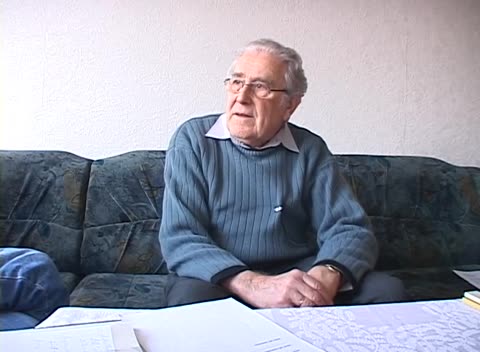
Rezmovits speaks about the contemporary community. He also mentions his time in Israel.
From the machine transcript
Rezmovits and Kerler discuss other Yiddish speakers he can recommend to the interviewers, including a Russian-born man, a blacksmith from the Carpathians who got extra rations in forced labor, and a man of Polish descent who speaks Yiddish. Rezmovits then mentions meeting Polish Jews and speaking Yiddish with them during his time in Israel.
Most of the passage is about recommending other Yiddish speakers and their backgrounds, not the community as such.
Rezmovits provides personal information and talks about his family. His parents were born in Sighetu Marmației. His father moved to Buda before World War I.
From the machine transcript
Rezmovits gives his birthplace as Debrecen and his official name as Andor, while at home he was called Avrom. His parents came from the Máramaros region; his father, whose Yiddish name is given, was born in 1896(?) and came before the First World War. He never knew his grandfather, who died in 1929, a year before Rezmovits was born in 1930.
The transcript also gives his birth year, his names, his father's name and his grandfather's death.
Rezmovits addresses his religious school (talmud torah) education. Rezmovits published a book about this period of his life. He also gives a glimpse of local Jewish life in prewar Debrecen.
From the machine transcript
Rezmovits speaks about the talmud torah and mentions a story he wrote in his book about a boy in his class and a teacher who beat pupils with a stick. He then turns to the Hungarian occupation of March 1944 and the family's being put into wagons.
The passage also covers the start of the 1944 deportation.
Rezmovits speaks about his life during World War II, when he was deported on a train from Debrecen to Auschwitz on March 19, 1944. Rezmovits grew up with three sisters and two brothers. He describes the journey, particularly when the train stopped in Košice, Slovakia, and was then rerouted to Austria. Rezmovits explains why he was not deported to Auschwitz, which he learned from historical studies. According to the historian Marion Amber, documents were switched. Rezmovits's immediate family survived and his father was liberated by the Red Army from forced labor.
From the machine transcript
Rezmovits tells how the train taking his family from Debrecen stood for hours at Košice and was then sent to Austria instead of Auschwitz. He explains this from a historian's book based on German archives, which describes a mix-up of transport papers and an SS man's error, and gives the book's Hungarian title. He mentions that most Debrecen Jews survived, that his father was in forced labor, and that a camp commander picked men for a march toward Munkács, all of whom were killed when the Russians arrived. He ends by saying that surviving made him feel he had to do something for Jewry, and so he went to Israel.
The passage also covers a historian's book, the SS officer's mistake and Eichmann's role, and the father's forced labor.
Rezmovits speaks about his life after the war. He made aliyah and returned to help out his family in 1953. Rezmovits served in the Israeli army and then worked as brick layer in Israel. Rezmovits speaks about his work as laborer and antisemitism he encountered. He then worked as technician until his retirement. Rezmovits raised two sons.
From the machine transcript
Rezmovits explains that he returned from Israel in 1953 to support his parents and younger sisters. He describes hard times under Rákosi, being refused a job at a factory because of his Israeli background, and the manual work he did, including carrying bricks. He worked as a technician and studied at night; his wife died after 21 years, leaving him with two sons, both now in Budapest, one a calculator operator and one a lawyer. He has no grandchildren. He names his mother, Tojbe, whose parents came from Máramaros and had a large onion business.
The passage also covers his wife's death, his sons and the start of his account of his mother's family.
Rezmovits speaks about his family. His maternal grandparents owned an onion shop.
From the machine transcript
Rezmovits speaks about his father's side, where his grandfather Avrom was a poor teacher (melamed), and about visiting his maternal grandparents at about age four. He recalls a cousin, Sara, who turned up in 1945 as the only survivor of her family, then married a ritual slaughterer and went to Manchester. He names his three sisters and brothers and says four of the six siblings are alive; his brother in Debrecen is ill. Kerler then asks about his childhood memories of Debrecen.
The passage also covers his siblings' names, the surviving cousin who went to Manchester, and his paternal grandfather the melamed.
Rezmovits addresses his childhood memories, growing up in Debrecen. In particular, he speaks about his education at a primary school and talmud torah school. According to Rezmovits, both schools were located in the same building.
From the machine transcript
Rezmovits describes his Orthodox community in Debrecen. In the morning he studied secular subjects at a school in the Real School Street, and in the afternoon he went to the talmud torah in the same building. He and Kerler discuss the synagogue on Post Street, a cantor whose son became an opera singer in Switzerland, and the Paul Robeson records he collected. They also talk about the surviving remnant of the old school with its Star of David on a window grating, the mikveh, and the Orthodox and status quo communities in the same street.
The passage also covers the cantor's family, Paul Robeson records and the layout of the Jewish streets of Debrecen.
Rezmovits talks about his family and speaking Yiddish before the war. He recalls antisemitic sentiments among Christian boys. Rezmovits returns to his education at a talmud torah school.
From the machine transcript
Rezmovits talks about his ill brother in Debrecen, with whom he now speaks Hungarian. In the family only Yiddish was spoken, but outside Jewish children were beaten by non-Jewish boys, so he learned to speak Hungarian and to box. Debrecen is described as an antisemitic town. In the talmud torah he studied Humash, Rashi and some Gemara and learned to write Yiddish. He says he was pious as a boy and gives the reason he lost his faith.
The passage also covers language use at home and the schoolboys' Yiddish writing.
Rezmovits speaks about his aliyah. According to him, he became less observant during that period. He then talks about prewar religious life, including the Hasidic community, in Debrecen.
From the machine transcript
Rezmovits speaks about his arrival in Israel and says he and his comrades there left Jewish observance behind. He mentions that he was the leader of a Hebrew club where people came who did not speak Yiddish but kept holidays and put on tefillin.
The transcript does not clearly show talk about the Hasidic community of Debrecen.
Rezmovits speaks about his life before the war. He states that he attended meetings at Zionist youth organizations, such as Hashomer Hatzair and Po'el Mizrakhim. He then sings a Zionist songs.
From the machine transcript
Rezmovits talks about Zionist youth movements and the songs he learned. A song about the attic and the pioneers is recalled by Kerler and sung in part by Rezmovits, and he also recites a humorous rebbe song. He mentions the Communist Yiddish newspaper Frei Israel, which he read in Israel, and says he felt reborn on arrival, though he found conditions difficult.
The passage also covers Yiddish songs, the Communist newspaper and his early years in Israel.
Rezmovits talks about his return to Debrecen in the 1953 and postwar Jewish life. He then shares an example of how his mother spoke Yiddish.
From the machine transcript
Rezmovits describes the Jewish population of Debrecen, some 10,000 Jews, most of them not Yiddish-speaking. He remembers his mother's saying a line in an old Yiddish full of Hungarian and Polish words about a curfew. He also describes her courage.
The transcript shows no clear talk of his return in 1953 here; it deals with the Jewish population, local language and his mother's Yiddish.
Rezmovits speaks about his and his family's life in Klausen-Leopoldsdorf, Austria, toward the end of World War II. In particular, he shares episodes from daily life and fighting on the front line.
From the machine transcript
Rezmovits recalls the family's time in Klausen-Leopoldsdorf in Austria near the end of the war, where they posed as Hungarian refugees. They hid a young Jewish man whose looks might betray him, and heard that twenty Jews had been killed nearby. As the Red Army approached, he describes an Italian soldier and a cellar scene, in which German soldiers threw grenades into houses before entering.
Rezmovits addresses his liberation by the Red Army. He specifically recalls a Russian Jewish soldier who spoke Yiddish to him. He then speaks about his life in Israel and search for survivors of the Warsaw Ghetto Uprising. Rezmovits wrote an article in Hebrew about it.
From the machine transcript
Rezmovits recounts the arrival of Russian soldiers and a Jewish officer who spoke Yiddish to the family, and says this made a deep impression on him. He then speaks about his search in Israel for survivors of the Warsaw Ghetto Uprising, his meeting with two of them near Nahariya and his article in Hebrew on Masada. He then gives Kerler addresses of Yiddish speakers in Budapest to contact, including Tamás Miller and Shmuyevitsh (?).
The passage also covers arranging a further interview with Yiddish speakers in Budapest.
Rezmovits addresses regional differences and studying Aramaic in Israel.
From the machine transcript
Kerler asks about the regional term for Jews from the Carpathians and about the term used in Debrecen. Rezmovits answers with a Hungarian-language stretch, then describes the Máramaros origin of such Jews. He then talks about meeting a woman at an Israeli university who invited him in, how he read Yiddish books there, and how he studied Aramaic for a year to understand prayer.
The transcript also shows talk of the regional term for Jews of Máramaros origin.
Rezmovits provides personal information and speaks about members of the contemporary local Yiddish club.
From the machine transcript
Rezmovit and Kerler first settle how his surname is spelled in English and Hungarian, and Rezmovit offers his email. He then talks about people who come to the local Yiddish club, among them a professor of anthropology and sociology of Lithuanian descent who knows no Yiddish, and a German woman and an artist from the Hebrew club who cannot speak Yiddish. He also mentions a young mathematician who brings material, and says that many of the older members have died.
Opens with the spelling of the name and an email exchange before turning to the club members.
Rezmovits sings a comical song portraying Hasidic life ("Oy di rebetsn") and then again the funny Zionist song. He also repeats his mother's way of speaking Yiddish.
From the machine transcript
At Kerler's request Rezmovit sings again a comic song about the rebbe and the rebbetsin, and the funny Zionist song about the attic and the halutsim. He then repeats a saying of his mother's, in her way of speaking Yiddish, about a curfew and the gendarmes. They discuss the origin of one word in it. He describes his mother's sense of humor and her stories.
Begins with the rebbe song and also includes a discussion of his mother's humor and the start of her bandit stories.
Rezmovits shares stories about "Froim der ganeydiker" (Froim the merciful), he learned from his mother. One story involves Froim going to a restaurant, pretending to be a wealthy man, and bilks. Another story deals with Froim visiting a priest and stealing from him.
From the machine transcript
Rezmovit tells stories his mother told about Froim the merciful, a trickster figure. In one he eats at a Jewish inn and escapes without paying by tying the landlady's eyes. In another he steals from a Catholic priest by getting the dogs drunk. Kerler asks about the word for the rising agent used in baking. Rezmovit then recalls his mother's patience and wisdom, and how in the deportation wagon she and other Jewish women dealt with pork fat packed in a bundle.
Also covers a baking term and the deportation wagon episode with his mother.
Rezmovits talks about his family, particularly his mother. Rezmovits then recalls songs about poverty, he learned from his mother.
From the machine transcript
Rezmovit continues about his mother's courage and what she told the Germans. He recalls a song of hers on not boasting when one has money, and says other poverty songs of hers exist. He mentions an American Yiddish songbook, in Yiddish transliteration with English text, that he received as a gift from the professor.
Rezmovits talks about his life during World War II, particularly singing German songs in the concentration camp and the Hungarian occupation.
From the machine transcript
Rezmovit answers Kerler's question about songs in the camp. He recalls fear of the Germans, German songs, and the Hitler Youth throwing snow and stones. He describes work for the elderly and an encounter with a Hungarian policeman who asked whether they were still alive, showing that others knew where the Jews were being taken. He says he felt hatred everywhere, though a few non-Jews were decent.
Centers on the camp, the Hungarian policeman and hatred rather than songs.
Rezmovits addresses his life in Israel and then Ukraine after the war. He mentions that his sister was imprisoned during the post-Soviet era.
From the machine transcript
Rezmovit talks about how well he felt in Israel and why he returned home to Hungary. His father was ill with cancer, and the three brothers could not decide who should go back to help their parents. He mentions a man named Friedman who called them returnees, and his sister Rivka, who was imprisoned. A photograph of his bearded father may have saved her, and she has since died.
The transcript places the return and the sister's imprisonment in connection with Israel and Hungary, not Ukraine.
Rezmovits speaks about prewar holiday celebration in Debrecen. He also recalls a Purim shpiel. Rezmovits then recalls songs from his childhood.
From the machine transcript
Answering Kerler, Rezmovit recalls Purim in the Orthodox community in Debrecen before the war: sending gifts, a rhyme, reading the megillah, and a school play about Joseph and his brothers, sung without instruments. He recalls Hebrew and Yiddish songs from childhood, among them a sad one and one about the messiah, and mentions his harmonica. Near the end the interviewers arrange the microphone and bring a drink.
Includes Hanukkah money and the arrangement of microphone and refreshments at the end.
Rezmovits speaks about his aliyah. According to him, he became less observant during that period. He then talks about prewar religious life, including the Hasidic community, in Debrecen.
Rezmovits shares an epsiode from army life in Israel. He then explains how he learned to play the harmonica from a gypsy boy in Debrecen.
From the machine transcript
Rezmovit recalls learning to play the harmonica at about age ten in Debrecen from a Gypsy boy of fifteen or sixteen who spoke Hungarian. He tells a joke about advice he gave the boy. He remarks that Jewish children, even under oppression, sought some joy.
The transcript does not show an Israeli army episode; the passage begins with the Gypsy boy.
Rezmovits discusses his childhood memories, particularly games. He then addresses the influence of Zionist organizations before and after the war, before speaking about languages of communication within his family.
From the machine transcript
Rezmovit recalls childhood games in the courtyard, including a stick game with barrel rings and one named for a ball made of stockings. He says Zionism reached the Jewish community only after the war and that his devout father then wanted to go to the Holy Land. He discusses writing letters to his children in Hungarian, since the daughters could not write Yiddish. He speaks of translating his mother's poem and of Hungarian-language poets, and mentions his wife's death.
Rezmovits talks about his family, specifically the period after his wife passed away. He then speaks about his father, who was a hasid of the Kaliver rebbe.
From the machine transcript
Rezmovit describes the period after his wife's death, when he was left with two sons and learned to cook and look after the house. Kerler then asks about his father before the war. His father was no Hasid, since his own father was a melamed, but he traveled to the Kaliver rebbe, and Rezmovit mentions a song linked to the Kaliver rebbe.
Begins with the widowhood and cooking, then asks about his father's Hasidic affiliation.
Rezmovits shares the legend how the Kaliver rebbe learned a song from a Christian shepherd. He then plays the melody of the Hasidic tune "Szól a kakas már" on the harmonica.
From the machine transcript
Rezmovit relates the legend that the Kaliver rebbe heard a song from a Christian shepherd and turned it into a Hebrew song, keeping the Hungarian words. Kerler establishes that the rebbe only heard it and did not buy it. Rezmovit tries to play or recall the Hungarian melody on the harmonica and sings, with Kerler, the Sabbath song his father sang. He then speaks of his father's piety and his remark that a Jew on a mountaintop must still be a Jew.
Also covers his father's Sabbath singing and his piety, beyond the harmonica melody.
Rezmovits talks about his military service in Israel, for which he was drafted in 1949 and served until 1951. He explains that he joined the army six days after his arrival. Rezmovits then shares episodes from warfare facing the Egyptian army.
From the machine transcript
Rezmovit describes his military service in Israel, with arrival in 1949, six days' leave and then basic training at a British-built base. He recounts serving in the south, including Eilat, the killing of an Arab, road patrols, a fight with the Jordanians and an incident in which a comrade lost a leg. He tells of a Passover when a driver offered him a lift and he refused to leave his unit, and of other incidents of the 1950–51 period.
The years given in the catalogue (1949–51) are confirmed only in part, as the dates are unclear in the transcript.
Rezmovits speaks about his life in Israel after the war. He continues to share episodes from his military service and mentions wartime comrades. Rezmovits then addresses his work as brick layer and other construction tasks.
From the machine transcript
Rezmovits recalls his Israeli army service, including a commander who had asked him to travel with him and who was later killed with five comrades. He mentions a friend from Hungary, named Reiner (?), whose father was shot into the Danube. Kerler asks about his family background and how long he served. Rezmovits then describes learning bricklaying and building water pipelines in the Safed (Tsfat) area, and says he took on any kind of work.
includes a Hungarian-born friend named Reiner and the fate of his father
Rezmovits answers questions about cultural terminology, before addressing his parents.
From the machine transcript
Rezmovits answers Kerler's questions about how to say 'sick' and 'holy place' in his Yiddish. He then talks about his mother, who could read Hebrew and ate pork when it was necessary to stay alive, and about his father, a poor ritual slaughterer. He mentions Romanian Yiddish theater from Bucharest.
includes the mother's pork story and the father's poverty
Rezmovits talks about postwar Yiddish culture, specifically theater performances and how his mother reflected on them. He then continues to answer questions about cultural terminology.
From the machine transcript
Rezmovits recalls a Yiddish theater visit after the war and the humorous way his mother retold the performance. Kerler asks about a Yiddish newspaper and about the terms 'dybbuk' and 'golem', which Rezmovits explains from his mother's stories, and he also mentions films. He adds how the word 'golem' is used for a fool.
includes the dybbuk and golem terms
Rezmovits speaks about prewar Passover celebrations at home. He then reads his text about Passover.
From the machine transcript
Rezmovits recalls the Passover seder at home before the war, where the youngest boy asked the four questions and the afikoman was stolen, which upset his father. He then reads a text of his own about the four questions and antisemitism, and mentions writing in school.
Rezmovits answers dialectological questions from the AHEYM Yiddish linguistic questionnaire and recalls folk customs. He then addresses traditional weddings and Yiddish sayings.
From the machine transcript
Rezmovits answers questionnaire items about dialect words, the evil eye and customs such as putting salt in pockets, and recalls a story about Polish Jews in Israel with a comic speech. Kerler asks about Jewish weddings in Debrecen, and Rezmovits speaks of the village wedding jester and his mother's stories. He mentions learning Aramaic from Sonia and translating a Hungarian poem.
includes the Debrecen weddings and his Aramaic studies
Rezmovits speaks about his talmud torah education and life before the war. He then shares more episodes from his military service in the Israeli army.
From the machine transcript
Rezmovits speaks about his religious schooling, the study of Mishnah, and why neither he nor his brother attended yeshiva. He mentions Folkovitch (?), his last melamed, who was strict, and the melamed's Hungarian origin. Kerler asks about his languages, and Rezmovits tells a story from the Israeli army about a Canadian-English-speaking officer who watched who did not laugh at him.
includes the melamed and an army anecdote
Rezmovits sings a songs about poverty and the village idiot, he remembers from his mother. He then talks about prewar Sabbath food customs, before answering questions about cultural terminology related to food terms.
From the machine transcript
Rezmovits sings or recites a song about poverty and a village fool that his mother knew. He says the family was poor and seldom travelled, and describes Sabbath meals of soup, meat and fish without sugar. In answer to Kerler's questions he gives words for a non-Jewish cemetery, talks about Christmas customs and a rhyme about Yossl, and describes 'zakhor' bundles and a charm against the evil eye.
includes Sabbath fish without sugar, Christmas customs and the evil-eye charm
Rezmovits shares a saying, intended to avert the evil eye.
From the machine transcript
Rezmovits repeats a rhymed saying against the evil eye that he heard from his mother, who performed it humorously. Kerler asks him to say it again, and Rezmovits adds a related spitting formula and discusses the phrase 'three persons'. A Russian-sounding opening formula is also noted.
Rezmovits answers dialectological questions from the AHEYM Yiddish linguistic questionnaire. He then addresses Yiddish literature.
From the machine transcript
Rezmovits answers questions about Hungarian Yiddish speech, the vowel in 'Eloheinu' as pronounced by Polish and Hungarian Jews, and greetings such as good day and good year. He speaks of reading Sholem Aleichem in Yiddish only after the war, at a seminar, and of reading aloud in the Yiddish club in Budapest. He mentions Jews from Satmar and from the Budapest district where he lives.
includes the Yiddish club and Sholem Aleichem
The team concludes the interview with Rezmovits.
From the machine transcript
Kerler thanks Rezmovits and the two arrange further contact, including an email address, to close the interview.