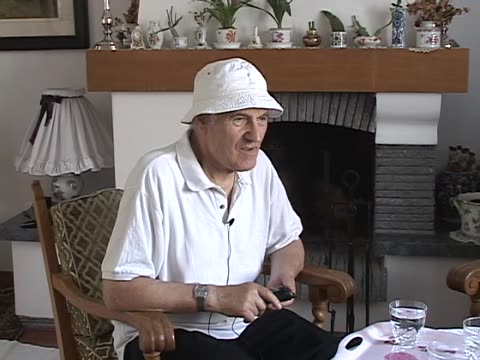
Pearl speaks about his work related to building buses in Russia after the war.
From the machine transcript
Pearl explains that he once spoke Russian better but has forgotten much of it. He says he worked in Hungary on buses with automatic hydraulic servo systems that were supplied to Russia, and that he visited there as a Hungarian specialist rather than working or studying. Kerler admires his skullcap, and Pearl says he designed and built something himself and has pictures of it.
The transcript also shows talk about Pearl's skullcap and a porcelain piece or paintings in the room.
The formal interview begins. He provides personal information and then speaks about Reb Shayale (Rabbi Yeshaya Steiner of Kerestir). The camera then records paintings in Pearl's apartment.
From the machine transcript
The formal interview begins with the date and Pearl's name, and his birthplace Tállya, spelled out for the record, with its distance from Budapest. He mentions Reb Shayale, a nearby rebbe, whom his father and uncle visited but whom he never met because he was still a child when the rebbe died. He says he had to leave in 1942 and go quickly to Budapest after a false rumor about him.
Kerler asks about the folk belief that a rebbe's picture protects against mice, which Pearl has not heard.
Pearl addresses his life during World War II, in particular during 1942. According to Pearl, approximately two hundred Jews lived in Tállya; of whom 170 died during the war. His parents perished in Auschwitz. Pearl grew up with two sisters and one brother, who lives in France. He then speaks about his life as forced laborer. Pearl worked in a copper mine in the forced labor camp Bor, Yugoslavia. Pearl then describes the conditions in the camp of approxminately 6,000 prisoners, according to him.
From the machine transcript
Pearl says he already had a trade and worked in Budapest, visiting Tállya for the holidays. He gives the size of the Jewish community in Tállya, about 200 people, and says the village was deported in 1944 and most did not return. His parents died in Auschwitz and his younger sister Edit died in Bergen-Belsen after liberation. His older sister lives in Paris and his brother, also a forced laborer, in France. He describes his own forced labor in the copper factory at Bor in Yugoslavia, where about six thousand Hungarian Jews were held, and the march in which many were shot. He mentions a book he co-wrote with an eleven-page contribution.
Pearl addresses his liberation. He recalls the moment when the Russian and the German front met. Pearl then speaks about his life after the war and return home via Romania. He moved from Tállya to Budapest and became an engineer.
From the machine transcript
Pearl says he was freed by partisans and spent weeks in the forest. From there he watched the German soldiers retreating from the Balkans and the Russian army waiting beyond them. He returned via Romania, went home to Tállya and found his brother, then went back to Budapest, continued his studies and became an engineer. He says he survived the camp because he was young and healthy.
Pearl speaks about his work as forced laborer. He then addresses Jewish life in Budapest in 1942. He specifically remembers Polish refugees and the return of the Mukachever Rebbe and Belzer Rebbe. Pearl recalls how the rebbe spoke about the fate of Jews in Western Europe.
From the machine transcript
Pearl briefly describes the work groups in the labor service and how the younger men helped the older. Asked when he was born, he gives 1924. He recalls Polish refugees in Budapest and the return of the Mukachevo rebbe from Poland, whose sermon he heard, and mentions the deportation of Hungarian Jews to Poland. He tells of meeting a man who had escaped a massacre and later reached Bor, and describes Jewish life in Budapest before the German invasion in March 1944.
The transcript adds the escapee's account of killings and the 1944 German entry into Hungary.
Pearl describes the invasion of the German army in Hungary in 1944, as well as subsequent deportation to forced labor camps.
From the machine transcript
Pearl describes working for a non-Jewish firm whose director was an antisemite but decent. He says he gave out false non-Jewish papers to people and used some himself, but gave them up when people were caught and killed, so he reported for labor service. He says he knew his parents had already been deported and had no alternative.
The transcript shows false papers and the speaker's own decision to enter labor service rather than the invasion itself.
Pearl again talks about the return of the Mukachever Rebbe and Belzer Rebbe to Budapest in 1942. During that time, Pearl worked at a military factory. He also mentions that he met the Belzer Rebbe again in the Bor forced labor camp, where they held services together.
From the machine transcript
Kerler asks for the year of the rebbes' return. Pearl says the Mukachevo rebbe came to Hungary in 1942, bearded and tall, and the Belzer and Bilgoray rebbes arrived in Budapest in 1943. He prayed once at the Belzer rebbe's minyan on Rosh Hashanah and Yom Kippur 1943 and has a photograph. He worked in a military factory and later met the rebbe's gabbai David Spira and other Belzer Hasidim in the Bor camp, where they held a Belzer minyan.
Pearl describes his encounter with a Polish friend of the Spira Rebbe in Budapest before 1944. He then describes how he helped him hide.
From the machine transcript
Pearl tells how David Spira had a Polish friend, about eighteen, who tried to cross into Romania but was caught at the border and brought back to Budapest. The young man jumped from the train and spent a night with Pearl, and Pearl describes wearing no yellow star at the military factory. He recounts hiding a tall man in the factory cellar when German soldiers came looking for him, and later taking him to his family. He did not want to stay in Budapest because he was living on non-Jewish papers.
The transcript shows two linked stories: the Polish friend who jumped from the train, and a fugitive Pearl hid in the factory cellar.
Pearl discusses his childhood memories and prewar religious life in Tállya. Before he mentions his religious education, Pearl lists yeshivot in surrounding towns. According to him, 3000 non-Jews lived there. Pearl then addresses Jewish and non-Jewish relations.
From the machine transcript
Asked about his childhood, Pearl describes Tállya's one synagogue, daily minyan, cheder, mikveh and rabbi Rosenbaum, who came from a place whose name is unclear in the transcript. There was no yeshiva in the village, but there were several in nearby towns, including one his brother attended. He says the rabbi preached in Yiddish and kept strict observance of the Sabbath and kashrut, and that about 3,200 non-Jews lived in the village without antisemitism. Only one non-Jew, born in Munkács, knew Yiddish, while Jewish women spoke it.
The transcript shows the rabbi's name and origin, the Yiddish sermons, and the question of which languages were spoken in the village.
Pearl talks about his family. His father was also born in Tállya and owned a shop. He then addresses antisemitism in 1938. Pearl explains how his father had to close down his shop and bred rabbits. Pearl sold rabbit hair in the market in Budapest. Pearl's mother was also born in Tállya.
From the machine transcript
Pearl says his family spoke Yiddish and Hungarian. His father, a shopkeeper, was born in Tállya in 1883 and his father's family came from Sighet. His grandfather and great-grandfather are named, and Pearl says he was named for his mother's father and has a son Shlomo in Syracuse. Because of the antisemitic laws of 1938 shops had to close, and the family kept animals and raised rabbits for wool. He sold the wool and fur goods, which his mother and sister made, in Budapest. Kerler and S2 try to find the Yiddish word for rabbit. Pearl gives his mother as Berta Rosenberg, born in Tállya, says he visits the family graves each year and describes how the Jewish community sold the synagogue, mikveh and rabbi's house.
The transcript also shows genealogy across three generations, and a search for the Yiddish word for rabbit.
Pearl speaks about prewar Jewish life in Tállya, particularly institutions. He recalls religious figures frequently going to the local bath house. Pearl then addresses their fate during the war.
From the machine transcript
Pearl describes the mikveh in Tállya: a spring with water from the hillside, heated with an iron vessel and wood. He answers Kerler's terminology questions about it and says the pious men went there daily and that it was fully heated on Fridays. He names Rabbi Mordechai Rosenberg and three young men, Teitelbaum and Markovitsh among them, who went with him to Dachau on the march and were shot. Pearl also speaks of the death march at Bor and says he can show the photographs from the book.
The transcript adds the rabbi and young men who died on the march, and a terminology exchange about the mikveh's water.
Pearl talks about his family, specifically their observance. He then speaks about his life in Ukraine after the war. Pearl maintains that he did not hide his Jewish identity and did not encounter antisemitism.
From the machine transcript
Pearl says his father kept no beard but observed the Sabbath and Jewish traditions, while his grandfathers had beards and sidelocks. He himself does not shave on the nine days. He says that in the Soviet and Communist period he never hid being Jewish, taking his tallis and tefillin with him to Russia and telling people he was a Jew, and he recounts an encounter in Kharkov or Kyiv (?) where he was still accepted.
The transcript places the open-Jewishness account in travels to Russia rather than life in Ukraine.
Pearl discusses his childhood memories, including education. He attended a religious school (cheder) at the age of four, as well as a Catholic primary school. Pearl then mentions his teachers (melamdim) and describes his cheder schedule. After his bar mitzvah, Pearl studied at a professional school to become a locksmith.
From the machine transcript
Pearl recalls his childhood schooling: from age four he attended cheder and the village Evangelical Christian school, because there was no Jewish school. His two melamdim were Mushkovitsh and Mordechai Stern, and he studied Humash, Rashi and Gemara, naming tractates, up to age twelve or thirteen. Kerler asks whether Maimonides or Tosafot were studied. After his bar mitzvah he went to a trade school and became a locksmith, since the quota for Jews in high school was six percent, and he went on to study during the war.
Pearl speaks about his life and education after World War II. Pearl studied at a university and then worked at a patent office. He then speaks about postwar religious life. Pearl's children attended Hebrew School. Pearl then shares an episode when the Party checked upon his family.
From the machine transcript
Pearl says he stayed attached to Jewish life under Communism, kept out of the party, and made patents as a scientific worker, three of which were accepted, and is working on another. He could keep Rosh Hashanah and Yom Kippur at the factory, where colleagues knew he had a holiday. His children went to the Sunday school and he sent them to cheder, and he tells of being checked once about where he lived and how he raised them. The Russians asked for him as a specialist in Russia but local officials would not let him go.
The transcript adds Pearl's patents, the invitation to work in Russia, and the Sunday school for the children.
Pearl addresses his sons' circumcision. Pearl also raised a daughter. He then speaks about prewar religious life. Pearl visited with his family rebbes in 56:45 Mad, orostisko, kerestir. They traveled with a horse and wagon.
From the machine transcript
Pearl says his sons were circumcised despite some difficulty because his wife's family was not religious. He recounts that his daughter was married quietly under a huppah, and he and Kerler speak of marriage customs. Asked which rebbes the family visited before the war, he names Kerestir, Mád and Olaszliszka (?), and says that as a boy he went with his father each year in a horse and wagon.
The transcript shows the daughter's quiet wedding as well as circumcision and the visits to rebbes.
Pearl speaks about attending synagogue services in 1942. He then addresses his encounter with the Belzer Rebbe, before talking about Jewish life in Budapest under German occupation in 1944.
From the machine transcript
Pearl describes attending synagogues in Budapest, including a Polish synagogue and the Belzer rebbe's, where he alone was let in at age twenty. He recalls the straw on the floor and the sleepless night there. He turns to Budapest during the German occupation, when people were seized and killed daily, and recalls Polish and Slovak refugees. He worked in a military factory but concluded it was not worth staying in Budapest.
The transcript shows the visit to the Belzer rebbe's synagogue and the daily killings under the occupation.
Pearl speaks about his life during World War II, specifically moving to Budapest from his hometown.
From the machine transcript
Kerler asks why Pearl left his village. Pearl answers with an episode in Tállya: a man told the police how fast the Germans were winning, and the Catholic teacher at the school told the children the war could still reverse. Three days later a mail carrier told Pearl what was going on, and he left for Budapest.
Pearl addresses folk customs from his childhood, using bread in order to avert the evil eye.
From the machine transcript
Pearl describes a folk cure for the evil eye from his childhood, in which pieces of bread (or coal) are dropped into water and the result is read; his father's sister performed it for him, and the water was poured at the doorpost near the mezuzah. Kerler asks for details, such as what the number of pieces means. Pearl says only Jews did this. The passage ends with Kerler's question about the mother's salting of meat and Sabbath fish.
The cure is explained in detail, with water at the mezuzah and an aunt performing it, and the passage ends on Kerler's question about Sabbath fish.
Pearl speaks about food customs before the war. He explains how he bought fish for Sabbath each week. After 1938, Pearl continues, the kosher slaughterer continued his work in secret. He then describes fish dishes.
From the machine transcript
Pearl speaks about Sabbath fish before the war: he walked to the Hernád river to buy from a fisherman almost every week. He explains that after 1938 kosher slaughter of cattle was banned and a Jewish butcher/slaughterer from a nearby place continued in secret. He then describes how his mother prepared fish, including gefilte fish and soup, and says his father liked it sweetened.
Adds the Hernád river, the ban on kosher slaughter and gefilte fish preparation.
Pearl talks about his family. He then addresses drinking customs before the war. Pearl's family made their own kosher wine.
From the machine transcript
Pearl names his father's sister, who died in Auschwitz, and then answers questions about strong drinks. His family made its own kosher wine, enough for Sabbath, holidays and Passover, and he explains the custom of buying grapes and pressing them. He then discusses brandy at services and at Passover, and Kerler asks the Yiddish word for it.
Adds Kerler's question about the Yiddish word for palinka and the issue of wine's kosher status.
Pearl speaks about prewar Passover food customs. The community in Tállya baked shmura and regular Matzo. Pearl then answers questions about cultural terminology.
From the machine transcript
Pearl discusses how matzo was made before the war: shmura matzo baked for weeks before Passover and regular mitzvah matzo baked on the eve of Passover, in a place in the village where each household did its own. Kerler then asks about what is said when mentioning a deceased person, and Pearl recalls that the dead were addressed at the grave with the name of a mother. He recalls this from age six or eight.
Adds a questionnaire on formulas for mentioning the dead and a grave custom that Pearl recalls.
Pearl talks about prewar Jewish life. He then addresses traditional weddings and compares it to contemporary weddings.
From the machine transcript
Kerler asks about stories of a Jewish folk character and Pearl instead speaks about the old Rabbi Rosenbaum, whose table was reused after his death, and about his own cheder years. He says he attended a few Jewish weddings before the war and compares them with later ones. He also mentions the extra payments his father made to the rabbi and the shochet at holidays. Kerler then thanks him and wraps up.
Adds Rabbi Rosenbaum, cheder, payments to the rabbi and shochet, and a concluding thanks.
The team concludes the formal interview with Pearl and he points to a painting on his living room wall.
From the machine transcript
The formal interview ends, and Pearl points out old Dutch paintings in his living room, said to be about two hundred years old.
Adds the age of the paintings as Pearl states it.
Pearl speaks about his life during World War II, specifically his escape from Tállya to Budapest, via Rátka by train in 1941. In Budapest, Pearl worked with machines at a military factory. Pearl then describes his life in Budapest.
From the machine transcript
Pearl tells how he left Tállya in 1941 for Budapest, travelling from nearby Rátka by train after a local incident involving the postman, the police and the rabbi (the details are unclear). In Budapest he worked repairing and installing machines and motors in a military-supervised factory. He says he knew from refugees arriving from Poland and Slovakia what the Germans intended. Kerler's questions fix the date as 1941.
The transcript adds an incident with the postman, the police and the rabbi, and his knowledge of events from refugees.
Pearl addresses his childhood memories, particularly games. He explains how to play nuts, before recalling a Hanukkah game.
From the machine transcript
Pearl answers Kerler's questions about his childhood games, football and a game played with nuts. He also recalls Hanukkah games, with the dreidel and cards, and says the children cast their own lead dreidels. He answers a question about Hanukkah food unclearly and turns to a Passover dish.
The transcript adds football and card playing, and the move from Hanukkah food to Passover.
Pearl speaks about holiday food customs. He describes how the Hassidic family Teitelbaum cooked a beetroot soup ("Tsibele") for the entire community for Passover.
From the machine transcript
Pearl describes the beetroot soup (tsibere) made for Passover. The Teitelbaum family, whom he says were relatives, cooked a large quantity for everyone, and families fetched it from them. Kerler asks about the dish, and they discuss the word for it and a related term.
The transcript adds the terminology discussion and his statement that the Teitelbaums were relatives.
Pearl addresses prewar Purim celebrations and shpiels, performed by children. He then recites a postwar Purim shpiel, sang in Romania.
From the machine transcript
Pearl speaks about Purim before the war, when families exchanged gifts of food and children performed a Purim play lasting about half an hour. He then recites a postwar Purim song sung in Romania, in which Stalin is praised and Germany's fall is celebrated. Kerler has him repeat it so he can record the words, and they discuss the Romanian words in it.
The transcript shows Kerler having the song repeated line by line to record it.
Pearl talks about contemporary religious customs and recites a prayer. The camera then collects footage of Pearl's apartment.
From the machine transcript
Pearl talks about present-day religious singing, mentioning a Sephardic prayer book and the Saturday-afternoon service. He recalls the night-long Simchat Torah celebrations of his youth. He also mentions that he will show the gravestones and a picture of the Belzer rebbe that he distributed. The camera then films his apartment.
The transcript adds the Belzer rebbe's picture and plans to show the gravestones.
Pearl shows a study on forced labor in the Bor copper mine, edited by Erhard Roy Wiehn. He then shows a photograph of himself, taken in 1941.
From the machine transcript
Pearl shows a study of forced labor in the Bor copper mine, published in both Hungarian and German, and discusses where it can be bought. He then shows a photograph of himself taken in 1941. He starts to tell how he was hired at a non-Jewish factory.
The transcript adds that the study exists in German and Hungarian editions and that he starts telling about a factory job.
Pearl describes his work at a factory in Budapest during the war. Pearl maintains that he never denied his Jewish identity. He then shows family photographs and speaks about his family. Pearl has relatives in America. Pearl also mentions his travels to Austria and Germany.
From the machine transcript
Pearl describes his job at a factory in Budapest during the war. He says he told the director and a young woman asking about his identity that he was a Jew, and was kept on. He shows gravestones and photographs of his parents and relatives, and mentions a grandchild and cousins in America. He says he visited America and attended congresses in Germany and France.
The transcript adds the encounter with the young woman and the director about his Jewish identity.
Pearl speaks about this life after the war and continues to show family photographs. He then talks about his family.
From the machine transcript
Pearl answers Kerler's question about speaking Yiddish after the war and shows photographs of his family, including a younger sister who did not return. Kerler asks to record the names of his siblings. The talk drifts into Hungarian with others and to Pearl's mother, who played piano and went to school in Košice. He shows a Yiddish Bible, the tsene-rene.
The transcript adds the mother's schooling in Košice and the Hungarian-language stretches.
Pearl talks about his copy of tsene-rene (Yiddish-language bible). He then speaks about his life in the forced labor camp and holiday celebration. Pearl also addresses how he survived on a daily basis.
From the machine transcript
Pearl talks about his copies of the tsene-rene and a prayer book that his grandfather owned. He found the prayer book in a synagogue after the family was taken to the ghetto, around Passover 1944. He recalls Yiddish speech, Sabbath prayer and Yom Kippur in a labor camp. He also describes how he made pots from scrap metal to survive, and he names grandparents.
The transcript adds the prayer book recovered after the deportation and the pots he made to buy food.
Pearl speaks about his family. He grew up with one brother and two sisters. Pearl's brother and sister live in France.
From the machine transcript
Pearl names his father's mother and speaks about his siblings, saying there were four children. His brother Zvi Hersh (Emil) lives in France, aged 85, and a sister lives in France. Another sister did not return from the camps. He then looks for the old books.
The transcript adds that his brother is 85 and lives in France.
Pearl shows his copy of the machzor (prayer book for the High Holidays of Rosh Hashanah and Yom Kippur), published in Vienna 1794. He then shows his copy of the tsene-rene.
From the machine transcript
Pearl shows a machzor published in Vienna in 1794 and says he found it. Kerler and Pearl look through a Hebrew text, and Kerler judges the age of another book, saying it dates from the end of the nineteenth century. They discuss other old books, and Pearl mentions that many families throw old prayer books away. He then shows his copy of the tsene-rene.
The transcript adds Kerler's dating of a second book and Pearl's remark about prayer books being thrown out.
Pearl speaks about his mother's observance. He recalls how his mother read the tsene-rene. Pearl then talks about his family, particularly his wife's work. Pearl raised a daughter and a son. He then speaks about his life today.
From the machine transcript
Pearl recalls that his mother read the tsene-rene on Sabbath afternoons and that his father's sister told the stories to the children. He speaks about his wife, who was a professor of analytical chemistry and wrote a monograph, and about his daughter, a physician. He mentions a recent health scare and says he is now better.
The transcript adds his wife's profession, his health, and the aunt who told the stories.
Pearl addresses his best moments during his childhood. He recalls family Sabbath celebrations. He then discusses the possibility of living in other countries and addresses the contemporary living conditions in Hungary.
From the machine transcript
Asked about the best time of his life, Pearl names his childhood, with family Sabbath meals and harmony at home until 1938. He did not want to emigrate despite an uncle in America; his son did leave. He says he is dissatisfied with the situation in Hungary today and with antisemitism, and he speaks about the wartime bombing of Budapest in 1944.
The transcript adds Pearl's views on emigration, his son living abroad and the political situation.
Pearl describes the first German bombing of Budapest in 1944 and the difficulty to find cover among locals due to antisemitism.
From the machine transcript
Pearl describes the first major bombing of Budapest in 1944. At the factory, a woman said the Jews were bringing the bombs and should not be allowed into the cellar, and he insisted that everyone go in. Otherwise he says he felt no antisemitism in the factory and was not afraid to say he was a Jew. Kerler then speaks Hungarian, and Pearl says he does not understand what is being asked.
The transcript adds the cellar dispute and Pearl's statement that he did not feel antisemitism at work.
Pearl answers dialectological questions from the AHEYM Yiddish linguistic questionnaire. He also addresses different regional Yiddish dialects and answers questions about cultural terminology.
From the machine transcript
Pearl answers questionnaire items on language. Kerler asks for the Yiddish words for "I believe" and for "cold" and "warm", and Pearl says how Yiddish differs from Hungarian Yiddish and from the speech of Lithuanian, Russian and Polish Jews. They discuss the terms goy, a farmer, a Yiddish phrase for trouble, and the difference between a rov and a rebbe. Kerler also asks about words such as dibbuk and golem, a rhyme and other cultural terms.
The transcript adds the discussion of Russian and Polish Jews' Yiddish and the rov–rebbe distinction.