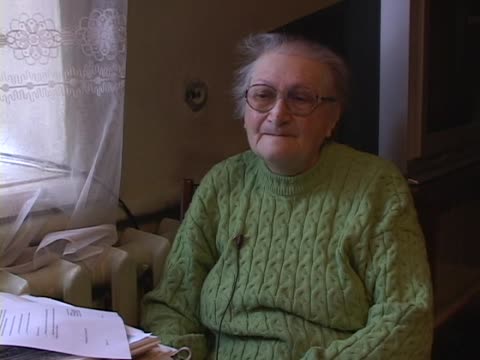
The formal interview with Shpitalnik begins. She provides personal information and speaks about her family. Her mother was also born in Chişinău and her father was born in the Jewish colony Dumbrăveni. Shpitalnik's father worked as accountant and was a member of the Yiddish organization Kultur-lige (Culture League). Her mother worked as cashier at a firm. Shpitalnik grew up as an only child.
From the machine transcript
Shpitalnik gives personal information and speaks about her parents and grandparents. Her maternal grandmother was widowed when her husband, from Staro-Konstantinov, fell in the Russo-Japanese War in 1905. Her mother finished a Russian gymnasium and worked as a cashier. Her father, from the Jewish colony Dumbrăveni, near Soroca, was an accountant and a member of the Yiddish Kultur-lige. She was an only child.
Details of the grandfather killed in 1905, the colony run by the Jewish colonization organization (JCA), and the parents' years.
Shpitalnik addresses her childhood memories and education. She attended a Romanian school at the age of six and took private French lessons. Her family evacuated to Bukhara, Uzbekistan. She then addresses her life after the war. Shpitalnik studied French philology at the Chernivtsi university and she was married in 1951. After Shpitalnik graduated from university, she worked at a village school, teaching English and French for five years. She then found a job in Chişinău as translator at the library of the Medical Institute, where she worked for 34 years. Shpitalnik then became the head of a department, where she published journals. In the last fifteen years, Shpitalnik has worked in the local Jewish library of the Kultur-lige. She has published several books on Jewish Moldova, as well as a calendar.
From the machine transcript
Shpitalnik talks about her childhood and schooling. Yiddish and Russian were spoken at home; she began a Romanian school at six and took private French lessons. The family was evacuated to Bukhara, Uzbekistan, and she began working at fourteen. She studied French at Chernivtsi, married in 1951, taught French and English in a village for five years, then translated medical literature at the Medical Institute library for 34 years. For fifteen years she has worked at the Yiddish library, publishing books and a yearly calendar of Jewish personalities.
Also covers her husband, a ghetto survivor from Balta, and the calendar and books she published.
Shpitalnik speaks about her family. She then describes her childhood home, which was located in a courtyard with twenty-five other Jewish families.
From the machine transcript
Answering Kerler's questions, Shpitalnik speaks about her paternal grandparents in Dumbrăveni and her visits there. Her childhood home in Chișinău stood in a courtyard of Jewish families (the transcript reads twenty-six) with a small prayer room. The grandfather, aged 87, was killed in Dumbrăveni; her maternal grandmother ran a household and worked as cashier at a slaughterhouse. Her parents loved reading and Jewishness.
Covers the grandfather's death in 1941 and the maternal grandparents' meeting story.
Shpitalnik speaks about her visits to Dumbrăveni before the war. She also addresses prewar Jewish life in Chişinău and Dumbrăveni. Shpitalnik then talks about her father, who traveled to neighboring villages at the age of twelve and worked as private religious teacher.
From the machine transcript
Shpitalnik recalls childhood visits to Dumbrăveni, where local children gathered and a Rabbi Steinberg was arrested in 1940 and died. She describes prewar Jewish culture in Chișinău and Dumbrăveni: Yiddish and Hebrew reading and girls' professional schools. Her father, who knew Hebrew well, travelled to nearby villages from age twelve as a private teacher, was boarded by families, and later trained as an accountant.
Includes the library and rabbi of Dumbrăveni and the father's early earnings.
Shpitalnik talks about her education and studying Hebrew. She then returns to her family, before addressing her childhood memories of traveling.
From the machine transcript
Shpitalnik says she learned Hebrew letters in courses about fifteen years ago, with thoughts of going to Israel. She then returns to her paternal grandfather Meir, who refused to leave and was killed, and to her grandmothers: one wore a wig and prayed in the Russian theatre building. Her maternal grandmother died in evacuation. She describes visits to Dumbrăveni as a child, travelling by horse from Bălți.
Starts with her Hebrew studies and learning to read.
Shpitalnik speaks about her education in Chişinău, as well as her mother's school education. She then addresses prewar holiday celebration (Purim, Hanukkah), including food customs. Shpitalnik recalls visiting her mother's cousin on holidays.
From the machine transcript
Shpitalnik tells of her schooling, starting a Romanian school at six without knowing the language, and of her mother's education at a Russian school and a private girls' gymnasium. She describes prewar celebration of Passover, Purim and Hanukkah at her mother's cousin Sonya Gershteyner's home. She remembers potato varenikes at Hanukkah, Purim gifts and filled pastries, and says Chișinău was a Jewish city. She did not see Purim plays.
Also covers her language difficulties at the Romanian school.
Shpitalnik speaks about prewar sports organizations, including Maccabi and Hakoach. She was a member of Hakoach. Shpitalnik recalls Yiddish apprentice schools for girls, which organized cultural evenings. Shpitalnik remembers when the Yiddish poet Yakov Shternberg visited her family and gave presentations at the apprentice schools.
From the machine transcript
Shpitalnik talks about the prewar sports clubs Maccabi and Hakoah in Chișinău. She was a member of Hakoah but not athletic. She describes Yiddish professional schools for girls, which held evenings of readings from Mendele, Sholem Aleichem and Peretz. She recalls the poet Yakov Shternberg, who visited her parents' home and taught her mother.
Details Shternberg's later imprisonment under Stalin.
Shpitalnik addresses prewar Yiddish press, including "Undzer tsayt" (our time). She also speaks about her family.
From the machine transcript
Shpitalnik speaks about the prewar Yiddish press in Chișinău, including the daily 'Undzer tsayt', read by both Zionists and Communists. She says her father was somewhat left-leaning. She tells of learning Yiddish poems from a woman friend of her father's and of her father's role as a trusted mediator, and how he was broken under the Soviets.
Adds the father's social role and his fate under the Soviets.
Shpitalnik discusses Yiddish poetry, before she speaks about prewar Yiddish cultural life, including libraries and theater. Shpitalnik recalls Yiddish plays, performed by the Vilna Troupe, as well as performances by Sidi Tal, Gina Zlotaya and Adolf Tefner. She also went to an author reading by Itzik Fefer.
From the machine transcript
Shpitalnik names the libraries of Chișinău before the war and says she read novels in Russian, later in French and Romanian. Asked about Yiddish theater, she recalls her parents attending the Vilna Troupe and performances by Sidi Tal, Gina Zlotaya (?) and Adolf Tefner (?). She also remembers an evening with Itsik Fefer in 1940.
Also includes a short exchange on a Yiddish poem and on reading languages.
Shpitalnik talks about her family, especially her grandmother.
From the machine transcript
Shpitalnik talks about her grandmother, who was said to have sung beautifully until she learned of her husband's death, and who later received a small pension under tsarist Russia. In answer to Kerler she says her mother did not sing and describes her as a kind woman who never spoke ill of anyone.
Also covers her mother's character and the grandmother's pension.
Shpitalnik addresses life before the war in Chişinău, specifically the relationship between Jews and non-Jews. She also recalls the persecution of Communists during Romanian rule, as well as of Zionists under early Soviet rule. In particular, Shpitalnik mentions the persecution of Zalmen Rosenthal, editor of "Undzer tsayt" (our time).
From the machine transcript
Shpitalnik answers questions about contact between Jews and non-Jews in Chișinău. She recalls that around 1938 the family moved to a house among Jews, and says that under the Romanians Communists rather than Zionists were persecuted. She recalls that after the Soviets arrived in 1940 Zionists were arrested and sent to Siberia, including Zalmen Rosenthal, editor of the paper Undzer Tsayt, and others; Kerler asks about Rosenthal's first name.
Also names other arrested Zionists and the question whether non-Jews spoke Yiddish.
Shpitalnik speaks about a Moldovan family, who rescued Jews during anti-Jewish pogroms and then continues addressing Jewish and non-Jewish relations. She then speaks about her life before the war, including childhood friends. Shpitalnik states that she learned how to speak Yiddish from her grandmother during the war.
From the machine transcript
Shpitalnik tells of a Moldovan family from whom her family rented rooms, whose parents had sheltered Jews during the pogroms, hiding them near a monastery on Astapovskaya (?) street. She speaks about rare intermarriage, her Jewish kindergarten and friends (one now in Los Angeles, another killed in the war). She says that before the war she only understood Yiddish and learned to speak it from her grandmother during the war, and explains why Russian was spoken at home.
Also covers her kindergarten, childhood friends and language use at home.
Shpitalnik speaks about Jewish life in Chişinău before the war. She mentions Judah Leib Zirelson, the chief rabbi of Chişinău.
From the machine transcript
Shpitalnik says there were no Yiddish shop signs in prewar Chișinău, only Romanian. Asked about Rabbi Tsirelson, she recalls her grandfather knowing him and describes him as a small man with a white beard, a member of the Romanian senate who tore up his mandate when the fascists came. She also mentions the slaughterhouse where her mother grew up, a street named after Tsirelson, excursions she led, and religious instruction in the Romanian gymnasium.
Also covers shop signs, the slaughterhouse, Shpitalnik's own excursions and the religion lesson at school.
Shpitalnik speaks about her school education at a Romanian school before the war. She remembers how Jewish students were given lessons by a religious teacher. She then speaks about prewar religious life and local rebbes, before answering questions about cultural terminology.
From the machine transcript
Shpitalnik describes how Jewish pupils in the Romanian gymnasium were taught religion in the corridor by a rabbi (Epelbaum or Yampolski). Asked about Hasidim, she says she knew of none before the war but knew of a good Jew in Bender and of the Ribnitser rebbe Chaim Zalbul(?), who died in Queens. Kerler then asks what 'a good Jew' and 'a good place' (cemetery) mean, which she answers briefly.
Also covers the religion lessons, tsadikim in Bender and Rybnitsa, and questions on 'a good Jew' and 'a good place'.
Shpitalnik recalls Jewish refugees in 1940. Her family received a Hungarian-speaking family from the Transylvanian region. She also addresses different regional Yiddish dialects.
From the machine transcript
Shpitalnik recalls that in 1940 Jewish refugees from elsewhere in Romania came to Chișinău, among them a Hungarian-speaking family from Transylvania whom her family took in and another from Bucharest. She says she was then in the sixth class and switched easily to Russian. She answers Kerler's questions on differences in Yiddish: Bucharest speakers, Baltic Jews who think theirs is the true Yiddish, and her own Bessarabian speech compared with Lithuanian Jews.
Also covers Yiddish dialect differences and her husband's reaction to Lithuanian Yiddish.
Shpitalnik talks about prewar Jewish life, including traditional weddings, in Chişinău. She was married in 1951 and states that there was no wedding canopy at her wedding because she considered it old-fashioned.
From the machine transcript
Shpitalnik says Chișinău was a Yiddish-speaking city with street vendors calling out in Yiddish, though she saw no street singers or klezmorim playing for money. She describes prewar Jewish weddings with canopies, glass-breaking, an entertainer and klezmer, and says she married in 1951 without a canopy, considering it old-fashioned, although her husband's parents wanted one.
Also covers street vendors, wedding customs and the entertainer.
Shpitalnik answers questions about cultural terminology.
From the machine transcript
Shpitalnik answers Kerler's questions on cultural terminology: the word dybbuk and its local meaning, a convert to Christianity (meshumed), the golem, formulas said after a dead person is mentioned, and a blessing that the deceased may plead for the living. She also recalls a known convert (Rovinovitsh (?)) from before her time.
Shpitalnik addresses prewar ethnic Jewish geography in Chişinău, as well as cultural life.
From the machine transcript
Shpitalnik describes the districts of prewar Chișinău, including the poor lower town and the Old Bridge area, and the richer upper parts. She talks about the Teater Ekspres, the Auerbach family and two Jewish dancers named Seltser, who performed Yiddish theater and European dances.
Shpitalnik speaks about the Yiddish cultural organization "Kultur-lige," including activists and activities before the war. She then speaks about the contemporary situation of the organization and activities.
From the machine transcript
Shpitalnik speaks about the prewar Yiddish Kultur-Lige: its meetings, members who wanted Yiddish at home, Lipe Altman (brother of the writer Moyshe Altman), the librarian Gitl Shvidkaya (?), and literary evenings. She says Rosenthal was a Zionist while the league leaned left, and reflects on peaceful relations among differing camps. She then describes her work as the only librarian handling Yiddish books today and the few remaining readers.
Also covers her library work today and the Zionist-communist relations.
Shpitalnik speaks about her life and work after World War II, as well as her return to Chişinău. She moved to Chernivtsi for university studies soon after her return. Shpitalnik then speaks about her husband's work.
From the machine transcript
Shpitalnik recalls that life in Chișinău after the war was very hard, with houses destroyed and the family home gone, so she left to study in Chernivtsi; she mentions the ration system. She then tells how her husband, a well-known agronomist who lacked a medal, was denied an award, and that he worked with tobacco and died of liver illness.
Shpitalnik talks about postwar religious life. She states that the only synagogue was closed down in the 1960s. She also addresses traditional weddings with performers. Shpitalnik then speaks about prewar Jewish occupational structure in Chişinău, particularly doctors and teachers.
From the machine transcript
Shpitalnik says that after the war there was one synagogue, which was closed in the 1960s, and that Yom Kippur crowds could not fit in. She discusses Jewish singers hired for weddings, why Odessan Jews had more education than Bessarabians, and the many prewar Jewish doctors, lawyers, pharmacists and the Jewish cooperative bank, with few Jewish teachers.
Also covers prewar Jewish doctors, lawyers, bankers and teachers.
Shpitalnik addresses the history and poverty of Jewish Chişinău. She then addresses Yiddish theater performances in the 1960s.
From the machine transcript
Shpitalnik says the 1903 pogrom is overemphasized and that prewar Jewish Chișinău was poor, with good tailors, shoemakers and craftsmen but no rich people; she mentions about seventy synagogues. She recalls the short-lived Yiddish folk theater of the late 1960s, performances she saw, and a story involving an Ukrainian doctor friend. The passage ends with talk among the interviewers about Moyshe and arrangements.
Shpitalnik speaks about contemporary Yiddish cultural life and her work. She then speaks about her life today.
From the machine transcript
Shpitalnik speaks about her current work in the Yiddish library, where she is the only Yiddish specialist. She has set up a Yiddish study room and published a booklet on Bessarabian writers, and mentions a new literature museum. The passage ends with arrangements for the next day, her remarks on being helped during her husband's illness, and thanks.