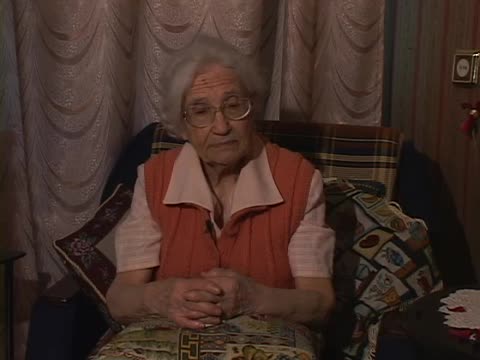
The formal interview with Mitlaeva begins. She provides personal information and talks about her family. Mitlaeva's father was born in Tiraspol and passed away in 1936. He was a merchant. Her mother was born in Novoselytsia, Ukraine. Mitlaeva grew up with two brothers and one sister.
From the machine transcript
Kerler asks Mitlaeva for her family details. She gives her birth year as 1915, says she lived in Chișinău until the war, and names her father Shmuel, a merchant who died aged 56 (the year is given by helpers as 1936). Her mother Rivke came from Novoselytsia in Bukovina and was a housewife who died aged 65. She names her brothers, mentions her paternal step-grandmother Alte, and recalls the grandmother as a pious woman.
Gives the mother's death date and age and names the brothers and the step-grandmother; a helper supplies the father's death year.
Mitlaeva shares stories about Hershl Ostropoler, she remembers from her mother. The stories are about Hershl and the diamond and Hershl looking for work.
From the machine transcript
Mitlaeva retells stories about Hershl Ostropoler that she heard from her mother. In one he buys a chicken and his wife cooks it, and a friend is frightened away. In another he stays in a rich house promising to show a diamond, and a third has him claim his wife has died before Passover. Kerler asks about the details.
Mitlaeva recalls Yiddish songs from her mother. She then sings Yiddish songs about a coachman and cemetery.
From the machine transcript
Asked what her mother used to sing, Mitlaeva recalls Yiddish songs and sings parts of one about rain and a road and one about the road to Bethlehem and Mother Rachel's grave. She cannot recall others, including one about a cheder corner, and the singing is partial and broken off. Kerler then turns to her earliest childhood years.
Mitlaeva speaks about her life, including education, before the war. Her mother taught her how to write and read in Yiddish. She then attended a Yiddish school for six months, which was run by a female principal. Mitlaeva maintains that there was a Romanian and a Yiddish school in the same building and the Jewish students would learn in the afternoons. She then describes her teachers and recalls the switch to the Romanian school. Mitlaeva then describes her education and teachers at the Romanian school and shares an episode about three priests coming to school and blessing the school.
From the machine transcript
Mitlaeva describes her early schooling. Her mother taught her the Yiddish alphabet, and at seven she went to a Yiddish school with a woman director, named Rezhnik (?). The school shared a building with a Romanian one, and she attended the afternoon Yiddish classes for about half a year until the school was made Romanian by decree. She names her Yiddish and Romanian teachers. She also recalls a ceremony with three priests who came to bless the school.
Adds the switch to Romanian and the blessing by three priests; the teacher names are uncertain.
Mitlaeva talks about local Jewish schools before the war. She then speaks about her childhood home and describes locals. Mitlaeva remembers how neighboring boys sang Hebrew and Yiddish songs in a choir. Mitlaeva was a French-language teacher.
From the machine transcript
Mitlaeva names three Jewish schools left in the town, two vocational schools and Magen David. Both Yiddish and Hebrew were taught in them, and there were Yiddishists among the teachers. She gives her childhood street as Balanovski (?) and says she lived as a lodger with a landlord. His sons sang Yiddish and Hebrew songs in a choir, and some of them emigrated. She also mentions teaching a girl French.
Adds the choir of neighbouring brothers and the postwar emigration of a family.
Mitlaeva speaks about life before the war and recalls a Romanian family that spoke Yiddish. She then addresses childhood games and touches upon prewar Sukkot and Simchat Torah celebrations. Mitlaeva also lists different local synagogues; e.g. cook's, baker's and glazier's synagogues.
From the machine transcript
Mitlaeva describes her mixed Jewish and non-Jewish street. She tells of a Romanian family whose mother was a converted Jewish woman who still spoke Yiddish and had a Jewish woman read to her from the siddur before she died. She answers Kerler's questions about children's games, including one played with nuts, and about Sukkot and Simchat Torah in her youth. She then lists local synagogues, including those of the cooks, bakers and glaziers.
Adds the Romanian family with the convert mother, children's games and the synagogue names.
Mitlaeva returns to speaking about non-Jewish neighbors. She then talks about the local Yiddish professional school and then addresses her education. Mitlaeva lists languages she studied and describes how she took the baccalaureate exam in 1936, as well as rewards from her family and friends. Mitlaeva attended secondary school between 1928 and 1934.
From the machine transcript
Mitlaeva talks about another non-Jewish neighbour, a Romanian woman of Jewish origin, and about a vocational Yiddish school where Yiddish and world literature were taught. She lists the languages she knew, attended a French lycée and describes taking the baccalaureate in 1936 with several hundred candidates. A Karaite friend paid the fee, and she was rewarded with gifts and a dress. She describes the written and oral exams.
Adds the French lycée and the 1936 baccalaureate; the catalogue's 1928–34 period for secondary school is only roughly supported.
Mitlaeva talks about her Crimean friends. She then speaks about Yiddish books, she read before the war.
From the machine transcript
Mitlaeva talks about her Karaite friends from Crimea, the Aivaz family, who kept Jewish holidays but not Christian ones. Lemster then asks about Yiddish books she read before the war. She recalls an alphabet primer, names Sheynberg (?) as an author, and mentions Poale Zion as a Zionist organization she attended.
Mitlaeva talks about prewar organizations, including Hashomer Hatzair and Poale Zion. She attended meetings, organized by Poale Zion. Mitlaeva also recalls prominent guests. Mitlaeva then speaks about the prewar local Yiddish press.
From the machine transcript
Mitlaeva talks about the Zionist organization Poale Zion, whose chief figure was a woman lawyer, and a lawyer named Reytekh (?) who attended. She says they sang Yiddish songs there. Lemster asks about Yiddish newspapers; she says her father read them without naming one, and she mentions Rozental and another prominent person.
Mitlaeva addresses prewar religious life and describes how her mother went to see a rebbe for advice in the 1920s. She then addresses folk and healing customs, before addressing prewar Passover celebrations; including how to kasher dishes. In particular, Mitlaeva recalls how her mother practiced healing customs.
From the machine transcript
Mitlaeva says that in the 1920s her mother travelled to a rebbe in Chernivtsi (?) and Novoselytsia for advice in hard times. She answers questions about folk healing, such as pouring coals against the evil eye. She then describes Passover customs, including removing and burning the chametz, koshering dishes, the seder and Elijah, and her older brother asking the four questions.
Adds the visits to a rebbe and the mother's healing; the Passover and seder details also come in.
Mitlaeva addresses prewar Purim celebrations, including food customs, costumes and Klezmer musicians.
From the machine transcript
Mitlaeva recalls Purim customs before the war. She talks about the baked treats, including filled hamantaschen, and the gifts of food. She mentions masquerades and children going from house to house with a greeting, and says klezmer musicians came to play on Purim. She also says she learned about Esther in French at the gymnasium.
Mitlaeva talks about food customs and Sabbath celebrations at home, before addressing prewar cultural life. Mitlaeva recalls local klezmer musicians. Mitlaeva then describes how her mother koshered meat and returns to describing her mother's cooking.
From the machine transcript
Mitlaeva says her mother made gefilte fish for Sabbath and holidays. She speaks about the Jewish klezmer musicians she knew, including a neighbour. She then describes how her mother salted meat and washed it, and recalls going to the shochet. She also talks about her mother blessing the Sabbath candles, and recalls her mother's matzo dishes.
Mitlaeva speaks about her life, including Zionist activities, before the war. She then shares Yiddish proverbs and sayings.
From the machine transcript
Mitlaeva recalls her mother's sayings about Jesus on a Christian holiday. Lemster and Kerler ask for proverbs, jokes and curses, and she gives a couple of blessings and curses. Kerler then asks if she took part in any movement; she answers in Russian and Yiddish that she attended Zionist meetings.
Adds the mother's sayings and her attending Zionist meetings, which comes after the proverbs.
Mitlaeva shares Yiddish sayings and proverbs. She then speaks about her life before the war, particularly meetings at Poale Zion and a Baptist organization. Mitlaeva also recalls a local Zionist school and kindergarten.
From the machine transcript
Mitlaeva and Kerler discuss Yiddish sayings, including one about the length of the Jewish exile and expressions with 'Jewish' and 'gentile' (luck, head). She says she was active in Poale Zion, where there was singing, dancing and plays in Yiddish. She recalls a rich synagogue and Zionist library and kindergarten on Nikolaevskaya Street. She also remembers a Baptist circle where a Jew spoke Yiddish, which she once attended with a friend's mother.
Kerler's questions about the meaning of 'goyish' idioms precede the Zionist material.
Mitlaeva speaks about her life after the war. She taught at a school in Chudei, Ukraine, for ten years. She recalls Baptist locals. Mitlaeva worked in Varenikovsky, Kuban region, and then received a work assignment for Velikaya, Russia. She was married to a non-Jew.
From the machine transcript
Mitlaeva recalls the Baptists in the village of Chudei in the Chernivtsi region, Bukovina, where she taught for ten years after the war. She says the Baptists were Romanians who sang Christian hymns in Yiddish, and Kerler asks why. She then tells of being sent to a village among Kuban Cossacks and of a Russian man who spoke against Jews until she told him she was Jewish. The passage ends with an anecdote about her grandson.
Adds the Bukovina Baptists singing in Yiddish and the antisemitic remark episode in the Kuban.
Mitlaeva talks about her family. She then addresses her educaton and work before the war. Mitlaeva was trained as language teacher for Russian, Romanian, French and German at the local French lyceum. She also recalls a Latin proverb. Mitlaeva taught Romanian at a private Yiddish school, owned by the Vakhman family.
From the machine transcript
Mitlaeva says she was a teacher before the war of French, Russian, Romanian and German, after studying at the French lyceum, and mentions Greek, Latin and Old Church Slavonic. She recites a few Greek words and a Latin saying. She taught Romanian at the private Yiddish school of the Vakhman family. She also describes the pupils and how her teaching documents were lost in a bombing during the war.
Adds the Greek and Old Church Slavonic study and the loss of her documents in a bombing.
Mitlaeva speaks about her life during World War II. In particular, she remembers the year 1942, when the German army moved closer to the Kuban region and she had to evacuate. Mitlaeva then describes how she evacuated by train passing the Sea of Azov, Baku, Azerbaijan, Krasnovodsk, Turkmenistan and Severodvinsk, Russia. She then speaks about her school education and encounters with fellow Jews in Severodvinsk.
From the machine transcript
Mitlaeva recalls 1942, when German forces approached the Kuban and she and her mother evacuated. She describes how border guards told locals not to leave, a bombed train split in two, and the journey by the Sea of Azov and onward. The route continues through Baku, Krasnovodsk and the Urals. She then talks about working in a school in the Urals where the director and a Jewish administrator helped her with documents and food.
Adds the Jewish shop owner's family and the Jewish official who helped her at the school.
Mitlaeva recalls the beginning of the war, including bombing, in Chişinău in 1941. Mitlaeva describes in Russian her evacuation, via Dnipropetrovsk and Varenikovsky, Kuban region. She then talks about her work as teacher in Varenikovsky.
From the machine transcript
Mitlaeva recalls the first day of the war in Chișinău in June 1941, with the bombing and Molotov's radio speech, and their evacuation about two weeks later. She describes the flight by cart to the Dniester and Bender, a night in a synagogue and a bridge that was bombed. The route then goes by train via Dnipropetrovsk to the Kuban, where she taught in Varenikovsky. She speaks of colleagues there, including a German teacher and a Jewish woman teacher who had been saved from a pogrom.
Adds the Dniester crossing, the night in the Bender synagogue and the Jewish colleagues in Varenikovsky.
Mitlaeva addresses Yiddish dialects and then answers questions about cultural terminology. Mitlaeva also recalls Yiddish poem about Galician Jews.
From the machine transcript
Mitlaeva and Kerler discuss Polish and Lithuanian Yiddish and how Litvaks were regarded in Chișinău, including a Lithuanian-Jewish neighbor. They go on to terms such as golem and dybbuk. She recalls a Yiddish poem about Galitsyaner and Litvaks being equal before God.
Adds the golem and dybbuk terms and the recited saying on Galitsyaner and Litvaks.
Mitlaeva talks about holiday food and drinking customs at home before the war. She remembers how she was allowed to try wine on Passover.
From the machine transcript
Mitlaeva answers Kerler's questions about prewar holiday food at home: Hanukkah gelt, latkes made from buckwheat flour, potato pancakes and Passover dishes such as matzo kugel. They discuss tsimes and its varieties, fruit compote and the plum-based drinks. She says children were not given brandy except for a taste of wine at Passover.
Mitlaeva answers questions about cultural terminology, before she speaks about prewar traditional weddings.
From the machine transcript
Mitlaeva answers terminology questions, including the old and new cemetery fields in Chișinău and the meaning of tsadik. Kerler then asks about traditional Jewish weddings, who spoke to the bride and groom, the covering of the bride and women's crying. She recalls little of the details.
Mitlaeva talks about prewar religious customs and synagogue services. She also touches upon Sabbath celebrations and remembers family friends before the war.
From the machine transcript
Mitlaeva speaks about the women's section of the synagogue, her mother's mikveh visits and her Sabbath headscarf, and her mother's Sabbath reading of the prayer book and Yiddish books. She recalls a Jewish family, Mordechai and Leike and their children, and another very religious family named Stapudis who lived on Nikolaevskaya Street. She also talks about Rabbi Zirlson, who she says was educated and known to the Romanian authorities, and Kerler quotes a 'When in Rome' saying.
Adds the mikveh, the rabbi Zirlson and the Stapudis family.
Mitlaeva speaks about prewar Chișinău, as well as explains photographs of city buildings and recalls local figures.
From the machine transcript
Kerler shows old photographs of Chișinău from around 1900 and Mitlaeva identifies buildings and streets. These include the main Aleksandrovskaya street, now Ștefan cel Mare, the Savoy and Bristol hotels, the fire brigade and the city bank. She also names the town hall, where King Carol II and Prince Mihai appeared, and the Passage, and mentions local theaters such as the Orfeum and a Romanian national theater. She also recalls her self-taught English and a merchant named Katarzhil (?).
Adds identification of photographs of city buildings and the royal visit.
Mitlaeva talks about prewar Jewish cultural life, particularly Yiddish theater. She then returns to describing city buildings, as well as the central market.
From the machine transcript
Mitlaeva talks about the Yiddish and Hebrew theater in Chișinău, including the Reidl Zal hall, and visiting actors and directors, with Kerler and others. The photographs then continue with a villa and the New Market. She describes the market's sections and Jewish shops, including a Litvak's store, the kosher butcher Grabois, and a non-kosher shop. A confectionery on the central street is also mentioned.
Adds the market and Jewish shops, the kosher butcher and the Litvak store.
Mitlaeva speaks about prewar cultural life, including Jewish films at the local cinema and circus.
From the machine transcript
Asked by Kerler what films were shown in Chișinău before the war, Mitlaeva names several Soviet films, among them adaptations of Tolstoy and Ostrovsky and a comedy, and recalls a Jewish film shown around Passover or Purim. They also touch on the circus and theatre and on the barracks and other buildings of the Romanian-era town, and Kerler asks her to recall verses she learned at school.
also covers the barracks and streets of the Romanian-era town and a request for verses learned in school
Mitlaeva talks about her family. Her son and sister live in Israel.
From the machine transcript
Mitlaeva speaks about her two brothers and her sister. The elder brother was last reported digging trenches near Stalingrad. A second brother worked in Murmansk and visited her once, and she has had no news of him since. Her sister and son live in Israel, and she expects the sister to visit.
also covers the brothers' fates (Stalingrad, Murmansk)
Mitlaeva addresses her life and work after the war. Among other places, Mitlaeva taught at a school in Străşeni for approximately thirty years. She then mentions Jewish locals in Străşeni.
From the machine transcript
Mitlaeva says that after Bukovina she worked as a teacher in Străşeni, a large town with several schools, including Russian and Romanian ones. She recalls a pogrom there in tsarist times, a conflict with a colleague who was dismissed, a Jewish surgeon and Jewish veterans working in the town. She also says she knew Romanian well and speaks it today, though she has never been to Romania.
also covers a pogrom, a dispute with a colleague, a Jewish surgeon, and her knowledge of Romanian
Mitlaeva speaks about her family. She then talks about her work as teacher after the war and discusses languages.
From the machine transcript
Mitlaeva's sister is expected to visit in summer, and she says her son, a painter, lives in the same flat. The talk turns to the Yiddish and German words for 'artist' and to Yiddish words with two origins. Kerler asks her to speak Yiddish, and she mentions two Yiddish professional schools, her work years and not having studied Russian formally. She also recalls Yiddish words in English and a few Yiddish phrases.
also covers a discussion of the Yiddish and German words for 'artist' and her languages
Mitlaeva answers dialectological questions from the AHEYM Yiddish linguistic questionnaire. She also shares episodes from her daily and political life in Chernivtsi.
From the machine transcript
Kerler asks how to say 'come here' and 'go there' in Yiddish, and Mitlaeva gives forms and says she has not heard others. She mentions a stay in Chernivtsi and an episode involving antisemitic abuse, then answers questions about God and religion. She says she was an atheist and a Communist Party member and describes being valued as an honest communist. Kerler then begins a question about postwar prayer in Chișinău.
also covers her atheism and party membership
Mitlaeva addresses postwar, as well as prewar, religious life in Chișinău. She also addresses antisemitism.
From the machine transcript
Mitlaeva recalls the small synagogue where her father took her before the war and some holiday customs. Asked about postwar Jewish prayer in Chișinău, she says she does not know how those who wanted to pray managed. She also comments on Soviet policy and says antisemitism existed, though the Soviet authorities also made evacuation possible.
Mitlaeva speaks about prewar cultural life and visits of Yiddish writers.
From the machine transcript
Asked about Yiddish writers visiting Chișinău, Mitlaeva says there were Yiddish writers, Yiddish books and a small Yiddish library before the war. The library was on a street whose name is unclear in the transcript.