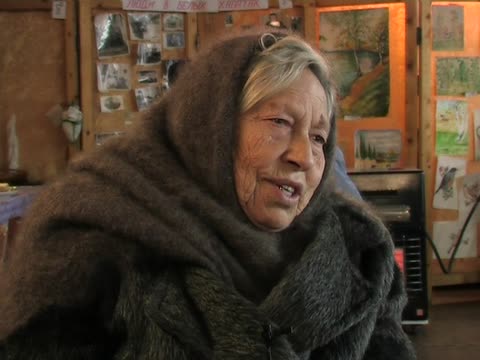
Mirenburg, nee Grinman, provides personal information and talks about her return home to Sguritzy from the ghetto and life after World War II. Mirenburg finished her school education after seven grades and then moved to Soroca to become a nurse.
From the machine transcript
Mirenburg gives personal information. She was born in Sguritzy in 1928 as Dina Grinman, daughter of Avrom, and her married name is Mirenburg. She describes the family's walk on foot back to Sguritzy from the camp after liberation. After the war she finished the seventh grade and went to Soroca to train as a nurse. She also explains that she was called Dania at home, and her mother's pet name for her.
Gives her maiden and married names and the different names she was called at home.
Mirenburg talks about her family. Her father, who owned six hectare land, was also born in Sguritzy and traded in grains. Her mother was a homemaker and owned a small grocery shop. Three of Mirensburg's cousins live in Israel. She then recalls her paternal grandmother and how she inherited a pair of earrings from her.
From the machine transcript
Mirenburg describes her family. Her father, from Sguritzy as were his father and grandfather, traded in grain and the family owned about six hectares of field. Her mother had two names and kept a small shop. She says three cousins live in Israel, and that people in the family speak a mixture of languages rather than Yiddish. She recalls her two grandmothers, Rokhl and Etl, and how Rokhl's will left her a pair of gold earrings. She later bought similar earrings and gave them to a grandchild as a keepsake.
Covers the grandmothers' names and Rokhl's will in detail, and the family's mixed everyday language.
Mirenburg discusses about holiday celebrations, in particular Sabbath with her father. She then talks about prewar Jewish life in Sguritzy. According to Mirenburg, 15,000 Jews lived there before the war.
From the machine transcript
Mirenburg talks about her family's observance, including Passover and the writing of a Torah scroll funded by a great-grandfather's gold chain. She describes Sguritzy before the war, saying there were fifteen thousand Jews and at least three synagogues; one on her street later became a school. The family kept separate dairy and meat dishes. Kerler asks about the Torah scroll and the synagogues.
Adds the Torah scroll written with the family's gift and the three synagogues.
Mirenburg talks about her education at a Romanian school and her training at the medical institute in Soroca. Her father hired a private tutor from Soroca for Mirenburg's religious and Hebrew language education. Mirenburg grew up with two brothers and one sister.
From the machine transcript
Mirenburg describes her schooling in Sguritzy in a Romanian school and her later nurse's training in Soroca, taught by named local doctors. Before the war her father hired a tutor from Soroca who taught her the Hebrew alphabet at home. She remembers the letters but little of the lessons and says she learned no Yiddish reading. Kerler and Lemster ask about the teacher and the lessons.
Adds the doctors who taught her and the question of Yiddish reading.
Mirenburg discusses holiday celebrations, in particular Sabbath. She also explains how her mother koshered meat. Mirenburg then talks about the fasting tradition on Yom Kippur and recalls how she also fasted in the ghetto. She then remembers Passover celebrations, including food customs.
From the machine transcript
Mirenburg answers questions about Sabbath in her parents' home: her mother's blessing over the candles, the non-Jewish 'Shabbes goy' who came to heat the stove, and her mother's baking of challah and salting of meat. She recalls her grandfather, who knew Yiddish and Hebrew and acted as a peacemaker. She remembers beginning to fast on Yom Kippur at age nine (and fasting in the camp/ghetto), and recounts a childhood incident when she told her mother that her sister sewed a sack on Sabbath. She then describes the Passover seder led by her grandfather, the afikoman gift, the four questions, and Passover foods such as matzo pancakes, potato cakes and 'Pesach bagels'.
Includes a childhood anecdote about her sister and the sack on Sabbath, and Passover food terms elicited by the interviewers.
Mirenbug discusses food customs, in particular gefilte fish, before she addresses Hanukkah and Purim celebrations. Mirenburg also remembers a childhood game and briefly talks about Simchat Torah.
From the machine transcript
Mirenburg answers questions on her mother's gefilte fish and on sweet Sabbath cholent, then on Hanukkah: lighting the candles, Hanukkah money and a dreidel from her grandfather, and playing the nut game in a hole. She says little of Purim, mentioning Esther and Mordechai and the Purim play held in the synagogue, and the Interviewers prompt her about Purim mumming, Simchat Torah (carrying an apple with a candle) and a Hebrew booklet about amulets, none of which she recalls in detail.
Gives details of the Hanukkah money and dreidel from her grandfather and the nut game; the Purim answer is thin.
Mirenburg talks about her family and about life before the war. She recalls how her mother sang Sabbath songs.
From the machine transcript
Mirenburg talks about her family before the war: her grandmother left young with two children and learned a trade, and her mother, with four children, had no time to attend storytelling evenings. She recalls her mother singing Yiddish songs and teaching the children Sabbath observance but cannot remember the songs. Kerler then asks about food eaten before the Yom Kippur fast.
Mirenburg talks about prewar Jewish life and occupations. She remembers taking food, her mother prepared for Sabbath, to a less well-off family.
From the machine transcript
Mirenburg says there were craftsmen in Sguritzy, though none in her family, and recalls her mother sending her with Sabbath food to a poor tailor's family with several children. She also describes the kapores custom before Yom Kippur, with a chicken for each child, which was given to the poor.
Adds the kapores custom.
Mirenburg talks about life before the war, including her childhood friends and non-Jews who spoke Yiddish. She then talks about prewar cultural life. Mirenburg attended concerts by Sidi Tal.
From the machine transcript
Mirenburg talks about her childhood friends, Jewish children and non-Jewish servants who spoke Yiddish, and mentions a Jewish girl who married a Christian, a rare case. She says there was a library of Yiddish books and recalls children watching the singer Sidi Tal perform Yiddish songs in a neighbor's courtyard; the interviewers ask whether she came from Chernivtsi. Kerler also asks about a fire brigade, which she does not know of.
Mirenburg discusses prewar religious life in her hometown Sguritzy, including visits to the Ştefăneşti rebbe. She also addresses blessings and talks about folk customs.
From the machine transcript
Mirenburg describes religious life in Sguritzy: sending questions to the rabbi about whether meat was kosher, and trips to the Ştefăneşti rebbe (Shtefaneshter rebbe), about which she knows little. She answers questions about terms for a holy man and a holy place and about prayer at graves. She also answers questions about drinking, the blessing 'azgile'(?) and folk remedies for the evil eye.
Adds the interviewers' terminology questions, graveside customs and evil-eye remedies.
Mirenburg answers questions about cultural terminology. She then talks about her life during World War II, in particular addressing the year 1941. She describes the beginnings of the German occupation in 1941, when her relatives happened to visit her family and how Mirenburg's family was forced to leave the house. She recalls how a Romanian soldier shot into the house and almost hit her aunt. Mirenburg maintains that she went to check on her aunt, while her family left the house; and as soon as she came outside her family already departed. Mirenburg explains how she came across an older woman, with whom she looked for family. Mirenburg then describes how she looked for her family and encounters with Romanian soldiers. Mirenburg recalls how she saw familiar people dead on the way and finally reunited with her parents and siblings. She then talks about the forced march toward the Rubleniţa woods andr recalls how they received food from Christians in the surrounding villages. According to Mirenburg, they stayed in the woods for ten days, before marching to the Cosăuţi woods. She mentions a woman who gave birth and collecting groups for forced labor during the time in the Rubleniţa woods. Mirenburg then reflects on reasons why the Christian inhabitants of Cosăuţi and Rubleniţa did not admit to the cruelties happening to Jews during the war. She then continues with her life during the war. According to Mirenburg, they stayed in the Cosăuţi woods for ten days, before marching to Yampil, where they stayed for three days. Mirenburg talks about the time in Yampil, during which her mother went to town to get food and encountered a German soldier. Mirenburg continues that after three days abidance in Yampil, her family was allowed to return home to Sguritzy, where they stayed for another three days, before forced to gather in the local synagogue. Mirenburg recalls the conditions in the synagogue and talks about how they were sent to Vertiujeni, where they had to stay for two months. From Vertiujeni, Mirenburg explains, they were supposed to go to the Rîbniţa ghetto, but returned home instead.
From the machine transcript
Mirenburg answers questions on the meanings of 'dibbuk' and 'golem', then at Kerler's request tells of the war. Following the German and Romanian entry into Sguritzy on 22 June 1941 (as she gives it), she describes relatives arriving, soldiers shooting into the house and her family fleeing, her search with an old woman for her family among dead townspeople, and being reunited with her parents. She recounts the forced march to the Rubleniţa woods, then the Cosăuţi woods, with little food from villagers and men taken for labor; then Yampil, where a German soldier brought food. After returning home they were crowded into a Soroca synagogue, held at Vertiujeni for two months, and told they would go to Rîbniţa but were returned.
Begins with a terminology questionnaire on dibbuk and golem; the transcript does not clearly show the aunt-shot episode in detail.
Mirenburg talks about her life during the war. After she and her family returned home to Sguritzy, Mirenburg explains, how they were supposed to go the Rîbniţa ghetto, but went to Yampil instead. She recalls a family friend, who was injured. When they arrived in Yampil, Mirenburg's family moved further through different Ukrainian towns, including Myskivye 2:27, Dzyhivka, and Potashna. She describes the journey and how they received food from Jewish families. Mirenburg talks about their stay on the Potashna kolkhoz and the time she fell ill with typhus. Her younger brother died of typhus there. She then recalls what people on the kolkhoz told about the Bershad ghetto, which encouraged her family to move on to the Bershad ghetto. She also lost her youngest brother and father during the war. Mirenburg talks about how she begged for food in the surrounding villages for two weeks and the beatings she and her mother suffered. She then addresses life in the Bershad ghetto and her family. Mirenburg recalls a song non-Jewish boys in the surrounding villages would sing.
From the machine transcript
Mirenburg continues her war account. Her group was sent to Yampil instead of Rîbniţa, and she tells of a family friend from Sguritzy who survived a massacre of a column. Then come the march through Ukrainian towns, food rations, and the Potashna cowshed, where she fell ill with typhus and had a dream while ill. Her brother and then her father died. In Bershad the family begged in the villages, and a Ukrainian village elder beat her and her mother. She also tells of a boy who was tied to a motorcycle. Kerler asks about a song the village boys sang.
Adds the typhus dream, the boy tied to a motorcycle, and the father's death date.
Mirenburg describes her liberation from the Bershad ghetto. She recalls interactions with Jewish partisans, who informed them about the liberation. In particular, Mirenburg remembers Yashe the Partisan. Mirenburg then talks about the losses of her family members and her life after the war in Soroca. She finished her school education.
From the machine transcript
Mirenburg describes the liberation of the Bershad camp and the Jewish partisan Yashe, who told the prisoners what had happened. She recounts how he hid among the dead on a cart and how his family was tortured and killed. After the Dniester was crossed in March they returned home. Her mother and sister worked in a canteen in Soroca, and she herself was studying.
Adds the partisan Yashe's story in detail, including the fate of his parents.
Mirenburg briefly answers dialectological questions from the AHEYM Yiddish questionnaire, before the team concludes the official part of the interview.
From the machine transcript
Mirenburg answers Kerler's short dialect questions: words for 'frozen', 'sick', 'pious' and 'honest', and the phrase 'give me'. She comments on mixing Russian with Yiddish. Kerler thanks her and the formal part ends.
Mirenburg takes the team to the synagogue and describes the forced assembly in 1941. The camera then records footage of the synagogue.
From the machine transcript
Mirenburg describes the synagogue, where people were forced to gather in 1941, the room's earlier arrangement and its restoration. Kerler thanks her, and talk turns to the recording and what it is for. The camera then films the synagogue, with some Russian aside.
Adds the interviewer's discussion of the recording.