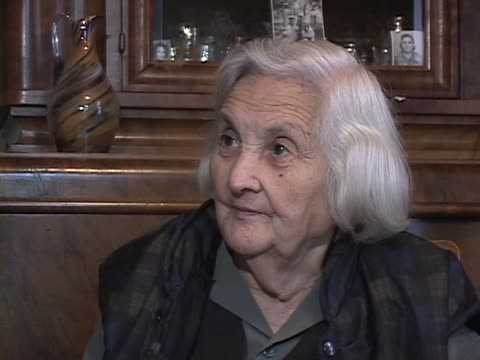
Shekhovich provides personal information and talks about her family. She then talks about her school education and discusses her childhood memories. Shekhovich studied at a trade school.
From the machine transcript
Shekhovich gives her maiden name Kamerman, her first name and her birthplace Sambor, and says her father was named Yisroel and her mother Mirl. She names several of her eight siblings (Yankev, Dovid, Itsik and sisters) and her grandmother Leye. She says she attended a Polish school and then a commercial (trade) school, and could not afford the Yiddish school. She did not work after school.
Gives the maiden name Kamerman, the parents' names and the siblings' names.
Shekhovich talks about Jewish life in prewar Sambor and holiday celebration at home. She left Sambor in 1944. She then talks about contemporary Jewish life and discusses holidays before the war.
From the machine transcript
Shekhovich talks about prewar Sambor, which she describes as a Jewish town with one large synagogue and small prayer houses. She recalls her mother's Sabbath fish and her own knowledge of how to prepare it, the Passover seder led by her father, and food made from matzo. She says she cannot remember Purim plays or a prewar wedding. Polish was the language of the town and Yiddish that of the home. She says she remembers few Yiddish songs.
Adds the home and town languages, the seder, Purim and wedding recollections, and the question about her grandson's schooling.
Shekhovich briefly addresses Yiddish songs and answers questions about cultural terminology. Shekhovich talks about her education at a religious school (cheder) and food customs.
From the machine transcript
Shekhovich briefly mentions a Yiddish song her husband sang to the children, then answers questions about words such as dybbuk and golem, which she does not know. She talks about attending cheder, her mother's candle blessing and the koshering of meat by soaking and salting, and says her mother baked challah. She describes the lack of Yiddish speakers today, even in the Hesed.
Adds the koshering of meat, the candle blessing, the lack of Yiddish speakers at the Hesed today and the dybbuk and golem questions.
Shekhovich answers dialectological questions from the AHEYM Yiddish questionnaire and mentions Yiddish sayings.
From the machine transcript
Shekhovich answers questions from the AHEYM Yiddish questionnaire: greetings and farewells, thanks and please, book, window and glass, and other everyday words such as temperature and height. She says that in her family the language was Polish and Moldovan-influenced speech. Lemster explains that the recordings are for students and the archive.
Adds the explanation of the archive's purpose and the languages spoken in childhood.
Shekhovich mentions the different languages she spoke before the war, including Polish and Yiddish. She then talks about life today and before the war.
From the machine transcript
Shekhovich says that she and other children spoke Polish as they grew up and that all teaching was in Polish. She discusses Yiddish theatre visiting from elsewhere and recalls a relative from America. She tells how Jews were poor and rich and how life was difficult, and the postwar life in Drohobych. When asked about her siblings, she says she can say little, only that there were troubles under Hitler.
Adds the language of schooling, the Yiddish theatre, and the postwar life in Drohobych.
Shekhovich talks about her family. She explains that she survived World War II in hiding with the help of her non-Jewish husband. Shekhovich talks about her life before the war and remembers her grandmother reading tkhine (Yiddish-language prayer book).
From the machine transcript
Shekhovich says she was the only one of her whole family to survive the war, thanks to her husband, who risked his life to hide her. She says she can say little about her brothers' fate. She talks about reading Yiddish, Jewish newspapers and the need for money for school, and recalls her grandmother reading a tkhine and her mother's use of Yiddish. She says her husband knew Yiddish better than she does.
Adds the husband's rescue, the grandmother Leye with her tkhine, newspapers and Christians who spoke Yiddish.
Shekhovich talks about Jewish life in prewar Sambor, as well as her life after the war.
From the machine transcript
Shekhovich talks about the occupations of Jews in prewar Sambor, such as shops and trade, and says some lived very well until Hitler came. She says few Jews remained after the war. She did not go back to her house, which her husband avoided, and her daughter has seen it. When asked about Purim customs and songs, she says she remembers little. Her daughter urges her in Ukrainian to recall songs.
Adds the occupations of Jews, the house after the war, and the Purim and songs questions.
Shekhovich recites blessings for lightning and thunder.
From the machine transcript
Shekhovich recites the blessings said at lightning and at thunder, with Lemster asking her to repeat them. Her daughter urges her in Ukrainian or Russian to recall more songs.
The first part of the tape is a continuation of a formal interview with Evgeniia Izrailovna Shekhovich. Shekhovich talks about religious customs and holiday celebration. She then sings a Yiddish Sabbath song. Shekhovich then talks about daughter, before she sings a couple of Yiddish song she learned from her husband. The first song includes a little girl and the second one deals with poverty and dreaming.
From the machine transcript
Lemster asks Shekhovich about holiday and Sabbath customs. She recalls Sabbath songs (zemires), Hanukkah, Purim and fasting only vaguely, and talks about Sambor. She sings a Yiddish Sabbath-eve song about a grandfather and grandmother telling a tale to children. Her daughter speaks in Russian about her schooling and about her father, and Shekhovich says she learned the next Hebrew-themed song and the song about dreaming and poverty from her husband. Lemster repeatedly asks where she heard the songs.
Adds Lemster's questions about Jewish converts in Sambor and about Hanukkah and Purim customs.
Shekhovich talks about the fate of her family during the war in Sambor. She was the only one from her immediate family who survived. Shekhovich recalls folk remedies.
From the machine transcript
Shekhovich says her father, mother, brothers and sister were taken from Sambor to Radłowice (?) and she was the only one of her family left. Lemster asks about her husband and their life together. He then asks about folk beliefs and remedies: the evil eye, charms, and putting out coals or bread crumbs. She says she cannot recall much, learned some from her mother, and knows new songs better than old ones.
Adds Lemster's questions about rebbes' tales and her husband's songs.
Shekhovich describes in Polish the Polish-language environment she lived in before the war.
From the machine transcript
Shekhovich and her companions, mostly in Polish, talk about growing up in a Polish-language environment. She went to a Polish school and kindergarten, spoke Polish in the street, and understands Polish better than Yiddish. The Polish language is dear to her, and she says that Yiddish was little spoken with children at home. Asked for Polish or Yiddish songs, poems or the Polish anthem, she cannot recall them, and says she lived through terrible things in the war.
The camera collects town footage of Drohobych.