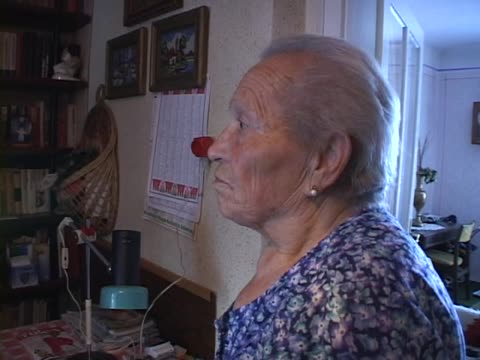
The first part of the tape includes a continuation of a formal interview, recorded in Solotvyno with Dora Abramovna Fiksler, born in 1924 in Solotvyno. Fiksler makes a number of phone calls, before they go inside to talk about Fiksler’s library, which includes prayer books. Fiksler then shows photographs of her family. Fiksler briefly talks about religious life before the war.
From the machine transcript
Fiksler makes a phone call or two, then shows her bookshelf. Kerler and Katz look at old Yiddish and Hebrew books, including a Yiddish Tsenerene-type book, a Humash with Yiddish translation, Haggadahs and a Soviet-era prayer book. She shows family photographs: her late husband, a grandchild and great-grandchild who speak Yiddish, and her brothers, one of whom died in Israel. Another brother's wife and daughter did not return from the camps. She says women went to synagogue only on holidays, and her son Yakov arrives at the end.
Also covers the phone calls and the Hungarian-language books she bought.
Fiksler’s son Iakob arrives. He provides biographical information and talks about his family. Iakob was born in Uzhhorod. He then talks about life today.
From the machine transcript
Fiksler's son Yakov arrives and speaks Yiddish with Kerler and Katz, who say they want to learn the proper local Yiddish. He mentions his birthplace (garbled in the transcript), his mother's teaching of Yiddish to the children, and his young daughter who speaks Yiddish well. He recalls a trip to Crimea. He compares credit and investment conditions in America and Ukraine and says life is hard for business. They discuss a roadside Jewish memorial seen on the way and plan a further visit, with Munkács as a destination.
Also covers Yakov's views on the economy, a memorial seen on the road, and plans to visit Munkács.
Fiksler recites the morning prayer “modeh ani.” She then talks about post-World War II Jewish life, in particular the kosher butcher.
From the machine transcript
Fiksler tries to recite the morning prayer Modeh ani but says she has forgotten much of it. Yakov remarks on how hard it is to get prayer books and religious services nearby. She says that after the war the kosher meat came from a shoykhet in Khust once the Solotvyno one had left. Poultry was slaughtered locally. Kerler then asks her about the start of the war.
Adds Yakov's remarks on the lack of prayer books and that Munkács and Uzhhorod are too far.
Fiksler discusses life at the beginning of World War II during Hungarian occupation, including the social and political discrimination of Jews. Fiksler remembers non-Jews speaking Yiddish, and even a Romanian boy, who attended religious school (cheder).
From the machine transcript
Fiksler tells how Hungarian forces advanced into Subcarpathia in 1938–39, and how Jewish children were then barred from school and Jewish shops were closed. She remembers life being harder for Jews than for others, a Jewish doctor and dentists, and good non-Jewish friends who returned her belongings. She recalls a Romanian (Vlach) man who knew Yiddish and attended cheder with the Jewish boys, and says Solotvyno's mixed population spoke little Yiddish among non-Jews. Kerler leads her to the events of March 1944.
Adds the dates of the Hungarian advance, the closing of shops and the Romanian boy in cheder.
Fiksler discusses the last two years of World War II. She explains that she was forced to live in a ghetto in 1944, before she was taken to Birkenau. She was then deported to Austria and worked in a factory. She was liberated by the Americans in Austria. Fiksler then talks about her life after the war, and her search for surviving family members.
From the machine transcript
Fiksler says she was taken into a ghetto in April 1944 and deported in May to Auschwitz-Birkenau, where she was in a camp block and had no number. Her parents were killed there. She was then sent to Austria, worked at machines in a factory near Linz, and was liberated by the Americans. She decided to go home to look for relatives.
Adds that her parents were killed in Auschwitz and that she worked in a factory in Austria.
Fiksler talks about her return home. She explains that they knew nothing about the deportations before 1944. She then recalls the first days of Hungarian occupation in 1939.
From the machine transcript
Fiksler speaks of her return, when neighbors gave back what she had left with them but the fields were later taken into the kolkhoz. She says they knew nothing of the deportations before 1944 and recalls an older brother's worried remark when Hungarians first arrived. She also describes the mixed Hungarian and Romanian population of Solotvyno and the Jews living there. She mentions that her family kept Passover.
Adds the kolkhoz and fields, the older brother's remark and the town's mixed population.
Fiksler talks about Purim in the prewar period and about Purim shpiels, during which she would dress up in costumes. Fiksler talks about Yiddish-speakers today.
From the machine transcript
Fiksler recalls prewar Purim, when people dressed up and performed a Purim play, and she recites a short rhymed Purim verse. Her granddaughter is mentioned as one who could recall more. The group then arranges follow-up contact by phone and discusses where the family is travelling. Katz and Kerler ask about Yiddish speakers today, and the family says few remain in Solotvyno or Munkács and that her eight-year-old granddaughter may be the only child in the Carpathians who speaks Yiddish. They also touch on Polish Jews' Yiddish and on visa rules for travelling to Sighet.
Adds the recited verse, phone-number exchange, Yiddish-speaking grandchildren and the visa discussion.
The team travels to the next interview with Hershel Ylyevich Vider in Mukacheve. After they enter his apartment, the team sets up the formal interview with Vider, born in Mukacheve in 1922. He provides personal information and talks about his family. His three brothers moved to Canada after the war. Vider then sings a Hasidic song in Hungarian, before he talks about Jewish life in Mukacheve today. Vider laments that Yiddish is not passed on to the next generation.
From the machine transcript
In Mukacheve the team is welcomed by Vider, and Kerler explains their project of collecting interviews on Jewish life, history and Yiddish. Vider says he was born in Munkács in 1922 and now lives there, and that his three brothers left after the war. He speaks of a rebbe, mentions a Hungarian Hasidic song, and sings a song about a rooster and the coming of the Messiah. He laments that in Mukacheve about five hundred Jews, nearly all Russian-speaking, no longer pass Yiddish or Hebrew on.
Adds Kerler's explanation of the project, the song about a rooster and Vider's criticism of the local rabbi.
Vider recalls prewar Jewish life in his home town. He attended religious school (cheder). At home, he spoke Yiddish with his grandparents and Hungarian with his parents. Vider then talks about his family. His father served in the Austro-Hungarian army.
From the machine transcript
Vider recalls growing up in Mukacheve on a largely Jewish street opposite the largest cheder, where he studied. He says his mother was Hungarian-speaking and his father came from Sighet and had served in the Austro-Hungarian army. At home Yiddish was spoken, and his grandmother Toybe and great-grandmother Zisl spoke only Yiddish. Today, he says, Jews pray in Russian and Jewish organizations do too little to preserve Yiddishkayt.
Adds the Jewish street, his mother's background and the great-grandmother.
Vider talks about his family and prewar Jewish life. Vider’s daughter lives in Hungary and his son is a Canadian citizen. His father was born in Sighetu Marma?iei. Vider recalls the wedding of Eluzer Spira’s daughter in 1934, as well as the rebbe’s funeral. He then talks about religious life today, praying in Russian. According to Vider, people called prewar Mukacheve “little Jerusalem.” He claims that even half of the non-Jews in the city spoke Yiddish. Vider explains that the former director of the local Hebrew school, Dr. Haim Kugel, became the mayor of Kholoniv after the war.
From the machine transcript
Vider talks about attending the setting of a new gravestone for a Jew in Berehove, and about the last Yiddish speakers there. Kerler introduces him as born in Mukacheve in 1922. He gives his father's and grandfather's names, with a father from Sighet, and discusses the Vider family name, the town's Jewish population (about sixteen thousand), and a Kleinbart family. He remembers the wedding of the rebbe's daughter and mentions the rebbe's funeral. He describes the town's many synagogues, prayer today in Russian with only a few praying in Hebrew, and bar mitzvah and bat mitzvah customs. He recalls Mukacheve as a 'little Jerusalem' with a multiethnic population where Hungarian was the main language and half of the non-Jews knew Yiddish, plus the Hebrew gymnasium under Dr. Haim Kugel, the orphanage, and the Munkács Hasidic court. He ends with his children (a daughter in Hungary and a son with Canadian citizenship) and a short Yiddish-Russian exchange about a word.
The transcript also shows the Kleinbart family, bar/bat mitzvah customs, charity boxes and the Hasidic court.
Vider talks about the wedding of Chaim Elazar Spira’s daughter and shows several illustrated books about the history of Mukacheve. Vider then shows a Hungarian Jewish newspaper from the 1930s that reports on Hasidic life, before he shows photographs of the wedding and funeral of Eluzer Spira, as well as other photos of prewar Jewish life.
From the machine transcript
Vider shows Kerler books and papers from his collection: a Hungarian chronicle of the Holocaust, a Hungarian Jewish newspaper he had for years, old photographs and postcards, and an old map of the town. He mentions the Safed museum director and a historian, and names the Hebrew gymnasium and a Mukacheve rabbi's wedding, and photos of Hakhshara and of his father. The talk touches on the Czech-era name of the town and the wedding photos of the Munkács rebbe, his daughter and her groom Rabinovitsh. It also includes a mention of the Spinka rebbe.
The transcript also shows an old map of the town, a historian's name, the museum in Safed, and a Hakhshara photograph.
Vider talks about Frume’s (Spira’s daughter) wedding. He also sings Yiddish songs. He then talks about his family. Vider put up a canopy for his wedding in 1949. His son was circumcised in 1955. He then shows a book on the Holocaust of the Transcarpathian region and other illustrated books about Mukacheve. Vider then talks about food customs and shows a video of a relative, playing music.
From the machine transcript
Vider and Kerler look at photographs of Fruma's wedding and of the rebbe, and Vider recalls the wedding in the courtyard, with dancing and Yiddish and Hungarian songs. He sings a song and sits with S3 singing along. He mentions his own wedding canopy and a circumcision he knows of, and says circumcisions are performed in Mukacheve today. He shows a book on the Holocaust in Transcarpathia and other volumes, and is asked about a Yiddish term for a non-Jewish church. After a discussion of food words, including challah and berches, he shows a video of a relative who is a musician.
The transcript also shows a book on Hungarian deportations, a question on a Yiddish word for a church, food terms, and a video of a relative musician.
Vider talks about his family, in particular his great-grandmother Zisl Berger. He then describes the folk custom “leshn koyln,” before recalling prewar Hasidic life.
From the machine transcript
Vider talks about his great-grandmother Zisl and his grandmother Toybe, whose family names (Vetnshteyn, Berger) he explains; he also mentions his mother Leye and his own Hebrew name. He answers Kerler's questions about 'leshn koyln' (extinguishing coals), a folk remedy against the evil eye that his mother used. He then tells a story of the Munkács rebbe's meeting with the Czech foreign minister Beneš.
The transcript also shows the story of the rebbe's meeting with Beneš.
Vider talks about his life during World War II. He was imprisoned in the Vorkuta gulag (building railroads) from 1940 to 1946, accused of spying. His brother Mendl hid in Budapest and his other brother Moyshe served in the Czechoslovak army during the war. Vider then talks about his family, in particular his children.
From the machine transcript
Vider speaks about his wartime years, saying he spent six and a half years in the Vorkuta gulag, accused of spying (for the English); there he learned Russian. His brothers' fates: one hid in Budapest, and Moyshe served in the Czechoslovak army in France and Africa and later married in England. He then returns to his own family, saying his daughter lives in Hungary and does not speak Yiddish and his son does, and he names his children after relatives. Kerler closes by asking about Purim customs.
Vider remembers prewar celebrations of Purim. He remembers snippets of Purim shpiels, as well as a Hasidic anecdote about healing. He then talks about literature.
From the machine transcript
Vider describes how Purim was celebrated before the war: the megillah in the study house, a festive meal at home, singing, dancing and masks. He recalls scraps of purim-shpil lines and tells an anecdote about a Munkács rebbe's greetings. He also tells a story of a rabbi-physician during the Spanish Inquisition who identified a worm by a Torah law. He then talks about his reading (history, geography) and the languages he read in, Hungarian and Czech.
Adds the Inquisition-era doctor story and the languages he read in.
Vider remembers prewar Sabbath celebrations. He sings a Sabbath song in Hungarian. Vider learned some Hebrew from friends who attended the Hebrew school. He then describes prewar Jewish life. Vider explains that he had at one point joined the Mizrachi movement and later joined Betar, where he once saw Zeev Jabotinsky speak. He then joined the Hashomer Hatzair movement, thereby switching from the extreme right to the extreme left within the Zionist spectrum. He laughs that he went wherever the girls were.
From the machine transcript
Vider sings a Sabbath song, partly in Hungarian, that his father loved, and explains how songs were sung at home on Sabbath. He says he learned some Hebrew from friends at the Hebrew gymnasium. He describes moving from Mizrachi to Betar, where he heard Jabotinsky speak in German, and then to Hashomer Hatzair. He jokes that he followed the girls. There is also talk of caterers for weddings in Mukacheve, a brother in Toronto, and a Jew in Klechanove (Moshe Neiman) to visit.
Adds the Toronto brother's catering, the sarbers question and Moshe Neiman in Klechanove.
The camera records his family photographs. The team goes with Vider on a tour of the former Jewish neighborhood. They arrive at the former Jewish tekhnikum and go inside. Vider remembers Jewish football clubs before the war. Outside the former Jewish tekhnikum, Vider talks about prewar Jewish life.
From the machine transcript
The group looks at family photographs, then walks through the former Jewish quarter. They reach the building of the former Hebrew gymnasium and look inside; Vider recalls playing football there and the Jewish team Makabi, and the other local and Jewish teams from nearby towns. A tune of Hatikvah is mentioned. The passage ends with a remark that the Hasidim, and the Munkács rebbe in his sermons, opposed the Zionists.
Adds the Hasidic opposition to Zionism and the football teams of nearby towns.
Vider and the team are headed to a former synagogue. Vider explains former Jewish buildings. The next stop includes the old Jewish cemetery. They visit graves of rebbes.
From the machine transcript
On the walk toward a former synagogue, Vider points out former Jewish buildings, among them an orphanage with a menorah facade from the 1920s. He says the old Jewish cemetery has been built over and gravestones were stolen. Fragments of stones were walled in, and Americans paid to protect the site. He mentions the grave of Rabbi Chaim Elazar Shapira and rebbes' graves. Interspersed are a pharmacy aside and talk about Hungarian and Romanian words.
Adds the orphanage, the walled-in gravestones and the American Jews' payment for the site.
Vider and the team are headed to the new Jewish cemetery. At the cemetery, Vider talks about Jewish life today and visits several graves, including the structure housing the graves of the Shapiro family (the Hasidic rebbes of Mukacheve) and the monument for the Jews murdered during the Holocaust.
From the machine transcript
At the new Jewish cemetery, Vider and the team look at gravestones, some moved from the old cemetery, with names such as Chaim Yona and Meir Shteynberg (?). Photos on graves, which the Munkács rebbe forbade, are discussed. A mother's four children who died in Auschwitz in 1944 are named on a stone, and the stone of the Shapira family and the Holocaust memorial are mentioned. The place Benerikovitsh near Chernivtsi (?) comes up in connection with a rebbe's wife. There are Hungarian-language asides.
Adds the Auschwitz memorial inscription and the discussion of photographs on gravestones.
Vider and the team continue the formal interview at a restaurant. Vider remembers folk remedies. He talks about his return after World War II and postwar religious life. Vider attended privately organized prayer services and discusses how he would bake matzo at a Romanian Jew’s (Lebovich) house until 1953.
From the machine transcript
At the restaurant, Vider and Kerler exchange Yiddish farewell sayings. Vider says he returned in December 1946, after his brother's return in 1945, to a few remaining Jews; there was still a shoykhet. He describes meeting for prayer in a Romanian Jew's house (Leybovitsh), baking matzo there until about 1953, and the Leybovitsh grandsons today. He then answers a question about the men who came back from labor in Siberia.
Adds the postwar shoykhet, and the Leybovitsh family and their grandsons.
Vider talks about his experience at the Vorkuta gulag. Vider worked ten to twelve hours a day of hard labor building the railroad tracks from Pechera to Vorkuta. Vider then talks about his family and childhood memories. His father was a commission merchant for two retail companies (metal and colonial goods) from Prague. Vider explains how well-off his family was because they owned a telephone.
From the machine transcript
Vider talks about the Vorkuta camp: ten to twelve hours of work a day, the mosquitoes, fellow Jewish prisoners including one who died, and singing to himself in the Gulag. He then speaks about his father, a commission agent for two Prague firms (metal goods and colonial goods) whose territory covered Subcarpathia and Slovakia as far as Košice. The family lived well, and in the 1920s they had a telephone. A brief break and a question about a man's name follow.
Adds the Jewish fellow prisoners and singing in the camp.
The first part of the tape is the continuation of a formal interview with Hershel Ylyevich Vider, recorded in Mukacheve. Vider talks about his childhood memories and his family. Vider then discusses prewar Jewish life, in particular his political activity. He describes how he joined the Betar movement.
From the machine transcript
Vider talks about his family: his father was an only son with many sisters, and his mother's brother married in Satu Mare and the relatives came to Mukacheve in summer. Kerler asks about a local kosher meat dealer, and Vider says only veal was sold. He mentions his children's studies and careers. He then describes his youth in Mizrachi and Betar, reading about Yosef Trumpeldor in Hungarian, and the evenings with singing, study and politics.
Also covers relatives in Satu Mare, the kosher meat trade and his children's careers.
Vider tells prewar Hasidic anecdotes and jokes. One anecdote includes a story about a wife who complains about her husband to the rebbe. He then discusses the prewar youth movements Betar and Mizrachi, as well as the Bund. Vider continues to talk about Yiddish literature.
From the machine transcript
Vider tells Hasidic jokes about a rebbe, including the wife who complains to the rebbe about her husband, and a poor Jew who writes a letter to God asking for money for Passover. He discusses the Zionist youth movements (Mizrachi as religious, Betar mixed, Shomer Hatzair less observant), communists and Bundists in the town. Asked about Yiddish books before the war, he says there were many, including Bialik and Sholem Aleichem. He ends with another joke and a remark about his own sleeping arrangements.
Also covers communists and Bundists in the town and Yiddish books before the war.
Vider explains different greeting customs. He then talks about contemporary Jewish life in Budapest.
From the machine transcript
Vider explains greeting customs, such as a Latin-derived word for greeting and handshaking, and the Hungarian influence on them. He says his Yiddish is weak and that he mostly watches Hungarian television. He talks about Jews in Hungary and Budapest today (a Jewish hospital, a choir, the old Jewish street and ghetto, and a children's summer camp). He answers a few terminology questions, then mentions that Nayman survived the Gulag with him and was born in Rakhiv.
Also covers greetings and Hungarian influence, plus a mention of Nayman.