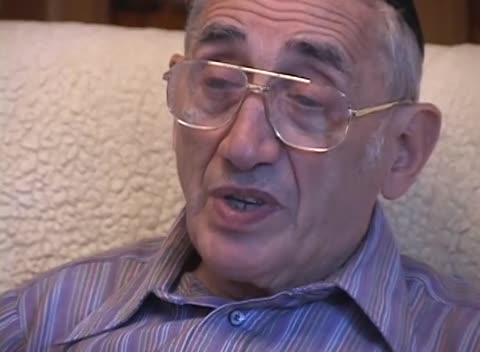
Herbst speaks about his life after the war. He worked as nuclear technician at an institute of physics. Herbst was married in 1961 and he raised a son. He then provides personal information and speaks about his hometown Bornobash (Yiddish: Berlabashe).
From the machine transcript
Herbst mentions his flat on a hill in Budapest and that he received it through work. He says he married in the 1960s (?). Asked by Kerler, he places his birth in a small village in the Carpathians known as Berlebash (Bornobash in Hungarian), between Rakhiv and Trebusa (?). It was a village of about three hundred inhabitants, mostly Ukrainians, with a minyan of Jews. He describes the surrounding mountains and wild animals.
The transcript shows his flat and workplace in Budapest and the village's setting among mountains and wild animals.
Herbst describes his childhood home and life before the war. He then addresses celebration of Tisha B'Av during World War II.
From the machine transcript
Herbst recalls his childhood home at the foot of a hill, with a few geese and hens, and a story of wolves coming down from the forest. He speaks of Tisha B'Av, when the children fasted and did not work. During the war he picked raspberries in the mountains with friends because of the bears. He and Kerler briefly discuss a Yiddish word for a children's game, and he says he began working in Hungary in the late 1930s.
Raspberry picking with friends in the mountains and a wolf story from his childhood home.
Herbst speaks about his work at a lumbermill between 1938 and 1941. He then addresses his life after the war. He was hospitalized between 1945 and 1951.
From the machine transcript
Herbst says he worked at a sawmill and then after the war lay in hospital for several years from 1945 (?). Kerler asks whether he had been to Budapest before the war. Herbst says he knew it only from a picture and had stayed in Berlebash until 1944.
Herbst speaks about his life and travels to Romania before the war.
From the machine transcript
Herbst recounts that he travelled once to Romania, to a married sister in Vişeu de Sus (Oyber Visheve), where her husband was a melamed and he stayed a year before the war. He describes the border crossing with a one-month passport and how people advised him to buy a half-price train ticket. Kerler then asks when the war began.
A trip to a sister in Romania, with details of border crossing and cheap train tickets.
Herbst describes his family's life at the beginning of the German occupation in 1944. According to him, Jews from his hometown had to assemble and were deported to Rakhiv, before deported further to the 13:58 ghetto. Herbst then describes the conditions of the ghetto, where they had to sleep at the cemetery for six weeks. Herbst continues and explains how Jews from his family was deported to Auschwitz. Herbst stayed in Auschwitz for one week and then was sent to the Mauthausen concentration camp for a forced labor selection procedure, which also lasted one week. As a forced laborer, he was sent to Ebensee to work in a quarry for three years.
From the machine transcript
Herbst tells how the Carpathians changed hands several times (Czechoslovakia, Hungary) and how the Germans entered Hungary in March 1944. After Passover the Jews were ordered to Rakhiv and then taken to the ghetto at Mátészalka, where they lived for six weeks in the cemetery. From there the family was taken to Auschwitz in the first transport, where his sisters and their children, and probably his parents, were lost. He was selected at Mauthausen and sent to Ebensee, where he helped to build tunnels, and he mentions a cousin now in New York.
A joke about the changing of countries, and a young work leader who offered to let him stay behind in the mountains.
Herbst speaks about his liberation by the American army in Mauthausen. He explains that the forced laborers were rationed to one meal a day and therefore he became too weak to work. Herbst was sent to the hospital in the Mauthausen concentration camp, where he was liberated by the American army. He then recalls prisoner functionaries (Kapo) that helped him to recover in the hospital and describes the conditions at the hospital. Herbst specifically remembers the Polish Jew Boryslav Biyalik.
From the machine transcript
Herbst describes the liberation of the camps by the Americans and the Russians, his work at the quarry on one meal a day, and his return to the Mauthausen infirmary when too weak. There a Polish Jew from Krakow, whose name is given roughly as Boleslaw Bialik, shared bread and hid him from selections. He also speaks of Kapos, one of them a one-armed Hungarian Jew named Singer (?), and of overcrowded bunks. Kerler asks about the Russian word for bunks and about conditions in winter, and Herbst also mentions Hungarian Jews arriving in the autumn of 1944.
A Hungarian Jewish Kapo and the camp's sleeping conditions.
Herbst speaks about Jewish life in the region during German occupation in 1944. He then mentions how he always kept a prayer book (siddur) when traveling to Mauthausen.
From the machine transcript
Herbst speaks of the Budapest ghetto, whose Jews were not sent to Auschwitz, and of Hungarian Jews who arrived at Mauthausen. He tells how he found a prayer book and tefillin at Mauthausen and kept the tefillin with him, naming their owner as Chaim Meir Weiss (?). The last part is a muddled exchange with Kerler about a seminary and a teacher or acquaintance who wrote an article about Herbst.
The tefillin found at Mauthausen and a conversation about a seminary teacher.
Herbst shows his prayer book and recites prayers for the fourth and second days.
From the machine transcript
Herbst and Kerler talk about his prayer book, and Kerler asks him to read something aloud. Herbst then reads or recites prayers, which are largely garbled in the transcript; Kerler remarks that they are for the Monday and Thursday service. Kerler then asks where he learned to read Hebrew.
Kerler's remark that the prayers are for Mondays and Thursdays, and a question about where he learned Hebrew.
Herbst addresses his prewar religious education and speaks about religious institutions in the region. He attended a yeshiva high school for one year in Vişeu de Sus, Romania, (Yiddish: Oyber Visheve).
From the machine transcript
Herbst says he last studied Jewish subjects during his year in Vişeu de Sus, at a yeshiva with some two hundred and fifty students (?). He and Kerler mention larger yeshivas in Pressburg and Cluj. Kerler explains his own interest in collecting Yiddish and then asks Herbst for more about Berlebash.
A chat about Kerler's collecting of Yiddish.
Herbst speaks about Jewish life in his hometown Bornobash. In particular, he describes how the local inn produced wine for the community on Rosh Hashana. He then mentions a wealthy Jew from Rakhiv who gave out wine before Passover.
From the machine transcript
Herbst describes Berlebash as tiny, with barely a minyan and boys without tallit until marriage. The wealthiest family kept an inn that obtained grapes for Rosh Hashanah wine, which was distributed to each family. A wealthy Jew from Rakhiv with a sawmill, Abish (?), gave out kosher wine before Passover, and raisin wine was otherwise made at home.
A wealthy Rakhiv sawmill owner who provided wine before Passover.
Herbst discusses his family. His father owned a grocery shop. Herbst grew up with four sisters, who worked as seamstresses, and three brothers. He then describes his family's life before and during the war.
From the machine transcript
Herbst says his father kept a small grocery shop largely on credit, while four sisters did handwork and sewing for the local Ukrainians, paid in food. He grew up with four sisters and several brothers, one of whom studied tailoring. The sisters went to Auschwitz with their children and did not return, the youngest brother was lost before the war, and another brother survived Mauthausen and was liberated in 1945. He also mentions living in a sukkah-like hut in the mountains.
Details on the sisters' needlework, the family's economic situation and the brothers' fates.
Herbst depicts his return home from Mauthausen (by car), via Melk (on foot next to horse and wagon), Bratislava, Slovakia, (by train), Győr, Budapest and Debrecen in 1945. Herbst mentions that the Joint Distribution Committee supported the community in Debrecen in the immediate postwar period.
From the machine transcript
Herbst describes his return in 1945: by lorry from Mauthausen to Melk, then on foot with a horse and wagon in the Russian zone toward Bratislava, then by train to Hungary. The Joint helped him in Budapest, where he went straight to hospital, and he was then sent to Debrecen, where the Joint supported the Jews with clothes and food. He later went back to a Budapest hospital and a sanatorium and began to learn a trade.
His later stays in hospital and sanatorium and the start of his vocational training.
Herbst talks about his life and work after the war.
From the machine transcript
Herbst recounts how a physicist invited him to work at a physics institute, with a trial month, and how a doctor friend had helped him find work and a post. He says it was hard because the others were highly educated, and mentions kosher supervision.
Herbst speaks about his school education at a Ukrainian school in his hometown. He then returns to his life in the postwar period in Debrecen, which included attending synagogue services. Herbst gives snippets of postwar religious life in Debrecen.
From the machine transcript
Kerler asks about Herbst's schooling, and he says he attended a four-class school in Berlebash, taught in Russian or Ukrainian. He then returns to postwar Debrecen, where he lived in a small room and received meals and money from the Joint, and mentions a yeshiva. He describes attending synagogue and meeting a Russian rabbi (Moshe Weiss, ?) and speaks of a rabbi's sermon in a mixed Hungarian and Yiddish setting.
Postwar religious life in Debrecen, including the Russian rabbi and a sermon.
Herbst speaks about his life today and recalls a prayer. He then briefly addresses prewar Jewish life in Bornobash and shows his parents' photographs. Herbst also speaks about languages spoken at home.
From the machine transcript
Herbst speaks about a recent operation and hospital stays, and a prayer for protection. Kerler asks whether the Jews of Berlebash wore beards, and Herbst says his father did and shows photographs of his parents, naming them as Ephraim Fishl and Perl. He says the family spoke only Yiddish at home and Russian with non-Jews, and that after the war he had to learn Hungarian.
A recent operation, photographs of his parents and the family's languages.
Herbst speaks about his childhood memories. He describes his childhood home and animals. He then addresses prewar Sabbath food customs.
From the machine transcript
Herbst recalls that the family had a cow, geese and hens but did not sell milk, because eight children needed it. His mother baked round bread and challah and some flat dough cakes, and they ate meat on Sabbath only rarely. He mentions a goose slaughtered once a year in winter and a simple dessert of noodles with sugar.
Herbst explains how his mother koshered meat.
From the machine transcript
Kerler asks whether Herbst remembers how his mother salted meat, and Herbst describes a homemade wooden implement. Asked about anything she used to say while salting, he says he heard it but did not understand. Kerler then says he must change the cassette.
Herbst recalls prewar Purim celebrations in Vişeu de Sus and Bornobash.
From the machine transcript
Opens with a remark about which languages a woman knew: Russian, but not Hungarian. Kerler then asks Herbst about Purim in Upper Vişeu and in Bornobash. Herbst recalls being alone one Purim in a strange town, cared for by a friend of his sister, and children going from house to house with Purim rhymes. Kerler asks whether there was a Purim play about a chimney sweep, and Herbst does not remember one. A side conversation with S2 turns to work and jobs. The passage ends with Kerler asking whether non-Jews in Bornobash spoke Yiddish; there were too few Jews for that.
Also covers the opening remark on languages, the Purim play question and the non-Jews' lack of Yiddish.
Herbst addresses prewar life in Bornobash. He specifically mentions a non-Jewish friend who substituted for him at work on Sabbath.
From the machine transcript
Herbst speaks about a non-Jewish friend who worked with him at the sawmill, handling timber and owning a bicycle. The friend knew no Yiddish but took his place at work on the Sabbath. Kerler ends the passage by asking for the Hungarian word for 'peasant'.
Herbst answers dialectological questions from the AHEYM Yiddish linguistic questionnaire. He then discusses his childhood memories, including games and daily food customs.
From the machine transcript
Herbst answers questions on what Yiddish speakers called forest workers and peasants, and on how the word 'goy' was used. He then describes childhood games, including sledding and a ball game with homemade equipment. He recalls how one big loaf of bread, baked by his mother, had to last a week, and what he took to work. He mentions wild berries and fruit picked in the woods. Towards the end Herbst turns to his plot in the cemetery and the stone on which he wrote his ancestors' names. Kerler discusses function words such as 'oder' and 'ober' and mentions a scholarship at Bloomington.
Adds the bread and lunch routine, wild fruit, a function-word question and the family gravestone.
Herbst shows his gravestone inscription. He then continues to answer dialectological questions from the AHEYM Yiddish linguistic questionnaire.
From the machine transcript
Kerler asks how certain sentences were said in Yiddish, such as asking someone to pour water, and about the older phrase for asking where a person is from. Herbst answers. Between the questions the talk turns to preparing for death: he has set aside his old tallit and kittel, and he wants a Psalms book placed with him when he dies. The transcript does not clearly show the gravestone inscription mentioned in the catalogue.
Adds burial preparations (tallit, kittel, Psalms) in place of the shown gravestone.
Herbst addresses prewar Hasidic Sabbath dinners in Vişeu de Sus and contemporary Hasidic life and customs.
From the machine transcript
Prompted by Kerler's question about Hasidim, Herbst recalls meeting many Hasidim in Upper Vişeu and now in Budapest. He talks about the Kalever rebbe's grave in Budapest, visited by Jews from America and Israel. He tells of writing a note to place at the grave and of the Sabbath meals with visiting rabbis in Vişeu, with Kerler and S2 asking about the Hasidic groups. Kerler and Herbst also discuss making a copy of the recording on DVD.
Adds the Kalever rebbe's grave in Budapest, the note written for the grave and the talk about copying the recording.
Herbst speaks about life today. He then recites a prayer.
From the machine transcript
Herbst and Kerler talk about memory and lost phones. They then discuss how Herbst can get a copy of the recording and about relatives abroad. Herbst recites a series of prayer or psalm passages and says he reads the day's psalms daily. Herbst asks Kerler about his family; Kerler has a wife and two children of seventeen and fifteen.
Herbst shares proverbs from his childhood. He then returns to prewar Hasidic life in Vişeu de Sus. In particular, he recalls a rebbe from Rakhiv and poverty.
From the machine transcript
Herbst gives blessing and wish formulas he knew from childhood. Kerler then asks about the Hasidic rebbes he saw. Herbst explains that the old Rakhiv rebbe lived in Upper Vişeu, while the younger one headed a yeshiva. He attended his Friday night table and recalls his Hasidic fervour, and says he lived in nearby Bornobash. He describes how poor the area was, with only wild apples, cherries and plums. In answer to Kerler's questions he says potatoes, a potato soup and a potato kugel were eaten.
Adds the proverb-style wishes, the Friday night table, and potato dishes.
Herbst addresses food customs, including recipes for mamaliga at home. He then answers questions about cultural terminology.
From the machine transcript
Herbst explains how his mother made mamaliga, layered with cheese, sour cream and butter and baked in the oven. He also says how it was eaten with milk, and what he and Romanians called it (a word possibly tokan). Kerler then asks about cultural terminology: what 'a good Jew' meant (a Hasidic tsadik), and the word for a cemetery as a holy place. He goes on to ask about the golem and the dybbuk, the latter of which Herbst knows only by hearsay. The passage ends with Herbst saying he began work at a sawmill after his bar mitzvah.
Adds the golem and dybbuk questions and the start of sawmill work.
Herbst speaks about his life before the war. After his bar mitzvah, he began to work at a lumbermill. He then turns to his life after the war and also mentions his friend Anton Revis, a painter.
From the machine transcript
Herbst says he worked at the sawmill with Russians, Ukrainians and Romanians and heard no Yiddish there, and that after the war he met few Yiddish speakers outside the hospital. He and Kerler talk about his Yiddish, which resembles that of Hungarian-Jewish Debrecen, and about the words 'Litvak' and 'pani' (thief) as Yiddish usage. Kerler asks about photographs, and Herbst describes postwar friends, including musicians, a pianist he met in hospital, and professors. He mentions a painter friend (name unclear, perhaps Anton Revis) who painted his parents.
Herbst explains the paintings on his living room wall by several Jewish friends.
From the machine transcript
Herbst explains the paintings on his living-room wall. The portraits of his parents were done by a painter friend and his wife. Another friend, a disabled artist whose name is unclear, gave a gift picture. A woman's first large work from art school, made from his father, and a village landscape and still life by another Jewish painter also hang there. He gives the Hebrew name Yona Binyomin ben Moshe Yisroel for one friend and tells how that friend asked him about the shofar blast. He adds that people in the hospital at first laughed at him.
Herbst speaks about life in the concentration camps and his encounters with Jews from his region.
From the machine transcript
Kerler asks what languages were heard among the Jews in the camps. Herbst says most of his fellow prisoners were Hungarian speakers and that the Germans forbade Yiddish. After a short remark on the Haggadah, Herbst offers to sing table songs (zemirot) next time. Kerler asks for a Hasidic tune or a Yiddish song. Herbst starts a song about a butcher at the end.
Herbst sings a Yiddish song about kosher butcher.
From the machine transcript
Herbst sings a Yiddish comic song about a low-status butcher who goes into business, and then recites and repeats its words slowly so that Kerler can write them down. The transcript suggests the butcher deals in pigs, rather than being a kosher butcher as the catalogue says. Kerler asks Herbst to go through the lines again, and the passage ends with an offer of something to drink.
The camera collects footage of Herbst's apartment.
From the machine transcript
Herbst is largely silent. Kerler and S2 talk between themselves about the form of a Yiddish verb, and about money in dollars and the cost of live music. Whether the camera recorded the apartment cannot be judged from the transcript.
The transcript shows talk between Kerler and S2 rather than silent footage.
Herbst sings a Yiddish song about a woman going to see a rebbe. They then talk about life today.
From the machine transcript
Kerler asks Herbst to repeat a song he has just given. Herbst sings a Yiddish song about a childless woman who goes to a rebbe, who gives a blessing. Kerler then discusses homemade schnapps and where it is made, including the Sighet area and a village near Cluj (Klausenburg), and the Hungarian saying that one does not drink alone. A picture on glass is mentioned at the end.
Adds Kerler's talk about homemade schnapps and drinking customs.
Herbst explains another picture on his wall.
From the machine transcript
Herbst describes another picture on his wall, a Garden of Eden scene he received as a birthday or jubilee present. Kerler and S2 briefly mention more pictures and a song.
Herbst addresses Yiddish dialects.
From the machine transcript
Herbst says he was with Polish Jews in a camp and knows some Polish, and that their Yiddish was different, mainly in its melody. Kerler explains that Podolian and Bessarabian Yiddish are close but not the same, and that articulation, dialect and individual words differ. He compares the case to Punjabi and Hindi. S2 joins in the discussion.
They speak about life today. Herbst then speaks about his family.
From the machine transcript
Chat about Kerler's plans to travel to Jerusalem and to be there for the Sabbath, and about Kerler's feelings for Jerusalem versus Tel Aviv. Herbst mentions a young grandson who is ill with an ear complaint, and begins to say that he has not sung Sabbath songs for anyone.
The transcript shows talk of travel plans to Jerusalem and a grandson's illness rather than a biography of the family.
Herbst sings the Sabbath song (zemira) "Yom Zeh M'chubad" (this day is most honored). They then talk about the contemporary community.
From the machine transcript
The transcript does not show the song itself clearly. Kerler and Herbst talk about finding older Jewish people in Budapest to visit, a kosher kitchen, and an acquaintance Herbst knows. Herbst mentions a prayer book and a brother of someone from Nyíregyháza, and Kerler asks about a song from yeshiva life.
No song is clearly visible; the transcript shows a search for elderly people to interview and talk about a yeshiva song.
Herbst talks about his family. They then discuss drinking songs.
From the machine transcript
Herbst mentions a cousin in America, then he and Kerler talk about drinking and drunkenness: the saying that a drunk is a non-Jew, and the habit of having a snack with a drink. Kerler remarks that many books will be written by many people, and Herbst says there will be nothing without his name.
Herbst speaks about his life and friends today.
From the machine transcript
Herbst talks about a female friend in Jerusalem, an ethnomusicologist who wants to write a booklet about him, and gives his address. Kerler remarks on the dangers he survived and asks about a Polish man who saved him. Long Hungarian stretches concern friends and acquaintances in Budapest and people to visit. Kerler compliments Herbst's Hungarian and asks about Yiddish speakers in Budapest after the war.
Adds the Jerusalem friend, a rescuer in the war, and the long Hungarian conversation about acquaintances.
Herbst speaks about the Jewish community and the use of the Yiddish language after the war. He moved from Debrecen to Budapest in 1951.
From the machine transcript
Herbst and Kerler talk about Jewish speakers of Yiddish in Budapest after the war, and about Herbst's wish to keep speaking Yiddish. He says Yiddish, the mother tongue, comes from deep in the heart, more than Hungarian does. He says he came to Budapest after the war.
The Debrecen move in 1951 is not shown clearly in the transcript.
The team concludes the formal interview with Herbst. They talk about the contemporary community in Budapest.
From the machine transcript
Kerler and Herbst close the formal interview: Kerler leaves his address. They talk about another interviewee, Reiznovits (?), with whom Kerler spoke for hours by phone and in December, and Kerler says they did not talk enough with Herbst.
The camera collects footage of Herbst's paintings.
From the machine transcript
Talk around Herbst's pictures (paintings) and the people who looked at them, with talk of a woman who studied Russian in a Hungarian school. Herbst begins a song about a burning town, and there are mentions of Drohobych and Zhytomyr. Kerler reads out the date of the recording as 20 June 2007.
The transcript shows spoken talk, a song fragment and the recording date as well as the paintings.