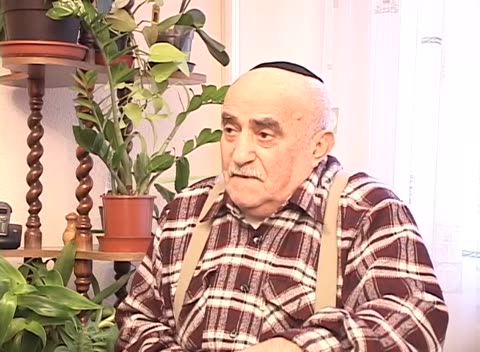
Blobshteyn provides personal information and addresses his childhood education. Blobshteyn attended a religious school (cheder) until the age of fourteen. He then did an apprenticeship in a clothing shop from 1937 to 1944.
From the machine transcript
Kerler notes the date, and Blobshteyn gives the Jewish calendar date and says he was born in Mukacheve in 1923. He lived in Mukacheve until the war. He attended cheder until fourteen, then was an apprentice and later journeyman in a clothing (confection) trade, from 1937 until 1944. He mentions that the Germans came in April 1944, the day before Passover, and that Jews were taken away the day after Passover.
Opens with the date and the Jewish calendar date, and mentions the arrival of the Germans.
Blobshteyn talks about his life during World War II, when Germany occupied Hungary in 1944. He explains how he was deported to NeuBanye 2:10, where he worked as forced laborer, building railway tracks for one year. Blobshteyn's parents and siblings were deported to Auschwitz. He was liberated in the Mauthausen concentration camp by the American army.
From the machine transcript
Blobshteyn describes being taken to a forced-labour site (the place name, which he says was in Romania, is unclear in the transcript). He and other young men born in 1923 built railway track for the Germans for about a year. He was liberated in Mauthausen in May 1945. The transcript does not clearly mention what happened to his parents and siblings in this passage.
The catalogue's sentence about his parents and siblings in Auschwitz is not clearly heard here; the place name of the work site is unclear.
Blobshteyn speaks about his life after the war. He returned from Mauthausen, via Prague, Bratislava and Pest to Mukacheve. Blobshteyn describes his short stay at a yeshiva in Pest. In Mukacheve, he reunited with his brother, who lives in America, as well as two sisters.
From the machine transcript
Blobshteyn recounts the return home from Mauthausen: first Prague, then by train via Pilsen and Bratislava to Pest. In Pest he prayed at a synagogue on Sabbath, and each returnee was given food, a place to sleep and money. In Mukacheve he met his brother, later in America, and the two sisters who had returned from Auschwitz. He then names a sister living in America, Feige Mermerstein, and says something about her husband.
Describes the stop in Pest as a synagogue visit with food and money; the yeshiva stay in the catalogue is not clearly heard.
Blobshteyn speaks about his siblings. He grew up with three brothers and three sisters.
From the machine transcript
Blobshteyn lists his siblings and their names and fates: seven children in the family, five of whom came home, two died in Auschwitz. Besides Feige (alive in America) there are brothers Wolf (Willy, died in America) and Naftali (died in Israel), and a sister Tsipre, who died in Mukacheve. The youngest brother was Berl, and another brother's Yiddish name he cannot recall. Kerler and Blobshteyn also discuss his own Hungarian and Hebrew names and double names.
Gives the siblings' names, their fates and name discussions, not only the number.
Blobshteyn talks about his family. His father was a kosher butcher and was born in Siltse. Blobshteyn's mother was born in Mukacheve. He then tells an episode of a cholera outbreak and burning of sick people during his mother's childhood.
From the machine transcript
Blobshteyn says his father David was a kosher butcher from Siltse, near Mukacheve, and his mother Sara Rivka a native of Mukacheve. His maternal grandfather came from Poland. He tells how his mother, in an earlier cholera outbreak, was said to have been hidden in an attic and sick people were burned alive, and how this gave her second name. He adds that his father, as a kosher butcher, depended on the rabbi, and that the family was large.
Names grandfather Itsik Leyb Fridman; the cholera story is told as family hearsay from the grandmother.
Blobshteyn speaks about Jewish life in Ukraine during the war.
From the machine transcript
Blobshteyn talks about Jewish families in the early 1940s, including a family with American relatives. Their journey to Kamianets-Podilskyi and a child's death in a car are mentioned. He recalls the 1941 roundup of Jews without Hungarian papers, including Polish ones, by Hungarian gendarmes, who deported them to Kamianets-Podilskyi, where they were shot. He notes a memorial there and a yearly commemoration.
Concerns the 1941 Kamianets-Podilskyi deportation and killings, and a memorial, not only 'Ukraine during the war'.
Blobshteyn speaks about his life after the war. When he returned, he began working as kosher butcher and stayed in this profession for fifty years. He moved to Budapest in 1992. Blobshteyn then addresses his childhood memories, including poverty and relations among Jews and non-Jews.
From the machine transcript
Blobshteyn says that after returning he worked as a butcher for fifty years under the Soviets in Mukacheve and then moved to Budapest in the early 1990s. He explains that Yiddish was spoken at home, Hungarian in the street, and Russian too. He describes childhood poverty, a mother who knew what was allowed to be given to Rusyn neighbors, and lack of pensions for Jews, and his father's difficulties under the Czechs.
Adds the languages spoken at home and in the street, and the poverty of the Jews.
Blobshteyn speaks about his family and Jewish life under Czechoslovak rule. His father joined the labor battalion of the Hungarian army in 1939.
From the machine transcript
Blobshteyn tells how his father, in Czechoslovak times, avoided army service because Sabbath would conflict with carrying arms, and how a friend who worked on Sabbath was in trouble. He recalls the Hungarian entry into Mukacheve and his father's call-up to a labour service in the 1940s. Blobshteyn mentions his own Russian, and Kerler and he discuss the Kleinbart family of Mukacheve and its members in America.
Adds Sabbath observance under the Czechs and the Kleinbart family; the year of the father's call-up is unclear.
Blobshteyn talks about postwar religious life in Mukacheve. He then talks about his education at the local cheder with his melamed (teacher) Friedman. Blobshteyn also attended a Russian school. He then describes his daily school routine, as well as holiday celebration, including Passover and Hanukkah, in cheder.
From the machine transcript
Blobshteyn compares postwar and present-day religious life (difficulty of getting a minyan) with the prewar cheder in Mukacheve, taught by a melamed named Fridman, with daily cheder and school hours and Hanukkah and Passover customs at cheder. Kerler asks about the languages of schooling; Blobshteyn says he attended a Russian school. Terms for the non-Jewish Christmas and New Year are also discussed.
Adds present-day minyan problems, the daily schedule and the Yiddish terms for non-Jewish holidays.
Blobshteyn talks about his childhood memories. He mentions that his mother followed rituals to diassociate her family from non-Jewish holidays.
From the machine transcript
Blobshteyn recalls his mother's practices on the non-Jewish New Year to ward off bad luck, such as placing a nail on the lard and keeping poultry shut in. He mentions the family's home slaughter of geese and the food made from liver. Kerler asks about the term for the non-Jewish New Year and Easter, and Blobshteyn recalls that the winters were snowy and cold.
Adds goose and liver food and the question about the term for non-Jewish Easter.
Blobshteyn addresses prewar Jewish life in Mukacheve. He recalls non-Jewish students in cheder. He then shares episodes from cheder routine and relationships between Jews and non-Jews.
From the machine transcript
Blobshteyn recalls prewar Jewish streets in Mukacheve, where Jews outnumbered non-Jews, and non-Jewish boys who attended cheder and whose mothers spoke Yiddish. He tells of summer lessons outdoors, the melamed napping, and boys bathing in the river Latorica. Kerler asks why non-Jewish children were in cheder, and the answer has to do with friendship. A non-Jewish neighbor and the tobacco factory are mentioned. Kerler starts a question about the father's shop.
Adds the bathing and the river Latorica, and non-Jewish neighbors' relations with the family.
Blobshteyn describes the work of kosher butchers in town. He then speaks about Rabbi Chaim Elazar Spira, who was his mohel, as well as prewar religious life. Blobshteyn describes collective matzo baking in town. He then speaks about contemporary religious life.
From the machine transcript
Blobshteyn describes the kosher butchers' courtyard with thirteen Jewish butchers under supervision, and Mukacheve's matzo baking in a dozen or so places with no machine matzo. He mentions the Rabbi Chaim Elazar Spira, his funds for the yeshiva, and a dispute over exemption of yeshiva students from military service, as well as contemporary religious life and the "Erlekh" fund (?). The English-language line and a loop at about 40:03 are recogniser noise.
Adds the butchers' courtyard, the yeshiva funding dispute and the military-exemption argument; the mohel detail is not clearly heard.
Blobshteyn addresses prewar Jewish life, including religious institutions. He then recalls the Rabbi Chaim Elazar Spira's son's wedding, as well as speaks about the Spira family.
From the machine transcript
Blobshteyn names the one yeshiva of Chaim Elazar (Spira) in Mukacheve, and bigger cheders, talmud torahs and a beis medrash, noting his late brother Wolf studied. He recalls the rebbe's son's wedding, when gendarmes beat him with rubber truncheons as he tried to run past. Kerler and he discuss Spira's family, including a daughter's daughter born on a ship, and grandchildren in Brooklyn and Williamsburg.
Adds the gendarmes' beating and the Spira descendants in New York.
Blobshteyn talks about the conditions of the cemetery in Mukacheve. He then talks about Rabbi Spira and addresses Jewish and non-Jewish relations. Blobshteyn then recalls other local religious figures.
From the machine transcript
Blobshteyn and Kerler discuss the old Jewish cemetery in Mukacheve, whose gravestones were destroyed or stolen after the war. Blobshteyn says the rebbe spoke only Yiddish and had a friendship with Czech president Masaryk. He tells of non-Jews who preferred to go to a rabbi (and not a non-Jewish authority) to settle disputes. The terms for a hasidic tsadik and an honest Jew are also discussed.
Adds Masaryk, non-Jews going to a rabbi, and the term for a righteous Jew.
Blobshteyn speaks about his life before the war. In particular, he describes journeys to Uzhhorod and Beregszász in order to watch soccer matches with friends.
From the machine transcript
Blobshteyn says he rarely left Mukacheve as a young man, but went by train or bus for football matches, to Uzhhorod and Berehove (Beregszász). Kerler and he discuss bus fares, kreuzers and the Czech crown, and Kerler asks about the Yiddish of Jews from smaller places who came to Mukacheve.
Adds bus fares and the word for the Czech crown.
Blobshteyn talks about Jewish communities in the surrounding villages. He then addresses food customs, including his mother's baking for Sabbath and fish dishes. Blobshteyn's family kept animals and therefore cooked meat during the week. Blobshteyn also mentions how his family obtained carp for the Sabbath meal.
From the machine transcript
Blobshteyn discusses Jews in surrounding villages (including the paternal village Siltse). His mother baked bread and cake for Sabbath and made plum pastries on Friday; the family ate meat in the week thanks to the father's trade and their own hens and cows. Kerler asks about dairy food, sour cream (smeyte), fish and herring, and Blobshteyn describes live carp from tanks and gefilte pike, and a Friday fish seller.
Adds poverty, herring, the sour cream term and Kerler's questions on Yiddish names.
Blobshteyn talks about prewar Sabbath celebrations at home. He then speaks about prewar Hanukkah celebrations, including food customs and games.
From the machine transcript
Opens with an exchange about Hungarian and Yiddish words, such as a term for the TV or a kind of drink (?), and the blessing after a meal. Blobshteyn then describes Hanukkah at home: goose, card games including twenty-one, dreidels, and gambling for money. He explains that children's study was forbidden on Hanukkah and on one other day of the year. Kerler's question about folk protection against the evil eye ends the passage.
opens with a short discussion of Yiddish versus Hungarian words, and mentions the ban on study
Blobshteyn addresses folk customs to avert the evil eye. He also discusses life during non-Jewish holidays. Blobshteyn remembers a non-Jewish local village idiot, who frequently came to a prayer house.
From the machine transcript
Blobshteyn describes remedies against the evil eye, including a red ribbon on children's wrists and sprinkling a child with water and charcoal. He discusses the 'bad year' and 'good year' and the nights of non-Jewish holidays, when Jews did not fear going out. He tells of a drunken non-Jew who made a disturbance in the klayzl (prayer house) one Friday night, was beaten and thrown out, and came on Monday to ask forgiveness. He ends by contrasting the hard-working boys of that time with those today.
the tale of the non-Jew in the klayzl is placed in the sequence of the evil-eye talk and non-Jewish holidays
Blobshteyn speaks about food customs at home. He then returns to food customs on Hanukkah.
From the machine transcript
Blobshteyn explains the name of a bread, apparently of Hungarian origin, and a dish eaten with it, with milk or fried onion, as food of the poor. Kerler asks about Hanukkah foods, and Blobshteyn names fried doughnut-like pancakes with jam, calling them by a name he says is Hungarian and Russian rather than Yiddish. They discuss whether the word has a k or a g. He says that turkey was eaten only at Purim.
Blobshteyn speaks about food customs on Purim and describes how he went to the rabbi to get the turkey blessed for the holiday. He then speaks about his mother's sewing, as well as spending Sabbath with family and neighbors.
From the machine transcript
Blobshteyn describes taking a live turkey with his brother to the rabbi to be blessed at Purim, and how his mother sold the turkeys after the holiday to buy shirts for the children. His mother sewed all the children's clothes on an old Singer machine. He describes Sabbath afternoons, when old women sat on benches in the street and talked, and says that girls also went to a special cheder taught by pious women. He recalls the decorative papercut (mizrekh) on the wall.
includes girls' cheder taught by women and the papercut decorations
Blubstheyn briefly talks about arts and crafts at home, before answering questions about cultural terminology. He also speaks about his parents.
From the machine transcript
Briefly discusses wall decorations in the home, including Purim items, papercuts and children's pictures, and the terms for Sabbath bread (challah versus barkhes). Blobshteyn then describes his father's place at the table and the respect given to him, including that no one sat in his seat.
the catalogue's 'cultural terminology' is limited to the term for challah
Blobshteyn recalls a religious song and then sings zemirot (Sabbath songs).
From the machine transcript
Blobshteyn recalls the Sabbath hymn he knew as a child and, at Kerler's request, tries to sing parts of it. He then sings Sabbath table songs (zemirot), with Kerler responding.
Blobshteyn speaks about prewar Purim celebrations. He describes how wealthier Jews went around with Romani musicians and performed Purim shpiels in the neighborhood in order to collect money. Blobshteyn then addresses food customs on Purim and then recalls Purim shpiels.
From the machine transcript
Blobshteyn describes Purim in his town: wealthier Jews went around with two Roma musicians and Purim players to collect money for matzo for the poor, while children went around with Purim plays and received small coins and sweets. He tells a story from his childhood about his mother hiding honey cakes and his taking the key. Kerler also asks about Purim plays, and Blobshteyn recalls the sung greetings and rewards.
includes a family story about honey cakes kept for Passover
Blobshteyn talks about traditional weddings customs. He then speaks about prewar Passover celebrations, including food customs.
From the machine transcript
Blobshteyn explains wedding customs: rich families held the wedding on Sunday, with a separate table for the poor and a jester (badkhn, 'gramer'). Two Roma musicians played at the chuppah. He then describes preparing for Passover: sewing and cleaning, making beet borscht in a large barrel, the matzo baking and cooking, and eggs. He mentions egg dishes, pickles and the Yiddish word for them.
Blobshteyn describes Sabbath food customs and then dishes in general. He also shares childhood memories of eating and drinking customs. In particular, he recalls how his religious tutor ate garlic.
From the machine transcript
Blobshteyn lists Sabbath foods, such as cholent with stuffed stomach kugel, and explains where cholent was kept at the baker's. He describes the Jewish street where he lived and typical foods, including fish, cholent, kugel, a dish called refenik (?) and plain dumplings. He tells how the religious tutor ate with his family on certain days of the week, and discusses brandy and a Passover drink called slivovitz and its kashrut. He mentions wine at Passover.
extends to brandy and wine on Sabbath and Passover
Blobshteyn addresses the prewar celebrations of Hoshana Rabbah and Simchat Torah. He then explains when children played nuts and also mentions other games.
From the machine transcript
Blobshteyn recalls Hoshana Rabbah and Simchat Torah: going to morning prayers, the hakafot with dancing, and the sale of honors for money. He then explains games children played with nuts at Passover and Sukkot, and mentions stealing nuts and a game with a spinning top.
Blobshteyn speaks about his education, specifically religious education with a private tutor and in cheder. He then speaks about childhood pranks on Tisha B'Av.
From the machine transcript
Blobshteyn talks about his religious education: the tutor in the 1930s and cheder, long hours in summer, and prayers recited without understanding the Hebrew. He says that the village melamed was chosen for being healthy and strong. Kerler asks about Tisha B'Av, and Blobshteyn explains that children threw burrs at girls' hair and beards, and a boy with long hair might have to have it cut.
adds the Tisha B'Av pranks with burrs and hair
Blobshteyn addresses prewar religious life and songs, including "Szól a kakas már." He then shares episodes about daily interactions with non-Jews.
From the machine transcript
Asked about a song on the coming of the Messiah, Blobshteyn says he cannot recall it and mentions the Hungarian song 'Szól a kakas már', associated with the Kolever rebbe. Kerler asks about a secret language used so that others would not understand, and Blobshteyn tells of a servant girl who knew Yiddish. They discuss mame-loshn as a name for Yiddish, and Kerler asks about non-Jews who became Jews.
covers a servant girl who understood Yiddish and the term mame-loshn
Blobshteyn speaks about prewar life and recalls non-Jews who converted. He then addresses postwar religious life and state persecution. Blobshteyn recalls interruptions of High Holiday services and mentions his friend, a chief police officer, who warned the community before planned antireligious activities.
From the machine transcript
Blobshteyn explains the word for a disturbance (krivaln?) and a story about a Jewish girl who left with a non-Jew, and talks about fire brigades and Jewish work on Saturday. He then speaks of religious life under the Soviets: synagogues taken, Yom Kippur services broken up, and fear of arrest. He says that his friend, the chief of the militia, warned him about planned antireligious actions, and that he was able to buy flats for his two children.
Blobshteyn speaks about his life and work after the war. He then speaks about a fellow kosher butcher, who was persecuted and imprisoned for his work.
From the machine transcript
Blobshteyn talks about working as a kosher butcher after the war. He bought meat from a slaughterhouse chief who paid in a share, and he split it with two partners. He recalls another Jew who bought a calf and brought a shoykhet, was caught and sentenced to prison, and speaks about a Jewish family who lived opposite and later emigrated to Los Angeles.
Blobshteyn talks about his family, particularly his brother-in-law who was a wedding jester. He then shows a family photograph.
From the machine transcript
Blobshteyn talks about his sister's husband, a famous wedding jester (badkhn) from Munkács who worked across America, his sister Feyge (Fayga) in Brooklyn, and her age and return home from the camp. He shows a family photograph with her sons and son-in-law. He tells about his own descendants, including a great-grandson who is seriously ill, and a visit to find a mother's gravestone near Solotvina.
identifies the brother-in-law as a badkhn and adds the photograph
Blobshteyn answers questions about cultural terminology and addresses regional language characteristics.
From the machine transcript
Kerler asks Blobshteyn terminology questions, such as the plural of rabbi and rebbetsin, and forms of address for a rabbi. They also discuss 'Litvak', and Blobshteyn tells a story about travelling to America, where he met a Hungarian-speaking Jew in a restaurant and discussed food. It ends with food and drink words.
Blobshteyn speaks about his travels to America, visiting his family.
From the machine transcript
Blobshteyn tells of a trip to America to see relatives. The passage includes his religiously observant sister, a visit to a relative named Mermershteyn (?), and a Sabbath with his brother after about fifty years apart. He also tells of a young man sent from America to Lithuania who ate non-kosher food. Kerler asks what Hungarians and Russians were called in Yiddish and whether Ukrainians had a name, and Blobshteyn answers. He then begins on the emigration of Jews from Mukacheve and Torah scrolls being taken away.
Also includes a Kerler question about names for Hungarians, Russians and Ukrainians in Yiddish, and the start of the story about the Torah scrolls.
Blobstheyn addresses Jewish life in the 1970s, when Jews from Mukacheve prepared emigration. He then answers questions about dialectology and cultural terminology.
From the machine transcript
Blobshteyn describes how, in the 1970s, Jews leaving Mukacheve for America sold Torah scrolls. Only one poor scroll was left, and he criticises the Jewish traders who sold them. Kerler then asks about words such as 'to pack' meaning to deceive, a Russian-derived word for a trick, and words for a trickster, which Blobshteyn explains. Kerler also asks about kosher meat.
The catalogue's 1970s emigration topic is confirmed; the passage mainly concerns the sale of Torah scrolls and word meanings.
Blobshteyn shares an episode from his work as kosher butcher after the war. He then talks about his family, who lived in Mukacheve after the war.
From the machine transcript
Blobshteyn recalls working as a kosher butcher after the war. A Jewish woman once bought meat that turned out to be treyf, and the episode shows how the sale was handled. He mentions that he went to pray every Sabbath. He then talks about his sister and brother-in-law, who lived in Mukacheve, and of the dwindling number of Jews after the war, and says he is now losing his sight. Kerler adds remarks about a planned visit to see him and about phone calls between them.
Also covers a sister and brother-in-law who stayed in Mukacheve, Blobshteyn's failing eyesight and Kerler's planned visit.
Blobshteyn answers questions about cultural terminology. He also talks about the contemporary community and discusses Jewish teachings.
From the machine transcript
Blobshteyn explains several terms (golem, a non-Jewish house of worship, dybbuk) in answer to Kerler's questions. He goes on to compare Christian and Jewish teaching, including the weekly Torah reading and Sunday services. They then discuss the Christian claim to be the true Jews and the origin of the Arabs. Blobshteyn also recalls a Jewish butcher who was denounced and imprisoned, and a village man he knew as a child.
Adds a long discussion of Christianity, Abraham and the Arabs and a story about a denounced Jewish butcher, in addition to the terminology questions.
Blobshteyn speaks about prewar religious customs. He then shares a family episode, where his father, uncle, cousin and he went to see a rebbe in Keretsky to find help for his cousin. Blobshteyn explains that the rebbe cut his cousin's hair and he was able to walk out of the religious school (cheder) building afterward.
From the machine transcript
Blobshteyn recalls a rebbe in a village called Keretski (?) near Svalyava, to whom they took a sick boy, a cousin of his, along with his father and uncle. The rebbe had the child stand up and walk and, after three weeks, cut his hair so that he could go to cheder. He then describes Svalyava, where a cemetery lies on a hill and almost no Jews remain; two were left, one of whom died and the other left for Israel. Kerler asks for a further story or a song, and Blobshteyn says he remembers nothing and gives a brief remark on Hasidim and the rebbe.
Adds a description of Svalyava and its cemetery today, and Kerler's request for a song.
Blobshteyn recalls Yiddish songs from his childhood, as well as speaks about contemporary Sukkot celebrations in America. He then remembers Simchat Torah celebration in prewar Mukacheve.
From the machine transcript
Blobshteyn says he does not remember any songs, after Kerler asks. He describes lively dancing at Sukkot among pious Jews in America, where he has many friends. He recalls Simchat Torah in Mukacheve, where they formed circles and danced with three or four Torah scrolls while many children danced. Kerler then asks about a Yiddish periodical from Moscow.
Adds that the passage opens with Kerler's question about Zionist-youth activity in an attic and ends with the start of the question about Yiddish periodicals.
Blobshteyn talks about prewar Jewish press in Mukacheve. He then addresses his life during the Soviet period.
From the machine transcript
Blobshteyn talks about a journal and a newspaper in Mukacheve, saying there was a Yiddish one and that they mostly read Hungarian papers. They also discuss whether any Yiddish periodical appeared after the war. He then describes owning television sets in the 1960s, when he worked in an organization he calls Vinterak (?), and having three rooms. Kerler thanks him at the end of the visit.
Adds television and the owning of sets in the 1960s, and the closing thanks, to the press topic.