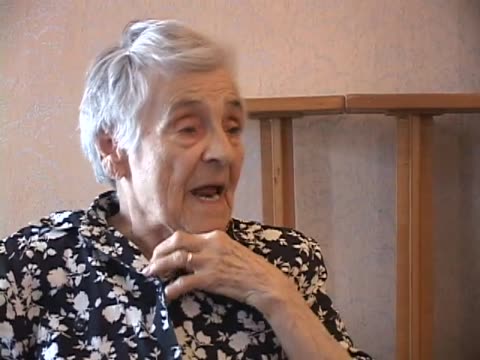
Freundlich addresses linguistic questions and then talks about her family. Her father owned a store in Satu Mare. Freundlich also recalls the moment her grandfather passed away. Freundlich maintains that her grandfathers gave her a Torah when she was a child.
From the machine transcript
Opens with a short exchange on Hebrew versus the holy tongue and the Judaic studies department. Freundlich gives her Yiddish name and talks about her father's family: her father was a merchant with a shop in Satu Mare and had studied in Pressburg (Bratislava) with his brothers. She recalls in detail her grandfather's death on a Friday in Hanukkah (a year in the 1920s is heard) and his funeral. She mentions the rabbinic Weisz/Welz family connections and her grandfathers donating a Torah scroll.
adds her Yiddish name, the rabbinic Welz family and the grandfathers' Torah donation
Freundlich discusses prewar religious life and the activities of her family.
From the machine transcript
Freundlich describes her father's religious life in Satu Mare: the seats he held in the Hasidic and other prayer houses, the garden he donated for the Bixad rebbe's beis midrash, and his daily attendance at prayer and study. She talks about the Talmud volumes in leather bindings in the family library, and about the dowry gifts he gave his four daughters. Kerler asks about who studied with whom, and the passage ends with a Hungarian aside.
Freundlich speaks about Jewish life today.
From the machine transcript
Freundlich talks about a recently built synagogue in a Hungarian town, reported on television and attended by the chief rabbi of Hungary, and about a speech by the mayor. The passage is partly garbled and includes Hungarian side remarks on the synagogue's purpose, and Kerler comments on the interviewee's Yiddish.
specifies that the passage concerns a new synagogue built in a Hungarian town
Freundlich discusses her childhood memories and holiday celebration at home. She also addresses her family's fate during World War II.
From the machine transcript
Asked what she remembers of childhood in Satu Mare, Freundlich describes a strictly observant home with honest Sabbath keeping and simple parents. She tells of her parents' and siblings' deportation, a married sister deported with her husband and three children, and her youngest sister now seriously ill in a hospital in the United States (Florida/New York).
Freundlich addresses the differences of Hasidic groups before the war and her father's affiliation.
From the machine transcript
Freundlich explains that her father did not follow a certain Hasidic rebbe (R. Yoyle, the Satmar rebbe) but went to the Bixad rebbe, and why he disapproved of the other's customs. She recounts a story of Emperor Charles passing through Satu Mare and the religions coming to bless him, with her father's comments.
adds the story of the emperor's visit and the father's reasons for following the Bixad rebbe
Freundlich speaks about food customs on Sabbath.
From the machine transcript
Freundlich lists Sabbath food at home, including fish, soup, meat and plum compote, and discusses the word for plums. She speaks of her father's custom of bringing a poor guest home for the Sabbath and of the Bixad rebbe's austere eating. There are Hungarian side exchanges about acquaintances in Cluj.
Freundlich mentions Rabbi Moshe Schonfeld who left Cluj in 1958. She then talks about her family.
From the machine transcript
Freundlich mentions a rabbi (Schonfeld) who left Cluj in 1958 and how her own family applied to emigrate and was harassed. She talks about her children: a son and a daughter in Canada and Israel, a grandson, and a daughter who is a piano teacher and a leader of the Jewish community. She speaks of her husband's grave, a memorial in Satu Mare for her parents and sister, and her father's saying on keeping a Jewish name.
adds her children and grandson, a memorial in Satu Mare and the Canada emigration
Freundlich shares her recipe of gefilte fish.
From the machine transcript
Kerler asks whether gefilte fish was eaten on Sabbath. Freundlich answers that she now makes fish in aspic, shows a photograph from her grandson's bar mitzvah and discusses the name for the dish in different languages.
Freundlich talks about Passover celebrations at home before the war, in particular seder and food customs. She then shows family photographs.
From the machine transcript
Freundlich describes the seder at home before the war, which lasted until morning, with counting of the omer the next night, and the Passover foods. Kerler asks about the Yiddish word for 'to try' (prombirn). The rest of the passage is Hungarian talk about photographs and her grandchildren's musical careers, with Kerler asking to copy them on camera.
adds the Hungarian talk about photographs and the grandchildren's music
Freundlich talks about her lessons with a female Yiddish teacher, as well as her school education. She also mentions her sister's letter press (Klein's printing press), printing Hebrew letters, black letters and the Latin alphabet.
From the machine transcript
Freundlich says a governess taught the daughters at home, while the sons went to cheder, and that she did not read Yiddish books but read Bashevis and Holocaust literature in Hungarian. She learned German at school and mentions her sister Hinde's husband Klein, who ran a bookshop and printing press in Kisvárda (?) that printed Hebrew, Gothic and Latin letters.
Freundlich talks about life today.
From the machine transcript
Freundlich says that no Jews are left in Kisvárda and the surviving Hungarian Jews are in Budapest. Kerler asks about the meaning of the Hungarian expression she uses. She then talks about the chief rabbi of Jerusalem and the closing of women's sections, and about a Sabbath meeting at which she was asked to attend.
Freundlich speaks about her family life before the war. Her family conversed in Hungarian during the week, but, Freundlich maintains, on Sabbath they only spoke Yiddish. She also addresses Purim celebrations and costumes.
From the machine transcript
Freundlich explains that at home the family spoke Hungarian on weekdays but only Yiddish on Sabbath, and that everyone knew Yiddish, the mother tongue. She describes her father's Purim meal and the Purim play, with youths dressed as women and a Purim rabbi, the charity given, and says she has a Hungarian translation of the megillah.
Freundlich shows her Megillah, she brought from Satu Mare.
From the machine transcript
Freundlich and Kerler look at a Megillah. It is from Satu Mare and was read at home by her father; the details are only partly clear. A long, garbled stretch in Hungarian and Yiddish follows about a bishop who was driven out of the town for condemning killing. Kerler then asks about books printed at the local printing house.
The passage also includes a story about a bishop driven out for speaking against killing.
Freundlich talks about her sister's printing press, including local books and journals.
From the machine transcript
Freundlich talks about her sister's printing house in Satu Mare. It printed the town newspaper, toys, books, prayer books and other items, in Hungarian, Latin and Hebrew scripts. She mentions a book by her brother-in-law and a Hungarian children's tale, and then her son's invitation to the Metropolitan (Opera) in New York.
Freundlich talks about her son's career. She also addresses her son's circumcision in 1956.
From the machine transcript
Freundlich mentions her son as a singer who performed at the Metropolitan, and a radio interview with her. Kerler asks about Jewish weddings. She talks about her son's circumcision in 1956, which was held at home with a rabbi because few Jews were left. She also mentions his bar mitzvah meal, to which the non-Jewish officials did not come.
The passage also covers her son's bar mitzvah meal.
Freundlich speaks about prewar traditional weddings in Satu Mare. She also interjects episodes about contemporary Jewish life.
From the machine transcript
Freundlich recalls prewar Jewish weddings with the 'mitzvah dance' and the hired announcer. She then talks about relatives in Várdan (?), about Jews left in Satu Mare and Cluj and the community's problems. She goes on at length, partly in Hungarian, about her husband's family (Weinstock) and their business, an uncle in Nyíregyháza who was head of the Judenrat, and a minister who helped them. Kerler also asks about a humorist who was paid to amuse guests at weddings.
The passage also includes a long Hungarian account of the husband's family business and its wartime fate.
Freundlich talks about life today. She then speaks about her babysitter in Satu Mare, who taught her Yiddish songs. She also addresses a contemporary wedding.
From the machine transcript
Freundlich speaks about life today and Hungarian radio, saying she can no longer sing. She then recalls her nursemaid from Maramureș, a Ruthenian-speaking woman who taught her Yiddish songs and refused to wear shoes on Shabbat. She also talks about wedding customs and a choir led by her daughter, and says that nowadays only Purim songs are sung.
The passage also includes the explanation of the word for a nursemaid and the choir.
Freundlich mentions Passover songs. She then addresses contemporary Jewish life.
From the machine transcript
Freundlich mentions songs sung at Passover and a haggadah she gave to her grandchildren. The talk turns to people from the community who are still alive, and to the lack of a minyan in Satu Mare. She goes on in Hungarian about the Jewish population of the region, the ghettos and rabbis driven out of Székely towns, and a landowner's fate. The latter part is in a long Hungarian monologue about the Weinstock family dryer and a minister.
The catalogue's 'contemporary Jewish life' is only partly visible; the transcript shows mostly Hungarian monologue on the region's Jews and her husband's family.
Freundlich talks about traditional dances. She then speaks about her family, in particular her grandfather's observant life.
From the machine transcript
Kerler asks about the 'brogez' dance and other dances, and Freundlich explains that it is a comic dance done on happy occasions and distinguishes it from the mitzvah dance. She speaks about her grandfathers: one was a regular visitor to the Belz rabbi, and the other gave a Torah scroll. She also describes her daughter's religious teaching of women in English and Hebrew, and a visit to Jerusalem.
The passage also includes her daughter's teaching and a Jerusalem visit.
Freundlich answers questions about cultural terminology and mentions prewar religious family life.
From the machine transcript
Freundlich answers Kerler's terminology questions on what 'a good Jew' means, and on words for a non-Jewish cemetery, a church and Christmas. She says her maternal grandfather went to the Belz rabbi, her father was observant without Hasidic dress, and he ran a grocery and ironware shop that was closed on Sabbath and holidays. At the end she talks about Jewish studies at the university.
The passage also has her father's occupation and a note on the university.
Freundlich talks about contemporary Jewish Studies and her education. Freundlich attended a Hungarian school. She then recalls book sales during her childhood.
From the machine transcript
Freundlich talks about Jewish studies students at the university today and the languages taught there. She says she went to a Hungarian school and learned Romanian later, when her children began school, and that Hungarian is her better language. She recalls the Hungarian book days in July and the bookshop of her sister, with authors signing autographs.
The passage also covers her language preferences.
Freundlich answers questions about cultural terminology and talks about prewar religious life, as well as shares religious anecdotes.
From the machine transcript
Freundlich answers questions about the difference between a rav and a rebbe, and says that only the rav was recognised and paid by the state. She tells how a rabbi shaved on a day when it was forbidden because he was asked about it. She also tells a story about a man who built two prayer houses, and answers questions on Ashkenazi prayer and the women's prayers, which were sung beautifully.
The passage also has two religious anecdotes and the Ashkenazi/Sephardi question.
Freundlich addresses a contemporary performance of the Dybbuk in Cluj-Napoca. She then answers questions about cultural terminology.
From the machine transcript
Freundlich answers Kerler's question about a Dybbuk play performed recently in Cluj. Kerler asks the meaning of 'golem' and of 'baal shem', and she answers briefly. She mentions a professor, Abraham Braham (?), who wrote a book on the Holocaust in Hungarian and came to Cluj.
The passage also includes a Hungarian-language book on the Holocaust by a visiting professor.
Freundlich speaks about the prewar religious tradition for women.
From the machine transcript
Kerler asks about women's prayer. Freundlich explains that women read the techines at home and the tsenerene in Yiddish, and that the techines were in Hebrew with translation. She says that women sat in a women's section at the synagogue and listened to the cantor. She then talks, in Hungarian, about a CD of her radio interview in Hungarian.
Freundlich shares prewar anecdotes. She then talks about contemporary memorialization in Gheorghe Gheorghiu-Dej.
From the machine transcript
Freundlich tells jokes: two Jews and a baker and a tailor, and a competition among forest animals. Kerler asks the Yiddish word for a monument. She says she was at a memorial and a Jewish monument in Dej (?) and visited the site of a mass killing of Jews, and a pilgrimage with a Swiss visitor. The place is partly unclear in the transcript.
The catalogue's memorialization topic appears, but the place name is unclear in the transcript.
Freundlich visited Auschwitz in 1969, where she was imprisoned during World War II. She then sings a Yiddish song about departing for a long journey, before returning to her Auschwitz visit experience.
From the machine transcript
Freundlich says she visited Auschwitz in 1969. At Kerler's request a Yiddish travel song about taking food for a journey is sung, apparently by another woman. Freundlich then speaks, partly in Hungarian, about Satmar, a mass killing and burial in a pit, and a history professor in Jerusalem originally from Satmar whose father was a shochet.
The song is sung by another voice, and Freundlich also talks about Satmar and a professor in Jerusalem.
Freundlich sings a Sabbath song, her father sang at the rebben's tish.
From the machine transcript
Freundlich describes a Sabbath table song sung at the rebbe's tish, which her father attended, and a woman's voice sings it. Kerler asks when the earlier travel song was known; Freundlich recalls a priest from Leipzig who taught Jewish history and a conversation about the mezuzah. The passage ends with Hungarian talk about a klezmer band in Budapest.
Includes a story about a priest teaching Jewish history and the mezuzah, and talk of klezmer.
Freundlich answers questions about cultural terminology and talks about prewar religious life.
From the machine transcript
Kerler asks about terms such as converts to and from Judaism, and Freundlich answers about whether Satmar had converts and about apostates. Much of the second half is Hungarian talk among the others.
Freundlich discusses contemporary Jewish life.
From the machine transcript
Freundlich and the others discuss Jewish life today in Bistrița and Cluj: whether anyone is left in Bistrița, a planned trip there, and contacts with community members. Much of the passage is Hungarian talk about street names, the synagogue and community office in Cluj, and arrangements for the visitors.
Freundlich answers dialectological questions from the AHEYM Yiddish linguistic questionnaire. She then addresses folk and healing customs. Freundlich explains how to avert the evil eye.
From the machine transcript
Kerler elicits how to say 'pour a glass of wine', after which he asks about older women's remedy against the evil eye. Freundlich explains the cure with bread crumbs or coals counted into a glass of water, with salt and a formula, and the water poured at the door.
Includes the evil-eye cure.
Freundlich talks about contemporary Jewish in surrounding towns. She also addresses cultural terminology.
From the machine transcript
Freundlich and others discuss the few remaining Jews and their lack of interest in Yiddish or Jewish life in Cluj, Bistrița, Târgu Mureș, Timișoara, Oradea, Satu Mare and Sighet, with much of it in Hungarian. Kerler asks about community presidents and places to visit. There is also a story of a wedding and a Passover seder that needed thirty people, a Yiddish term asked by Kerler, and a story about declaring Yiddish as mother tongue under Ceaușescu.
Includes talk of other towns, a wedding and the seder, and Ceaușescu.
Freundlich speaks about census questions during the postwar Soviet period.
From the machine transcript
Freundlich recalls the census question about mother tongue: nobody answered Yiddish, though some did later, and she could not deny being Jewish. Kerler then asks about a name, Avraham Yankl, which Freundlich says was a Wallachian nobleman. The passage ends with Hungarian talk about visitors from Indiana University.
Concerns the mother-tongue question and the name Avraham Yankl, not the Soviet period.
Freundlich answers questions about cultural terminology and speaks about life today. She also addresses Yiddish-speaking communities in the region before the war.
From the machine transcript
Kerler asks about yeshiva terms such as hoyz bokher and khazer bokher, and Freundlich explains them. Hungarian discussion about community leaders and visits follows. Freundlich states that in Timișoara, Oradea, Cluj and Bistrița people did not speak Yiddish, unlike Satmar, and Kerler discusses sending a recording by post and planning a further session.
Includes talk of the Yiddish-speaking regions and postal arrangements.
Freundlich speaks about her husband and singing activities. She then sings a Yiddish song about remembering the mother.
From the machine transcript
Freundlich says she was a soloist and that her husband was a precentor. A woman sings a Yiddish folk song about longing for the mother, and Freundlich then tells of a Hungarian-language theatrical production of Shir HaShirim that she criticised.
Freundlich talks about contemporary performances of Shir HaShirim. She also mentions a song about the time when messiah comes.
From the machine transcript
Freundlich talks about Shir HaShirim as a folk song, which she says was sung in Yiddish and Hungarian and which she recited in Hungarian. Kerler asks what she remembers of it in Yiddish, and she also recalls a Hungarian song about the messiah's coming. The passage ends in Hungarian talk about a hospital.