People › Klara Meerovna Antsis › conversation

Klara Meerovna Antsis

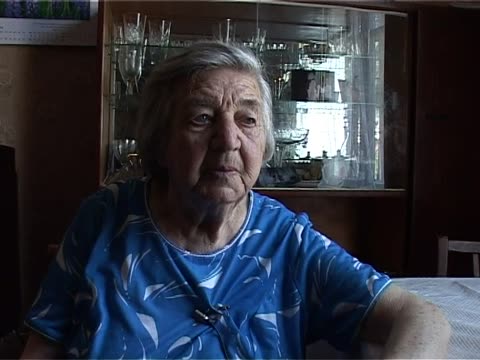
Zhytomyr or Berdychiv 10 July 2002 Interviewed by Dov-Ber Kerler, Dovid Katz, Jeffrey Veidlinger, Anatolii Kerzhner 2.0 h · 3 parts on 3 tapes proposed
Loading the player…
  1. MDV 790 0:00–40:58 · 41 min · not online — MCO
  2. MDV 791 0:00–39:27 · 40 min · not online — MCO
  3. MDV 792 0:00–41:28 · 42 min · not online — MCO
Passages
MDV 790 0:00–40:58

0:00

Team discussion.

From the machine transcript

The interviewers confer among themselves about which questions from the questionnaire to put to the informant and which to leave out. Kerler then turns to her with a question about where her mother was born.

1:36

Family and childhood memories.

From the machine transcript

Antsis says she does not know where her parents were born. Kerler asks her to speak Yiddish, and she says she knows Russian well. She recalls Lyubar and a girlfriend from school who was very poor, with whom she shared her bread and butter; the friend once reproached her for eating the second piece. They spoke Yiddish at school.

Kerler's request that she speak Yiddish and the language of her friends

4:40

Education at schools.

From the machine transcript

Antsis answers questions about her schooling: the Yiddish School No. 3 and the name of its director (unclear in the transcript). She studied for seven years, and then at a technical school in Zhytomyr. She recalls how her mother, after the move to Zhytomyr, sold cigarettes (papirosn) at a stall on Malovinska (?) street.

her mother's work selling cigarettes in Zhytomyr

7:12

Prewar life in Lyubar.

before the war Daily life (general) MDV 790 · MCO
From the machine transcript

Kerler asks Antsis to describe the town of Lyubar. She names trades such as shoemakers, cobblers, tailors and smiths, and the Yiddish and Ukrainian words for them. She also talks about two wealthy men, one named Katz, who left when the war began, and about the local doctor Refild (?). She remembers the cinema in town and a film about going to Birobidzhan, and the conversation turns to the Yiddish words involved.

the trades, the doctor and the cinema, and word elicitation

13:38

Prewar religious life and kheyder.

From the machine transcript

Antsis recalls the three synagogues of Lyubar, and a bathhouse with a mikveh. Her mother learned to pray from her own father, and Antsis recalls her reading aloud at Yom Kippur while the women wept around her. She remembers learning the Modeh ani prayer, her mother blessing the Sabbath candles, and being taken to kheyder for a few months at about three or four years old, led by a helper (a belfer). She also remembers her father working and Sabbath observance.

20:27

Food customs.

From the machine transcript

Antsis answers questions about Sabbath food in her parents' home, including kugel with a stuffing (a so-called mamzer), kishke, and fresh carp. She remembers her mother preparing gefilte fish, though she says she herself has not made it for a long time.

23:55

Dialectology.

From the machine transcript

Antsis answers Kerler's questions from the Yiddish questionnaire, with some contributions from Katz. Items include the words for Jew, table, bed, mouse, cat, dog, sun, dove, numbers such as ten, and a deaf person, along with phrases such as 'my son', 'all together', 'everything' and 'one and a half'. She remarks that she forgets words, speaks Yiddish with others on Sundays, finds reading Yiddish hard, and has a view on Lithuanian Yiddish. She also comments on being the only Jew in her neighborhood or building.
39:50

Passover celebration.

From the machine transcript

Antsis answers questions about Passover in Lyubar. She says she does not keep it herself now. She recalls baking matzo, the separate dishes and table for the holiday, matzo meal and kugels, and the large crowd that came to the matzo bakery.

MDV 791 0:00–39:27

0:00

Passover celebration and other holidays.

From the machine transcript

Kerler asks Antsis about the Passover seder: what was said and done, the four questions, and the afikoman. She does not remember these, as she was only a child, and mentions her father's early death. They then turn to Hanukkah: Hanukkah gelt and what was eaten, with latkes discussed and a mention of buckwheat flour. She remarks on how clearly she remembers early years while forgetting recent things.

Includes Hanukkah foods and gelt, and her remarks on memory.

2:54

Dialectology.

From the machine transcript

Dialectological questionnaire. Kerler asks how Antsis says various words, including colours (grey), words for wealthy man, rich and gevir, and Purim baked goods (hamantashn). Other items are a wagon and carts, a boat, 'toves' (?), a fool and its plural, and the word 'lehavdl'. She answers some items and says she has not heard others in a long time.

11:01

Travel of team.

Informal MDV 791 · MCO
From the machine transcript

Kerler tells Antsis the team is travelling to Berdychiv today after the interview. She remarks that some Jews still live there, and they briefly discuss whether Zhytomyr belongs to Podolia or Volhynia.

12:13

(missing index details).

From the machine transcript

A short break is arranged: the team leaves the equipment while Kerler goes outside for a smoke and Antsis says she will rest, with talk of resuming in ten minutes.

12:48

Childhood memories and family.

From the machine transcript

Antsis talks about her childhood friend Manye (Shabes?), sharing the bread and butter her mother packed for school and a quarrel over a forgotten sandwich. She also names other Jewish friends from Lyubar and talks about her family: her only son died, her brother and his son are dead, and a granddaughter (of her brother) and her two children live in Zhytomyr. She mentions a relative in America and a niece who writes to her, and begins to say that she receives help locally.

Adds her other friends from Lyubar, the death of her son, and relatives in Zhytomyr and America.

18:14

Life today and family.

From the machine transcript

Antsis describes the help she receives today. Meals are brought to her all week, young people come and assist her, and Hesed picks her up once a week for the bath and a social gathering. She says she loves being among people and prays for her health and that of her relatives, recalling how her sister died in her sleep. She ends by saying that many Russians helped Jews during the war.

24:05

Informal chat and life today.

Informal life today Life today MDV 791 · MCO
From the machine transcript

Kerler asks the Yiddish name of a plant, and Antsis says there is none and gives the Russian one. Kerler says he was born in Moscow and that the team is making an archive of films of elderly people who remember Yiddish. She says her own children do not speak Yiddish, but her niece does. She also complains that her pension is small, speaking of the difficulty of life and fate, and then starts recalling Lyubar with its rain and big puddles.

Includes the plant-name question, the language of her children, and her pension.

29:21

Childhood memories from Lyubar.

before the war Childhood MDV 791 · MCO
From the machine transcript

Antsis continues with childhood memories of Lyubar: boards laid across puddles, and in summer villagers singing at night in the surrounding villages. She describes Lyubar as a poor little town and begins to be asked about what kind of Jews lived there.

30:50

Refugees during war.

during the war World War II (general) MDV 791 · MCO
From the machine transcript

Antsis recalls refugees who came to Lyubar, in 1939 (?), and lived with her family, her mother giving them a room. Life was hard, and she speaks of the war as a blow to the whole Jewish world. She switches briefly into Russian and wants to continue in Yiddish.

32:22

Yiddish literature and cultural life.

From the machine transcript

Asked about Yiddish writers and theater, Antsis says the family read Sholem Aleichem, and that on Sabbath neighbors gathered while her mother read aloud and people laughed. She recalls a Sholem Aleichem story about a poor wedding and a rich one. Young people put on plays at her grandfather's house, and the grandfather traded goods from Berdychiv. A gramophone in the house frightened her.

Adds Sholem Aleichem readings, the grandfather's trade, and the gramophone.

36:51

Electricity.

From the machine transcript

Asked whether there was electricity, Antsis recalls the great joy when it was first installed. She retells her mother's story of the local man who understood electricity and wired the town, and whom people paid with eggs and butter to repair it. She mentions he was Jewish and an early Komsomol member, with a name that sounds like Shirovski (?).

38:54

Returning into apartment.

Informal MDV 791 · MCO
From the machine transcript

Kerler and Antsis arrange to go back inside the apartment so the team can look at her books.

MDV 792 0:00–41:28

0:00

Yiddish books.

From the machine transcript

Antsis says she wants to find Yiddish books and that few are left. Kerler asks about stories by Soviet Yiddish writers from the 1950s–60s. She says she used to read newspapers and books, and that reading helps her forget herself. Kerler thanks her warmly.

Kerler asks about Soviet Yiddish authors, and the transcript shows her reading habits rather than only a search for books.

2:04

Concluding the interview.

From the machine transcript

A man asks Antsis whether she has relatives in Kyiv. She says she has none: her relatives are all in Israel or America. He explains he only knew a man in Kyiv with the same surname, and the interview is closed with thanks.

Relatives all abroad, and the question about Kyiv relatives.

2:57

Outside shots of Antsis’ house and neighborhood and Russian explanation of the project.

Footage MDV 792 · MCO
From the machine transcript

A Russian-speaking member of the team (Petr Ivanov, per the catalogue) explains the project to the camera. It is an expedition of Indiana University with Dovid Katz and Dov-Ber Kerler, covering Kyiv, the Vinnytsia region and Zhytomyr, and begun some ten years earlier. It started from nothing, without transport, equipment, money or contacts, and developed a working method for building an archive of older people's speech and folklore. Afterwards a few remarks are made about photographing the house.

The speech is a Russian account of the project's history and method.

8:13

(Not Described).

From the machine transcript

At the synagogue a man who says he is American, from near New York (Monsey), talks with the team about finding old Berdychiv Yiddish speakers. He mentions a phone call, a local Berdychiv Jew named Iakov (Yasha) Shor, and says the team wants a local Jew rather than a Litvak. They discuss a minyan the next morning at nine, getting the shul opened, and hotel arrangements.

13:00

Finding Yiddish-speakers in Berdychiv.

Informal life today MDV 792 · MCO
From the machine transcript

Conversation in Berdychiv about the Jewish community today, apparently with the rabbi: about five hundred Jews remain out of a city of some ninety thousand, where Jews were once the great majority. Other topics are the hotel and its water supply, a song attributed to Avraham Fried, old synagogue items, a visitor's family from Slovakia and Skver, and plans for travelling on.

13:00

Tour of the synagogue in Berdychiv (check begin time).

Tour life today Synagogue and prayer MDV 792 · MCO
From the machine transcript

Same stretch as the preceding passage: talk in and around the Berdychiv synagogue about its old furnishings and how much of it is old. Also about the small Jewish population today, an American visitor's papers and visa, and the schedule for travel to Zhytomyr. The transcript does not clearly show a guided tour.

24:55

Town footage of Berdychiv.

Footage MDV 792 · MCO
From the machine transcript

Mostly background talk over town footage of Berdychiv, fragmentary: days of the week and Sabbath, a stay in Zhytomyr, distances by road, and a building that looks like a synagogue.

31:32

Biographical introduction and family.

From the machine transcript

The interview with Shor opens. The people present compare their origins (parents from Rogachov in Belarus, a Litvak's Yiddish, a team member born in New York), and Kerler states the date and place. Shor gives his name (Yosl/Yosef) and his father's name (Hershl), and the family name Shor (Hebrew for ox). He was born in 1926 in Orhei (Urive in Yiddish, Moldova), and his mother Feyge came from Telenesht. His only sister Rive died at nine, and the family spent about three war years at Stalingrad. His father was a trader, with the item (eggs or hay) unclear.

Also the preliminary talk about origins, Litvak Yiddish, Shor's birth year, and his sister and father's trade.

Questions put in this conversation

Items of the dialect questionnaire asked here; each link plays the moment.