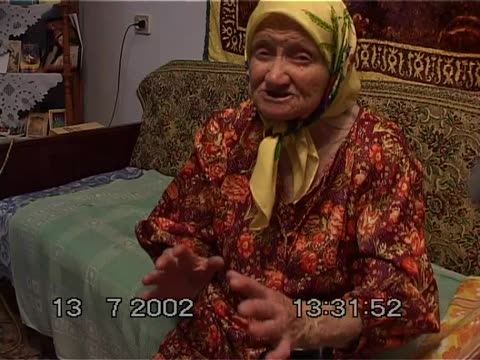
Conversation with Chirkova
From the machine transcript
Chirkova talks about her family, including a grandchild named after her brother, and complains about neighbours and her treatment. She mentions the deaths of her parents and grandparents, a relative in America and her own operations. Kerler asks whether the team can come to her home.
Entering Chirkova’s home and setting up interview
From the machine transcript
The team enters Chirkova's flat and sits down in the kitchen. She starts showing things on the wall and explaining photographs. Kerler asks about her books.
Life during war
From the machine transcript
Chirkova explains photographs on the wall, including one sent from America. She says her brother fought at the front and was captured. She also mentions a sister who has died. Another voice asks what Yiddish books she has, and she offers a book.
Chirkova provides personal information.
From the machine transcript
Kerler records Chirkova's name, patronymic and surname, and they work out how the surname Chirkova is to be spelled and pronounced. She gives her maiden name Kleyman and a birth date of April 1912, and says she will tell the story of why she bears this name.
The passage is mostly about the spelling of her name and surname, with her birth date and her maiden name.
Chirkova talks about her return to Vinnytsya after World War II. She then continues to provide personal information, before she briefly speaks about her life before the war.
From the machine transcript
Chirkova names her birthplace as Krasne in the Tyvriv district (?) of the Vinnytsya region and says she finished a seven-year Yiddish school there. Kerler asks the Yiddish and Russian names of the place and the spelling of her Yiddish name Beylle, and begins to ask for her address.
The return to Vinnytsya is not clear in this stretch; it is mostly about birthplace, district and schooling.
The team formally introduces Chirkova and she provides more personal information. She then addresses her family. Chirkova's parents were also born in Krasnoye. Her father was the local rabbi and her grandfather was a cantor.
From the machine transcript
Chirkova gives her maiden name Kleyman and her birth in Krasne in April 1912, and says she lived there until the war. She names her parents, Simkhe and Rivka, and says they were also born in places in Poland (?) whose names are unclear. Her father was a rabbi and her grandfather a cantor, whose name is given as Shmuel (?).
Chirkova speaks about her family, particularly her grandfather's fate during World War II. She then tells the history of the local Jews' fate during the war, before she says a personal prayer thanking God for her survival.
From the machine transcript
Chirkova speaks of her grandfather, who was tormented and killed during the war, and of Jews of the ghetto who were forced to dig their own graves and thrown in alive. She says she returned with her son and was helped through the ordeal, and she speaks of God keeping her alive. She also mentions an album of pictures about the Jews and the people who came to take things.
Chirkova shares insights about her strong Jewish identity, before she talks about contemporary visitors and the support she receives from the state pension.
From the machine transcript
Chirkova speaks about her Jewish identity and her readiness to do anything for Jews, and about visitors who come, including people going to America. She also describes preparing young people for work abroad and receiving money from them and support from the state. The details are unclear in the transcript.
Chirkova briefly speaks about her life after the war. She worked as a nurse. She then discusses her family and friends that passed away.
From the machine transcript
Chirkova speaks of her work after the war, apparently with invalids, and of her friends and relatives buried in a cemetery in Vinnytsya. She describes arranging the burial of a man in a prayer shawl and tefillin and her sense of having done what was needed.
Chirkova shows her military awards. She then talks about her life today.
From the machine transcript
Chirkova speaks about her awards and medals and her service at the front, and about her poor hearing. She complains of her health and difficulty moving around, and Kerler suggests she get a new hearing device.
The catalogue says she shows military awards; the transcript is mainly about the medals, her hearing and her health today.
Chirkova speaks about her life before the war. She finished seven years of schooling, before applying to a technical institute. She also speaks about her family and bribing during her educational years. Chirkova also discusses keeping her faith.
From the machine transcript
Chirkova describes applying to a technical institute and meeting Stalin (?) or an official about it, and how gifts were given to a duty person to get things done. She says God records everything a person does, speaks of a trial of her factory director over goods sent to the front, and mentions Uzbekistan and her parents' death there. The account is difficult to follow.
Chirkova talks about her family and parent's graves. She then speaks about her life after the war, when she graduated from the pedagogical institute in Vinnytsya (Вінницький Державний Педагогічний Інститут ВДПІ). Chirkova also shows a present from the institute.
From the machine transcript
Chirkova speaks of her parents' graves and her studies at the institute in Vinnytsya. She says she was told Jews and Jewish schools were not needed, and mentions a gift from the institute on its eightieth anniversary. Kerler tries to steer her to his own questions, beginning with what her mother did in Krasne.
Chirkova speaks about her family, particularly her mother. She grew up with two sisters and two brothers. Chirkova then explains her mother sold her children to a Ukrainian female neighbor to avert the evil eye.
From the machine transcript
Chirkova says her mother did not work outside the home but looked after the children. She names her siblings, brothers Yosl and Yankl and sisters Sonya (?) and Basya, with herself the youngest of five, and says many boys died. She tells of her mother's custom of selling children to a Ukrainian neighbor against the evil eye, and of the brother in Moscow.
The catalogue says two sisters and two brothers; she names three sisters including herself and two brothers.
Chirkova explains a folk custom by stringing pebbles to a leather band to put around the neck to avert the evil eye. Her mother learned it from an older Christian woman to avoid selling her daughter. Chirkova states that she wore the necklace until better times.
From the machine transcript
Chirkova describes the folk custom against the evil eye of buying seven needles from seven shops, in which they were stuck into a leather strap or cord. The strap was hung round her neck, apparently to be worn until better times. Kerler asks how the needles were set, and she says it was the mother who bought a house for the Russian woman.
The catalogue says pebbles; the transcript speaks of needles stuck in a leather strap.
Chirkova speaks about her family's life and Christian acquaintances before the war. She then addresses her father's work as forwarding agent, before she talks about her life today. Chirkova also describes contemporary antisemitism.
From the machine transcript
Chirkova speaks of the non-Jewish woman to whom the children were sold, who gave her gifts and attended the wedding, and who knew some Yiddish and told her about life. Asked about her father's work, she says he was a rabbi and also an expediter who traveled to villages buying goods. She then complains about her situation today and about a Gentile who treated her badly, and confronts a woman over her wartime conduct.
Chirkova addresses prewar religious life, particularly occupational synagogues.
From the machine transcript
Chirkova says her father prayed in the beth midrash in Krasne and that craftsmen such as shoemakers and tailors had their own synagogues. She puts the number of synagogues at two or three, and cannot recall the name of her father's.
Chirkova speaks about her life after the war. She taught dance to children for six months. Chirkova then talks about prewar religious life in Krasne, before addressing postwar life, as well as life today.
From the machine transcript
Chirkova speaks about teaching in a dance class for children for about six months, and Kerler asks whether her parents took her to synagogue in Krasne. She mentions separate prayer groups of the shoemakers and tailors and answers questions about Hasidim in the town. She then moves to her postwar working life, studies and a long, partly unclear story about an illness and treatment.
adds Kerler's questions about Hasidim and opponents in Krasne and a story about an illness and treatment
Chirkova speaks about religious customs and prayers.
From the machine transcript
Kerler asks Chirkova whether she remembers prayers and how she prays; she says she prays and knows the books in Yiddish. He asks her to recite the Modeh ani for the camera, and she answers in fragments and talks about her children.
Chirkova talks about her life and encounters with soldiers during World War II. She was a nurse at the front in Central Asia. Chirkova shares episodes from the front in Uzbekistan upon the encounter of locals.
From the machine transcript
Chirkova recalls being sent to the front as a nurse and working in a hospital in Uzbekistan, with an episode involving a transport of canned goods and an accusation to be cleared before a tribunal. She describes Uzbek customs she saw, such as eating on the ground and men having three wives. She ends by saying she wants to speak, joke and sing in Yiddish.
adds her account of Uzbek customs and polygamy
Chirkova shares insights about her Jewish idenitity. She then addresses religious customs, including cleaning before Passover.
From the machine transcript
Chirkova states her Jewish identity and says Jews should observe holidays such as Shavuot and Passover, including kashrut and cleaning of the dishes and spoons. Kerler asks how Yiddish says 'cross' and about wearing a Star of David. She talks about the professor who served with her, and asks the interviewers to write to her, mentioning a letter from New York in Yiddish.
adds the dialect question about the word for cross and her request for correspondence
Chirkova talks about her Yiddish books, before she answers dialectological questions from the AHEYM Yiddish linguistic questionnaire.
From the machine transcript
Chirkova talks about Yiddish books and her schooling in Yiddish, then answers dialectological questions from Kerler and Katz. They ask for the Yiddish words for a cross and for the Star of David, and for colours of the sky, eyes and sea, such as blue. The talk shifts to her memory and age, and Katz begins asking for more words.
adds the colour-term questions and her talk of her memory and age
Chirkova speaks about Hanukkah celebrations, including food customs. She also mentions charity in Krasne before World War II.
From the machine transcript
Katz asks about Hanukkah; Chirkova says people must prepare, pray and help the poor, and that there was no dreidel spinning. She recalls hemp work from earlier times, and describes preparing Sabbath food in the oven, a stew kept closed until guests arrived.
adds Sabbath oven cooking and hemp work; the Krasne charity point is only loosely supported
Chirkova addresses prewar religious life in Krasne. She also gives advice on being a good human being, as well as conducting a religious life.
From the machine transcript
Katz asks about tsadikim and a hazzan and rabbi in Krasne. Chirkova describes a boy becoming a Jew at age twelve with the tallis, and gives advice on how to be a good person, to help others and keep faith in God. She says who can be a tsadik or a 'good Jew' and a rabbi.
adds the bar-mitzvah-age remark and her views on who a tsadik is
Chirkova discusses folk customs, including healers who avert the evil eye. She describes how an old woman would roll an egg.
From the machine transcript
Katz asks about people being cured of fright or the evil eye. Chirkova describes an old woman who says a prayer and rolls an egg and pours it into a glass, to find who frightened the person. A story about a Roma woman who came to her begins at the end.
Chirkova speaks about her life after World War II, particularly an encounter with a Roma woman that predicted her Chirkova's future. She recalls how the woman rolled an egg over Chirkova.
From the machine transcript
Chirkova tells how a Roma woman came to her after the war and offered to tell her fortune, and how she tested her by asking for a glass of water and then an egg poured into the glass. The woman predicted things about her husband and a child and said a guide would come to her. Chirkova speaks about her return from the front.
adds the fortune-telling details, which are only partly clear in the transcript
Chirkova addresses her personal piety.
From the machine transcript
Chirkova speaks about her personal piety, praying to God for the strength to help people for good and not for harm, and says she has shared what she has with others.
Chirkova speaks about her life today, as well as the support she receives from her children. She then discusses religious customs, particularly explains how to bless Sabbath candles. Chirkova also shares a personal prayer.
From the machine transcript
Chirkova mentions the food parcels her children send her, and Katz asks about the prayers she remembers from Krasne. She says she blesses Sabbath and holiday candles herself, names the holidays on which she does so, and describes lighting before going to synagogue. Pressed by Katz for the blessing itself, she instead describes her own personal prayer to God for help and for her children's health. Katz then begins asking about spells against the evil eye.
Katz's prompting for the actual blessing, which she answers with a personal prayer, and the start of the evil-eye questions.
Chirkova talks about folk customs, especially to avert the evil eye. She also mentions alternative medicine (agave and urine) to recover from the flu. Chirkova then speaks about an acquaintance.
From the machine transcript
Chirkova talks about folk healing and says she knows how to help people with spells and remedies. She describes remedies she recommends, including a plant remedy for a cough and flu, one involving urine, and a plant that Kerler asks her to explain again. Kerler and Katz ask for the details and for the Yiddish terms. She then turns to an acquaintance who learned Yiddish songs from Jews and whom she criticises, apparently in connection with the war and the ghetto.
Kerler's questions about how a plant remedy is made, and the criticism of an acquaintance who sings Yiddish songs.
Chirkova speaks about the fate of the local Jews during World War II.
From the machine transcript
Chirkova speaks about Jews during the war, how they gave up valuables to survive, and what she kept or gave away. Katz asks for the Yiddish word for a silver or gold object, and she settles on a ring and a watch. She says she has passed these things on to a Jewish person since she has no children. Kerler asks about her having no children.
Katz's elicitation of Yiddish words for silver and gold objects, and a ring and a watch.
Chirkova talks about her family, as well as her personal piety and faith.
From the machine transcript
Chirkova talks about her family, including a son and a grandson in another town, and a brother who came back from the front and died. She expresses her faith that God fixes each person's span of life and that no one can change it. She says she thanks God at every moment and gives away her pension, and she mentions attending both Jewish and non-Jewish gatherings.
Details on her brother, grandson and son, and her belief in God as the one who decides when a person dies.
Chirkova speaks about life today. She particularly addresses non-Jews who go to Jewish services and mentions that she gives lectures churches.
From the machine transcript
Chirkova says non-Jews attend Jewish events and that she lectures to people, including in a monastery, where audiences are pleased. Kerler asks whether she tells them about Jewishness, and she says she teaches them about Yiddish and Jewish matters.
Kerler's questions about what she tells her audiences.
Chirkova addresses her life after she returned from the front. She then speaks her life during World War II, when she served as part of a factory for the war effort in Uzbekistan. She also speaks about her sister's work.
From the machine transcript
Kerler asks about a photograph, and Chirkova says it shows her when she came back from the front. She tells of having it taken at a photographer's, and says she was at the front or working on supplies for it. She mentions a sister who worked in a factory and sent packages. Kerler asks which front she was on; her answers are unclear.
The photograph she shows from the war years, and the unclear answer to Kerler's question about her front.
Chirkova talks about her life before the war. She worked on a kolkhoz in Krasne.
From the machine transcript
Chirkova talks about working on the kolkhoz, being recognised by the head of the kolkhoz in Krasne, and growing old and losing strength. She says she was used to speaking and singing in Yiddish and was kept from it. She begins to explain a song about not quarrelling at a wedding, then starts to sing it.
Her talk about aging and about being used to Yiddish speech and song.
Chirkova sings a version of the well-known Yiddish song "Lomir zikh iberbetn" (let's make up). She then addresses her involvement in the local Yiddish choir.
From the machine transcript
Chirkova sings "Lomir zikh iberbetn", with verses that exchange gifts and objects. She then says people at meetings did not let her speak Yiddish, and she tells of confrontations with others, including antisemites, who tried to stop her speaking and singing it. She stresses that she wants to be loved and respected and that others only imitate Jews.
The song's verses, and her account of being stopped from speaking and singing Yiddish at meetings.
Chirkova discusses Yiddish songs and speaks about her life today.
From the machine transcript
Katz asks for another Yiddish song. Chirkova says she has forgotten it, but she insists she sings only in Yiddish and says she was not allowed to speak. She says one must tell the truth about being Jewish. Katz then asks what one does for someone sick with a fever.
Her statement that she must tell the truth about being a Jew, and Katz's turn to a healing question.
Chirkova talks about healing customs, as well as the local medical service. She also mentions her injuries from the front.
From the machine transcript
Katz asks how to bring down a fever, and Chirkova answers in Yiddish with scattered Russian terms, naming various remedies. She talks about local medical care, doctors, pharmacies and a healer, and describes her own health problems. She mentions a collapse and injuries from the front.
Her account of her own collapse and wartime injuries, and the local healer and doctors.
Religious life and holiday celebration at home
From the machine transcript
A woman speaks about Jewish observance before the war, saying each person kept it as he wished. She recalls the Passover seder, the four questions asked by the boys, and her father's teaching of religious duties. She closes with an exhortation to remain faithful Jews.
includes her exhortation to stay faithful Jews, which the catalogue label does not mention
Concluding the interview
From the machine transcript
The interview with the woman is concluded. She and Kerler exchange thanks, she offers further help, and they discuss books and signing something.
Personal information and family
From the machine transcript
After some talk about a chair, Kerler begins the next interview. The interviewee gives his Jewish name Avrom Shmiels, his family name Furer and his Soviet name Arkadii Samoilevich. He gives his birth in Kryzhopil', his parents Shmuel and Beyle and his grandfather who lived to 101. He begins to mention being drafted in 1940.
the personal information and family come in an interview with a different person than the preceding passages
Army service
From the machine transcript
Furer says he was drafted in 1940 and served in Chisinau. He was there when the war broke out in 1941. Kerler then asks where he lived before the army.
Family
From the machine transcript
Furer says his father was a tailor. There were three brothers, he the eldest, with Nusem and Gabriel named. One brother was killed in the war near Odessa. Furer also describes the roundup of Jews by the Romanians in Kryzhopil'.
Brother’s life during the war
From the machine transcript
Furer describes the crowded living conditions of Jews in Kryzhopil' during the occupation. He tells of his younger brother, drafted at 17 and sent to work in a kolkhoz, who was killed in 1943 at 19. He then says he himself was wounded and concussed, and begins on the Caucasus.
the account of the Jews' crowded housing in Kryzhopil' under occupation, in addition to the brother's death
Service in the army during war
From the machine transcript
Furer tells of his war service: the Caucasus, Stalingrad where he was buried and concussed, and an escape across a river near Konstantinovka. He describes his work in the airfield and specialist school, and the Crimea, where he took part in the removal of Tatars. He ends with Belarus, Baltic states, Prussia and Königsberg, and a mined airfield there.
the Crimean Tatar deportation and the mined Königsberg airfield episode
Life before the war
From the machine transcript
Furer talks about life before the war. His father died at 43, and his mother was left with three sons. They went to work at a kolkhoz outside town for food, the father working as a tailor there.
Life after the war and family
From the machine transcript
Furer returns to Kryzhopil' after the war, finding his mother and one brother. As a Communist he becomes a shop director and a cooperative chairman. His wife dies, and he later moves to Vinnytsya at about 60 where he works at the railway hospital.
includes his wife's death and the move to Vinnytsya
Life today
From the machine transcript
Furer speaks about life today: living alone, health, medicine costs and the help from the Hesed. He remembers his late wife Roza, from Kryzhopil', and their life together.
Early childhood memories and religious life
From the machine transcript
Asked by Kerler about earliest memories, Furer recalls being sent to cheder at six or seven. When classmates mocked him at the Yiddish school, he ran from the melamed. He also describes the Yiddish school and the town's synagogues, one of which later became a theater.
the town's synagogues and the one turned into a theater