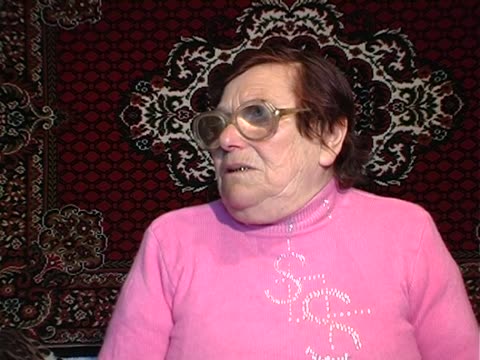
People › Brukhe Moisevna Feldman › conversation

Brukhe Moisevna Feldman

Bershad' 14 May 1903 29 min · 1 part on 1 tape
Loading the player…
  1. MDV 379 0:00–28:43 · 29 min · not online — MCO
Passages

0:00

Feldman talks about contemporary religious life in Bershad. She talks about her family. Feldman has relatives in America. She then answers questions about cultural terminology and talks about her contemporary travels.

From the machine transcript

Feldman talks about rabbis and about relatives who left for America, including a sister in Brooklyn. She recalls trips to synagogues in Uman', Vinnytsia and Kyiv, and a visit to a rebbe's grave. Lemster and Kerler ask what several words mean (dybbuk, golem, a good Jew, a person who is out of his mind).

The catalogue sentence does not mention the questions about the meanings of dybbuk and golem, or the visit to the rebbe's grave.

3:21

Feldman speaks contemporary Jewish life in Bershad. She also addresses contemporary relations between Jews and non-Jews.

From the machine transcript

Kerler and Lemster ask about singing in the Bershad' ghetto and about a song, and Feldman recalls fragments of it. Other people in the room then ask what it means to be a Jew in Ukraine today. Feldman answers with her relations with a non-Jewish neighbor who brought her food when her arm was broken, and says that she herself eats matzo because she is Jewish.

Also covers a song or singing in the ghetto and matzo as a mark of Jewish identity.

7:24

Feldman talks about religious life during the postwar Soviet period. She explains how the local community baked matzos. She then describes postwar Yom Kippur celebrations. Feldman states that she did not work at a factory on this holiday.

From the machine transcript

Feldman recalls how matzo was baked in Bershad' in an oven, with women rolling the dough, and says that matzo also came from Israel. She describes the custom of bringing money to the synagogue before Yom Kippur and fasting, and says she did not go to work on Yom Kippur, including in the Soviet period. They discuss who blew the shofar after the old rabbi died and whether the synagogue stayed open.

12:53

Feldman speaks about contemporary religious life. She then answers dialectological questions from the AHEYM Yiddish linguistic questionnaire.

From the machine transcript

Lemster explains that the interviewers want history, not the present, and Kerler then begins the dialectological questionnaire. Feldman is asked how to say thank you, please, ceiling, mouse, window glass, potatoes, colors, a house of one's own, cold, mountain, grandmother or midwife, cross, believe, honest and other items, some with Russian prompts. She often answers with Russian or Ukrainian-influenced forms and the interviewers correct her.

Most of the passage is questionnaire work, beginning at about 13:00.

28:11

The team concludes the interview with Feldman.

From the machine transcript

Kerler thanks Feldman and closes the interview.

Questions put in this conversation

Items of the dialect questionnaire asked here; each link plays the moment.