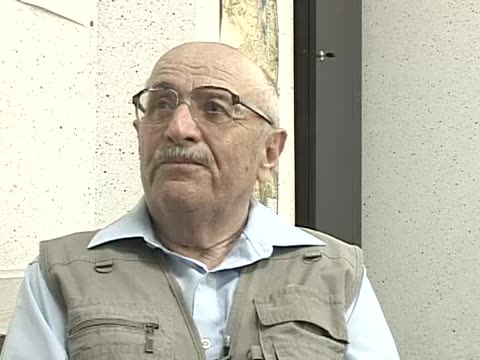
People › Velvl Fishman › conversation

Velvl Fishman; Aron Tsodikovich

Vinnytsya 22 May 2008 Interviewed by Moisei Lemster, Dov-Ber Kerler 1.7 h · 2 parts on 2 tapes
Loading the player…
  1. MDV 766 0:00–1:02:32 · 62 min · not online — MCO
  2. MDV 767 0:00–42:09 · 42 min · not online — MCO
Passages
MDV 766 0:00–1:02:32

0:00

Personal introduction and family

From the machine transcript

Fishman gives his birth in Odesa in 1931 and speaks about his parents. His father Yankl, son of Mordkhe, was born in Stara Ushytsia and worked as a photographer in Odesa. His mother Malke, daughter of Itsik Hershl Eyzik, worked in a Yiddish kindergarten on the Moldavanka and later as a kindergarten head. At home the family spoke Russian, and he learned a little Yiddish from his parents and from a grandmother in evacuation. He says his mother was born in Medzhibozh and that his grandfather's family was shot there. He tells how his mother, as a young Komsomol member, joined a May Day demonstration and her father chased after her, and how she later went to Odesa and studied at a pedagogical technikum.

12:15

Work and postwar religious life in Yampol

From the machine transcript

Fishman explains that he was sent from Odesa to Yampil after the institute and worked as a credit inspector at a bank. He lodged with an elderly Jewish couple and learned Yiddish from them. He recalls the synagogue near their house and a story about a Jewish elder in the ghetto under the Romanians. He estimates the Jewish population of Yampil after the war, notes there was a synagogue and a shoykhet but no rabbi, and mentions his grandmother taking chickens to the shoykhet.

Adds the lodging with the elderly couple, the ghetto story and the postwar Jewish community of Yampil.

15:31

Life during the war in evacuation and life after the war

during the warafter the war EvacuationDaily life (general) MDV 766 · MCO
From the machine transcript

Fishman says he was an only child. During the war the family lived at a station near Tashkent, where his mother worked in a kindergarten and he finished several grades of a Russian school. His father served at the front as a junior lieutenant and came back. Lemster asks how people said 'came back' in Yiddish.

17:00

Childhood memories of life Mezhbesh before the war

From the machine transcript

Fishman recalls two prewar visits to Medzhibozh, the second at age eight in 1939, and four visits in the last ten years. He mentions the large synagogue built by American Jews by the grave of the Baal Shem Tov, where only two Jews remain. He remembers a river near his grandfather's house and the geese and feathers, and retells a story his mother told about Hershele Ostropolyer as a poor guest who pours soup on his fine coat.

21:05

Food customs on holidays

From the machine transcript

Fishman talks about his mother's varnishkes with buckwheat kasha, which he can make himself and also stuff. He recalls holiday foods from her kitchen, such as matzo and lekach, but says he does not remember the holidays at his grandfather's.

22:13

Moving to Vinnytsya and religious life after the war

From the machine transcript

Fishman discusses where his Yiddish comes from, mainly from Yampil, and then his career moves. He was sent to Yampil after the institute in 1953, was transferred to head a bank office in a district centre where Jews had been shot, probably Tyvriv, and moved to Vinnytsya in 1959. He describes Jewish life in Vinnytsya, with one synagogue on Krasovsky street that was crowded on holidays, and says that before the war there were many synagogues.

Adds Fishman's later postings and the state of the Jewish community in Vinnytsya.

25:18

Food customs

From the machine transcript

Fishman says that today he makes only macaroni with kasha instead of varnishkes, and his wife does not make them either. He describes how the dough used to be rolled out, cut into pieces, pinched together diagonally and cooked, then served with buckwheat kasha.

26:23

Mother Malke

From the machine transcript

Fishman says he learned his songs from his mother. She learned them at the Yiddish school in Medzhibozh, which she attended for about eight classes. He also remembers her colleagues from the kindergarten coming to visit and speaking Yiddish.

27:26

Studies in Odessa

From the machine transcript

Fishman states that he studied at the credit and economic institute in Odesa, in the banking specialisation, from the 1940s until 1953.

28:06

Yiddish songs

From the machine transcript

Fishman sings a fragment of a song about the rabbi and the priest that his mother sang, and says he has forgotten the rest. S3 then sings the varnishkes song, in which a girl asks where to find a bachelor to eat them, and a humorous song about a shepherd searching for his lost sheep, with Russian and Ukrainian lines. Lemster asks whether the grandparents sang.

33:43

Concluding the interview

From the machine transcript

The Fishman interview winds down. Fishman says he cannot recall some Russian-Yiddish equivalents, and Lemster talks with the second man about a small honorarium. That man begins to speak about a search for missing family members up to 1949.

The transcript shows the closing as an informal exchange and a change of speaker to the second interviewee.

34:43

Interview with Aron Tsodikovitch and family

From the machine transcript

Lemster interviews Tsodikovich, who gives his name as Aron Isakovich(?) and says he was born in Kopayhorod, apparently in 1939. He can say little about his father. His mother was Manya Mendelevna, a bookkeeper(?), and her parents, a grandfather who was a clerk and a grandmother who did not work, were named Popovsky(?). There is also talk of his surname and of Yermolyntsi. He says the war left him with little memory and he was an only child.

Adds Tsodikovich's birth, parents and grandparents.

39:29

Life during the war and childhood memories of holidays

From the machine transcript

Tsodikovich says he lived in the Kopayhorod ghetto as a child, apparently at a station about five kilometres from the town. At home the family spoke Yiddish with his mother and grandparents. He recalls that his grandparents were strongly observant and that the town had two or three synagogues. He remembers Passover, Purim and Hanukkah gelt, a hard year in 1946, and that his family left in the 1950s. He also remembers good relations with non-Jewish neighbours.

Adds Tsodikovich's memories of the ghetto, the synagogues and his grandparents' observance.

45:00

The rabbi/shoyket of Keparet and religious (food) customs

From the machine transcript

Tsodikovich recalls Kopayhorod, whose population was about half Jewish, half non-Jewish. He says there was no antisemitism, and that non-Jews helped during the ghetto. He names Jewish neighbours, a water seller called Avrom Rud(?), the rabbi and the shoykhet Leyb. He says a mohel was brought from Sharhorod or Zhmerynka, and matzo came from Mohyliv(?). He describes festival dishes, and mentions Yankl, the shoykhet in Vinnytsya. He also gives dates: studies in Zhytomyr, army service on Sakhalin and Kamchatka from 1958 to 1961, and a wedding in Kopayhorod around 1961, without a khupe but in the club, with Jewish klezmer in heavy snow.

Adds the shoykhet, the mohel, the local rabbi, army service in Sakhalin and Kamchatka, and the klezmer wedding.

57:51

Work and family

From the machine transcript

Tsodikovich says he trained as a pharmacist at a technikum and worked in a pharmacy. He then moved to a construction organization and came back to Vinnytsya, where he again worked as a pharmacist. For the last three years he has been a volunteer at Hesed. His wife has died. One son is in Israel and another lives in Vinnytsya. Lemster ends by asking about songs in Kopayhorod.

MDV 767 0:00–42:09

0:00

Childhood memories of Kapaigerod and celebration of holidays

From the machine transcript

Tsodikovich answers Lemster's questions about Kopayhorod food customs, such as stuffed geese and cracklings, and says some things were not done in his family. He remembers his grandparents as very religious, with his grandfather praying morning and evening. They then discuss the town's tailors, barbers and shoemakers. Tsodikovich and Lemster try to recall local musicians and singers, a father and sons who played accordion and guitar, and Yiddish periodicals read in town.

Adds the talk about local musicians and singers and about reading Yiddish periodicals.

6:58

Religious life in Vinnytsya after the war and dialectology

From the machine transcript

Lemster asks about expressions and terms: the evil eye, a dybbuk, a golem, an apostate, and the word for a cemetery. Tsodikovich often does not know them. He then says a few things about Vinnytsya after the war: Yiddish theater troupes visiting, and a small synagogue on one street where many Jews stood outside on holidays. He also answers a question about the phrase 'a good Jew'.

Adds the questions on evil eye, dybbuk, golem and cemetery terms, and the postwar Yiddish theater visits.

14:00

Childhood memories of Vinnytsya

From the machine transcript

Tsodikovich says he left Kopayhorod around 1950, and that as a child he came to his grandparents for the school holidays. His grandmother was like a mother to him and his grandfather like a father. He kept visiting them after technical school and army service.

14:59

Dialectology

From the machine transcript

Lemster asks vocabulary items given in Russian, and Tsodikovich gives or fails to recall the Yiddish. They include greetings and thanks, house, skin, 'later', 'earlier', 'cold', 'colder', 'fast', 'near', and 'sick' versus 'sleepy'. Kerler joins in the discussion. Tsodikovich notes he has no one to speak Yiddish with now. At the end Lemster and Kerler return to dybbuk and golem and to a tailor from Kopayhorod.

24:04

Childhood memories and Yiddish-speakers from the area

From the machine transcript

Tsodikovich recalls a tailor's son in Kopayhorod who played the accordion. He says Yiddish songs were not sung in public, only among friends at night. They discuss the town's Jews after the war, and Yarmolyntsi, where few Jews remained. He mentions a woman from Kopayhorod now in Germany and a barber who cut his hair as a child. Kerler asks about non-Jews who spoke Yiddish: a classmate, a neighbor named Misha, and a teacher of Ukrainian who speaks it very well. They also discuss a Jewish school director, Weinstein, and the Chabad or Skverer rabbi, then Vinnytsya today, antisemitism and politics. Part of this is in Russian.

Adds the Yiddish-speaking non-Jews, the Jewish school director, and the talk about contemporary politics.

33:38

Life today

life today Life today MDV 767 · MCO
From the machine transcript

Kerler asks why Vinnytsya needs a Jewish mayor or official. Tsodikovich answers that people chose him, that he is doing a great deal of good, and that people are ungrateful. In part he speaks Russian. They also discuss earlier Jewish figures in Vinnytsya, a former deputy, and whether the present official is Jewish. Tsodikovich and Kerler disagree about whether there is antisemitism in Vinnytsya. Tsodikovich says people feel it, while Kerler says they do not.

36:33

Concluding the interview and Yiddish-speakers from Vinnytsya

From the machine transcript

Kerler and Lemster thank Tsodikovich and close the interview. Tsodikovich says Yiddish was spoken at home with his grandparents and mother, and recounts a long-lived woman. Kerler explains that the recordings will go into an archive for future generations and online. Tsodikovich is pessimistic about the future of Yiddish, and Kerler says he is optimistic. Tsodikovich also mentions children in Israel, and both wish each other good health.

Adds Kerler's explanation of the archive and the future of Yiddish.

Questions put in this conversation

Items of the dialect questionnaire asked here; each link plays the moment.