0:00
The first part of the tape is a concert by community members, performed in the Odesa community center. Members sing a number of songs.
The first part of the tape is a concert by community members, performed in the Odesa community center. Members sing a number of songs.
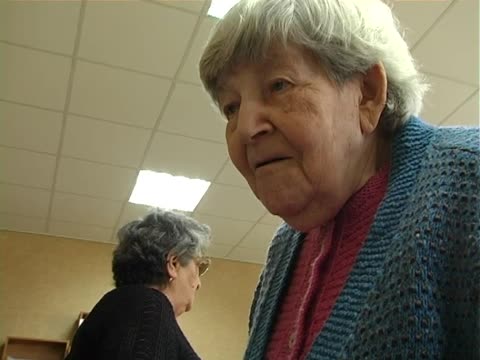
The second part of the tape includes informal chat with members about setting up formal interviews. The team speaks with Riva (Rivke) Borukhovna Medved, born 1927 in Gorodkovka.
Informal chat among community members and the visiting team. A woman and an interviewer discuss languages: Yiddish and German, and Russian film titles. Kerler says he is from America and talks with them about Jews in America speaking English. Lemster asks them to sit down and settle for the interview.
The chat is about language and America.
The first part of the formal interview with Medved, nee Chernousova, begins. She provides personal information and talks about her family. She worked as 3:55 for thirty years. She lived there for 43 years.
Brief start of the interview with an elderly woman. Kerler asks her name and she gives her own and her father's. She says her grandmother died young and the granddaughters were named after her. She says she worked at one workplace for thirty years and, as Kerler states, lived somewhere for forty-three years (?).
Gives the speaker's father's name and the naming after the grandmother.
The camera cuts to the third part of the tape, which includes a formal interview with Alexander (Shure) Ilyich Cherner, born 1935 in Balta. Cherner provides personal information and talks about his family. He then talks about his grandfather who was a klezmer musician, as well as his own klezmer melodies. Cherner played the Fidl in klezmer bands.
Cherner introduces himself: his first name, Alexander, with Shure in Yiddish, and his birth in 1935. Lemster says he is from Chişinău. Cherner mentions an uncle who was repressed under Stalin as a revolutionary, and his grandfather Khayim Zise, a glazier, who was a klezmer. He says he writes klezmer melodies, more than five hundred, and songs in Russian, Ukrainian and Yiddish. He played the violin with his grandfather's band at Jewish weddings in Balta and describes dancing the sher. He recalls no Purim-shpil texts, only melodies.
Adds the repressed uncle, the sher dance and Cherner's own composing.
Cherner talks about Yiddish culture, in particular theater, after World War II. He then talks about his work. He moved to Kharkiv and worked at a factory as turner and locksmith. After the war, Cherner lived in Balta until 1952 and moved to Odesa in 1961. He then talks about his family.
Cherner talks about Yiddish culture after the war: a Moscow theater troupe was sent and his grandfather was invited to play with it in the late 1940s. He left music, moved to Kharkiv and worked at a factory as a turner and locksmith. He lived in Balta until the early 1950s. He says his grandmother died long before and that his mother hardly remembered her.
Adds the Moscow troupe and the grandmother's early death.
Cherner discusses his childhood memories and Jewish life in prewar Balta. Cherner performed with his grandfather at Jewish weddings. He recalls one wedding with a wedding canopy in 1948 in Balta. Cherner also addresses postwar religious life in Balta.
Cherner talks about prewar Balta as a largely Jewish town and about playing with his grandfather and the other klezmers, four or five of them, at Jewish weddings. His grandfather, born in 1800s (the year is unclear), taught his children several instruments. He remembers playing once, around 1948, at a wedding with a canopy held outdoors. He describes the sad and happy melodies played, the guests and the food. He also tells of the synagogue in Balta, which stayed open after the war while the old congregation died out.
Adds the outdoor wedding canopy, the postwar synagogue and the wedding foods.
Cherner discusses holiday celebrations and recalls the local kosher butcher after the war. He then answers questions about cultural terminology and talks about his family. Cherner was imprisoned in the Balta ghetto.
Cherner says holidays were barely observed at home, there was no matzo baking, and the old men marked them. He describes the shoykhet in a large courtyard after the war, who slaughtered poultry for Jews every day, and the custom of kapores. He answers questions about words for a field and a village, about dialects, and tells of his grandfather Israel Cherner and Khayim Zise, who was with them in the ghetto. A relative died in Moscow. The synagogue stayed open until the early 1950s, and few Jews now speak Yiddish.
Adds the shoykhet, kapores, terminology and the grandfather in the ghetto.
Cherner discusses his childhood memories. He attended a Russian school. He then talks about wedding performances with his grandfather.
Cherner says that at home they spoke Yiddish and Russian, Russian when children were in Russian school and Yiddish with parents as they grew older. He recalls that the klezmers used a special jargon with a word for money. He describes the order of a Jewish wedding as his grandfather, the bandleader, greeted the guests with music and paid dances were taken. The greeting was spoken in Russian and he cannot recall it in Yiddish.
Cherner talks about his family and holiday celebrations, as well as touching upon food customs. He then talks about prewar Jewish life.
Cherner answers questions about family, memorial days and holidays; he says there was little Jewish observance in his home. Memorial customs, the cemetery and food are touched upon. He says Soviet policy removed Jewish culture, magazines and theaters, and that one had to join the Party to live. He recalls a Soviet Yiddish editorial office and writing in Yiddish.
Cherner talks about his life in Odesa, where he moved to in 1961. He addresses his own wedding in 1962. Cherner then talks about Jewish agricultural colonies and Jewish communists.
Cherner says he moved to Odesa in 1961 and married in 1962 without a wedding. His wife, who comes from Kherson, does not speak Yiddish. He answers a question about Jewish colonies and kolkhozes: there were many rich ones and non-Jewish neighbors praised the Jews' farm work. He says Jews in America mostly do not know Yiddish, that many Jews were in the Party before the war and were shot by Stalin, and that Yiddish writers were shot. Afterward people were afraid and no longer taught or painted their children in Jewish ways.
Adds his wife and the Stalin-era shootings of Yiddish writers.
Cherner talks about his life during the war, when he was imprisoned in the Balta ghetto. Cherner’s family lived at a neighbor’s house. He recalls Jews from different regions, including Bessarabia and Romania. Cherner talks about the shooting of his uncle, who was locked with other people in a room at the train station.
Cherner talks about the Balta ghetto. Many Jews arrived from Bessarabia, Chişinău and Romania, and Romanian, German and Italian soldiers were in town. His family was housed in a room in a neighbor's courtyard, while Romanian and German officers lived in their own house. The family returned in 1945. He describes how the Soviet army's arrival saved the Jews from the Germans, and how an uncle, taken to work at the station, was locked with other Jews in a room and shot or burned; the details are unclear.
Adds the housing arrangements, the soldiers' nationalities and the return in 1945.
Cherner discusses Yiddish dialects. He then talks about his family. His mother was born in Balta and his father in Odesa.
Cherner answers questions about the Yiddish dialect in Balta, which he says is like Chişinău, with many Ukrainian and Russian words. He says his mother was born in Balta and his father in Odesa in 1912 (?). He says he goes to his mother's grave in Odesa and does not say a prayer; instead he sings a song he wrote himself in Russian and Yiddish about longing for his mother.
Adds the dialect question, the parents' birthplaces and the visit to the grave.
Cherner talks about the song he sings at his mother’s grave. He then talks about the song “Yerushalayim” he wrote the melody for in Israel.
Cherner talks about the song he sings at his mother's grave, saying he reads the words from a paper. He then tells about the song "Yerushalayim" he wrote, to words by Sara Zinger, whom he knows through Zhenya Fayerman. She is from Odesa and lives in Israel, and he recites a few lines of it.
Adds Zinger and Fayerman and that the words and melody were sent from Israel.
Cherner answers questions about cultural terminology and from the AHEYM Yiddish questionnaire.
Cherner answers questions about individual words and expressions: dybbuk, golem, a New Year greeting, and a word of Hebrew origin that he says is not his dialect. He then explains a greeting formula used at weddings.
Cherner answers dialectological questions from the AHEYM Yiddish linguistic questionnaire. He concludes the interview by listing Yiddish authors and discusses prewar Yiddish culture.
Cherner answers a long run of dialectological questions, with Lemster giving prompts in Yiddish and Russian. Items include words for thanks, groups, leather, hat, pickled and sour cucumbers, sour or vinegar meat, the tongue and the ear, deaf person, late and early, cold, high and higher, near, ill, very beautiful, 'I like him', run away, honest and pious person, apostate or convert (?), Christian and peasant, tree, brandy, potatoes and potato pancakes, street, road, and to live on a street. He often says he has forgotten a word or cannot hear the prompt. Later items include sentence-type prompts such as 'you will come at one', 'came back', 'on the ceiling' and 'on the bridge', and words for enemy, fence and monument.
The transcript shows only word elicitation; it contains no list of Yiddish authors or talk of prewar Yiddish culture.
Items of the dialect questionnaire asked here; each link plays the moment.