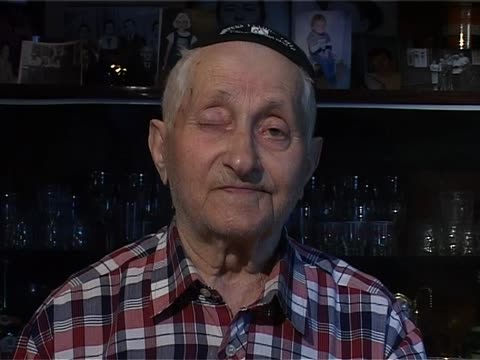
Holiday celebration and food customs.
From the machine transcript
Feldman talks about holiday food in his childhood home: Rosh Hashanah, the pre–Yom Kippur meal, Shavuot dairy dishes, and the Sabbath cholent with kugel. The interviewers ask what went into the cholent. He mentions walking to a river for tashlikh and his father bringing a shoykhet from Volednyk. Kerler also asks about Kol Nidre, and Feldman begins to describe the one Jewish family in his village.
includes Kol Nidre, tashlikh at the river and the shoykhet brought by his father
Family and religious school education.
From the machine transcript
Feldman says he studied in cheder in Volednyk and Slavechna(?) and in the Belarusian town of Lyel'chytsy, travelling by horse and wagon in summer and sleigh in winter. A sister lived in Lyel'chytsy. Katz asks whether the Yiddish there differed from his own, and Feldman answers with the local form of the word for "where".
the dialect difference between his village and Belarus
Prewar life and family.
From the machine transcript
Asked about his childhood, Feldman instead says he married in the 1930s. His eldest daughter was born then; she lives in Canada and is a dentist, and has lived in Israel. He mentions a son-in-law who worked as an editor in Simferopol.
Childhood memories.
From the machine transcript
Feldman recalls childhood summers bathing in the river and winters skating and sledding down the hill. He says he had little pleasure because his father was killed in 1919 and he went on studying. Katz asks the distance to Lyel'chytsy, and he describes the journey by a big river. At the end the interviewers arrange to meet the next day.
also the distance to Lyel'chytsy
Informal chat.
From the machine transcript
The interviewers and Feldman arrange to meet next morning at his home, around eleven. He asks where they are staying (a hotel) and where they came from (Zhytomyr), and begins to mention aid he receives from Hesed.
Jewish life today and dialectology.
From the machine transcript
Feldman talks about his hardships today: he receives no food parcels from the local Hesed, is a first-group war invalid with a small pension, and does not go to the canteen because it is not kosher. He asks the interviewers to write to the director of the Jewish center in Zhytomyr, and to a rabbi who has not replied to letters. Katz asks two dialect questions, the words for ceiling and floor.
includes his complaint about Hesed aid and a short dialect elicitation
Prewar religious life and today.
From the machine transcript
Feldman and Kerler talk about the Hasidic rebbe buried in Volednyk (Yisroel Leyb, son of Yosef), the shtetl and its Jewish absence today. In Ovruch he led a minyan of older men until recently, and handed two Torah scrolls to the community. He complains that the rabbis of Zhytomyr and Kyiv do not answer letters. Kerler then asks about his home village.
adds the rebbe's grave in Volednyk and the Ovruch minyan
Home village and childhood memory.
From the machine transcript
Feldman names his home village, Yanova Rudnya, which had only six houses, and discusses how its name was said in Yiddish and the origin of "rudnya" (ore). After his father's death he lived in a town and worked in a shop. He describes the water mill his father leased, the fish in the river, and being taught at home by a hired teacher together with four sisters. He begins to mention the holiday songs he sang with the minyan.
adds the mill and home tutoring
Prayer song for holidays.
From the machine transcript
Asked by Katz, Feldman sings a holiday prayer melody he remembers from synagogue, the Adon Olam, and notes that it has several verses. A Russian-language remark is interjected.
Sabbath prayers.
From the machine transcript
Katz and Kerler ask Feldman about prayers around the Torah reading and the Sabbath service. He recalls studying the Pentateuch, the Hallel and Pirkei Avot, and the Sabbath morning prayers. He mentions the prayer books he inherited from his father, including holiday prayer books.
Sabbath prayers, prayer books and Hallel
Prayer books and prayers.
From the machine transcript
Feldman recites several blessings and psalm verses from memory and shows prayer books from his father. The interviewers praise his memory. He says he has lost his eyesight in recent years and cannot read or write.
Four Questions for Passover and celebration.
From the machine transcript
Feldman says he remembers the Four Questions and the Haggadah only in part, and not Chad Gadya's melody. At Katz's request he sings a Yiddish Passover song about a grandfather who traveled to Yalta and learned what must not be told outside cheder. He then reflects that Jewish life was beautiful before the war.
the Passover song and memory of the Haggadah
Family.
From the machine transcript
Feldman tells about his younger brother who served in the army in the Far East, and came home with medals and crosses. His father threw the uniform into the river and the brother swam after it. He emigrated to America before a war, was drafted in World War I, wounded, and later as a veteran sent money so that their mother received 38 dollars a month. Feldman names the brother in America (Harry) and says their house was bought with that money.
it is about his brother's army and America story
Holiday celebration.
From the machine transcript
Feldman says that for Purim the family travelled to the nearby village of Skrebelychi, where there was a minyan, to hear the megillah; they did not sing anything there. Katz and Feldman compare how Purim is pronounced in his area and among Lithuanian Jews.
Dialectology and Purim celebration.
From the machine transcript
Feldman says Belarus begins about 90 or 45 km away, and answers dialect questions on how Yiddish was spoken there and on Purim. He is asked about hamentashn (three-cornered) and the Purim story with Esther and Mordecai; the names of Haman's sons are not remembered.
hamentashn and the Purim story
Hasidism and holiday celebration.
From the machine transcript
Feldman says his father was a hasid of the Volednyk rebbe, and of the Chernobyl rebbe Shlimke, whom he visited on a Sabbath. Katz asks about Chernobyl Jews, Tisha B'Av and Rosh Hashanah customs (apples with honey), Hanukkah candles, and the dreidel. Feldman says he was a believer who went with a tallis. Kerler then asks about his life before the Second World War.
adds Rosh Hashanah and Hanukkah customs
Education and life before World War II.
From the machine transcript
Feldman says he studied until 1923, and that the family worked land at Yanova Rudnya. After the revolution, in 1928 (?), the landowners' land was divided among the Christians, and he was given a plot at Skrebelychi, which he worked. Later a kolkhoz was formed, which he joined for a few years, and no Jewish trade remained.
Kolkhoz and work.
From the machine transcript
Feldman tells how he was sent from the kolkhoz for about six months to a course in Korosten (?) to train for cooperative trade, then worked as a storehouse manager and in a large purchasing office until he retired. Kerler asks whether he studied before or after the war.
adds the training course and warehouse job
World War I and Revolution.
From the machine transcript
Feldman says he was about ten at the start of the First World War and was still in cheder. He barely remembers the German occupation, except that they spoke German and some Yiddish. He remembers the 1917 revolution, attacks on Jews, robberies and killings, and says the Red Army defended Jews. Kerler then asks about his father's death.
Father's death in 1919.
From the machine transcript
Feldman tells how his father was killed in 1919 by a band of local peasants, apparently Poles, who wanted his boots; he had refused. The band took him to the forest at night and killed him, and the family searched a week before finding the body. After that they moved to Skrebelychi.
Life after the Revolution and family.
From the machine transcript
Feldman says the family moved to Skrebelychi, where his grandfather had lived. When his brother in America died, the mother received a pension of 38 rubles for years (?). Using it, she bought half a flat in the 1930s. At the start of the war she stayed put, and her sisters from other towns were killed, including sixteen relatives.
Draft and World War II.
From the machine transcript
Feldman says he was working in a warehouse when he was drafted in 1941. He served in an anti-aircraft unit near Voronezh (?), was wounded in the leg and hand, and became a first-group war invalid. His pension is about 246 hryvnias and he gets no more aid. Some Russian is mixed in.
Life today and childhood memories.
From the machine transcript
Feldman says half his pension goes on medicines and utilities. Katz and Kerler ask how a friend in California could send dollars to Feldman; he answers that letters with money do not arrive, but bank transfers do. A relative in Philadelphia has sent money that way. He gives his address in Ovruch for transfers. Feldman then explains Tisha B'Av and the destruction of the Temple, and says there were opponents (mitnagdim) among the Jews, who disbelieved the Messiah's coming.
adds sending money from abroad, his address, Tisha B'Av and the mitnagdim
Religious tradition.
From the machine transcript
Katz asks Feldman what he remembers of Yom Kippur prayers, especially Kol Nidre, and of services and the synagogue. Feldman recalls a few words and says he can no longer see to read. Katz then asks him to say the rabbis' Kaddish slowly.
Kaddish d'Rabbanan.
From the machine transcript
Feldman recites the rabbis' Kaddish (Kaddish d'Rabbanan), slowly at Katz's request; the recording of the recitation is largely garbled.
Prayers.
From the machine transcript
Feldman says he has forgotten much of what he once knew by heart in recent years. At Katz's prompting he recites or begins various prayers and blessings, including a morning blessing, parts of the Shemoneh Esrei, and a blessing for the Sabbath. The recitation is mostly unintelligible in the transcript.
Religious life today and prayers.
From the machine transcript
Feldman says that until about ten years ago he led the minyan at the Ovruch synagogue, until too few people were left. He describes what happened to the Torah scrolls of the old minyan: one went to the Korosten synagogue and one to Israel. Katz then asks for the Aleinu prayer and passages of the Torah (the opening of Genesis, with the Yiddish for earth, waste and darkness), the haftarah blessings and Simchat Torah. Feldman says he cannot recite the beginning of Genesis without a book.
Adds the fate of the Torah scrolls of the old minyan and Katz's questions on Genesis wording and the haftarah.
Prewar religious life.
From the machine transcript
Asked about pious non-Hasidic Jews before the war, Feldman says he does not remember, mentions that he lived in Ovruch from 1933, and says there were Hasidim in the area, including Volednicker Hasidim and Chernobyl ones.
Dialectology and prewar religious life.
From the machine transcript
Feldman says his father and brother and his grandfather were Hasidim of Skrebelitsh (?). Kerler and Katz ask him what a mitnaged is, whether he remembers Lithuanian Yiddish, and what he knows of Vilna, yeshivas in Volozhin and Minsk, and the Baal Shem Tov and other rebbes. Feldman explains the term baal-shem and mentions a baal shem near Zhytomir, and answers questions about Poland and Slobodka. He has no recollection of shadow-divination.
Adds the mitnaged terminology, discussion of Lithuanian Yiddish and Lithuanian yeshivas, and the baal shem.
Father's religion and Volednicker tzaddik.
From the machine transcript
Feldman says his father used to visit the Volednicker tzaddik, whose wife Esther Tsiba belonged to his father's family, and Kerler asks about the rebbe's full name. They work out the name Yisroel Dov Ber ben Yosef from what a woman told them. Feldman describes how women from Kotelnya (?) travelled to the rebbe by oxcart.
Adds the rebbe's wife Esther Tsiba and the women's oxcart journeys from Kotelnya.
Jewish Korosten.
Region of Ovruch and family.
From the machine transcript
Feldman discusses the Yiddish and Russian names of Korosten and what kind of town it was, and speaks of the Jews who settled there from the surrounding villages. Katz and Kerler ask for Yiddish forms of local places: Slovechno, Lehin (Luhyny), Veledniki, Narodychi and Norinsk. Feldman says his wife is from Narodychi, where her father was a lumber dealer. Kerler ends by asking about antisemitism before 1917.
Adds the Yiddish place-names and his wife's origin in Narodychi.
Prewar antisemitism and Korosten.
From the machine transcript
Feldman says there was no antisemitism before 1917 and that Petliura's forces killed Jews around 1919–20. He explains that Ovruch was a district town, that Korosten grew to three times its size, and that it was a railway junction. They return to the Yiddish form of the town's name.
Adds Petliura's killings of Jews, the growth of Korosten as a railway junction, and the Yiddish name of Korosten.
Prayers.
From the machine transcript
Feldman starts the Friday-night Kabbalat Shabbat prayers and says he remembers only a little. He is asked about grace after meals and Sabbath songs (zmires). He says that for about fifteen years there has been no minyan and he has forgotten it. Katz asks which Talmud tractate he studied.
Religious customs.
From the machine transcript
Kerler asks whether Feldman knows a word for a husband leaving his wife and about an abandoned wife (agune). Feldman says he does not know the word and that husbands only used to divorce in his time. Katz then asks about interesting people in the town in his youth.
Childhood memories of religious life.
From the machine transcript
Feldman names the teachers (melamdim) he studied with in Veledniki, Slovechno and Luhyny, including the sons of rabbis who had studied at the Vilna yeshiva. He names Yosl the rabbi's son and a relative. He also mentions a strange man living near the village. Kerler asks whether being a melamed was honourable, and Katz asks about women healers, who whispered cures and were called babkes (?).
Words in loshn-koydesh and life today.
From the machine transcript
Kerler asks Feldman for kinship terms in Hebrew, such as father, grandfather, grandmother, uncle and aunt. Feldman also says there are many yeshivas in America and Israel. Kerler asks for a story about the Volednicker rebbe.
Volednicker rebbe.
From the machine transcript
Feldman says people told stories of the Volednicker rebbe helping the childless and the poor. He describes a Khavner (?) man, a trefer (a seer who could tell you your name and background), who was killed in the war. He recalls that this man, who had come to Ovruch, called him by name in 1933 and later met him at work. Katz and Kerler then begin to ask Feldman about daily life.
Adds the story of the Khavner seer; the passage begins with a story about the rebbe himself.
Best moments of life and family.
From the machine transcript
Feldman compares the economy under Tsar Nicholas, when trade was free, with Soviet times, when state trade took over; he worked in a cooperative. He cannot name a best time in his life and recalls that his father was killed and that the war started for him in 1941 (?). He says he wants to sell his house in Ovruch to move to his daughter and son in Simferopol, and discusses prices. He talks about his second wife, who went to Germany with her children, and Katz suggests another match.
Adds the plan to sell the house and move, his second wife in Germany, and the comparison of tsarist and Soviet trade.
Dialectology.
From the machine transcript
Dialectological questionnaire put by Kerler and Katz. Feldman is asked for the Yiddish for words for animals, birds, body parts, household objects and food, as well as sentences with 'to live', 'to sit' and other verbs. The questions also test grammatical gender and diminutives of table, face, street, house and girl. He also describes what his mother cooked for Sabbath. He was asked Slavic words by the interviewers.