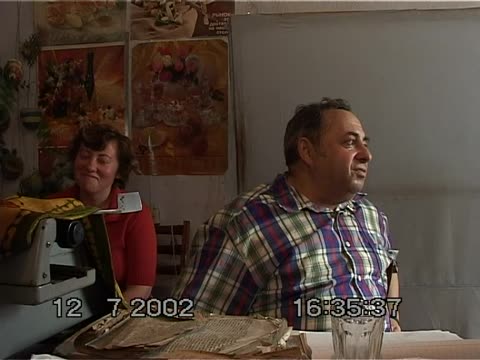
Continuation of interview with Abram (Arkadii, Abrashe) Khaimovich Vaisman, born 1940 in Sharhorod. (Part 2 of 4. See MDV 655, MDV 656, and Accession # 09-010.58-F MDV 776) His father, named Khayem was also born in Sharhorod, and, having lost his right hand, did not work. His grandmother owned a store. Vaisman is named for his grandfather Avrum. His mother Blume was born in Chernivtsi (Kleyn Tshernovits), a shtetl 15km away and worked as a seamstress. Vaisman has three siblings: Roza (b. 1923), Danya (b. 1929) and Kolmen (b. 1936), the third of whom now lives in Israel. Although Vaisman is now retired, he worked for the local newspaper as a photographer/photo-journalist, a craft he learned from his brother Danya and loved to do. Vaisman remembers Jewish religious holidays and how his father used to pray in shul (synagogue). Although he has been told that there were eight synagogues in the town before the war, he remembers only one shul, which was burned down after the war 40-45 years ago. Vaisman went to Ukrainian schools growing up and learned some English, but he cannot read or write in Yiddish. Vaisman describes his town as a Jewish city until emigration and shows old photos he took of the town’s elderly Jews, most of whom have since left for America or Israel. In Sharhorod, according to Vaisman, there were all kinds of Jews in the town, both religious and non-religious. He also tells the interviewers about the two tsadikim (righteous men) buried in Sharhorod’s cemetery who have been popularly credited with the fact that no Jews were killed when the Germans came to the town (Vaisman adds that some Jews also bought their way out of danger). Unlike other shtetlekh (towns) in the area where all the Jews were killed, in Sharhorod the Romanians killed no Jews.
From the machine transcript
After informal talk about water and arrangements, Vaisman gives personal data at Katz's request: the town's Yiddish name, his address, postal index and telephone, his name and nickname, and his birth in Sharhorod in 1940. He was named for his grandfather Avrum. His father Khayem, born in Sharhorod, lost his right hand and was on a disability pension, and his grandmother had a clothing shop. His mother Blume was born in Kleyn Tshernovits and was a seamstress. He names his sister Roza (b. 1923, deceased), brother Danya (b. 1929, deceased) and Kolmen (b. 1936, in Israel). He describes his work as a photographer and photo-correspondent for the local paper, learned from his brother. He then remembers his father at synagogue and the single synagogue he knew, which was burned down; others say there were eight before the war. He cannot read Yiddish and attended Ukrainian school. He recounts emigration from the town to Israel and America and anecdotes about shopping in Romania and Poland. He names older Jews such as a cantor, a shokhet, a hatter and a felt-seller. He looks at his old photographs, says Sharhorod was a Jewish town and is no longer, and describes the Jews as pious and non-pious. He closes with the two tsadikim and the belief that no Jews were killed under the Germans and Romanians, plus a story about money collected from townspeople.
Adds Vaisman's photo-journalist career, the old photographs he shows, anecdotes of emigrants, and a legend about the town paying off the Germans.
In this part of the interview, Vaisman discusses the ghetto set up in Sharhorod during the war. His sister used to credit Ukrainians with helping the Jews, as one woman in particular helped his family by bringing them food and other supplies, but he himself does not remember the war. When the Romanians came to Sharhorod, Vaisman relates, they did not kill any Jews. Rather, the Romanians brought their own Jews to the town, thousands of whom died of hunger and were subsequently buried in the Sharhorod Jewish cemetery. Vaisman also tells a Hershele Ostropolyer story, and shares his memories of Passover, when his mother would bake matzo kugels and bagels. He relates how one bakery would receive official permission to bake matzos for the whole town. Vaisman answers a series of dialectological and linguistic questions on the Yiddish language. Vaisman’s daughter, Klava, shows photos of her Jewish childhood friends who spoke Yiddish, most of whom have now emigrated. Vaisman also shares his opinions about the contemporary state of Yiddish and life in Israel.
From the machine transcript
Vaisman says there was a ghetto in Sharhorod and recounts his sister's belief that Ukrainians helped the Jews. He names a Ukrainian woman, Ksenia Vasilovna Loyanich (spelling uncertain), who brought his family food and whom he wants recognised. He says he does not remember the war, and that the Romanians did not kill Jews in Sharhorod but brought their own Jews, thousands of whom starved and were buried in the local cemetery. He tells a Hershele Ostropolyer story about a poor guest at a Sabbath meal. He recalls the Passover seder, with his mother's matzo bagels and kugels and the bakery that needed official permission to bake matzo, and also Hanukkah, Purim and the Ninth of Av. Katz and Kerler ask many dialect questions on bird names (a dove, a small bird), the colour of the sky, words for ugly face, back, house, 'almost', Lithuanian Jews and converts to Christianity, the town as shtetl, and the word for life. Vaisman also recounts the case of a local Jewish man who converted. In the last part the daughter shows an album of Jewish childhood friends who spoke Yiddish and have mostly emigrated to Israel, America and Moscow. The talk turns to Yiddish and Jewish life in America and Israel, Vaisman's brother in Israel, and his father's relatives, who were killed during the war.
Katz and Kerler's dialect questions on word forms and the Hanukkah and Purim recollections, plus the Hershele story, the wartime ghetto, the Passover memories and the photo album are all present as the catalogue says; the transcript also adds a convert anecdote and talk of Vaisman's relatives killed in Yaruga (?).
Klava Vaisman (Abram's daughter) used to work as a machinist and typist, although she has never learned how to work on a computer. The camera cuts to the Vaisman family outside their house, speaking about contemporary Jewish life in the town and why they do not want to leave. Abram leads the research team to the old Jewish cemetery where the local tsadikim (righteous men) are buried. Shots of the street leading away from cemetery. Passing the plant on the road, Dov-Ber Kerler explains thistles, which are thrown in the hair of those crying on Tisha b’Av. Abram leads the team to the home of Faina (Feyge) Rivelis. The researchers go into Rivelis’s house and begin a formal interview. She remembers her parents, Shmil Khayem and Sheyve Srulovna Rivelis, as very pious. Her father was a tailor and had four kids, of whom she was youngest (b. 1916). She remembers the shul (synagogue) in town, and religious holidays, including Passover. As a child, she attended Yiddish schools where she learned to read and write in that language. Faina lived in Germany for a year, but returned to Sharhorod to be between her “fir vent”, her “four walls”. Rivelis recalls how the Jews in her town survived the war years, but nevertheless lived through hardship and hunger. Faina worked for fifty years in the village government. Rivelis answers a series of dialectological and linguistic questions about the Yiddish language. Outside Rivelis’s home, the researchers also talk to Faina about her father’s old prayer books. Shots of the town’s old synagogue. Video of the team driving on the road at night.
From the machine transcript
Outside the Vaisman house the family and the interviewers talk about a document Abram Vaisman was seeking and about the daughter's former typing and stamping work. They discuss computers, a Yiddish word for the harm screens do, and what is left of Jewish life: roughly forty Jews in town and delegations visiting. The family explains why they stay in Sharhorod and not go to America or Germany, and one family member answers in Ukrainian. Vaisman then leads the team to the cemetery of the two tsadikim, with talk of gravestones, inscriptions and a story of a man shot by soldiers. He also speaks of the prewar Jewish population and emigration. Kerler explains the thistles thrown on Tisha b'Av, and Vaisman brings the team to Feyge Rivelis. In the interview Rivelis speaks about her tailor father, her pious parents, and holidays and the Passover seder. She also speaks about a Yiddish school, Sholem Aleichem, the war years of hardship and help from peasants, and her year in Germany. She says she worked fifty years and knows little of Hasidim. She answers a few word questions and Kerler asks about her father's books. The last minutes are garbled.
Adds the family's reasons for staying in Sharhorod, the cemetery and a story of a shooting, and the word questions at the end of the Rivelis interview.