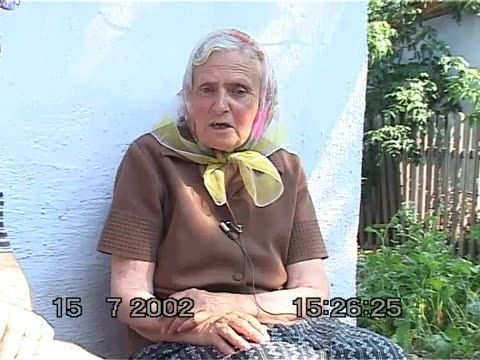
0:00
Kurman remembers going to synagogue with her mother, a woman who, as she describes it, knew Yiddish, loshn-koydesh (Biblical Hebrew) and loved to pray. She remembers the interior of the synagogue as decorated with painted murals on the walls as well as with candles. Although the synagogue was closed before the war, her father continued to pray in a private home with other Jews—he was a pious man and Kurman remembers how he would make blessings before and after eating. Kurman’s father decided to send her to a Russian school because career opportunities would be better than with a Yiddish education—she therefore can neither read nor write in Yiddish. Kurman recalls celebrating Passover and the hiding of the afikoymen (matzah), but says that when her siblings got older they were more interested in going to the theater than in the holidays. Kurman then answers a series of dialectological and linguistic questions about the Yiddish language. Kurman remembers Dr. Taykh, a rich Jew from Bukovina, who died in Sharhorod during the war and is buried there. It was with his help that she and her family survived. The camera cuts to the research team in Shpykiv at the home of Evgeniia Krasner. (Part 1 of 4. See Accession # 09-010.45-F MDV 664, MDV 665, and MDV 666) When Evgeniia (Sheyndele) Isaakovna Krasner finally emerges, she and the team introduce themselves to each other, telling jokes. She sings a Russian song and tells the researchers about Reb Shulem-Munye (Shulemunye), the local tsadik (righteous man). Krasner then sings “Ay iz dus a Rebenyu”, a theater song she knows from her mother with whom she spoke only in Yiddish. The house Krasner currently lives in belonged to her uncle, who was killed in the camp in Pechera. Evgeniia recites a children’s counting ditty and nursery rhymes and then sings another Yiddish song learned from her mother.
Kurman recalls going to the synagogue with her parents, her mother's knowledge of Yiddish and Hebrew, and the lit interior, now gone. The synagogue closed before the war, and her father prayed at home. She says she was sent to a Russian school and cannot read Yiddish. She recalls the Passover seder and hiding the afikoymen, and that her older siblings preferred the cinema or theater. Kerler then puts a long series of vocabulary and translation questions: greetings, everyday objects, Passover and Hanukkah food and the dreidel game, a year in words, and the word for a gravestone. Kurman then tells of the war: the Germans' arrival, the family's hiding place under the stove, the Bukovinian Dr. Taykh who paid the contributions and saved them, and hunger deaths under the Romanians. After a short talk about her health, the camera moves to Shpykiv. The team meets a woman who gives her name as Sheyndele (Krasner), with mostly Russian talk, jokes and a Polish song. She tells of a rebbe of the town, her mother's family and her uncle's house, and her uncle's death at Pechera. She recites a counting rhyme and sings Yiddish songs learned from her mother.
The transcript also shows the war narrative of hiding under the stove, a break to the Shpykiv visit, and a further Hanukkah and vocabulary section.